You were made — and you were made on purpose
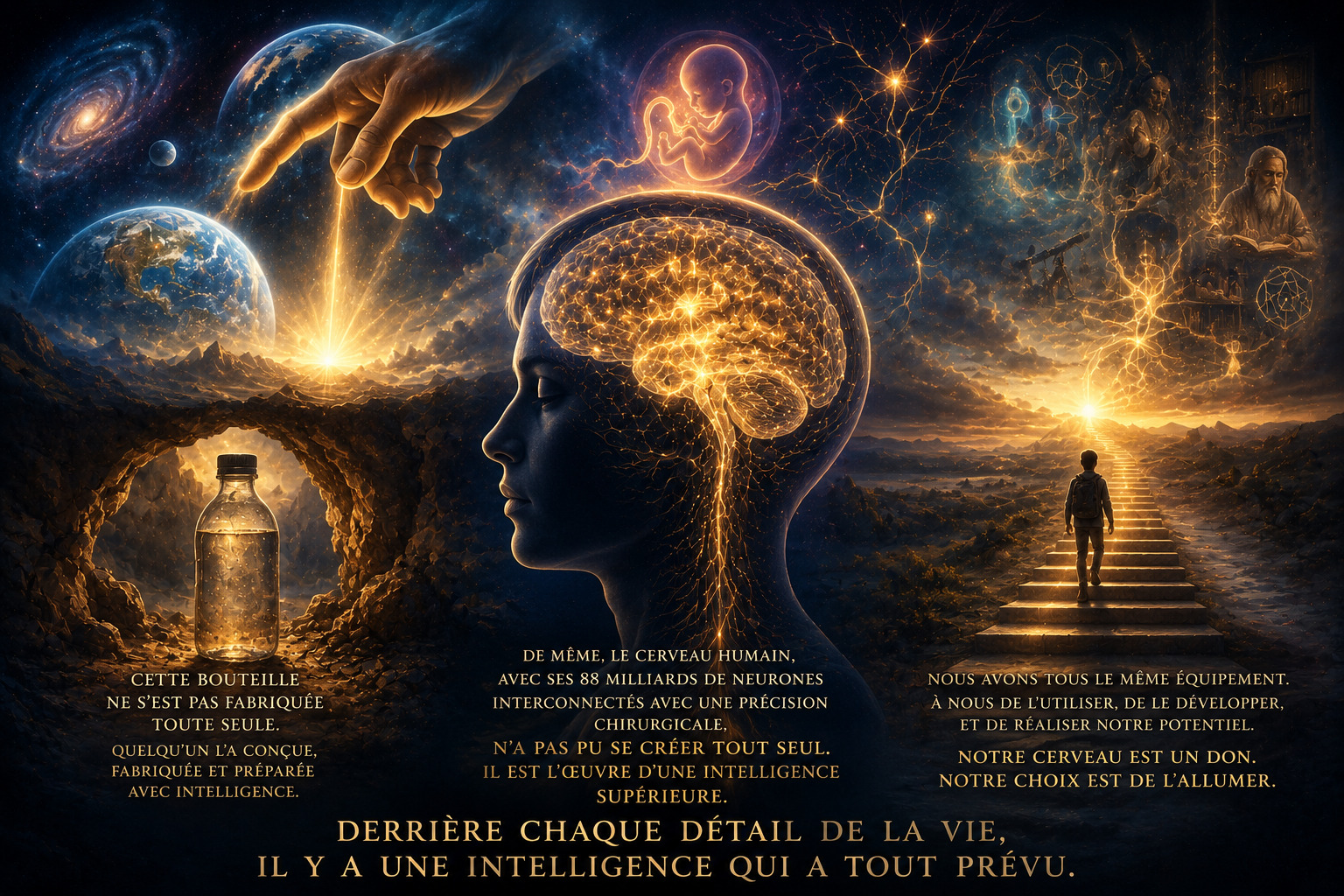
Begin with something small. A finished bottle — the glass shaped, the water sealed, the label printed — could never have risen out of the ground on its own, however many billions of years you grant it. Where there is a design, there was someone to conceive it. This is not a religious claim; it is the plainest reading of reality. Nothing finished assembles itself.
Now turn that same logic on the one holding the bottle. Inside the skull sits a brain of some eighty-eight billion neurons, wired together with a precision no laboratory can imitate — an entire world of connection folded into the space between your ears. The most advanced minds of our age, in America and in China, pour fortunes into building artificial intelligence, and they reach only a distant likeness of thought. They will not reproduce this. And it was knit together while you were still hidden inside your mother, before you had done anything to deserve it. If a bottle requires a maker, the brain requires one beyond all measure. Call the force “nature” if the word reassures you — but a nature that reaches such precision is not blind. It is intelligent. There is a Maker, and you are His work.
The engine left in first gear
Here is the quiet tragedy. Each of us is handed the same extraordinary instrument, and most of us use a sliver of it while the rest sleeps. It is the man who owns a Ferrari and never leaves first gear, afraid of wearing out the engine — when it is precisely the idling that ruins it. The mind was not given to be spared effort; it was given to be spent. What you refuse to use, you lose.
Then set the question down
Once this is clear — that there is a Maker, and that He is not careless — the great accusation loses its footing. “And the suffering? And the six million?” The existence of God does not rise or fall on our ability to explain every wound. He is, regardless. And it is only from that firm ground that the suffering itself begins to make sense. So let us begin where the world begins.
A name is a destiny
The first man was named by no committee and no fashion. We choose names by the season — in style this year, forgotten the next — yet a name is not an ornament. It is a person’s mazal, the grain of his destiny; give a child the wrong one and you may lay on him a weight he never asked to carry. The careful parent at least pauses, asks, looks into it before the child arrives. But the first man was named by his Maker, who consulted neither fashion nor fear. He called him Adam — and into that single word He folded two opposite fates.
Stars, or dust
Adam, from adameh la’Elyon — “I will resemble the One Above” — the creature who can come to look like the heavens. And Adam, from afar min ha-adamah — dust of the ground, the lowest thing there is. Your name holds both at once: the height and the dust, offered together. No one assigns you to either. You lean toward one or the other by the way you live. And that single freedom — to become the stars or to settle for the dust — is the whole secret of why life tests you at all.
The three letters of the name
Look closer at the word itself. Adam is written with three letters — aleph, dalet, mem. The first and the last, aleph and mem, are the opening and closing letters of Elohim, the divine Name of strict justice, the midat ha-din. And what is that rigor? It is the law that never pauses. Your heart cannot announce on Friday evening, “I’ll rest for twenty-five hours, see you after Shabbat” — it beats without stopping, like the lungs, like the kidneys, like nature itself, which never takes a day off. The Temple was the heart of the world, and its fire, the esh tamid, burned without interruption, families of kohanim relieving one another so the flame would never die. Man’s very name opens and closes with that unresting Name.
And in the middle stands one letter: dalet. Dalet is dal — the poor man, the one who is always hungry. Dalet is also four, and there are four kingdoms in creation: mineral, vegetable, animal, human. Watch how contentment runs backwards through them. The stone needs nothing at all — rain or no rain, it is indifferent; that is why we call a hard man a “heart of stone.” The plant has only to wait for rain. The animal must run for its food, yet once fed it lies down at peace, untroubled by tomorrow. And the human? The human is the poorest creature of all — never satisfied, forever glancing at the neighbor’s car, the neighbor’s house, the neighbor’s life, and wanting it. The one who would rule the whole world is poorest of them all, because no sum is ever enough; he has taps of gold and still cannot rest. “Who is rich?” asks the Mishnah. “The one who rejoices in his portion.” That is the cure folded into the dalet: stop measuring your life against the window across the street, look instead at what is already yours, and the storm in the soul falls quiet.
So the whole of you is folded into a single name — the relentless Name of justice on either side, the hungry restless dalet in the middle, the man suspended between the stars and the dust. Your endless dissatisfaction is not a flaw. It is the very engine that can carry you upward — if you aim it at the heavens instead of at your neighbor.
Two mothers
Watch two mothers raise the same kind of son. The first cannot bear to see him cry. He refuses school — she lets him stay home. He reaches for the screen — she hands it to him. Whatever he wants, she gives, because she loves him and her love has never learned to say no. And the boy grows. At twenty he has learned nothing, holds no trade, can build nothing and feed no one — he is, in the oldest sense of the word, a poor man, the dal standing in the very middle of his own name, his hand always open because it was never taught to make a thing.
The second mother walks her screaming child to school against his will, every single morning, while he wails that he would rather have his games. She refuses him a hundred things he begs for. To the boy — and to anyone watching — she is the hard one, the cruel one, the one who makes him suffer. And yet it is her son who, twenty years on, stands on his own two feet, a craft in his hands and a family he can feed. So which of the two was cruel? The one who spared him every pain raised a pauper; the one who made him suffer raised a man. Stay with that — do not hurry past it — because the question it opens is the largest a person can ask. Why must becoming pass through suffering at all? What is the pain for?
And before you answer, look at the name once more. Lift the child out of the middle of Adam — take away the dalet — and the two letters left standing, the aleph and the mem, spell em: mother. The very letters that open and close Elohim, the Name of strict justice; the letters of the rigor itself; the letters of the mother who made her son weep the whole way to school. The entire question now rests in two letters: the mother is the din, the din is the suffering, and the suffering is what made the man. Is it cruelty — or is it the deepest love there is?
The secret in the letters
Now open a Sefer Torah, and look — not at what the letters say, but at how they are drawn. The aleph is built of three smaller letters: a yod above, a yod below, and a vav binding them on the slant — ten, and ten, and six. Twenty-six. The mem is built of a kaf and a vav — twenty, and six. Twenty-six again. And twenty-six is the number of the four-letter Name, Y-H-V-H — the Name of mercy, of rahamim. The letters of the rigor, opened by the scribe’s own hand, are each the Name of love. Read the rigor closely enough — the school it dragged you to, the screen it took from your hand, the comfort it refused you — and in its very bones you find it spells mercy.
Tu as été fait — et tu as été fait exprès
Commence par une petite chose. Une bouteille finie — le verre formé, l’eau scellée, l’étiquette imprimée — n’a jamais pu sortir de terre toute seule, quel que soit le nombre de milliards d’années qu’on lui accorde. Là où il y a un projet, il y a eu quelqu’un pour le concevoir. Ce n’est pas une affirmation religieuse, c’est la lecture la plus simple du réel : rien d’achevé ne s’assemble tout seul.
Applique maintenant cette même logique à celui qui tient la bouteille. Dans le crâne, un cerveau de quelque quatre-vingt-huit milliards de neurones, reliés avec une précision qu’aucun laboratoire ne sait imiter — un monde entier de connexions, plié dans l’espace entre tes deux oreilles. Les esprits les plus avancés de notre époque, en Amérique et en Chine, engloutissent des fortunes pour bâtir une intelligence artificielle, et n’en atteignent qu’une lointaine ressemblance. Ils ne reproduiront pas cela. Et cela a été tissé alors que tu étais encore caché dans le ventre de ta mère, avant que tu aies rien fait pour le mériter. Si une bouteille exige un fabricant, le cerveau en exige un sans commune mesure. Appelle cette force « la nature » si le mot te rassure — mais une nature qui atteint une telle précision n’est pas aveugle. Elle est intelligente. Il y a un Fabricant, et tu es Son œuvre.
Le moteur laissé en première
Voici la tragédie silencieuse. On reçoit tous le même instrument extraordinaire, et la plupart n’en utilisent qu’un éclat tandis que le reste dort. C’est l’homme qui possède une Ferrari et ne quitte jamais la première, de peur d’user le moteur — alors que c’est justement de tourner au ralenti qui l’abîme. L’esprit n’a pas été donné pour être épargné de l’effort ; il a été donné pour être dépensé. Ce que tu refuses d’utiliser, tu le perds.
Alors, pose la question
Une fois cela clair — qu’il y a un Fabricant, et qu’Il n’est pas négligent — la grande accusation perd son appui. « Et les souffrances ? Et les six millions ? » L’existence de Dieu ne dépend pas de notre capacité à expliquer chaque blessure. Il est, malgré tout. Et c’est seulement depuis ce sol ferme que la souffrance elle-même commence à prendre sens. Alors commençons là où le monde commence.
Un nom est un destin
Le premier homme ne fut nommé par aucun comité, aucune mode. On choisit les prénoms selon la saison — à la mode cette année, oubliés l’an prochain — pourtant un nom n’est pas un ornement. C’est le mazal d’une personne, le grain de son destin ; donne à un enfant le mauvais, et tu peux poser sur lui un poids qu’il n’a pas demandé. Le parent attentif s’arrête au moins, demande, se renseigne avant que l’enfant n’arrive. Mais le premier homme fut nommé par son Fabricant, qui ne consulta ni la mode ni la peur. Il l’appela Adam — et dans ce seul mot Il plia deux destins opposés.
Les étoiles, ou la poussière
Adam, de adamé la’Élion — « je ressemblerai à Celui d’en Haut » — la créature qui peut en venir à ressembler aux cieux. Et Adam, de afar min ha-adama — poussière de la terre, la chose la plus basse qui soit. Ton nom contient les deux à la fois : la hauteur et la poussière, offertes ensemble. Personne ne t’assigne à l’une ou à l’autre. Tu penches vers l’une ou vers l’autre par ta manière de vivre. Et cette unique liberté — devenir les étoiles ou te résigner à la poussière — est tout le secret de la raison pour laquelle la vie t’éprouve.
Les trois lettres du nom
Regarde le mot de plus près. Adam s’écrit de trois lettres — aleph, dalet, mem. La première et la dernière, aleph et mem, ouvrent et ferment Elohim, le Nom divin de la rigueur, la midat ha-din. Et qu’est-ce que cette rigueur ? C’est la loi qui ne s’arrête jamais. Ton cœur ne peut pas annoncer le vendredi soir : « je me repose vingt-cinq heures, on se revoit après Shabbat » — il bat sans relâche, comme les poumons, comme les reins, comme la nature elle-même, qui ne prend jamais un jour de congé. Le Temple était le cœur du monde, et son feu, l’esh tamid, brûlait sans interruption, les familles de kohanim se relayant pour que la flamme ne s’éteigne jamais. Le nom même de l’homme s’ouvre et se ferme sur ce Nom qui ne se repose pas.
Et au milieu, une seule lettre : dalet. Dalet, c’est dal — le pauvre, celui qui a toujours faim. Dalet, c’est aussi quatre, et il y a quatre règnes dans la création : minéral, végétal, animal, humain. Regarde comme le contentement les remonte à l’envers. La pierre n’a besoin de rien — qu’il pleuve ou non, elle est indifférente ; c’est pourquoi on dit d’un homme dur qu’il a « un cœur de pierre ». Le végétal n’a qu’à attendre la pluie. L’animal doit courir après sa nourriture, mais une fois rassasié il se couche en paix, sans s’inquiéter du lendemain. Et l’humain ? L’humain est la plus pauvre des créatures — jamais satisfait, l’œil sans cesse sur la voiture du voisin, la maison du voisin, la vie du voisin, et il la veut. Celui qui voudrait dominer le monde entier est le plus pauvre de tous, car aucune somme ne lui suffit ; il a des robinets en or et ne trouve toujours pas le repos. « Qui est riche ? » demande la Michna. « Celui qui se réjouit de sa part. » Voilà le remède plié dans le dalet : cesse de mesurer ta vie à la fenêtre d’en face, regarde plutôt ce qui est déjà à toi, et la tempête dans l’âme s’apaise.
Ainsi tu es tout entier plié dans un seul nom — le Nom inlassable de la rigueur de part et d’autre, le dalet affamé et inquiet au milieu, l’homme suspendu entre les étoiles et la poussière. Ton insatisfaction sans fin n’est pas un défaut. C’est le moteur même qui peut t’élever — si tu le diriges vers les cieux plutôt que vers ton voisin.
Deux mères
Regarde deux mères élever le même genre de fils. La première ne supporte pas de le voir pleurer. Il refuse l’école — elle le garde à la maison. Il tend la main vers l’écran — elle le lui donne. Tout ce qu’il veut, elle le lui cède, parce qu’elle l’aime et que son amour n’a jamais appris à dire non. Et l’enfant grandit. À vingt ans il n’a rien appris, n’a aucun métier, ne peut rien bâtir ni nourrir personne — il est, au sens le plus ancien du mot, un pauvre, le dal planté au beau milieu de son propre nom, la main toujours ouverte parce qu’on ne lui a jamais appris à fabriquer quoi que ce soit.
La seconde mère conduit chaque matin son enfant hurlant à l’école contre son gré, tandis qu’il crie qu’il préférerait ses jeux. Elle lui refuse cent choses qu’il supplie d’avoir. À ses yeux — et aux yeux de qui regarde — c’est elle la dure, la méchante, celle qui le fait souffrir. Et pourtant c’est son fils à elle qui, vingt ans plus tard, tient debout sur ses deux pieds, un métier entre les mains et une famille qu’il peut nourrir. Alors laquelle des deux était méchante ? Celle qui lui a épargné toute douleur a élevé un pauvre ; celle qui l’a fait souffrir a élevé un homme. Reste là-dessus — ne passe pas trop vite — car la question qui s’ouvre est la plus grande qu’un homme puisse poser. Pourquoi faut-il que devenir passe par la souffrance ? À quoi sert la douleur ?
Et avant de répondre, regarde encore le nom. Retire l’enfant du milieu d’Adam — ôte le dalet — et les deux lettres qui restent debout, le aleph et le mem, écrivent em : mère. Les lettres mêmes qui ouvrent et ferment Elohim, le Nom de la rigueur ; les lettres du din lui-même ; les lettres de la mère qui a fait pleurer son fils tout le long du chemin de l’école. Toute la question tient désormais dans deux lettres : la mère est le din, le din est la souffrance, et la souffrance est ce qui a fait l’homme. Cruauté — ou bien l’amour le plus profond qui soit ?
Le secret dans les lettres
Maintenant ouvre un Sefer Torah, et regarde — non pas ce que disent les lettres, mais comment elles se tracent. Le aleph est bâti de trois lettres plus petites : un youd en haut, un youd en bas, et un vav qui les noue en biais — dix, et dix, et six. Vingt-six. Le mem est bâti d’un caf et d’un vav — vingt, et six. Vingt-six encore. Et vingt-six, c’est le nombre du Nom de quatre lettres, Y-H-V-H — le Nom de la miséricorde, des ra’hamim. Les lettres de la rigueur, ouvertes par la main même du sofer, sont chacune le Nom de l’amour. Lis la rigueur d’assez près — l’école où elle t’a traîné, l’écran qu’elle a ôté de ta main, le confort qu’elle t’a refusé — et jusque dans ses os, tu la vois épeler : miséricorde.
נבראת — ובכוונה נבראת
התחל בדבר קטן. בקבוק גמור — הזכוכית מעוצבת, המים אטומים, התווית מודפסת — לעולם לא צמח מן האדמה לבדו, כמה מיליארדי שנים שתעניק לו. במקום שיש תכנון, היה מי שתִכנן. אין זו אמירה דתית, אלא הקריאה הפשוטה ביותר של המציאות: שום דבר מוגמר אינו מרכיב את עצמו.
עתה הפעל את אותו ההיגיון על מי שאוחז בבקבוק. בגולגולת מוח של כשמונים ושמונה מיליארד נוירונים, מחווטים בדיוק שאף מעבדה אינה יודעת לחקות — עולם שלם של חיבורים, מקופל בחלל שבין שתי אוזניך. גדולי המוחות של דורנו, באמריקה ובסין, שופכים הון כדי לבנות בינה מלאכותית, ואינם מגיעים אלא לדמיון רחוק. את זה הם לא ישחזרו. וזה נארג בעודך נסתר בבטן אמך, בטרם עשית דבר לזכותו. אם בקבוק תובע יוצר, המוח תובע יוצר שאין לו שיעור. קְרא לכוח הזה ”טבע“ אם המילה מנחמת אותך — אך טבע המגיע לדיוק כזה אינו עיוור. הוא נבון. יש יוצר, ואתה מעשה ידיו.
המנוע שנשאר בהילוך ראשון
והנה הטרגדיה השקטה. לכולנו נמסר אותו כלי נדיר, ורובנו מנצלים ממנו שבריר בעוד השאר ישֵן. כמו בעל פרארי שאינו יוצא לעולם מהילוך ראשון, מחשש לבַלות את המנוע — בעוד שדווקא הסרק הוא המקלקל. השכל לא ניתן כדי שיישמר מן המאמץ; הוא ניתן כדי שיוּצא לפועל. מה שאתה מסרב להשתמש בו — אתה מאבד.
אז הנח לשאלה
משזה ברור — שיש יוצר, ושאינו מזניח — האשמה הגדולה מאבדת את אחיזתה. ”ומה עם הסבל? ומה עם ששת המיליונים?“ קיומו של ה׳ אינו תלוי ביכולתנו לבאר כל פצע. הוא קיים, על אף הכול. ורק מן הקרקע היציבה הזו מתחיל הסבל עצמו לקבל פשר. אז נתחיל במקום שבו העולם מתחיל.
שֵם הוא גורל
האדם הראשון לא נקרא על ידי ועדה ולא על ידי אופנה. בוחרים שמות לפי העונה — אופנתי השנה, נשכח בשנה הבאה — אך שם אינו קישוט. הוא מזלו של אדם, גרעין גורלו; תן לילד שם לא נכון, ואתה עלול להניח עליו משא שלא ביקש. ההורה הזהיר לפחות עוצר, שואל, בודק בטרם יבוא הילד. אך האדם הראשון נקרא בידי יוצרו, שלא התייעץ לא באופנה ולא בפחד. הוא קראוֹ אדם — ובמילה אחת זו קיפל שני גורלות הפוכים.
כוכבים, או עפר
אדם, מלשון ”אֶדַּמֶּה לעליון“ — הברייה היכולה לדמות לשמים. ואדם, מלשון ”עפר מן האדמה“ — עפר הקרקע, השפל שבדברים. שמך אוצר את שניהם כאחד: הרום והעפר, ניתנים יחד. איש אינו משייך אותך לאחד מהם. אתה נוטה לזה או לזה בדרך חייך. והחירות האחת הזו — להיות הכוכבים או להשלים עם העפר — היא כל הסוד מדוע החיים מנסים אותך בכלל.
שלוש אותיות השם
הבט במילה מקרוב. ”אדם“ נכתב בשלוש אותיות — א, ד, ם. הראשונה והאחרונה, א ו־ם, פותחות וסוגרות את ”אלהים“, שם הדין — מידת הדין. ומהי אותה מידה? החוק שאינו פוסק לעולם. לבך אינו יכול להודיע בערב שבת ”אנוח עשרים וחמש שעות, נתראה במוצאי שבת“ — הוא פועם בלי הרף, כמו הריאות, כמו הכליות, כמו הטבע עצמו שאינו לוקח יום חופש. בית המקדש היה לבו של עולם, ואִשו — אש תמיד — בערה בלי הפסק, משמרות הכוהנים מתחלפות זו בזו כדי שהשלהבת לא תכבה לעולם. עצם שמו של האדם נפתח ונחתם באותו שם שאינו נח.
ובאמצע אות אחת: דלת. דלת היא ”דל“ — העני, זה שתמיד רעב. דלת היא גם ארבע, וארבעה רגנים בבריאה: דומם, צומח, חי, מדבר. וראה כיצד הסיפוק עולה בהם הפוך. הדומם אינו צריך דבר — גשם או לא, אדיש הוא; משום כך אומרים על אדם קשה ”לב אבן“. הצומח רק ממתין לגשם. החי חייב לרוץ אחר מזונו, אך משסעד שוכב לו בשלווה, בלי דאגה למחר. והאדם? האדם הוא העני שבברואים — לעולם אינו שבע, עינו תמיד במכונית של השכן, בביתו, בחייו, והוא חומד. מי שמבקש למשול בכל העולם הוא העני מכולם, כי שום סכום אינו מספיק לו; ברזי זהב בביתו ואין הוא מוצא מנוחה. ”איזהו עשיר?“ שואלת המשנה. ”השמח בחלקו.“ זהו המרפא הגנוז בדלת: חדל למדוד את חייך בחלון שממול, הבט במה שכבר שלך — והסערה שבנפש נרגעת.
וכך אתה כולך מקופל בשם אחד — שם הדין הבלתי-נלאה משני הצדדים, הדלת הרעבה וחסרת המנוחה באמצע, האדם תלוי בין הכוכבים לעפר. אי-שביעות הרצון האינסופית שלך אינה פגם. היא המנוע עצמו שיכול לשאת אותך מעלה — אם תכוון אותו אל השמים ולא אל שכנך.
שתי אמהות
ראה שתי אמהות מגדלות אותו סוג של בן. הראשונה אינה יכולה לשאת את בכיו. הוא מסרב ללכת לבית הספר — היא משאירה אותו בבית. הוא מושיט יד אל המסך — היא נותנת לו. כל מה שהוא רוצה היא מוסרת לו, כי היא אוהבת אותו ואהבתה מעולם לא למדה לומר לא. והילד גדל. בגיל עשרים לא למד דבר, אין בידו מקצוע, אינו יכול לבנות דבר ולא לפרנס איש — הוא, במובן הקדום של המילה, עני, הדל הניצב בְּלב שמו שלו, ידו תמיד פתוחה כי מעולם לא לימדו אותה לעשות דבר.
האם השנייה מוליכה מדי בוקר את ילדהּ הצורח לבית הספר בעל כורחו, בעוד הוא צועק שהיה מעדיף את משחקיו. היא מסרבת לו מאה דברים שהוא מתחנן עליהם. בעיניו — ובעיני כל מתבונן — היא הקשה, האכזרית, זו הגורמת לו לסבול. ואף על פי כן, דווקא בנהּ הוא שעומד, עשרים שנה אחר כך, על שתי רגליו, מקצוע בידיו ומשפחה שהוא יכול לפרנס. אם כן, מי מהן הייתה אכזרית? זו שחסכה ממנו כל כאב גידלה עני; זו שהכאיבה לו גידלה איש. הישאר עם זה — אל תחלוף על פניו במהירות — כי השאלה הנפתחת כאן היא הגדולה ביותר שאדם יכול לשאול. מדוע מוכרחה ההתהוות לעבור דרך הסבל? לְמה משמש הכאב?
וטרם שתשיב, הבט שוב בשם. הוצא את הילד מאמצע ”אדם“ — הסר את הדלת — ושתי האותיות הנותרות על עומדן, האל״ף והמ״ם, כותבות ”אם“. אותן האותיות הפותחות וחותמות את ”אלהים“, שם הדין; אותן אותיות הריגור עצמו; אותן אותיות האם שהבכּתה את בנהּ לכל אורך הדרך לבית הספר. כל השאלה יושבת עתה בשתי אותיות: האם היא הדין, הדין הוא הסבל, והסבל הוא שעשה את האיש. אכזריות — או שמא האהבה העמוקה ביותר שיש?
הסוד שבאותיות
עתה פתח ספר תורה, והבט — לא במה שהאותיות אומרות, אלא כיצד הן נכתבות. האל״ף בנויה משלוש אותיות קטנות יותר: יו״ד למעלה, יו״ד למטה, וי״ו הקושר ביניהן באלכסון — עשר, ועשר, ושש. עשרים ושש. המ״ם בנויה מכ״ף ומוי״ו — עשרים, ושש. שוב עשרים ושש. ועשרים ושש הוא מספר השם בן ארבע האותיות, י־ה־ו־ה — שם הרחמים. אותיות הדין, הפתוחות ביד הסופר עצמו, הן עצמן שם האהבה. קרא את הדין מקרוב דיו — בית הספר שאליו גרר אותך, המסך שנטל מידך, הנוחות שמנע ממך — ובתוך עצמותיו ממש, תמצא שהוא מאיית: רחמים.