Yom Yerushalayim · 28 Iyar 5786

Why God Swore on His Own Right Hand

To Never Forget Jerusalem · The Right-Hand Oath

Based on the shiur of M. Yéhouda Himi

Why God Swore on His Own Right Hand to Never Forget Jerusalem — Yom Yerushalayim

Why God Swore on His Own Right Hand to Never Forget Jerusalem

Rabbi Himi’s Torah class · gueoula.com
The prophet Yeshayahou foresees Jerusalem rebuilt with precious stones. One strange word, Kadkhod, repeats itself in a single breath. The Zohar reveals: it is G-d Himself settling a dispute between two angels. But that is only half the story. The other half ends with Levites biting off their own fingertips — and the Holy One swearing on His own right hand to never forget Jerusalem.

Measure for measure is not just legal principle — it is the covenant between G-d and His people. The Levites refused to play the Beit Hamiqdash music before idolatry, so they bit their fingers off. The Holy One swore on His own right hand. Since 1967, Jerusalem is in our hands. The covenant is being fulfilled before our eyes.

  1. Yeshayahou 54 prophesies: “I will make your windows of Kadkhod.” The word Kadkhod repeats twice in one breath — the second kaf strangely without dagesh.
  2. Bava Batra 75a — two angels argue: Mikha’el says Shoham, Gavri’el says Yashfe. These are stones from the Cohen Gadol’s breastplate — Yossef and Binyamin. The Holy One rules: kadén ve-kadén — both, together.
  3. Yashfe = “Yesh Pe” (he had a mouth). When his brothers accused Binyamin of stealing the goblet, he had every right to speak — he stayed silent, like his mother Ra’hel. His reward: the Beit Hamiqdash stands in his portion.
  4. The deeper layer: Mikha’el = ’Hessed (Mashia’h ben Yossef, the platform of awakening). Gavri’el = Din (Mashia’h ben David, the Beit Hamiqdash in Binyamin’s portion). G-d rules as He did at Creation: gam ve-gam — mercy and judgment together.
  5. Tehilim 137 — the Levites, exiled to Bavel, are ordered to play before idols. They bite off their own fingertips so they can no longer play. At that very hour, the Holy One swears: “If I forget you Jerusalem, may My right hand forget itself.” This is G-d Himself, swearing on His own right hand — measure for measure.
אִם אֶשְׁכָּחֵךְ יְרוּשָׁלָּיִם · תִּשְׁכַּח יְמִינִי
“If I forget you Jerusalem — let My right hand forget itself. Let my tongue cling to my palate if I do not remember you…”
Tehilim 137:5–6 — Both sides swore. History proved neither forgot.

To keep: Jerusalem was never lost. The Holy One swore on His own right hand. 1967 = the beginning of the oath’s fulfillment. We are the generation of the Redemption.

Action this week: On Yom Yerushalayim (Friday, 28 Iyar), join the Hallel prayer at your Beith Haknesset. If you are abroad, open a map of Jerusalem before prayer and aim your heart toward the Beit Hamiqdash. On Shabbat, pause on the word “Yerushalayim” in Birkat Hamazon. 1967 = 59 years. The covenant is active.

Pourquoi Hachem a juré sur Sa propre main droite de ne jamais oublier Jérusalem

Cours de M. Himi · gueoula.com
Yecha’ayahou prophétise une Jérusalem rebatie de pierres précieuses. Un mot étrange, Kadkhod, se répète en un seul souffle. Le Zohar révèle : c’est Hachem Lui-même qui tranche un débat entre deux anges. Mais ce n’est que la moitié de l’histoire. L’autre moitié se termine par des Léviim qui se mordent les doigts — et le Saint-Béni-soit-Il qui jure sur Sa propre main droite de ne jamais oublier Jérusalem.

Mesure pour mesure n’est pas qu’un principe juridique — c’est l’alliance entre Hachem et Son peuple. Les Léviim refusèrent de jouer la musique du Beit Hamiqdash devant l’idolâtrie, alors ils se sont mordu les doigts. Le Saint-Béni-soit-Il a juré sur Sa propre main droite. Depuis 1967, Jérusalem est entre nos mains. L’alliance s’accomplit sous nos yeux.

  1. Yecha’ayahou 54 prophétise : « Je ferai tes fenêtres de Kadkhod. » Le mot Kadkhod se répète deux fois d’un seul souffle — le second kaf étrangement sans daguéch.
  2. Bava Batra 75a — deux anges se disputent : Mikhaël dit Shoham, Gavriël dit Yashfe. Ce sont des pierres du Choshen du Cohen Gadol — Yossef et Binyamin. Hachem tranche : kadén ve-kadén — les deux ensemble.
  3. Yashfe = « Yesh Pe » (il avait une bouche). Quand ses frères accusèrent Binyamin d’avoir volé la coupe, il avait tout droit de parler — il s’est tu, comme sa mère Ra’hel. Sa récompense : le Beit Hamiqdash dans sa nahala.
  4. La couche profonde : Mikhaël = ’Hessed (Mashia’h ben Yossef, la plateforme de l’éveil). Gavriël = Din (Mashia’h ben David, le Beit Hamiqdash dans la nahala de Binyamin). Hachem tranche comme à la Création : gam ve-gam — rigueur et miséricorde ensemble.
  5. Tehilim 137 — les Léviim, exilés à Bavel, reçoivent l’ordre de jouer devant les idoles. Ils se mordent les doigts pour ne plus pouvoir jouer. À ce même instant, le Saint-Béni-soit-Il jure : « Si je t’oublie Jérusalem, que Ma main droite s’oublie elle-même. » C’est Hachem en personne, qui jure sur Sa propre main droite — mesure pour mesure.
אִם אֶשְׁכָּחֵךְ יְרוּשָׁלָּיִם · תִּשְׁכַּח יְמִינִי
« Si je t’oublie Jérusalem — que ma main droite s’oublie. Que ma langue colle à mon palais si je ne me souviens pas de toi… »
Tehilim 137:5–6 — Les deux côtés ont juré. L’histoire a prouvé qu’aucun n’a oublié.

À retenir : Jérusalem n’a jamais été perdue. Le Saint-Béni-soit-Il a juré sur Sa propre main droite. 1967 = le début de l’accomplissement du serment. Nous sommes la génération de la Guéoula.

Action cette semaine : À Yom Yerushalayim (vendredi, 28 Iyar), joins la téfilat du Hallel dans ton Beith Haknesset. Si tu n’es pas en Erets, ouvre une carte de Jérusalem avant la téfila et tourne ton cœur vers le Beit Hamiqdash. Chabbat, marque-toi sur le mot « Yeroushalayim » dans le Birkat Hamazon. 1967 = 59 ans. L’alliance est active.

לָמָּה הַקָּדוֹשׁ בָּרוּךְ הוּא נִשְׁבַּע עַל יְמִינוֹ לִזְכֹּר אֶת יְרוּשָׁלַיִם

שִׁיעוֹ שֶל מ. יְהוּדָה חִימִי · גְּאוּלָה.קוֹם
ישעיהו הנביא מתנבא על ירושלים העתידית ואומר: «וְשַׂמְתִּי כַּדְכֹד שִׁמְשֹׁתַיִךְ». מילה אחת חוזרת פעמיים — בלי דגש בכ״ השנייה. הזוהר חושף: זו הכרעה של הק״ב״ה במחלוקת שני מלאכים. אבל זה רק חצי מהסיפור — החצי השני מסתיים בלוויים שנושכים את אצבעותיהם ובהק״ב״ה שנשבע על ימינו לעולם לא לשכוח את ירושלים.

מידה כנגד מידה אינה רק עקרון משפטי — זוהי חוזה הברית בין הק״ב״ה לעמו. הלוויים סירבו לנגן את שירי בית המקדש לפני עבודה זרה, על כן נשכו את אצבעותיהם. הק״ב״ה נשבע בימינו שלו. מאז 1967, ירושלים בידינו. הברית מתגשמת מול עינינו.

  1. ישעיהו נ״ד מתנבא: «וְשַׂמְתִּי כַּדְכֹד שִׁמְשֹׁתַיִךְ». המילה כַּדְכֹד חוזרת פעמיים בלי דגש בכ״ השנייה. זה הסוד.
  2. בבא בתרא ע״ה.: שני מלאכים מתווכחים — מיכאל אומר שוהם, גבריאל אומר ישפה. אלו אבני החושן — יוסף ובנימין. הק״ב״ה מכריע: כדן וכדן — גם וגם.
  3. ישפה = «יש פה». כשהאחים האשימו את בנימין בגניבת הגביע, הייה לו פה להגיב — ושתק. כמו אמו רחל ששתקה כשלבן האשים אותה. שכרו: בית המקדש בנחלתו.
  4. העומק: מיכאל = חסד (משיח בן יוסף, פלטפורמת ההתעוררות). גבריאל = דין (משיח בן דוד, בית המקדש בנחלת בנימין). הק״ב״ה מכריע כמו בבריאת העולם: גם וגם — חסד ודין יחד.
  5. תהלים קל״ז — הלוויים בגלות בבל, נבוכדנאצר דורש שינגנו לפני עבודה זרה. הם נושכים את קצות אצבעותיהם כדי שלא יוכלו לנגן. באותה שעה נשבע הק״ב״ה: «אִם אֶשְׁכָּחֵךְ יְרוּשָׁלַיִם תִּשְׁכַּח יְמִינִי». זה הק״ב״ה באופן עצמו, נשבע על ימינו — מידה כנגד מידה.
אִם אֶשְׁכָּחֵךְ יְרוּשָׁלַּיִם · תִּשְׁכַּח יְמִינִי
תִּדְבַּק־לְשׁוֹנִי לְחִכִּי אִם לֹא אֶזְכְּרֵכִי
תהלים קל״ז:ה–ו — שני צדדים נשבעו. ההיסטוריה הוכיחה שאף אחד לא שכח.

לִזְכֹּר: ירושלים לא אבדה אף פעם. הק״ב״ה נשבע בימינו שלו. 1967 = תחילת מימוש השבועה. אנחנו דור הגאולה.

פְּעֻלָּה הַשָּׁבוּעַ: ביום ירושלים (שישי, כ״ח אייר): השתתף בתפילת ההלל בבית הכנסת. אם אתה בחו״ל: פתח מפה של ירושלים לפני התפילה וכוון לב לבית המקדש. בשבת, התעכב על «ירושלים» בברכת המזון. 1967 = 59 שנים. הברית פעילה.

— Go Deeper —
⚖️

Daily Halakha

Every day — clear ruling: MOUTTAR or ASSOUR. Sephardic halakha, Yalkout Yossef / Hazon Ovadia.

⚖️ Daily Halakha
🏠

Shalom Bayit

20 floors. One question per card. No answers — only mirrors.

📝

Torah Study

Want to dig deeper into Yom Yerushalayim? Our Beit Midrash offers extensive shiurim.

📝 Beit Midrash
📕

Spiritual Thrillers

Torah wisdom hidden inside gripping thrillers. The first book is free.

🔢

Gematria

Hidden numerical connections according to Rav David Menashe zatsal.

🔢 Gematria Course
🌙

Dream Interpretation

Mysterious dream? Check its meaning according to Rav Almoli.

🌙 Dreams
🎬

Videos

Shiurim on the festivals, the month, and the secrets of the Redemption.

🎬 Videos
✉️

Contact

Have a question on the shiur? We’d love to hear from you.

✉️ Contact
💛

This shiur was built thanks to donors

Every shiur, every translation, every page — love of Torah and generosity. You become a partner in the Redemption.

💛 I want to be a partner
— Aller plus loin —
⚖️

Halakha quotidienne

Chaque jour — pisk clair, MOUTTAR ou ASSOUR. Halakha séfarade, Yalkout Yossef / Hazon Ovadia.

⚖️ Halakha quotidienne
🏠

Chalom Baït

20 étages. Une question par carte. Pas de réponses — juste des miroirs.

📝

Étude de la Torah

Envie d’approfondir Yom Yeroushalaïm ? Notre Beit Midrash propose des shiourim étendus.

📝 Beit Midrash
📕

Thrillers spirituels

La sagesse de la Torah cachée dans des thrillers haletants. Le premier livre est gratuit.

🔢

Guématria

Liens numériques cachés selon le Rav David Menashé zatsal.

🔢 Cours de guématria
🌙

Interprétation des rêves

Rêve mystérieux ? Vérifie sa signification selon Rav Almoli.

🌙 Rêves
🎬

Vidéos

Shiourim sur les fêtes, le mois en cours et les secrets de la Guéoula.

🎬 Vidéos
✉️

Contact

Une question sur le shiour ? Nous serions ravis de t’entendre.

✉️ Contact
💛

Ce shiour a été bâti grâce à des donateurs

Chaque shiour, chaque traduction, chaque page — amour de la Torah et générosité. Tu deviens partenaire dans la Guéoula.

💛 Je veux être partenaire
— לְהַעֲמִיק עוֹד —
⚖️

הֲלָכָה יוֹם יוֹם

כָּל יוֹם — פְּסִיקָה בְרוּרָה: MOUTTAR אוֹ ASSOUR. הֲלָכָה סְפָּרַדִית.

⚖️ הֲלָכָה
🏠

שְׁלוֹם בַיִת

20 קוֹמוֹת. שְׁאֵלָה אַחַת לְכַּרטִיס. רַק מַרְאוֹת.

📝

לִמוּד תוֹרָה

רוֹצֶה לְהַעֲמִיק בְּפָּרָשַׁת אֱמוֹר? בֵּית הַמִּדְרָשׁ שֶׁלָּנוּ.

📝 בֵּית הַמִּדְרָשׁ
📕

סְפָרִים

חָכְמַת הַתָּוֹרָה מֻסְתֶּרֶת בְּתוֹךְ מְוּתְּרִים.

🔢

גִּימַטְרְיָה

קִשְׁרֵי מִסְפָּר נִסְתָּרִים לְפִי הָרַב דָוִד מְנַשֶּׁה זַצַּל.

🔢 קוּרס גִּימַטְרְיָה
🌙

פִּירוּשׁ חֲלוֹמוֹת

חֲלוֹם מְסוֹּרי? בְּדוֹק אֶת מַשְׁמָעוֹ לְפִי רַב אַלְמוּלִי.

🌙 פִּירוּשׁ חֲלוֹמוֹת
🎬

סְרְטוֹנִים

שִׁיעוּרִים עַל הַמוֹעֲדִים, הַחֹדֶשׁ וְסוֹד הַגְּאֻלָּה.

🎬 סְרְטוֹנִים
✉️

צְּר קֶשֶׁר

יֵשׁ לְךָ שְׁאֵלָה עַל הַשִּׁיעוּר? נִשְׁמַח לִשְׁמֹעַ מִמְּךָ.

✉️ צְּר קֶשֶׁר
💛

הַשִּׁיעוּר הַזֶּה נִבְנָה בִזְכוּת תוֹרְמִים

כָּל שִׁיעוּר, כָּל תַּרְגוּם, כָּל עַמוּד — אַהֲבַת תוֹרָה וּנְדִיבוּת לֵב. אַתָּה הוֹפֵךְ שּוּתָּף בַגְּאֻלָּה.

💛 אֲנִי רוֹצֶה לִהְיוֹת שּוּתָּף
Yom Yerushalayim · 28 Iyar 5786

The Right-Hand Oath

The Hidden Code of Jerusalem · From Yeshayahou 54 to Tehilim 137
Based on the shiur of M. Yéhouda Himi

Yom Yerushalayim this year (5786) falls on Friday, 28 Iyar. M. Himi opens with a prophecy from Yeshayahou 54 and ends with the binding oath of Tehilim 137. In between: a debate between two angels, a strange repeated word, the stones of the Cohen Gadol’s breastplate, and the silent mouth of Binyamin. The hidden code: measure for measure is not a rule of law — it is the very covenant between Hachem and His people. The Levites bit off their own fingertips so they could not play before idolatry. The Holy One swore on His own right hand. Since 1967, the oath is being fulfilled.

1 The Prophecy of Stones — Yeshayahou 54
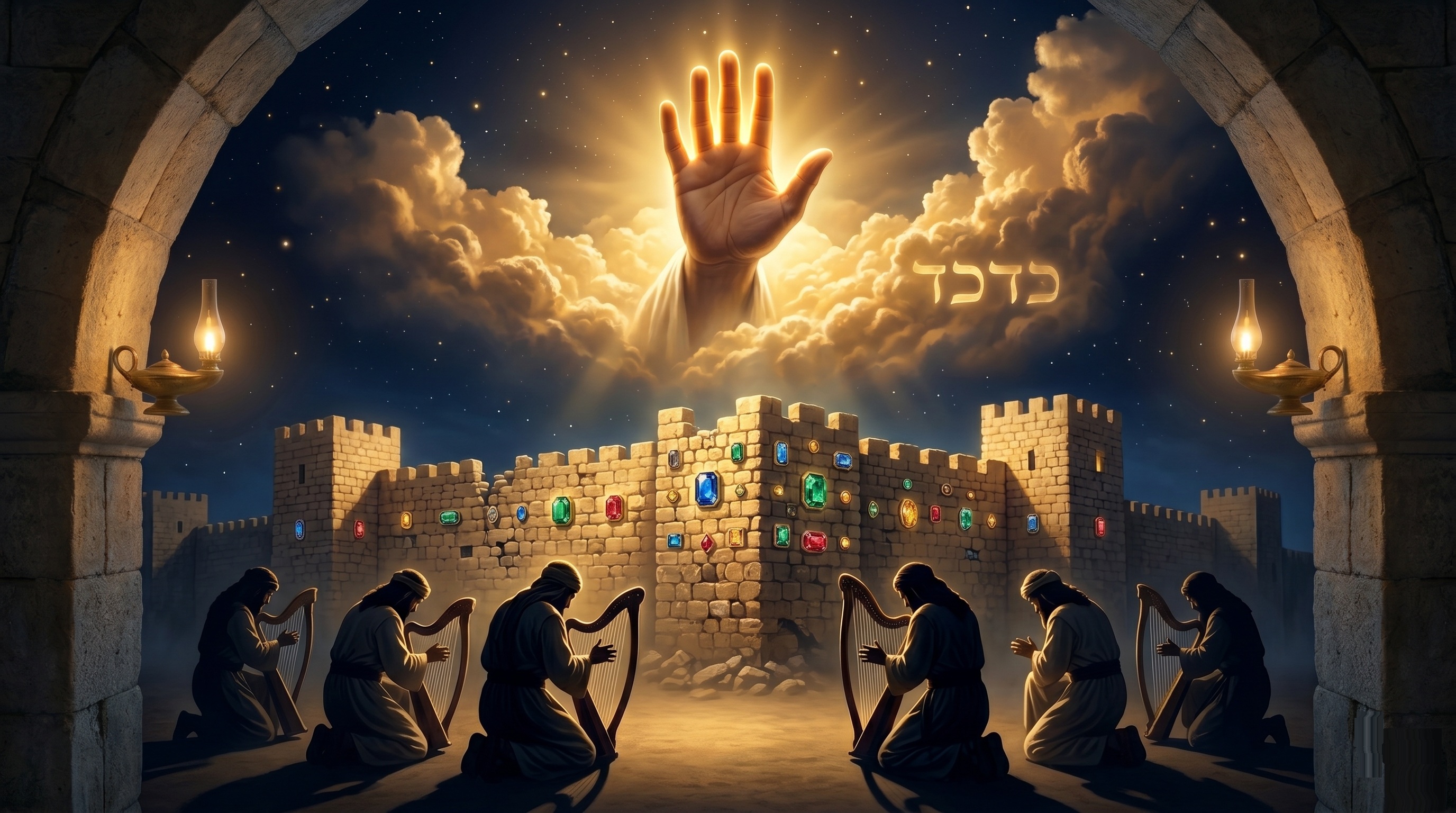
Yeshayahou sees Jerusalem rebuilt of stones, gates and borders. Why stones?
Behold, I will set your stones in carbuncle, and lay your foundations with sapphires. And I will make your windows of Kadkhod, and your gates of Avnei Ekdach, and all your borders of precious stonesYeshayahou 54:11-12

This is one of the seven haftarot of consolation read after Tisha be-Av. Avnei Hefetz = precious stones, jewels. Avnei Ekdach = pierced stones (the Hebrew root kadach means “to bore”), threaded with rods for ornate construction.

In the middle of the vision sits a strange word: Kadkhod — kaf-dalet-kaf-dalet. Two times the same syllable. The second kaf, after a sheva, has no dagesh.
⭐ Whenever the Torah doubles a word, something is hiding. The Zohar will reveal it.
2 Two Angels at War in Heaven
The Talmud (Bava Batra 75a) opens a window onto the heavenly debate.

Rabbi Shmuel bar Na’hmani teaches: two angels argued in heaven. Mikha’el and Gavri’el. The subject: with what stones will the streets of Jerusalem be paved in the days of Mashia’h?

Mikha’el said: Shoham. Gavri’el said: Yashfe. Both come from the Cohen Gadol’s Hoshen Mishpat — twelve stones for twelve tribes.
🔷 The Holy One does not pick a side. He says: kadén ve-kadén — like this, and like that. Both. Together. That is what the prophet writes: Kadkhod. Kad — kad.
⭐ The word is no longer strange. It is the verdict of Hachem.
3 The Stones and the Tribes
Which tribe does each stone represent?

The four rows of the Hoshen: Odem, Pitda, Bareket. Nofech, Sapir, Yahalom. Leshem, Shvo, A’hlama. Tarshish, Shoham, Yashfe. The order follows the birth of Ya’akov’s sons.

The fourth row holds the youngest. Shoham = Yossef. Yashfe = Binyamin. The two sons of Ra’hel.
⭐ The debate between Mikha’el and Gavri’el was never about geology. It was about which son of Ra’hel will define the redemption.
4 Yashfe = “Yesh Pe” — The Mouth That Stayed Silent
Why does the stone Yashfe correspond to Binyamin? The Midrash splits the word in two.

Yashfe = Yesh Pe — “he has a mouth.” When the brothers found the goblet in Binyamin’s sack, they turned on him: “You are a thief! Son of a thief! Just like your mother, who stole the trafim from Lavan.” They struck him on the shoulder.

🔷 Binyamin had a mouth. He could have said, “It was not me. Yossef planted it there.” He stayed silent. He absorbed the blows and the accusation against his mother.
For that silence, the Midrash teaches, Binyamin earned an eternal reward: the Beit Hamiqdash stands in his portion. The Temple Mount is in the inheritance of Binyamin. Not by chance — by silence.
⭐ To this day, the Temple Mount is in Binyamin’s portion. The Beit Hamiqdash sits on the seam between Yehuda and Binyamin.
5 The Deeper Layer — Mashia’h ben Yossef and Mashia’h ben David
Why does Hachem rule “kadén ve-kadén”? Because the debate hides a second debate.

The angels were not arguing about decorative pavement. They were arguing about the structure of the redemption. Shoham = Yossef = Mashia’h ben Yossef, the platform of awakening, the gathering of Israel. Yashfe = Binyamin = Mashia’h ben David, who builds the Third Beit Hamiqdash in Binyamin’s inheritance.

Hachem says: kadén ve-kadén. First Mashia’h ben Yossef — the platform that gathers all of Israel. Then Mashia’h ben David — the Beit Hamiqdash descends and is built. Yossef and Binyamin. Both. Neither alone.
6 ’Hessed and Din — Creation Repeats Itself
Beyond Mashia’h: the names of the angels reveal a deeper structure.

Gavri’el — his name contains gevurah, severity, Din. Mikha’el — the prince of Israel, the angel of ’Hessed. Fire and water. Two opposites.

🔷 “In the beginning, G-d created the heavens and the earth.” Hachem wanted to create with strict Din. He saw the world could not stand. So He joined Ra’hamim to Din. From chapter two of Bereshit, the world is created with Hachem Elokimmercy and judgment together.
Just as Hachem built the world — ’Hessed and Din together — so too Jerusalem will be rebuilt. Both Mikha’el and Gavri’el. Both Shoham and Yashfe. Both will be there. That is the meaning of Kadkhod.
7 Tehilim 137 — By the Rivers of Bavel
The first half of the shiur ends. The second begins. From prophecy to exile.
By the rivers of Bavel, there we sat and wept when we remembered Tzion. On the willows in its midst we hung our harpsTehilim 137:1-2

After the destruction of the first Beit Hamiqdash, the people of Israel were taken into exile in Bavel. With them went the Levites — the musicians of the Beit Hamiqdash. On the way, they rested by the rivers, by the willows.

🔷 Nabuchodonosor came to them: “Why do you sit and weep? Stand up. While we eat and drink, play for us — play for our gods — as you used to play before your G-d.”
A king of empires, not asking. Commanding. Play the music of the Beit Hamiqdash — before idols. The Levites had a choice. They had instruments. They had skill.
8 The Fingers in the Mouth
What did the Levites do?

They stood up. All of them. They put their right thumbs into their mouths — and they bit them off. They chewed the tips of their own fingers. Blood ran down their hands. They could no longer play.

They turned to Nabuchodonosor and said: “How shall we sing the song of Hachem on foreign soil?” They raised their bitten fingers: “We were tied up — and our fingers were cut off.”
🔷 The king flew into a rage. He threw them into mounds upon mounds of dead. He killed them for refusing. And the Levites died in joy — that they had not played the music of the Holy of Holies before an idol.
⭐ This is the Levites’ oath, written into the psalm: “If I forget you Jerusalem — let my right hand forget itself.” I swore on my hand. I cut off my hand. I will not forget.
9 The Holy One’s Right-Hand Oath
The classical reading: the Levites swore. The Midrash reveals a hidden second layer.
If I forget you Jerusalem — let My right hand forget itself. Let my tongue cling to my palate if I do not remember you, if I do not raise up Jerusalem upon my chief joyTehilim 137:5-6

The Midrash teaches: at that hour — when the Levites bit off their own fingers — Hachem Himself made an oath. Not in a courtroom. Not before witnesses. In His own being.

“You ruled over yourselves and cut off your own right fingers so that you would not play. I too swear — and My oath does not return to Me empty — as it is said: If I forget you Jerusalem, let My right hand forget itself.” Hachem swears on His own right hand. Yemin Hachem osa ’hayil — the right hand of Hachem acts with strength.
🔷 Measure for measure. The Levites gave up the use of their right hands so as not to defile the Beit Hamiqdash. Hachem pledges His own right hand to never forget the Beit Hamiqdash. 1967 — we are the generation that sees the oath fulfilled.
📕 A nation makes an oath. The Heavens swear back. Two thousand years later, a Jewish flag rises over the Old City — this is the kind of plot David Goldberg explores in “The Dream Thief.” What if the covenant was real, the oath was binding, and history is just the slow fulfillment? The first chapter is free.
📅 Week Plan — Seven Steps of the Oath
SUNDAY · Remember Yom Yerushalayim
If you celebrated Yom Yerushalayim this past Friday — take five minutes today to write what you felt. If you missed it — write down why. The covenant is yours.
MONDAY · The right hand
Today, pay attention to your right hand. Each time you use it — remember: Hachem swore on His. The hand is a witness.
TUESDAY · The silence of Binyamin
Identify one moment today when you could have defended yourself and chose silence. Honor it. Binyamin’s silence built the Beit Hamiqdash.
WEDNESDAY · Both, together
In any tension between ’Hessed (kindness) and Din (firmness), do not choose — combine. Kadén ve-kadén.
THURSDAY · A song you would not play
There is something in the surrounding culture you should not consume. Today, refuse it like a Levite. You are still alive. Hachem still hears.
FRIDAY NIGHT · Open the map
Before kiddush: open a map of Jerusalem for one minute. Look at the Old City walls. Hachem swore. We are the generation that sees the fulfillment.
SHABBAT · The word Yerushalayim
In Birkat Hamazon, pause on the word “Yerushalayim.” Slow down. Remember the bitten fingers. Remember the right-hand oath. 59 years since 1967.
Yom Yeroushalaïm · 28 Iyar 5786

Le serment de la main droite

Le code caché de Jérusalem · De Yecha’ayahou 54 à Tehilim 137
D’après le shiour de M. Yéhouda Himi

Yom Yeroushalaïm cette année (5786) tombe vendredi, 28 Iyar. M. Himi ouvre par une prophétie de Yecha’ayahou 54 et termine sur le serment liant de Tehilim 137. Entre les deux : un débat entre deux anges, un mot étrange répété, les pierres du Choshen, et la bouche silencieuse de Binyamin. Le code caché : mesure pour mesure n’est pas une règle de droit — c’est l’alliance entre Hachem et Son peuple. Les Léviim se sont mordu les doigts pour ne pas jouer devant l’idolâtrie. Le Saint-Béni-soit-Il a juré sur Sa propre main droite. Depuis 1967, le serment s’accomplit.

1 La prophétie des pierres — Yecha’ayahou 54
Yecha’ayahou voit Jérusalem rebatie. Une vision de pierres. Pourquoi des pierres ?
Voici, Je placerai tes pierres en escarboucle, et Je poserai tes fondations sur des saphirs. Et Je ferai tes fenêtres de Kadkhod, tes portes d’Avnei Ekdach, et toutes tes frontières de pierres précieusesYecha’ayahou 54:11-12

Cette prophétie est l’une des sept haftarot de consolation lues après Tisha be-Av. Avnei Hefetz = pierres précieuses. Avnei Ekdach = pierres percées (la racine hébraïque kadach signifie « percer »), traversées de tiges pour une construction ornée.

Au milieu de la vision se trouve un mot étrange : Kadkhod — kaf-dalet-kaf-dalet. Deux fois la même syllabe. Le second kaf, après un cheva, est sans daguéch.
⭐ Chaque fois que la Torah double un mot, quelque chose se cache. Le Zohar va le révéler.
2 Deux anges en guerre dans le ciel
Le Talmud (Bava Batra 75a) ouvre une fenêtre sur le débat céleste.

Rabbi Shmuel bar Na’hmani enseigne : deux anges se disputaient dans le ciel. Mikhaël et Gavriël. Par quelles pierres seront pavées les rues de Jérusalem aux jours du Mashia’h ?

Mikhaël a dit : Shoham. Gavriël a dit : Yashfe. Les deux viennent du Choshen Michpat — douze pierres pour douze tribus.
🔷 Le Saint-Béni-soit-Il ne choisit pas. Il dit : kadén ve-kadén — comme celui-ci, et comme celui-là. Les deux. Ensemble. C’est ce que le prophète écrit : Kadkhod.
⭐ Le mot n’est plus étrange. C’est le verdict de Hachem.
3 Les pierres et les tribus
Quelle tribu représente chaque pierre ?

Les quatre rangées du Choshen : Odem, Pitda, Bareket. Nofech, Sapir, Yahalom. Leshem, Shvo, A’hlama. Tarshish, Shoham, Yashfe. L’ordre suit la naissance des fils de Yaakov.

La quatrième rangée contient les plus jeunes. Shoham = Yossef. Yashfe = Binyamin. Les deux fils de Ra’hel.
⭐ Le débat entre Mikhaël et Gavriël n’a jamais été sur la géologie. Il portait sur quel fils de Ra’hel définira la guéoula.
4 Yashfe = « Yesh Pe » — la bouche qui s’est tue
Pourquoi Yashfe correspond-elle à Binyamin ? Le Midrash coupe le mot en deux.

Yashfe = Yesh Pe — « il a une bouche. » Quand les frères trouvèrent la coupe dans le sac de Binyamin, ils se retournèrent contre lui. « Tu es un voleur ! Fils de voleuse ! Comme ta mère qui a volé les trafim à Lavan. » Ils le frappèrent à l’épaule.

🔷 Binyamin avait une bouche. Il aurait pu dire : « Ce n’est pas moi. C’est Yossef qui l’a plantée là. » Il s’est tu. Il a absorbé les coups et l’accusation contre sa mère.
Pour ce silence, enseigne le Midrash, Binyamin a gagné une récompense éternelle : le Beit Hamiqdash se tient dans sa nahala. Le Mont du Temple est dans l’héritage de Binyamin. Pas par hasard — par silence.
⭐ Le Beit Hamiqdash se trouve sur la couture entre l’héritage de Yehouda et celui de Binyamin.
5 La couche profonde — Mashia’h ben Yossef et Mashia’h ben David
Pourquoi Hachem tranche « kadén ve-kadén » ?

Les anges ne se disputaient pas pour un pavage. Ils se disputaient sur la structure de la guéoula. Shoham = Yossef = Mashia’h ben Yossef, la plateforme de l’éveil. Yashfe = Binyamin = Mashia’h ben David, qui construit le troisième Beit Hamiqdash dans la nahala de Binyamin.

Hachem dit : kadén ve-kadén. D’abord Mashia’h ben Yossef — la plateforme qui rassemble. Puis Mashia’h ben David — le Beit Hamiqdash descend. Yossef et Binyamin. Aucun n’est complet seul.
6 ’Hessed et Din — la création se répète
Les noms des deux anges révèlent une structure plus profonde.

Gavriël — son nom contient gevoura, sévérité, Din. Mikhaël — le prince d’Israël, l’ange du ’Hessed. Feu et eau. Deux contraires.

🔷 « Au commencement, Dieu créa les cieux et la terre. » Hachem voulait créer avec le Din strict. Le monde ne pourrait pas tenir. Il joint Ra’hamim au Din. À partir du chapitre deux de Bereshit, le monde est créé avec Hachem Elokimmiséricorde et jugement ensemble.
Comme Hachem a bâti le monde — ’Hessed et Din ensemble — ainsi Jérusalem sera rebatie. Mikhaël et Gavriël. Shoham et Yashfe. C’est le sens de Kadkhod.
7 Tehilim 137 — Au bord des fleuves de Bavel
La première moitié du shiour se termine. La seconde commence.
Au bord des fleuves de Bavel, là nous nous sommes assis et nous avons pleuré en nous souvenant de Tzion. Aux saules qui s’y trouvaient, nous avons suspendu nos harpesTehilim 137:1-2

Après la destruction du premier Beit Hamiqdash, Israël fut emmené en exil à Bavel. Avec eux les Léviim — les musiciens du Beit Hamiqdash. Sur la route, une halte par les fleuves, aux saules de la berge.

🔷 Nabuchodonosor vint à eux : « Pourquoi pleurez-vous ? Levez-vous. Pendant que nous mangeons et buvons, jouez pour nous — pour nos dieux — comme vous jouiez devant votre Dieu. »
Un roi d’empires, qui ne demande pas. Qui ordonne. Jouer la musique du Beit Hamiqdash — devant des idoles.
8 Les doigts dans la bouche
Que firent les Léviim ?

Ils se sont levés. Tous. Ils ont mis les pouces droits dans leur bouche — et ils les ont mordus. Ils ont mastiqué les extrémités de leurs propres doigts. Le sang coulait. Ils ne pouvaient plus jouer.

Ils se sont tournés vers Nabuchodonosor : « Comment chanterons-nous le chant de Hachem en terre étrangère ? » Et ils ont levé leurs doigts mordus : « Nos doigts ont été coupés. »
🔷 Le roi entra en fureur. Il les jeta en monticules sur monticules de morts. Et les Léviim mouraient dans la joie — de n’avoir pas joué la musique du Saint des Saints devant une idole.
⭐ C’est le serment des Léviim : « Si je t’oublie Jérusalem — que ma main droite s’oublie. » J’ai juré sur ma main. J’ai coupé ma main. Je n’oublierai pas.
9 Le serment de Hachem sur Sa main droite
La lecture classique : les Léviim ont juré. Le Midrash révèle une seconde couche.
Si je t’oublie Jérusalem — que Ma main droite s’oublie. Que ma langue colle à mon palais si je ne me souviens pas de toi, si je n’élève pas Jérusalem au sommet de ma joieTehilim 137:5-6

Le Midrash enseigne : à cette heure-là — quand les Léviim se sont coupé les doigts — Hachem Lui-même a fait un serment. Pas dans un tribunal. Pas devant témoins. Dans Son être même.

« Vous vous êtes dominés et avez coupé vos propres doigts droits. Moi aussi je jure — et Mon serment ne revient jamais vide — comme il est dit : Si je t’oublie Jérusalem, que Ma main droite s’oublie elle-même. » Hachem jure sur Sa propre main droite. Yemin Hachem osa ’hayil — la main droite de Hachem agit avec force.
🔷 Mesure pour mesure. Les Léviim ont renoncé à leurs mains droites pour ne pas profaner le Beit Hamiqdash. Hachem engage Sa propre main droite pour ne jamais oublier le Beit Hamiqdash. 1967 — nous sommes la génération qui voit le serment s’accomplir.
📕 Une nation fait un serment. Les cieux jurent en retour. Deux mille ans plus tard, l’impossible se produit — un drapeau juif se lève sur la Vieille Ville — c’est ce que David Goldberg explore dans « The Dream Thief. » Et si l’alliance était réelle, le serment liant, et l’histoire juste le lent accomplissement ? Le premier chapitre est gratuit.
📅 Plan de la semaine — sept pas du serment
DIMANCHE · le Yom Yeroushalaïm qui vient de passer
Si tu as fêté Yom Yeroushalaïm vendredi — prends cinq minutes pour écrire ce que tu as ressenti. Si tu l’as manqué — écris pourquoi. L’alliance est tienne.
LUNDI · la main droite
Aujourd’hui, sois attentif à ta main droite. Chaque fois que tu l’utilises — rappelle-toi : Hachem a juré sur la Sienne. La main est un témoin.
MARDI · le silence de Binyamin
Identifie un moment où tu aurais pu te défendre et tu as choisi le silence. Honore-le. Le silence de Binyamin a bâti le Beit Hamiqdash.
MERCREDI · les deux ensemble
Dans toute tension entre ’Hessed et Din, ne choisis pas — combine. Kadén ve-kadén.
JEUDI · un chant que tu ne joueras pas
Il y a dans la culture environnante quelque chose que tu ne devrais pas consommer. Aujourd’hui, refuse comme un Lévi. Tu es toujours vivant.
VENDREDI SOIR · ouvre la carte
Avant le kiddouch : ouvre une carte de Jérusalem pendant une minute. Regarde les murs de la Vieille Ville. Hachem a juré.
CHABBAT · le mot Yeroushalaïm
Dans le Birkat Hamazon, marque-toi sur le mot « Yeroushalaïm. » Ralentis. Rappelle-toi les doigts mordus. Rappelle-toi le serment. 59 ans depuis 1967.
יום ירושלים · כ״ח אייר תשפ״ו

שבועת הימין

הקוד הנסתר של ירושלים · מישעיהו נ״ד עד תהלים קל״ז
על פי שיעורו של מ. יהודה חימי

יום ירושלים השנה (תשפ״ו) חל ביום שישי, כ״ח באייר. מ. חימי פותח בנבואה מישעיהו נ״ד ומסיים בשבועה המחייבת של תהלים קל״ז. ביניהם: ויכוח בין שני מלאכים, מילה חוזרת, אבני החושן, והפה השותקת של בנימין. הקוד הנסתר: מידה כנגד מידה זה לא חוק משפטי — זו הברית בין הק״ב״ה לעמו. הלוויים נשכו את אצבעותיהם. הק״ב״ה נשבע בימינו שלו. מאז 1967, השבועה מתגשמת.

א נְבוּאַת האֲבָנִים — ישעיהו נ״ד
ישעיהו רואה את ירושלים הבנויה. כולו אבנים. למה אבנים?
הִנֵּה אָנֹכִי מַרְבִיץ בַּפוּךְ אֲבָנַיִךְ וִיַסַדְתִּיךְ בַּסַּפִּירִים · וְשַׂמְתִּי כַּדְכֹד שִׁמְשֹׁתַיִךְישעיהו נ״ד:י״א-י״ב

זו אחת משבע ההפטרות של נחמה אחרי תשעה באב. אבנים — אבל לא אבנים רגילים. אבני חפץ = אבנים יקרות. אבני אקדח = אבנים עם קדחים, חורים שאפשר להעביר דרכם מוטות.

ובאמצע החזון: כַּדְכֹד. כ״ף-דל״ת-כ״ף-דל״ת. פעמיים אותה ההברה. הכ״ף השנייה, אחרי שווא, בלי דגש.
⭐ כל פעם שהתורה כופלת מילה, משהו מסתתר. הזוהר יגלה.
ב שְׁנֵי מַלְאָכִים
הגמרא (בבא בתרא ע״ה.) פותחת חלון אל הוויכוח השמימי.

רבי שמואל בר נחמאני מלמד: פליגי תרי מלאכים ברקיעא. מיכאל וגבריאל. באילו אבנים ירוצפו רחובות ירושלים לעתיד לבוא?

מיכאל אמר: שוהם. גבריאל אמר: ישפה. שני האבנים מחושן הכהן הגדול — שתים עשרה אבנים.
🔷 הק״ב״ה מתערב. הוא אומר: כדן וכדן — כמו זה, וכמו זה. שניהם. יחד. זה מה שהנביא כותב: כַּדְכֹד.
⭐ המילה כבר לא מוזרה. זו הכרעת הק״ב״ה.
ג הָאֲבָנִים וְהַשְׁבָטִים
איזו שבט מייצגת כל אבן?

ארבע הטורים של החושן: אודם, פטדה, ברקת. נופך, ספיר, יהלום. לשם, שבו, אחלמה. תרשיש, שוהם, ישפה. הסדר לפי סדר לידת בני יעקב.

הטור הרביעי מכיל את הצעירים. שוהם = יוסף. ישפה = בנימין. שני בניה של רחל.
⭐ הוויכוח לא היה על גיאולוגיה. הוא היה על איזה בן של רחל יגדיר את הגאולה.
ד ישפה = «יש פה» — הַפֶּה שֶּשָׁתַק
למה ישפה מייצגת את בנימין? המדרש מפרק את המילה לשנים.

ישפה = יש פה. כשהאחים מצאו את הגביע באמתחת בנימין, הם נפלו עליו: «אתה גנב! בן גנבת! כמו אמך, שגנבה את התרפים מלבן.» הכו אותו צפחות בכתף.

🔷 לבנימין הייתה פה. הוא יכול היה לומר: «זה לא אני. יוסף הטמין את זה.» הוא שתק. ספג את המכות ואת ההאשמה נגד אמו.
על השתיקה הזו, זכה בנימין לשכר נצח: בית המקדש בנחלתו. הר הבית בנחלת בנימין. לא במקרה — בשתיקה.
⭐ הבית המקדש בתפר בין נחלת יהודה לנחלת בנימין.
ה מָּשִׁיח בֶּן יוֹסֵף וּמָּשִׁיח בֶּן דָּוִד
למה הק״ב״ה מכריע «כדן וכדן»?

המלאכים לא התווכחו על ריצוף. הם התווכחו על עולם הגאולה עצמו. שוהם = יוסף = משיח בן יוסף, הפלטפורמה של ההתעוררות. ישפה = בנימין = משיח בן דוד, הבונה את בית המקדש השלישי.

הק״ב״ה אומר: כדן וכדן. תחילה משיח בן יוסף — הפלטפורמה שמקבצת. אחר כך משיח בן דוד — בית המקדש יורד. יוסף ובנימין.
ו חֶּסֶד וְדִין — הַבְּרִיאָה חוֹזֶרֶת
שמות שני המלאכים מרמזים מבנה עמוקה יותר.

גבריאל — שמו מכיל גבורה, דין. מיכאל — שר ישראל, מלאך החסד. אש ומים. שני ניגודים.

🔷 «בראשית ברא אלוקים את השמים ואת הארץ.» הק״ב״ה רצה לברוא את העולם בדין. ראה שאין העולם יכול לעמוד. שיתף איתו מידת הרחמים. מפרק ב של בראשית, העולם נברא עם ה׳ אלוקיםרחמים ודין יחד.
כשם שהק״ב״ה בנה את העולם — חסד ודין יחד — כך ירושלים תיבנה. גם מיכאל וגם גבריאל. גם שוהם וגם ישפה. זה הפירוש של כדכוד.
ז תְהִלִים קל״ז — עַל נַהֲרוֹת בָבֶל
מחציתו הראשונה של השיעור מסתיימת. השנייה מתחילה.
עַל נַהֲרוֹת בָבֶל שָׁם יָשַׁבְנוּ גַּם בָּכִינוּ בְּזָכְרֵנוּ אֶת צִיּוֹן · עַל עֲרָבִים בְּתוֹכָהּ תָּלִינוּ כִנֹּרוֹתֵינוּתהלים קל״ז:א-ב

אחרי חורבן בית ראשון, עם ישראל גלו גם הלוויים — נגני בית המקדש. בדרך, תחנת ביניים על נהר, ערבי הנחל.

🔷 נבוכדנאצר בא: «מה אתם יושבים ובוכים? עימדו הכינו עצמכם, בזמן שאנחנו אוכלים ושותים, אני מבקש שתעמדו ותקישו לפניי ולפני העבודה זרה בכינורות שלכם, כדרך שהייתם מקישים לפני אלוהיכם.»
מלך אימפריות, לא מבקש. מצווה. לנגן את מוסיקת בית המקדש — מול עבודה זרה.
ח הָאֶצְבָּעוֹת בַּפֶּה
מה עשו הלוויים?

עמדו כולם ושלטו בעצמם. נטלו אגודלי ימינם לתוך פיהם — ומרצצו אותם. בשינייהם נגסו קצות האצבעות. דם זרם. לא יכולים לנגן.

הם פנו לנבוכדנאצר ואמרו: «איך נשיר את שיר ה׳ על אדמת נכר?» והראו לו את אצבעותיהם: «היינו כפותים ונקטעו אצבעותינו.»
🔷 המלך התעצבן. עמד והשליך מישראל טילי טילים של הרוגים. והלוויים מתו בשמחה — שלא ניגנו את מוסיקת קודש הקדשים לפני עבודה זרה.
⭐ זו שבועת הלוויים הכתובה במזמור: «אם אשכחך ירושלים — תשכח ימיני.»
ט שְׁבוּעַת הַק״ב״ה עַל יְמִינוֹ
הקריאה הקלאסית: הלוויים נשבעו. המדרש חושף שכבה שנייה.
אִם אֶשְׁכָּחֵךְ יְרוּשָׁלַּיִם תִּשְׁכַּח יְמִינִי · תִּדְבַּק־לְשׁוֹנִי לְחִכִּי אִם לֹא אֶזְכְּרֵכִיתהלים קל״ז:ה-ו

המדרש מלמד: באותה שעה — כשהלוויים קטעו את אצבעותיהם — הק״ב״ה בעצמו נשבע. לא בבית דין. לא בפני עדים. בעצמיותו הוא.

«אתם שלטתם בעצמכם וקטעתם אצבעות ימינכם, כדי שלא תנגנו. אף אני נשבע — ושבועתי אינה חוזרת לעולם — שנאמר אם אשכחך ירושלים תשכח ימיני.» הק״ב״ה נשבע בימין שלו. ימין ה׳ עושה חיל.
🔷 מידה כנגד מידה. הלוויים ויתרו על השימוש בימינם כדי שלא לחלל את בית המקדש. הק״ב״ה מתערב בימינו שלו לעולם לא לשכוח את בית המקדש. 1967 — אנחנו הדור הרואה את הברית מתגשמת.
📕 עם נשבע. השמים נשבעו חזרה. אלפיים שנים אחר כך, דגל יהודי עולה מעל העיר העתיקה. זה בדיוק הסוג של עלילות דויד גולדברג חוקר ב «The Dream Thief». הפרק הראשון חינם.
📅 תָּחְנִית הַשָּׁבוּעַ
יום ראשון · זכור יום ירושלים
אם חגגת יום ירושלים ביום שישי — קח 5 דקות לכתוב את מה שהרגשת.
יום שני · יד ימין
היום שים לב אל יד ימינך. זכור — הק״ב״ה נשבע על שלו.
יום שלישי · שתיקת בנימין
זהה רגע שיכולת להגן על עצמך ובחרת שתיקה. כבד אותו.
יום רביעי · כדן וכדן
בכל מתח בין חסד לדין, אל תבחר — שלב.
יום חמישי · שיר שלא תנגן
יש בתרבות סביב משהו שאסור לך לצרוך. היום — סרב כמו לוי.
ליל שישי · פתח את המפה
לפני קידוש: פתח מפה של ירושלים לדקה.
שבת · המילה ירושלים
בברכת המזון, התעכב על «ירושלים.» זכור את האצבעות. 59 שנה מאז 1967.

The Right-Hand Oath Quiz

Five questions on the hidden code of Yom Yerushalayim

Question 1 of 5
What does the strange word Kadkhod in Yeshayahou 54 mean, according to the Zohar?
A very rare precious stone, found only in Jerusalem
Two angels argued; Hachem said “like this and like that” — both, together
A textual error preserved by tradition
The crown of the future Mashia’h
Question 2 of 5
In the heavenly debate, what stones did Mikha’el and Gavri’el propose?
Sapphire and ruby
Shoham (Yossef) and Yashfe (Binyamin) — from the breastplate
Marble and gold
Pearls and emeralds
Question 3 of 5
Why does the stone Yashfe correspond specifically to Binyamin?
Because his eyes were the color of yashfe
Yashfe = “Yesh Pe” (he had a mouth) — he could speak but stayed silent when accused
Because it was the largest stone in the breastplate
Because Binyamin was the smallest tribe
Question 4 of 5
When ordered to play before idols in Bavel, what did the Levites do?
They played but with the wrong notes
They escaped during the night
They bit off their own right thumbs so they could no longer play
They sang silently in their hearts only
Question 5 of 5
In the Midrash, who utters the verse “If I forget you Jerusalem, let My right hand forget itself”?
Only the Levites — as their oath
King David, speaking for future generations
Hachem Himself — swearing on His own right hand, measure for measure
The prophet Yeshayahou
🏆

Le quiz du serment de la main droite

Cinq questions sur le code caché de Yom Yeroushalaïm

Question 1 sur 5
Que signifie le mot étrange Kadkhod dans Yecha’ayahou 54, selon le Zohar ?
Une pierre très rare, trouvée uniquement à Jérusalem
Deux anges se disputaient ; Hachem a dit « comme celui-ci et comme celui-là » — les deux ensemble
Une erreur textuelle préservée par la tradition
La couronne du futur Mashia’h
Question 2 sur 5
Dans le débat céleste, quelles pierres ont proposées Mikhaël et Gavriël ?
Saphir et rubis
Shoham (Yossef) et Yashfe (Binyamin) — du Choshen
Marbre et or
Perles et émeraudes
Question 3 sur 5
Pourquoi la pierre Yashfe correspond-elle précisément à Binyamin ?
Parce que ses yeux avaient la couleur du yashfe
Yashfe = « Yesh Pe » (il avait une bouche) — il pouvait parler mais s’est tu quand on l’a accusé
Parce que c’était la plus grosse pierre du Choshen
Parce que Binyamin était la plus petite tribu
Question 4 sur 5
Quand on leur a ordonné de jouer devant des idoles à Bavel, qu’ont fait les Léviim ?
Ils ont joué mais avec de mauvaises notes
Ils se sont échappés pendant la nuit
Ils se sont mordu les pouces droits pour ne plus pouvoir jouer
Ils ont chanté silencieusement dans leur cœur
Question 5 sur 5
Dans le Midrash, qui prononce le verset « Si je t’oublie Jérusalem, que Ma main droite s’oublie » ?
Seulement les Léviim — comme leur serment
Le roi David, parlant pour les générations futures
Hachem Lui-même — jurant sur Sa propre main droite, mesure pour mesure
Le prophète Yecha’ayahou
🏆

חידון שבועת הימין

חמש שאלות על הקוד הנסתר של יום ירושלים

שאלה 1 מתוך 5
מה משמעות המילה כַּדְכֹד בישעיהו נ"ד, לפי הזוהר?
אבן יקרה נדירה בירושלים
שני מלאכים נחלקו; הק״ב״ה אמר «כדן וכדן» — שניהם יחד
טעות העתקה שנשמרה במסורת
כתרו של המשיח
שאלה 2 מתוך 5
בהוויכוח השמימי, איזו אבנים הציעו מיכאל וגבריאל?
ספיר ואודם
שוהם (יוסף) וישפה (בנימין) — מאבני החושן
שיש וזהב
פנינים ואזמרגד
שאלה 3 מתוך 5
למה האבן ישפה מסמלת דווקא את בנימין?
כי עיניו היו בצבע הישפה
ישפה = «יש פה» — הייתה לו פה אבל שתק כשהאשימוהו
כי היא האבן הגדולה ביותר בחושן
כי בנימין היה השבט הקטן ביותר
שאלה 4 מתוך 5
כשצווה עליהם לנגן לפני עבודה זרה בבבל, מה עשו הלוויים?
ניגנו אבל עם טעויות
ברחו בלילה
מרצצו את אגודלי ימינם כדי שלא יוכלו לנגן
שרו בשקט בלבם בלבד
שאלה 5 מתוך 5
במדרש, מי אומר את הפסוק «אם אשכחך ירושלים תשכח ימיני»?
רק הלוויים — כשבועתם
דוד המלך, מדבר בשם הדורות הבאים
הק״ב״ה בכבודו ובעצמו — נשבע בימינו, מידה כנגד מידה
ישעיהו הנביא
🏆