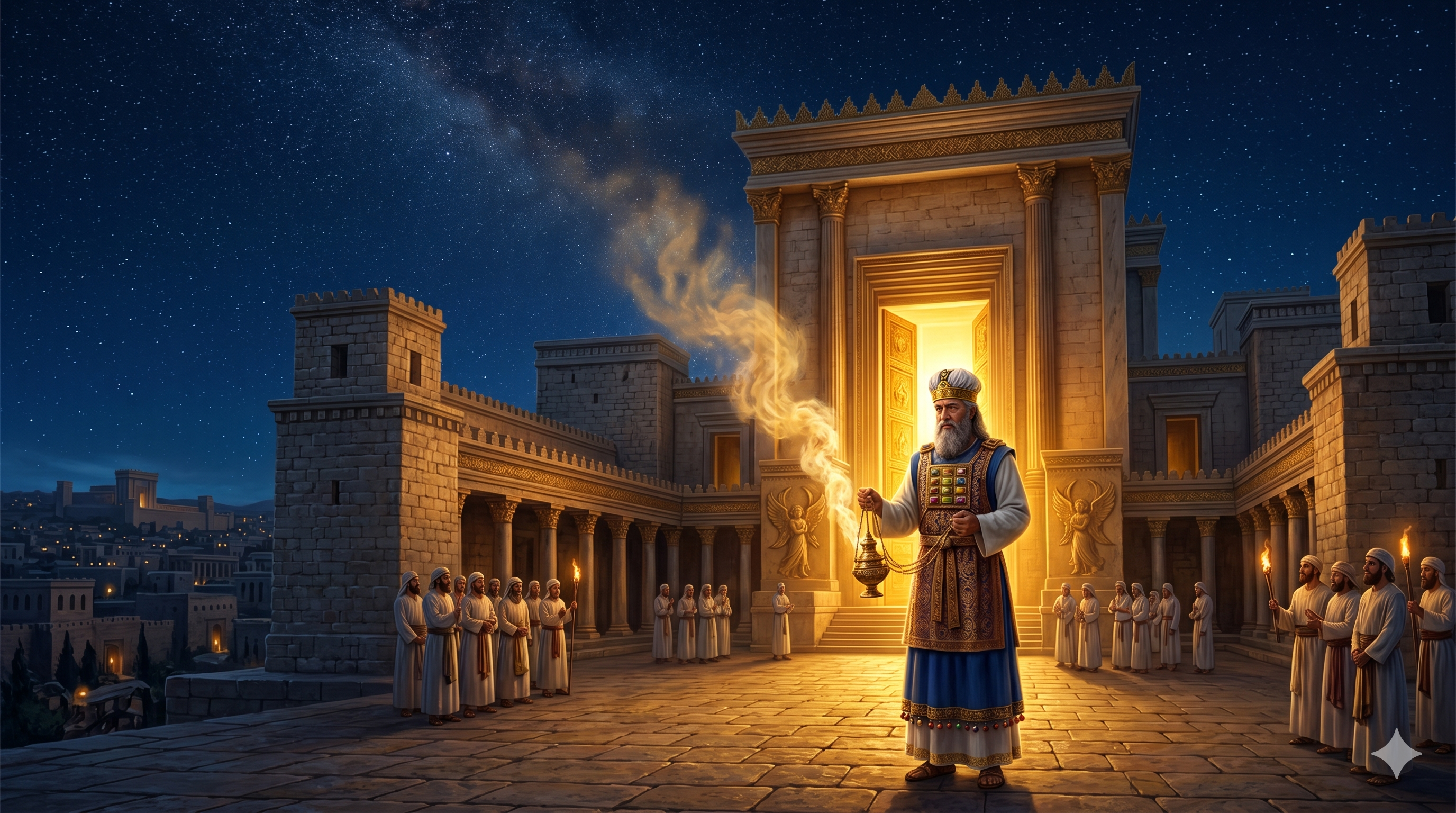
שתי פרשיות, מסר אחד: הקדושה היא לא משהו שאתה צריך לבנות מאפס — היא כבר שם, בפנים. מה שנשאר לעשות? רק לנקות את החיצוניות. "ויתקדשתם והייתם קדושים" — אתם כבר קדושים. הקדוש ברוך הוא בחר בכם. כל השאר נובע מזה.
נשים לב: "וְאַל יָבֹא בְכָל עֵת" — אל מי אומרים "אל תבוא בכל עת"? רק למי שיש לו פוטנציאל לבוא בכל עת. אם אהרן לא יכול היה להיכנס כלל — לא צריך לאסור!
המסקנה: אהרן הכהן יכול היה להיכנס לקודש הקודשים בכל עת — בתנאי הכנה מיוחדת (פר, בגדי קודש וכו'). לדורות — הכוהנים הגדולים מוגבלים לפעם אחת בשנה ביום הכיפורים. זה חידוש שלא הרבה שמים לב אליו.
⭐ הפתיחה "אַחֲרֵי מוֹת שְׁנֵי בְנֵי אַהֲרֹן בְּקָרְבָתָם" מלמדת: נדב ואביהו התקרבו ללא הכנה. אהרן, לעומתם, מוזמן להתקרב — אבל בתנאים. כניסה עם כוונה וכלים היא הדרך. כניסה פרועה — היא המוות.
ב "שְׁנֵי בְנֵי אַהֲרֹן" — נָדָב וַאֲבִיהוּא כַּכַּפָּרָה שֶׁל אַהֲרֹן
למה הפרשה לא אומרת "אחרי מות נדב ואביהוא" בשמם? למה "שני בני אהרן"?
היו לאהרן ארבעה בנים: נדב, אביהו, אלעזר ואיתמר. רק שניים מתו — ובכל זאת הפרשה כותבת "שְׁנֵי בְנֵי אַהֲרֹן" ולא "נדב ואביהוא." מה מסתתר בצורת הכתיבה הזאת?
🔷 אהרן לקח על עצמו את חטא העגל בצורה כל כך עמוקה שהוא הרגיש שאינו ראוי לעמוד לפני ה'. "שני בני אהרן בְּקָרְבָתָם לִפְנֵי ה'" — הם לא רק קרבו לה', הם קרבו במקום אביהם. הם לקחו על עצמם את הכפרה שהיה אהרן זקוק לה — ונשאו אותה בגופם.
⭐ לכן לא מוזכרים שמותיהם — כי הם לא פעלו כנדב ואביהוא בנפרד, אלא כ"בני אהרן", כהמשכו ותיקונו. הסמיכות לפרשת יום הכיפורים לא מקרית: ה' אומר לאהרן — "ובזאת יבוא אהרן" — עכשיו, אחרי שבניך כיפרו, בוא בתנאים הנכונים.
ג הָאָרֶץ כְּגוּף חַי — "וְתָקִיא הָאָרֶץ"
למה התורה לא אומרת סתם "לא תעשו כמצרים" אלא "כְּמַעֲשֵׂה אֶרֶץ מִצְרַיִם"? מה ההבדל?
הארץ היא גוף חי. היא מרגישה. היא מגיבה. הגויים שגרו בה לפניכם — גם אותם הקיאה, כי היא סבלה את הטומאה שלהם. ועכשיו אתם, עם קדוש, נכנסים לארץ קדושה — אם תתנהגו שלא בקדושה, הרפלקס יקרה שוב. הגלות היא לא עונש בלבד — היא הרפלקס הטבעי של ארץ ישראל.
הנביא ישעיה ישעיה א:ז מתאר את הגלות כ"הקאה." ותרגום אונקלוס ויקרא יח:כח מדייק: "ולא תְּרוֹקֵן" — מלשון ריקון. כשהארץ מקיאה, היא מתרוקנת ממה שמזיק לה. כשהיא קולטת אותנו — היא מלאה.
כיצד מסביר רש"י את הרפלקס של ארץ ישראל? ומה ההבדל בין ארץ ישראל לשאר הארצות?
רש"י מביא משל מרהיב:
🔶 משל למה הדבר דומה?
לבן מלך שחלה, האכילוהו מאכל אחד שאינו עומד במיעיו אלא מקיאו.
בן מלך — מפונק, רגיל לאוכל נקי בלבד. פתאום הוא אוכל משהו מהשוק, לא תקני, לא סטרילי. גופו מקיא אוטומטית. לא כי הוא "מחליט" — זה רפלקס.
כך ארץ ישראל: אינה מקיימת עוברי עברה. לא כעונש — אלא כרפלקס. היא רגילה לקדושה.
⭐ הגויים שהיו בארץ — הארץ "סבלה" אותם, כי הם לא ידעו טוב יותר. אבל עם ישראל — שיש לו תורה, שצופה ממנו להתנהג בקדושה — אם ישב בארץ ישראל כאילו היא "חתיכת אדמה" ויתנהג בטומאה, הרפלקס יהיה חזק בהרבה. כמה שאתה קרוב יותר לקדושה — יש לה ציפייה גדולה יותר ממך.
ה "קְדֹשִׁים תִּהְיוּ" — שַׁרְשֶׁרֶת אַחַת עִם אַבְרָהָם וְשָׂרָה
מה הקשר בין "קדושים תהיו" לבין "איש אמו ואביו תיראו"? ועל איזה אמא ואבא מדובר?
זאת לא רשימת מצוות — זאת שרשרת: (א) "קדושים תהיו" — העיקרון. (ב) "איש אמו ואביו תיראו" — איך? (ג) "ואת שבתותי תשמורו" — הביצוע.
על איזה אמא ואבא מדובר? לא רק ההורים הביולוגיים — אלא שורש האומה: אברהם ושרה. מה ראיה? הנביא ישעיה אומר: "הַבִּיטוּ אֶל אַבְרָהָם אֲבִיכֶם וְאֶל שָׂרָה תְּחוֹלֶלְכֶם"ישעיה נא:ב — הסתכלו איך הם חיו, בן דוגמה לקדושתם.
🔷 אברהם ושרה חיו 75 שנה ביחד — ואברהם אומר לה לפני ירידתם למצרים: "הִנֵּה נָא יָדַעְתִּי כִּי אִשָּׁה יְפַת מַרְאֶה אָתְּ"בראשית יב:יא. 75 שנה ולא "שם לב"? מחמת עומק הצניעות שחיו — הוא לא הגביר את תשומת לבו ב"חיצוניות." רק כשיש סיבה מעשית — הוא מזכיר זאת. זהו "איש אמו ואביו תיראו" — תראו את ההתנהגות שלהם ולמדו.
ו "כָּל עֲדַת בְּנֵי יִשְׂרָאֵל" — מַעֲמַד הַר סִינַי מֵחָדָשׁ
למה התורה כותבת "דַּבֵּר אֶל כָּל עֲדַת" — ולא סתם "דבר אל בני ישראל" כרגיל?
רש"י עומד על כך ואומר: "מלמד שנאמרה פרשה זו בהקהל" — כינוס של כל עם ישראל, כמו מעמד הר סיני. ולמה? "מפני שרוב גופי תורה תלויים בה."
פרשת קדושים היא התמצית של כל התורה. יש בה רמזים לעשרת הדיברות, לכל יחסי האדם עם חברו, לכל יחסי האדם עם ה'. לכן היא לא נאמרת רק לצדיקים — היא נאמרת לכל אחד ואחד. גם מי שמרגיש רחוק. גם מי שמרגיש לא ראוי. "קדושים תהיו" — כולם, ללא יוצא מהכלל.
⭐ "דַּבֵּר אֶל כָּל עֲדַת" — לא "לצדיקים שבהם." לכולם. כי הצו הזה, כפי שנראה בכרטיס הבא, לא תובע שתבנה קדושה יש מאין — הוא מזכיר לך שהיא כבר שם.
רבי עקיבא פסק: "חַיֶּיךָ קוֹדְמִים לְחַיֵּי חֲבֵרְךָ." אבל הוא גם אמר ש"ואהבת לרעך כמוך" הוא כלל גדול בתורה. איך מיישבים את הסתירה?
וְאָהַבְתָּ לְרֵעֲךָ כָּמוֹךָ אֲנִי ה'ויקרא יט:יח
הגמרא במסכת בבא מציעא בבא מציעא סב:א שואלת: שניים שהולכים במדבר, יש להם כמות מים שמספיקה לאחד בלבד. אם שניהם שותים — שניהם מתים. אם אחד שותה — הוא חי. מה עושים? רבי עקיבא פוסק: "חַיֶּיךָ קוֹדְמִים" — בעל הכד שותה, השני נגזר עליו.
🔷 אבל "ואהבת לרעך כמוך" — כמוך ממש! מה פירוש? כשאני מבין שה"רע" שלי הוא חלק ממני — הוא לא "אחר," הוא אחי ובשרי — אז "כמוך" מובן לחלוטין. לא תיקום ולא תיטור לאחיך — "בני עמך" = חלק ממך. ואז "כמוך" הוא לא ציווי בלתי אפשרי — הוא הגדרה של מי אנחנו.
24,000 תלמידי רבי עקיבא מתו בספירת העומר על שלא נהגו כבוד זה בזה. התיקון? חמישה תלמידים שבאו בדיוק לתקן את הנקודה הזאת:
רבי מאיר
ענווה ושפלות רוח. סיסמתו (אבות ד:א): "הֱוֵי שְׁפַל רוּחַ בִּפְנֵי כָל אָדָם" — בפני כל אדם, לא רק בפני גדולים.
רבי יוסי
ביטול הרצון בפני החבר. אמר על עצמו: "מעולם לא עברתי על דברי חבריי"שבת קיח:ב — ולא רק שאמר, הוא חי את זה.
רבי שמעון בר יוחאי
מסירות נפש לכבוד הזולת. סיסמתו: "נוֹחַ לוֹ לְאָדָם שֶׁיַּפִּיל עַצְמוֹ לְכִבְשַׁן הָאֵשׁ וְאַל יַלְבִּין פְּנֵי חֲבֵרוֹ בָּרַבִּים".
שלום בית מעשי. הסיפור: בא לפניו זוג סכסוך — הבעל טוען שאשתו מבשלת רע. רבי יהודה אכל מהתבשיל בעצמו ואמר: "טעים. ממה שאני אכלתי — לא קרה לי כלום." — רק כדי להשכין שלום.
מה ההבדל בין "כִּי קָדוֹשׁ אֲנִי" (פרשת שמיני) לבין "כִּי אֲנִי ה' אֱלֹקֵיכֶם" (פרשת קדושים)?
וְהִתְקַדִּשְׁתֶּם וִהְיִיתֶם קְדֹשִׁים כִּי אֲנִי ה' אֱלֹקֵיכֶםויקרא כ:ז
שימו לב לשינוי הדק: בפרשת שמיני כתוב "כִּי קָדוֹשׁ אֲנִי" — אני קדוש. כאן כתוב "כִּי אֲנִי ה' אֱלֹקֵיכֶם" — אני ה' שלכם, שבחרתי בכם להיות עמי הקדוש.
המשמעות: אתם לא בונים קדושה מאפס. היא כבר שם. ויתקדשתם והייתם קדושים — "והייתם" כבר מרמז על עבר: אתם כבר קדושים. מה שנשאר לעשות? לנקות את הקליפה החיצונית.
🌰 משל האגוז — מדרש שיר השירים:
"אֶל גִּנַּת אֱגוֹז יָרַדְתִּי" שיר השירים ו:יא — על מה נמשל עם ישראל? על אגוז.
אגוז שנפל לבוץ — כולו מלוכלך. אתה חושב: לא שווה אפילו לאסוף אותו. אבל ברגע שתרים אותו ותשטוף אותו בנחל — בפנים? מעולם לא נגע בו הבוץ.
כך עם ישראל: כמה שנתלכלכנו בגלות, בחטאים, בריחוק — זה רק הקליפה. הפנים תמיד קדושים. "כי אני ה' אלוקיכם" — אני הוא שבחרתי בכם, ובחירה זו לא בטלה לעולם.
🔷 משל התרנגולת והצפרדע: גוי אמר לרב: אתם מתפללים ועוד צריכים לטהר ידיים? אנחנו כל היום במים — אנחנו יותר טהורים! השיב לו: תרנגולת — כל היום בהשפעות ובעופרת. ועדיין היא בשר כשר, כי כך היא נולדה. צפרדע — כל היום במים. ועדיין היא שרץ. מה שאתה מה שאתה מבפנים — זה מה שקובע. לא הטבילה בחיצוניות.
עם ישראל נולד עם נשמה קדושה. זה לא משתנה. מה שנשאר — רק לנקות.
🗓 תָּכְנִית הַשָּׁבוּעַ
יום ראשון
קרא ויקרא יח:ג ו-כח. שאל: מה "ה-ארץ" מרגישה כלפי ההתנהגות שלי? אם הארץ היא גוף חי — מה אני מכניס לתוכה?
יום שני
קרא ויקרא יט:ב-ג. שאל: מי הם "אמי ואבי" הרוחניים שלי? איזו דמות בהיסטוריה של עם ישראל מייצגת עבורי את הקדושה שאני שואף אליה?
יום שלישי
קרא בבא מציעא סב:א — הסיפור של שני האנשים במדבר. שאל: איפה הגבול שלי בין "חַיֶּיךָ קוֹדְמִים" לבין "ואהבת לרעך כמוך"? האם אני מאוזן?
יום רביעי
קרא על חמשת תלמידיו של רבי עקיבא. שאל: איזה מחמשת המידות הכי קשה לי? ענווה, ביטול, מסירות, כבוד הזולת, שלום בית?
יום חמישי
חשוב על משל האגוז. בחיים שלך — מה ה"בוץ" שדבק עליך מבחוץ? ומה הוא ה"פנים" שמעולם לא נגעה בו הלכלוך? אמור: "אני מאמין שהפנים שלי תמיד קדושים."
ליל שישי
לפני הדלקת הנרות: "ריבונו של עולם, אני יודע שבחרת בי. אני יודע שהקדושה שלי לא ניתנת לביטול. תעזור לי לנקות את הקליפה שמבחוץ — ולגלות את מה שנמצא בפנים."
שבת
בבית הכנסת, כשתשמע "קְדֹשִׁים תִּהְיוּ" בקריאת התורה — עצור. לא "תהיו קדושים" כציווי רחוק. אתה כבר קדוש. זה מה שהפסוק אומר.
להעמיק עוד
⚖️
הלכה יום יום
כל יום — פסיקה ברורה, MOUTTAR או ASSOUR. הלכה ספרדית לפי יקוט יוסף / חזון עובדיה.
ליל שישי · אחרי מות קדושים תשפ"ו · על פי שיעורו של מ. יהודה חימי
אהרן הכהן יכול היה להיכנס לקודש הקודשים בכל עת — עם הכנה מיוחדת. "ואל יבוא בכל עת" — אל מי אומרים כך? למי שיש לו פוטנציאל. לדורות, הכוהנים הגדולים מוגבלים ליום כיפור. ומדוע "שני בני אהרן" ולא "נדב ואביהוא"? כי הם באו כפרה במקום אביהם, שנשא את חטא העגל כל כך קשה.
הארץ היא גוף חי. "ותקיא הארץ" — הגלות היא לא רק עונש, היא רפלקס. בן מלך שרגיל לאוכל נקי — מקיא כשמכניסים לגופו אוכל של השוק. כך ארץ ישראל. וקדושים תהיו — הפתרון: "איש אמו ואביו תיראו" — הביטו אל אברהם אביכם ואל שרה תחוללכם. שבת שלום.
בס״ד
האגוז שנפל בבוץ — "והייתם קדושים"
שבת בוקר · אחרי מות קדושים · מ. יהודה חימי
"ויתקדשתם והייתם קדושים כי אני ה' אלוקיכם" — לא "תהיו קדושים." אתם כבר קדושים. ה' בחר בכם. אגוז שנפל בבוץ — מבחוץ מלוכלך, אבל מבפנים? מעולם לא נגע בו הבוץ. כך עם ישראל: כמה שהתלכלכנו — הקדושה הפנימית לא ניתנת לביטול.
מה שנשאר לעשות? לנקות. ו"ואהבת לרעך כמוך" — כשתבין שה"רע" שלך הוא חלק ממך, "כמוך" הופך להיות טבעי לחלוטין. 24,000 תלמידים מתו כי לא נהגו כבוד זה בזה. חמישה תלמידים תיקנו: ענווה, ביטול, מסירות, כבוד הזולת, שלום בית. שבת שלום ומבורך.
Acharei Mot Kedoshim · 5786
You Shall Be Holy
The walnut in the mud — Aaron — the Land — 24,000 students
Based on the shiur of M. Yéhouda Himi
Two parashiyot, one message: holiness is not something you need to build from scratch — it is already there, inside. What remains? Just clean the outside. “Vit’kadishtem vihyitem kedoshim” — you are already holy. G-d chose you. Everything else flows from that.
1 Aaron the Kohen — Free Access to the Holy of Holies?
Did Aaron enter the Holy of Holies only once a year like later High Priests — or did he have a special privilege?
G-d spoke to Moses after the death of the two sons of Aaron… and said: “Speak to Aaron your brother: he shall not come at all times into the Sanctuary” Leviticus 16:1-2
Notice: “he shall not come at all times” — you only say this to someone who has the potential to come at any time. If Aaron had no access at all, there would be nothing to restrict.
The conclusion: Aaron the Kohen could enter the Holy of Holies at any time — given special preparation (bull, holy garments, etc.). For future generations, High Priests were limited to once a year on Yom Kippur. This is a point most people miss entirely.
⭐ The opening “after the death of the two sons of Aaron in their drawing near” teaches: Nadav and Avihu approached without preparation. Aaron, by contrast, is invited to draw near — but with conditions. Entry with intention and the right tools is the way. Unrestrained entry is death.
2 “The Two Sons of Aaron” — Nadav and Avihu as Atonement for Their Father
Why does the Torah say “the two sons of Aaron” instead of naming Nadav and Avihu directly?
Aaron had four sons: Nadav, Avihu, Elazar, and Itamar. Only two died — yet the Torah writes “the two sons of Aaron,” not their names. What is hidden in this phrasing?
🔷 Aaron carried the sin of the Golden Calf so deeply that he felt he was unworthy to stand before G-d at all. “The two sons of Aaron in their drawing near before G-d” — they did not just approach for themselves. They drew near in their father’s place. They took upon themselves the atonement that Aaron needed — and carried it in their bodies.
⭐ Their names are not mentioned because they did not act as Nadav and Avihu individually — but as “sons of Aaron,” as his continuation and his repair. The proximity to Yom Kippur is not coincidental: G-d tells Aaron — now, after your sons have atoned, come with the correct conditions.
3 The Land as a Living Body — “The Land Shall Vomit You Out”
Why does the Torah say “as the deeds of the land of Egypt” rather than simply “as the deeds of the Egyptians”? What is the difference?
You shall not do according to the deeds of the land of Egypt… and you shall not do according to the deeds of the land of Canaan Leviticus 18:3
The Torah does not say “the deeds of the Egyptians” — but “the deeds of the land of Egypt.” And at the end of the parasha, the reason is revealed:
The land shall not vomit you out for defiling it, as it vomited out the nation before you Leviticus 18:28
The Land is a living body. It feels. It reacts. The nations that lived there before you — it vomited them out too, because it suffered their impurity. And now you, a holy nation, entering a holy land — if you behave without holiness, the same reflex will occur. Exile is not only a punishment — it is the natural reflex of Eretz Yisrael.
4 The Parable of the Prince — Rashi on the Land of Israel
How does Rashi explain the reflex of Eretz Yisrael? And what sets it apart from all other lands?
🔶 Rashi’s Parable:
To what is this comparable? To a prince who fell ill and was fed food that his stomach cannot process — he vomits it out.
A prince is pampered, accustomed only to clean, pure food. Suddenly he is given market food — not sterile, not refined. His body vomits automatically. Not a “decision” — a reflex.
So too Eretz Yisrael: it does not sustain those who transgress. Not as punishment — but as reflex. It is accustomed to holiness.
⭐ The nations who lived in the Land — the Land “tolerated” them, because they did not know better. But the Jewish people — who have the Torah, who are expected to live with holiness — if they settle in Eretz Yisrael and behave with impurity, the reflex will be far stronger. The closer you are to holiness, the greater its expectation of you.
5 “You Shall Be Holy” — One Chain with Abraham and Sarah
What is the connection between “You shall be holy” and “Every man shall revere his mother and his father”? And which mother and father are meant?
Speak to all the congregation of Israel and say to them: You shall be holy, for I, G-d your Lord, am holy Leviticus 19:2
Every man shall revere his mother and his father, and you shall observe My Sabbaths Leviticus 19:3
This is not a list of commandments — it is a chain: (1) “You shall be holy” — the principle. (2) “Revere your mother and father” — how? (3) “Observe My Sabbaths” — the practice.
Which mother and father? Not only biological parents — but the roots of the nation: Abraham and Sarah. The Prophet Isaiah says explicitly: “Look to Abraham your father and to Sarah who bore you”Isaiah 51:2 — look at how they lived; model yourself on their holiness.
🔷 Abraham and Sarah lived together for 75 years — yet Abraham says to her before descending to Egypt: “Now I know that you are a beautiful woman”Genesis 12:11. 75 years and he “only now” notices? Because the depth of their modesty was so profound that he never focused on the external. Only when there is a practical reason does he mention it. This is “revere your mother and father” — look at their conduct and learn.
6 “All the Congregation of Israel” — The Revelation at Sinai, Again
Why does the Torah say “speak to all the congregation” — and not the usual “speak to the children of Israel”?
Rashi notes: “This teaches that this parasha was said in Hakhel” — a full assembly of all of Israel, like the Revelation at Sinai. Why? “Because most of the foundations of the Torah depend upon it.”
Parashat Kedoshim is the essence of the entire Torah. It contains allusions to the Ten Commandments, to every relationship between a person and his fellow, to every relationship between a person and G-d. Therefore it is not addressed only to the righteous — it is addressed to every single person. Even those who feel distant. Even those who feel unworthy. “You shall be holy” — all of you, without exception.
7 “Love Your Neighbor as Yourself” — 24,000 Students and Five Who Repaired Them
Rabbi Akiva ruled: “Your life takes precedence over your friend’s life.” But he also said “Love your neighbor as yourself” is the great principle of the Torah. How do we reconcile these?
Love your neighbor as yourself — I am G-d Leviticus 19:18
The Talmud in Bava Metzia Bava Metzia 62a asks: two people walking in the desert; they have water for only one. If both drink — both die. If one drinks — he survives. What should they do? Rabbi Akiva rules: “Your life takes precedence” — the owner of the water drinks; the other’s fate is sealed.
🔷 But “love your neighbor as yourself” — as yourself, literally! What does this mean? When I understand that my “neighbor” is part of me — he is not “other,” he is my brother, my flesh — then “as yourself” is completely natural. “The sons of your people” = part of you. Then “as yourself” is not an impossible command — it is a description of who we are.
24,000 of Rabbi Akiva’s students died during the Omer period because they did not honor one another. The repair? Five students who came to fix precisely this:
Rabbi Meir
Humility before all people. His motto (Avot 4:1): “Be of humble spirit before every person” — every person, not only the great.
Rabbi Yossi
Self-nullification before friends. He said: “I never violated the words of my colleagues”Shabbat 118b — and he meant it literally, for his entire life.
Rabbi Shimon bar Yochai
Self-sacrifice for another’s honor. His motto: “Better a person throw himself into a furnace than humiliate his fellow in public.”
Rabbi Elazar ben Shamua
Honor for others. His motto (Avot 4:12): “Let the honor of your student be as dear to you as your own, and the honor of your friend as the reverence of your teacher.”
Rabbi Yehuda
Practical shalom bayit. A husband complained his wife was a bad cook. Rabbi Yehuda ate the food himself and said: “It tastes fine to me.” — only to make peace between them. The husband’s shame at complaining after a sage ate the same meal without complaint was the real lesson.
8 “You Will Be Holy” — The Walnut in the Mud
What is the difference between “for I am holy” (Parashat Shemini) and “for I am G-d your G-d” (Parashat Kedoshim)?
You shall sanctify yourselves and be holy, for I am G-d your Lord Leviticus 20:7
Notice the subtle shift: in Parashat Shemini it says “for I am holy.” Here it says “for I am G-d your Lord” — I am the G-d who chose you to be My holy nation.
The meaning: you are not building holiness from nothing. It is already there.“Vit’kadishtem vihyitem kedoshim” — “you will be holy” implies you already are. What remains? Clean the outer shell.
🌰 The Walnut Parable — Midrash on Song of Songs:
“I descended to the garden of nuts” Song of Songs 6:11 — to what is Israel compared? To a walnut.
A walnut falls into mud — it becomes covered in filth. You might think: not worth picking up. But the moment you lift it and rinse it in a flowing stream — inside? The mud never touched it.
So too the Jewish people: no matter how much we have been dirtied in exile, in sin, in distance — that is only the shell. The inside is always holy. “For I am G-d your Lord” — I am the One who chose you, and that choice is never revoked.
🔷 The Hen and the Frog: A gentile asked a rabbi: you pray, and you still need to wash your hands? We are in water all day — we must be cleaner! He replied: A hen spends all day in filth. Yet it is kosher to eat, because it was born that way. A frog lives all day in water. Yet it remains a creeping thing — unclean. What you are on the inside is what counts. Not how much you bathe on the outside.
The Jewish people were born with a holy soul. That does not change. What remains is only to clean.
📅 Weekly Program — Seven Days, Seven Messages
Sunday
Read Leviticus 18:3 and 18:28. Ask: what does “the Land” feel about my behavior? If the Land is a living body — what am I putting into it?
Monday
Read Leviticus 19:2–3. Ask: who are my spiritual “mother and father”? Which figure in Jewish history represents the holiness I aspire to?
Tuesday
Read Bava Metzia 62a — the two men in the desert. Ask: where is my balance between “your life takes precedence” and “love your neighbor as yourself”?
Wednesday
Read about Rabbi Akiva’s five students. Ask: which of the five qualities is hardest for me? Humility, self-nullification, self-sacrifice, honoring others, or shalom bayit?
Thursday
Think about the walnut parable. In your life — what is the “mud” stuck to you on the outside? And what is the “inside” that has never been touched by it? Say: “I believe my inside is always holy.”
Friday Night
Before candle lighting: “Master of the Universe, I know You chose me. I know my holiness is irrevocable. Help me clean the outer shell — and reveal what has always been inside.”
Shabbat
In the Beith Haknesset when you hear “Kedoshim tihyu” — stop. Not “become holy” as a distant command. You are already holy. That is what the verse says.
Go Further
⚖️
Halakha Yom Yom
One ruling per day — MOUTTAR or ASSOUR. Clear, practical. Sephardic psak (Yalkout Yossef / Hazon Ovadia).
You Shall Be Holy — The Land, Aaron and the Walnut
Friday Night · Acharei Mot Kedoshim 5786 · Based on the shiur of M. Yéhouda Himi
Aaron the Kohen could enter the Holy of Holies at any time — with special preparation. “He shall not come at all times” is only said to someone with the potential to do so. Future High Priests are limited to once a year on Yom Kippur. And why “the two sons of Aaron” instead of naming Nadav and Avihu? Because they came as atonement in their father’s place for the sin of the Golden Calf.
The Land is a living body. “The Land shall vomit you out” — exile is not only punishment, it is a reflex. Like a prince whose body rejects impure food. And “You shall be holy” is the answer: “Revere your mother and father” — “Look to Abraham your father and to Sarah who bore you.” Good Shabbat.
בס״ד
The Walnut in the Mud — “You Will Be Holy”
Shabbat Morning · Acharei Mot Kedoshim · M. Yéhouda Himi
“You shall sanctify yourselves and be holy — for I am G-d your Lord.” Not “become holy.” You already are holy. G-d chose you. A walnut falls in mud — outside, covered in filth. But inside? The mud never touched it. So too Israel: no matter how much we have been dirtied, the inner holiness is irrevocable.
What remains? Only to clean. “Love your neighbor as yourself” — when you understand that your neighbor is part of you, “as yourself” becomes natural. 24,000 students died because they did not honor one another. Five repaired it: humility, self-nullification, self-sacrifice, honor for others, shalom bayit. Shabbat Shalom and Mevorah.
A’haré Mot Kedochim · 5786
Vous Serez Saints
La noix dans la boue — Aharon — la Terre — 24 000 étudiants
D’après le cours de M. Yéhouda Himi
Deux parachiot, un seul message : la sainteté n’est pas quelque chose que tu dois construire de zéro — elle est déjà là, à l’intérieur. Il ne reste qu’à nettoyer l’extérieur. « Vous vous sanctifierez et vous serez saints » — vous êtes déjà saints. D.ieu vous a choisis. Tout le reste découle de cela.
1 Aharon le Cohen — Accès libre au Saint des Saints ?
Aharon entrait-il dans le Saint des Saints uniquement une fois par an comme les Grands Prêtres des générations suivantes — ou bénéficiait-il d’un privilège spécial ?
L’Éternel parla à Moïse après la mort des deux fils d’Aharon… et dit : « Parle à Aharon ton frère : qu’il n’entre pas à tout moment dans le Sanctuaire » Lévitique 16:1-2
Remarquons : « qu’il n’entre pas à tout moment » — on ne dit cela qu’à quelqu’un qui a le potentiel d’entrer à tout moment. Si Aharon n’y avait pas accès du tout, il n’y aurait rien à interdire.
La conclusion : Aharon le Cohen pouvait entrer dans le Saint des Saints à tout moment — avec une préparation spéciale. Pour les générations suivantes, les Grands Prêtres sont limités à une fois par an, le jour de Kippour. C’est une nouveauté que peu de gens remarquent.
⭐ L’ouverture « après la mort des deux fils d’Aharon dans leur approche » enseigne : Nadav et Avihou se sont approchés sans préparation. Aharon, lui, est invité à s’approcher — mais avec des conditions. L’entrée avec intention et les bons outils est la voie. L’entrée déréglée est la mort.
2 « Les deux fils d’Aharon » — Nadav et Avihou comme expiation pour leur père
Pourquoi la Torah dit-elle « les deux fils d’Aharon » au lieu de nommer Nadav et Avihou directement ?
Aharon avait quatre fils : Nadav, Avihou, Eléazar et Itamar. Seuls deux sont morts — pourtant la Torah écrit « les deux fils d’Aharon » sans les nommer. Que cache cette formulation ?
🔷 Aharon porta le péché du Veau d’Or si profondément qu’il se sentait indigne de se tenir devant D.ieu. « Les deux fils d’Aharon dans leur approche devant l’Éternel » — ils ne se sont pas approchés pour eux-mêmes. Ils se sont approchés à la place de leur père. Ils ont pris sur eux l’expiation dont Aharon avait besoin — et l’ont portée dans leur corps.
⭐ Leurs noms ne sont pas mentionnés car ils n’ont pas agi en tant que Nadav et Avihou séparément — mais en tant que « fils d’Aharon », comme sa continuation et sa réparation. La proximité avec Yom Kippour n’est pas fortuite : D.ieu dit à Aharon — maintenant, après que tes fils ont expieré, viens avec les bonnes conditions.
3 La Terre comme corps vivant — « La Terre vous vomira »
Pourquoi la Torah dit-elle « selon les actes de la terre d’Égypte » et non simplement « selon les actes des Égyptiens » ?
Vous n’agirez pas selon les actes de la terre d’Égypte… et vous n’agirez pas selon les actes de la terre de Canaan Lévitique 18:3
La Torah ne dit pas « les actes des Égyptiens » — mais « les actes de la terre d’Égypte. » Et à la fin de la paracha, la raison se révèle :
Que la Terre ne vous vomisse pas en la souillant, comme elle a vomi la nation qui était avant vous Lévitique 18:28
La Terre est un corps vivant. Elle ressent. Elle réagit. Les nations qui l’habitaient avant vous — elle les a vomies également, parce qu’elle souffrait de leur impureté. Et maintenant vous, un peuple saint, entrant dans une terre sainte — si vous vous comportez sans sainteté, le même réflexe se produira. L’exil n’est pas seulement une punition — c’est le réflexe naturel d’Eretz Israël.
4 La parabole du Prince — Rachi sur la Terre d’Israël
Comment Rachi explique-t-il le réflexe d’Eretz Israël ? Et en quoi est-elle différente de toutes les autres terres ?
🔶 La parabole de Rachi :
À quoi cela est-il comparable ? À un fils de roi qui est tombé malade et à qui on a donné un aliment que son estomac ne peut supporter — il le vomit.
Un fils de roi est gaté, habitué uniquement à une nourriture pure. Soudain, on lui donne de la nourriture du marché, non stérilisée. Son corps vomit automatiquement. Pas une « décision » — un réflexe.
Ainsi Eretz Israël : elle ne maintient pas ceux qui transgressent. Non comme punition — mais comme réflexe. Elle est habituée à la sainteté.
⭐ Les nations qui vivaient dans le Pays — la Terre les « a tolérées » car elles ne savaient pas mieux. Mais le peuple juif — qui a la Torah, à qui on attend une vie de sainteté — si il s’établit en Eretz Israël et se comporte dans l’impureté, le réflexe sera bien plus fort. Plus tu es proche de la sainteté, plus grande est son attente de toi.
5 « Vous serez saints » — Une chaîne avec Abraham et Sarah
Quel est le lien entre « vous serez saints » et « que chacun respecte sa mère et son père » ? Et de quelle mère et de quel père s’agit-il ?
Parle à toute la communauté des enfants d’Israël : vous serez saints, car Je suis saint — l’Éternel votre D.ieu Lévitique 19:2
Que chacun respecte sa mère et son père, et vous observerez mes Chabbatot Lévitique 19:3
Ce n’est pas une liste de commandements — c’est une chaîne : (1) « vous serez saints » — le principe. (2) « respectez votre mère et votre père » — comment ? (3) « observez mes Chabbatot » — la pratique.
De quelle mère et de quel père s’agit-il ? Pas seulement des parents biologiques — mais des racines de la nation : Abraham et Sarah. Le prophète Echaïe dit explicitement : « Regardez Abraham votre père, et Sarah qui vous a engendrés »Echaïe 51:2 — observez comment ils ont vécu ; modelez-vous sur leur sainteté.
🔷 Abraham et Sarah ont vécu ensemble 75 ans — et Abraham lui dit avant de descendre en Égypte : « Je sais maintenant que tu es une femme belle d’aspect »Genèse 12:11. 75 ans et il « ne l’avait pas remarqué » ? Parce que la profondeur de leur pudeur était si grande qu’il ne focalisait jamais sur l’extérieur. C’est cela « respecter sa mère et son père » — observer leur conduite et en tirer les leçons.
6 « Toute la communauté » — Le Sinaï, à nouveau
Pourquoi la Torah écrit-elle « parle à toute la communauté » et non le simple « parle aux enfants d’Israël » ?
Rachi note : « Cela enseigne que cette paracha a été énoncée en Hakhél (grand rassemblement) » — une assemblée de tout le peuple d’Israël, comme la Révélation du Sinaï. Pourquoi ? « Parce que la plupart des fondements de la Torah en dépendent. »
La paracha Kedochim est l’essence de toute la Torah. Elle contient des allusions aux Dix Commandements, à toutes les relations entre un homme et son prochain, à toutes les relations entre l’homme et D.ieu. Elle n’est donc pas adressée uniquement aux justes — elle est adressée à chaque personne. Même celui qui se sent loin. Même celui qui se sent indigne. « Vous serez saints » — tous, sans exception.
7 « Tu aimeras ton prochain comme toi-même » — 24 000 étudiants et cinq qui les ont réparés
Rabbi Akiva a tranché : « Ta vie passe avant celle de ton ami. » Mais il a aussi dit que « tu aimeras ton prochain comme toi-même » est le grand principe de la Torah. Comment réconcilier ces deux positions ?
Tu aimeras ton prochain comme toi-même — Je suis l’Éternel Lévitique 19:18
Le Talmud dans Bava Metsia Bava Metsia 62a pose la question : deux hommes marchent dans le désert ; ils ont de l’eau pour un seul. S’ils boivent tous les deux — ils meurent tous les deux. Si l’un boit — il survit. Que faire ? Rabbi Akiva tranche : « Ta vie passe en premier » — celui qui a la gourde boit, l’autre est condamné.
🔷 Mais « aime ton prochain comme toi-même » — comme toi-même, littéralement ! Que cela signifie-t-il ? Quand je comprends que mon « prochain » fait partie de moi — il n’est pas « autre », il est mon frère, ma chair — alors « comme toi-même » devient complètement naturel. « Les fils de ton peuple » = une partie de toi.
24 000 étudiants de Rabbi Akiva sont morts pendant la période du Omer parce qu’ils ne se respectaient pas mutuellement. La réparation ? Cinq étudiants qui sont venus corriger précisément cela :
Rabbi Méïr
Humilité devant tout le monde. Sa devise (Avot 4:1) : « Sois d’esprit humble devant toute personne » — toute personne, pas seulement les grands.
Rabbi Yossi
Annulation de sa volonté devant ses amis. Il a dit : « Je n’ai jamais transgressé les paroles de mes collègues »Chabbat 118b — et il le pensait littéralement.
Rabbi Chiméon bar Yo’haï
Dévouement pour l’honneur d’autrui. Sa devise : « Mieux vaut qu’un homme se jette lui-même dans une fournaise que d’humilier son ami en public. »
Rabbi Eléazar ben Chamou’a
Respect de l’autre. Sa devise (Avot 4:12) : « Que l’honneur de ton étudiant te soit aussi cher que le tien » — et l’honneur de ton ami comme la crainte de ton maître.
Rabbi Yehouda
Chalom bayit concret. Un mari se plaignait de la cuisine de sa femme. Rabbi Yehouda a mangé lui-même du plat et a dit : « Ça me semble bon. » — uniquement pour rétablir la paix. La honte du mari fut la leçon.
8 « Vous serez saints » — La noix dans la boue
Quelle est la différence entre « car Je suis saint » (paracha Chémini) et « car Je suis l’Éternel votre D.ieu » (paracha Kedochim) ?
Vous vous sanctifierez et vous serez saints, car Je suis l’Éternel votre D.ieu Lévitique 20:7
Remarquons le changement subtil : dans la paracha Chémini il est écrit « car Je suis saint. » Ici il est écrit « car Je suis l’Éternel votre D.ieu » — Je suis le D.ieu qui vous a choisis pour être Mon peuple saint.
La signification : vous ne construisez pas la sainteté de rien. Elle est déjà là. « Vous vous sanctifierez et vous serez saints » — « vous serez » implique que vous l’êtes déjà. Il ne reste qu’à nettoyer la coquille extérieure.
🌰 La parabole de la noix — Midrach Chir Hachirim :
« Je suis descendu au jardin des noix » Cantique des Cantiques 6:11 — à quoi Israël est-il comparé ? À une noix.
Une noix tombe dans la boue — elle est couverte de saleté. Tu pourrais penser : ça ne vaut pas la peine de la ramasser. Mais le moment où tu la soulèves et la rinces dans un ruisseau — à l’intérieur ? La boue ne l’a jamais touchée.
Ainsi le peuple juif : quelle que soit la souillure accumulée en exil, dans le péché, dans l’éloignement — c’est seulement la coquille. L’intérieur est toujours saint. « Car Je suis l’Éternel votre D.ieu » — Je suis Celui qui vous a choisis, et ce choix n’est jamais révoqué.
🔷 La poule et la grenouille : Un non-juif dit à un rabbin : vous priez, et vous devez encore vous laver les mains ? Nous sommes dans l’eau toute la journée — nous devons être plus purs ! Il répondit : Une poule passe la journée dans la saleté. Elle reste pourtant cacher, parce qu’elle est née ainsi. Une grenouille vit dans l’eau. Elle reste un insecte impur — peu importe le temps passé dans l’eau. Ce que tu es à l’intérieur est ce qui compte. Pas combien tu te baignes à l’extérieur.
Le peuple juif est né avec une âme sainte. Cela ne change pas.
Lis Lévitique 18:3 et 18:28. Demande-toi : qu’est-ce que « la Terre » ressent face à mon comportement ? Si la Terre est un corps vivant — qu’est-ce que j’y intègre ?
Lundi
Lis Lévitique 19:2–3. Demande-toi : qui sont mes « mère et père » spirituels ? Quelle figure de l’histoire juive représente pour moi la sainteté à laquelle j’aspire ?
Mardi
Lis Bava Metsia 62a — les deux hommes dans le désert. Demande-toi : où est mon équilibre entre « ta vie passe en premier » et « aime ton prochain comme toi-même » ?
Mercredi
Lis l’histoire des cinq étudiants de Rabbi Akiva. Demande-toi : laquelle des cinq qualités est la plus difficile pour moi ? L’humilité, l’annulation, le dévouement, le respect de l’autre, ou le chalom bayit ?
Jeudi
Réfléchis à la parabole de la noix. Dans ta vie — quelle est la « boue » qui te colle de l’extérieur ? Et quel est l’« intérieur » que rien n’a jamais touché ? Dis : « Je crois que mon intérieur est toujours saint. »
Vendredi soir
Avant l’allumage des bougies : « Maître du monde, je sais que Tu m’as choisi. Je sais que ma sainteté est irrévocable. Aide-moi à nettoyer la coquille extérieure — et à révéler ce qui a toujours été à l’intérieur. »
Chabbat
Au Beith HaKnesset quand tu entends « Kedochim tihyou » — arrête-toi. Pas « devenez saints » comme un commandement lointain. Tu es déjà saint. C’est ce que dit le verset.
Aller plus loin
⚖️
Halakha Yom Yom
Une halakha par jour — MOUTTAR ou ASSOUR. Clair, pratique. Psak sépharade (Yalkout Yossef / Hazon Ovadia).
Vendredi soir · A’haré Mot Kedochim 5786 · D’après le cours de M. Yéhouda Himi
Aharon le Cohen pouvait entrer dans le Saint des Saints à tout moment — avec une préparation spéciale. « Qu’il n’entre pas à tout moment » ne se dit qu’à quelqu’un qui en a le potentiel. Et pourquoi « les deux fils d’Aharon » sans les nommer ? Parce qu’ils sont venus comme expiation à la place de leur père pour le péché du Veau d’Or.
La Terre est un corps vivant. « La Terre vous vomira » — l’exil n’est pas seulement une punition, c’est un réflexe. Comme un prince dont le corps rejette la nourriture impure. Et « vous serez saints » est la réponse : « respectez votre mère et votre père » — « regardez Abraham votre père et Sarah qui vous a engendrés. » Chabbat Chalom.
בס״ד
La noix dans la boue — « Vous serez saints »
Chabbat matin · A’haré Mot Kedochim · M. Yéhouda Himi
« Vous vous sanctifierez et vous serez saints — car Je suis l’Éternel votre D.ieu. » Pas « devenez saints. » Vous êtes déjà saints. D.ieu vous a choisis. Une noix tombe dans la boue — sale à l’extérieur, mais à l’intérieur ? La boue ne l’a jamais touchée. Ainsi le peuple juif : quelle que soit la souillure, la sainteté intérieure est irrévocable.
Il ne reste qu’à nettoyer. « Aime ton prochain comme toi-même » — quand tu comprends que ton prochain fait partie de toi, « comme toi-même » devient naturel. 24 000 étudiants sont morts parce qu’ils ne se respectaient pas mutuellement. Cinq ont réparé : humilité, annulation, dévouement, respect, chalom bayit. Chabbat Chalom Oumevora’kh.