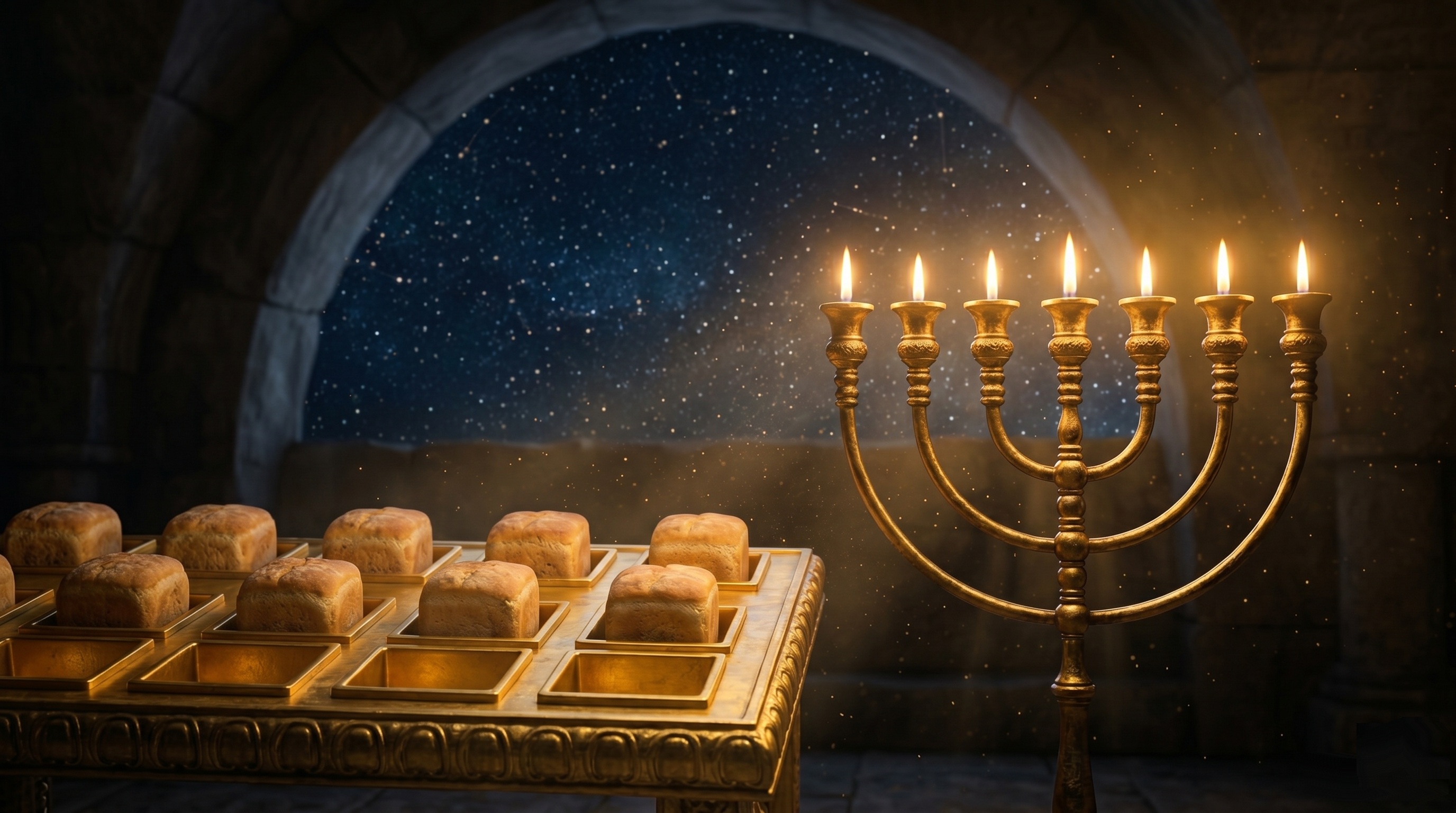
קוד השבע, לחם הפנים ובן המצרי — פרשת אמור
פרשת אמור · תשפD;ו
קוד הַשֶּׁבַע
לֶחֶם הַפָּנִים — הַמְּנוֹרָה — וּבֶן הָאִישׁ הַמִּצְרִי
על פי שיעורו של מ. יהודה חימי

בסוף פרשת אמור התורה חוזרת לכאורה ללא הקשר על שמן זית זך למאור ועל שולחן הפנים — מצוות שכבר נצטוו בפרשת תצוה. ומיד אחר כך — סיפור מוזר על בן אישה ישראלית שמקלל. רש"י מתרץ. האור החיים אומר: "אין בדבריו דבר מספיק". ואז הוא חושף את הקוד הנסתר של פרשת אמור — קוד אחד מסביר את הכל.

א הַחֲזָרָה הַמְּשֻׁנָּה — לָמָּה כָּאן?
למה התורה חוזרת בסוף פרשת אמור על מצוות שמן הזית והמנורה? הרי כל זה כבר נאמר בפרשת תצוה במפורש!
וַיְדַבֵּר ה' אֶל מֹשֶׁה לֵּאמֹר. צַו אֶת בְּנֵי יִשְׂרָאֵל וְיִקְחוּ אֵלֶיךָ שֶׁמֶן זַיִת זָךְ כָּתִית לַמָּאוֹר לְהַעֲלֹת נֵר תָּמִידויקרא כד:א-ב

אנחנו עוצרים. למה לחזור על המצווה הזאת בדיוק כאן, בסוף פרשת אמור, אחרי שדיברנו על המועדים? ומה הקשר בין המנורה ל"פרשת המועדים" שזה עתה סיימנו? ולא רק זה — אחרי המנורה, התורה ממשיכה גם על שולחן הפנים, את שתים עשרה החלות, ושוב — מצווה כפולה שכבר נאמרה בתצוה.

רש"י מנסה לתרץ: "פרשת ואתה תצוה לא נאמרה אלא על סדר מלאכת המשכן, לפרש צורך המנורה" — זה רק הכרזה. כאן בלבד מתבצע הציווי בפועל.
🔷 אבל האור החיים הקדוש מרשה לעצמו להגיב במילים נדירות: "רש"י זצ"ל פירש מה שפירש, ואין בדבריו דבר מספיק". הסבר רש"י לא מספיק. למה בכלל לחלק בין הכרזה לציווי? ולמה דווקא כאן? יש כאן יותר מתשובה טכנית — יש כאן קוד נסתר.
ב תֵּרוּץ הָרַמְבַּ"ן — הַשֶּׁמֶן שֶׁאָזַל?
הרמב"ן מציע: בינתיים, מאז חנוכת המשכן בראש חודש ניסן, השמן אזל — לכן עכשיו צריך לצוות שוב. האם זה משכנע?

הרמב"ן מציע פתרון פרגמטי: בין חנוכת המשכן (ראש חודש ניסן) לבין התקופה של פרשת אמור — נגמרה מנת השמן הראשונה. הציווי כאן הוא ציווי מחודש לאספקה שוטפת.

האור החיים הקדוש דוחה גם את זה: "אין ראיה לדבר". אין שום הוכחה בכתוב שהשמן אזל. הסברה הזאת היא רק השערה, וההשערה הזאת לא מספקת בכתב התורה. חייבת להיות סיבה עמוקה יותר — סיבה שכל מה שכתוב בפרשה מתחבר אליה.
⭐ הרגע הזה — שבו אור החיים בולם את שני הפרשנים הגדולים ביותר ואומר "לא מספיק" — מסמן לנו שמתחת לפני השטח של פרשת אמור מסתתר משהו ענק. ההכרעה שלו תפיל את כל הקלפים.
ג הַתְּשׁוּבָה — קוֹד הַשֶּׁבַע
מה הקדים את החזרה על המנורה והשולחן? תסתכלו אחורה — ותראו את הקוד.

האור החיים מבקש מאיתנו לזכור את ההקשר. רגע לפני המנורה, מה היה? פרשת המועדים. וידבר ה' אל משה לאמר... אלה מועדי ה'... שבת, פסח, ספירת העומר, שבועות, ראש השנה, יום הכיפורים, סוכות.

אז שואל האור החיים: "כיון שציוה מצוות שביעיות" — מה רואים בכל המועדים? השבע חוזר בכולם.
פסח
שבעה ימים של חג. שבעה ימי איסור חמץ.
ספירת העומר
שבעה שבועות שלמים. 49 ימים = 7×7.
סוכות
שבעה ימים. ארבעת המינים — שבעה ימי נטילה.
ראש השנה / יום כיפור
בחודש השביעי. הם בבחינת השבע.
שבת
היום השביעי. נזכר גם הוא בפרשה.
המנורה
שבעה קנים — כנגד שבעת ימי המעשה.
"כלל כל מצוות השביעיות יחד וסדרם, ועיקרם אחד" — אומר האור החיים. אם התורה כבר עוסקת ב"שבעיות" — תכלול בזה גם את המנורה (7 קנים). תכלול גם את השולחן. למה? כי גם השולחן בסוד שבע.
ד הַשֻּׁלְחָן בְּסוֹד הַשֶּׁבַע
איך גם שולחן הפנים נכלל בקוד השבע? הרי יש שתים עשרה חלות, לא שבע!
וְלָקַחְתָּ סֹלֶת וְאָפִיתָ אֹתָהּ שְׁתֵּים עֶשְׂרֵה חַלּוֹת... וְשַׂמְתָּ אוֹתָם שְׁתַּיִם מַעֲרָכוֹת שֵׁשׁ הַמַּעֲרָכֶת עַל הַשֻּׁלְחָן הַטָּהֹרויקרא כד:ה-ו

שתי מערכות של שש חלות. שש ושש. אבל לא רק זה — השולחן עצמו הוא הבסיס שמחזיק את שש המערכות. הוא הקנה השביעי שנושא את כולן.

האור החיים מדייק: "גם השולחן ישנו בסוד שבע, דכתיב 'שֵׁשׁ הַמַּעֲרָכֶת' והשולחן הסדורות עליו — שהוא סוד המתקבץ בו שש מעלות והיא משלמת שבע". שש המערכות + השולחן עצמו = שבע.
⭐ זאת לא מקריות. כל מצוות השביעיות מתאחדות תחת רעיון אחד — הקדוש ברוך הוא ברא את העולם בשבעה ימים, ואחרי השבעה — נח, כביכול שכינתו שורה בעולם. כל "שבעיה" בתורה היא עדות לכך שהבריאה לא נטושה, שהמלך נשאר בארמון.
ה הַמְּנוֹרָה אֵינָהּ לְהָאִיר — הִיא לְהָעִיד
אם הקדוש ברוך הוא יצר את האור — בשביל מה הוא צריך את האור של המנורה? מה היא בעצם מאירה?
מִחוּץ לְפָרֹכֶת הָעֵדֻת בְּאֹהֶל מוֹעֵד יַעֲרֹךְ אֹתוֹ אַהֲרֹןויקרא כד:ג

הגמרא במסכת שבת שואלת בדיוק את השאלה הזאת: "וכי לאורה הוא צריך?" כל ארבעים שנה במדבר עם ישראל לא הלך לאור החמה, אלא לאור עמוד הענן ביום ועמוד האש בלילה. אם הם לא היו צריכים שמש לתאורה — קל וחומר שהשכינה לא צריכה את אור המנורה.

אז למה המנורה? אומרת הגמרא: "עדות היא לבאי עולם שהשכינה שורה בישראל". המנורה היא לא תאורה — היא עדות. סימן שהמלך גר כאן.
🔷 כל יום, אהרן הכהן מדליק את שבעת הנרות. שבעת הנרות הם כנגד שבעת ימי הבריאה. בכל הדלקה — הוא מצהיר מחדש: השכינה שורה כאן. זה לא בית של אדם המתפלל לא־לוהיו רחוק. זה בית שהאל בעצמו גר בו. קוד השבע = קוד הנוכחות.
ו הַמַּעֲבָר — מִן הַשֻּׁלְחָן אֶל בֶּן הַמִּצְרִי
מיד אחרי הציווי על שתים עשרה החלות, התורה קופצת לסיפור על בן אישה ישראלית שיוצא לקלל. ויצא — מאיפה יצא? למה כאן?
וַיֵּצֵא בֶּן אִשָּׁה יִשְׂרְאֵלִית וְהוּא בֶּן אִישׁ מִצְרִי בְּתוֹךְ בְּנֵי יִשְׂרָאֵל וַיִּנָּצוּ בַּמַּחֲנֶה בֶּן הַיִּשְׂרְאֵלִית וְאִישׁ הַיִּשְׂרְאֵלִיויקרא כד:י

המדרש שואל את השאלה במפורש: "ויצא — מאין יצא?" שלושה פירושים, וכולם מתחברים זה לזה:

פירוש א
"יָצָא מֵעוֹלָמוֹ" — סופו שיוצא לעולם הבא בעקבות חטאו. הוא נדון למיתה, וזהו סיומו.
פירוש ב
"יָצָא מִפָּרָשָׁה שֶׁל מַעְלָה" — מהפרשה הקודמת. הוא יצא ולגלג: "דרך המלך לאכול פת חמה בכל יום, או פת צוננת של תשעה ימים?" — הוא לעג ללחם הפנים.
פירוש ג
"יָצָא מִבֵּית דִּינוֹ שֶׁל מֹשֶׁה מְחוּיָּב" — הוא בא לדין על שייכותו לשבט דן, ויצא נדחה. אז התחיל לקלל.
⭐ הרגע הזה הוא דרמטי: התורה הציבה את הסיפור הזה בדיוק במקום הזה בלי הסבר. ככה, פתאום, באמצע הציווי על השולחן והמנורה. החיבור הוא הפיצוץ — סיפור על אדם שלא הבין מהו שולחן הפנים, ולכן הוא לעג עליו.
ז שְׁלוֹמִית בַּת דִּבְרִי — הַסִּפּוּר הַשָּׁלֵם
מי הוא בן האיש המצרי? והאם משה רבנו "סתם" הרג מצרי במצרים?

חזרה אחורה לספר שמות. רש"י מספר את הסיפור המלא: שלומית בת דברי — אישה ישראלית, אשתו של דתן (לפי המדרש). שמה רומז להתנהגותה: "דברי דברי — לכל אדם הייתה אומרת שלום עליך, שלום עליך". פתחה בשלום עם כל אחד — לא בצניעות.

השוטר המצרי — שהיה ממונה על העבודה — שם לב שהאישה הזאת קצת "פתוחה". יום אחד, הוא חיכה שבעלה יצא לעבודה. ברגע שהבעל יצא — האיש המצרי נכנס. שלומית חשבה שזה בעלה חזר. ככה, בלי לראות במדויק, היא לא הבחינה. וזה היה האקט שגרם להריון. בן האישה הישראלית — שעכשיו מקלל בפרשת אמור — הוא בנו של אותו מצרי.
🔷 אחר כך, כדי להשמיד ראיות, אותו מצרי הכה את בעלה של שלומית. משה רבנו ראה "איש מצרי מכה איש עברי" — הוא ראה את ההכאה. "וירא כי אין איש" — ראה ברוח הקודש שלא יצא ממנו שום צאצא טוב לעם ישראל. אז הכה את המצרי וקטע את השושלת. אבל ילד אחד כבר נולד.
⭐ הילד הזה התגייר. הוא יהודי לכל דבר. אבל מבחינת ייחוס שבטי — לפני מתן תורה, הייחוס הלך אחרי האב. אביו מצרי. אז הוא ללא שבט. "שתוקי" — בלי שורש בעם ישראל.
ח אֵין סְתִירָה — דָּ״נָא מִצְרִי
איך שלושת הפירושים מתחברים? איך יציאתו מן העולם, לעגו על השולחן, וחיובו בדין — הם בעצם אותו דבר?

בן האיש המצרי בא לבית דין של משה רבנו לתבוע מקום בשבט דן (שבט אמו). נדחה. "איש על דגלו באותות לבית אבותם" — אבא שלך מצרי, אין לך מקום. הוא יצא מבית הדין מקלל.

למה הוא קילל? כי כאיש שגדל עם דנא מצרי, הוא לא הבין שני דברים יסודיים:

(1) שהקדוש ברוך הוא אינו מלך בשר ודם הזקוק לכבוד. במצרים, כבוד למלך = להגיש לו פת חמה בכל יום. אז שמע על שולחן הפנים — לחם של תשעה ימים מונח לפני ה'! פדיחה! לעג: "דרך המלך לאכול פת חמה בכל יום, או פת צוננת של תשעה ימים?" הוא לא הבין שזה בכלל לא לחם בשבילו.
🔷 (2) מה זה לחם הפנים? "פנים" כפשוטו: הקנה שמסתכל פנים אל פנים. אבל בעומק: "יָאֵר ה' פָּנָיו אֵלֶיךָ" במדבר ו:כה. הקדוש ברוך הוא מאיר פניו על עם ישראל, ודרך השולחן יורד שפע הפרנסה. הקדוש ברוך הוא לא מקבל מאיתנו — הוא נותן לנו. השולחן הוא צינור של ברכה, לא מתנה למלך.
⭐ זו הסתירה הפנימית של בן המצרי: הוא לא מסוגל לקלוט את הקוד הישראלי. אצלו, הקב"ה כמו פרעה — מלך שמקבל. וכשהוא רואה ש"לא מתאים" לפי הסטנדרטים שלו — הוא לועג. בו ברגע, יוצא מבית הדין מחויב, ויוצא בסוף מן העולם. שלושת הפירושים אחד — אדם בלי שורש בעם ישראל לא יכול להישאר בעם ישראל. ככה משה רבנו "ראה כי אין איש" — קרא את העתיד הזה.
📕 הסיפור הזה — אדם שמקלל מלך שהוא מדמיין שצריך כבוד, ומאבד את שורשו — הוא בדיוק סוג המתח שדויד גולדברג חוקר בספרו "The Dream Thief". מה קורה כשמישהו לא רואה את האמת שמולו? הפרק הראשון בחינם.
🗓 תָּכְנִית הַשָּׁבוּעַ — שִׁבְעָה יָמִים, שִׁבְעָה שֶׁבַעִים
יום ראשון · השבע של פסח
חשוב על שבעת ימי פסח. שבעה ימי חירות. שאל: באיזה מקום בחיי אני עדיין עבד? איזה "מצרים" לא יצאתי ממנו?
יום שני · השבע של ספירת העומר
אנחנו בתוך ספירת העומר עכשיו. שבעה שבועות שלמים = 49 ימים של בנייה. שאל: מה אני בונה השבוע? איזו מידה אני מזכך?
יום שלישי · השבע של החודש השביעי
ראש השנה ויום הכיפורים — בחודש השביעי. לא במקרה. שאל: מה היה ה"דין" האחרון שלי? יצאתי זכאי או חייב?
יום רביעי · השבע של סוכות
שבעה ימי סוכה. שבעה ימים בלי גג קבוע. שאל: על מה אני סומך כשאין לי קירות? מה הביטחון שלי באמת?
יום חמישי · השבע של המנורה
המנורה לא להאיר — להעיד. שבעה קנים = שבעה ימי הבריאה. שאל: מה אני מעיד עליו בחיי? כשאנשים רואים אותי — מה הם לומדים על השכינה?
ליל שישי · השבע של השולחן
לפני קידוש: הסתכל על שולחן השבת שלך. שש מערכות + השולחן = 7. הקדוש ברוך הוא לא מקבל ממך פת חמה — הוא נותן לך את הפרנסה דרך השולחן הזה. אמור: "ה', הפנים שלך מאירות עליי."
שבת · השבע של השבת
בקריאת התורה, כשתשמע את הציווי על השמן והלחם — תזכור: זה הקוד. לא מצוות מקריות. כל "שבע" בתורה הוא חתימת הבורא. השבת היא העדות הגדולה ביותר. שמור אותה היום כאילו אתה הראשון שמקבל אותה.
להעמיק עוד
⚖️

הלכה יום יום

כל יום — פסיקה ברורה, MOUTTAR או ASSOUR. הלכה ספרדית לפי ילקוט יוסף / חזון עובדיה.

⚖️ הלכה יום יום
🏠

שלום בית

20 קומות. שאלה אחת לכרטיס. בלי תשובות — רק מראות.

📝

לימוד תורה

רוצה להעמיק בפרשת אמור? בית המדרש שלנו מציע שיעורים מקיפים.

📝 בית המדרש
📕

ספרים

חכמת התורה בפורמט מרתק — הוצאת גאולה.

🔢

גימטריה — יסוד ותפארת

קשרים נסתרים לפי הרב מנשה זצ"ל.

🔢 קורס גימטריה
🌙

פירוש חלומות

חלום מסתורי? בדוק את משמעותו לפי רב אלמולי.

🌙 פירוש חלומות
🎬

סרטונים

צפה בסרטונים על המועדים, חודש אייר וסוד הגאולה.

🎬 סרטונים
✉️

צור קשר

יש לך שאלה על השיעור? נשמח לשמוע ממך.

✉️ צור קשר
💛

השיעור הזה נבנה בזכות תורמים

כל שיעור, כל תרגום, כל עמוד — אהבת תורה ונדיבות לב. אתה הופך לשותף בגאולה.

💛 אני רוצה להיות שותף
בס״ד
קוד הַשֶּׁבַע — לֶחֶם הַפָּנִים וְהַמְּנוֹרָה
ליל שישי · אמור תשפ"ו · על פי שיעורו של מ. יהודה חימי

בסוף פרשת אמור התורה חוזרת על מצוות שמן הזית והמנורה, ועל שולחן הפנים — מצוות שכבר נצטוו בתצוה. רש"י מנסה לתרץ. האור החיים אומר במילים נדירות: "ואין בדבריו דבר מספיק". הרמב"ן מציע שהשמן אזל. גם זאת — "אין ראיה לדבר".

התשובה האמיתית: קוד השבע. הפרשה זה עתה דיברה על המועדים — וכולם בסוד שבע. פסח 7 ימים, סוכות 7 ימים, ספירת העומר 7×7, החודש השביעי, השבת. אז המנורה (7 קנים) והשולחן (6+6+הבסיס=7) נכנסים גם הם. "כלל כל מצוות השביעיות יחד וסדרם, ועיקרם אחד". כולם עדות אחת — השכינה שורה בעולם. שבת שלום.

בס״ד
בֶּן הַמִּצְרִי וְלַעַג הַשֻּׁלְחָן
שבת בוקר · אמור · מ. יהודה חימי

מיד אחרי השולחן — סיפור של בן אישה ישראלית שיצא לקלל. למה כאן? המדרש: "יצא מפרשה של מעלה" — לעג על לחם הפנים. "דרך המלך לאכול פת חמה בכל יום, או פת צוננת של תשעה ימים?" אבל זו טעות יסודית. הקב"ה לא מקבל — הוא נותן. לחם הפנים = שפע פרנסה דרך השולחן.

בן האיש המצרי גדל עם דנא מצרי. אצל פרעה, מלך מקבל. אצל הקב"ה — מלך נותן. הוא לא קלט. יצא מבית הדין מחויב, יצא מן העולם. שלושת הפירושים = אחד. אדם בלי שורש בעם ישראל לא יכול להישאר בעם ישראל. שבת שלום ומבורך.

The Code of Seven, the Bread of the Face and the Egyptian Son — Parashat Emor
Parashat Emor · 5786
The Code of Seven
The Bread of the Face — The Menorah — The Egyptian Son
Based on the shiur of M. Yéhouda Himi

At the end of Parashat Emor, the Torah seemingly returns out of context to commands already given in Tetzaveh: pure olive oil for the Menorah, twelve loaves on the showbread table. Rashi attempts an answer. The Or HaHayim breaks an unwritten rule and replies: “His words are not sufficient.” Then he reveals the hidden code — one code that explains everything, including why an Egyptian-born man steps out the next moment and curses G-d.

1 The Strange Repetition — Why Here?
Why does the Torah repeat the laws of the olive oil and the Menorah at the end of Emor? They are already explicitly commanded in Tetzaveh!
G-d spoke to Moshe saying: command the Children of Israel to take pure pressed olive oil for lighting, to kindle a continual lamp Leviticus 24:1-2

Stop and ask. Why this command, here, at the end of Parashat Emor, right after the chapter on the festivals? And what is the connection between the Menorah and the festival cycle we just finished? It is not an isolated repetition either. Right after the Menorah, the Torah continues with the showbread — the twelve loaves — another double command already given in Tetzaveh.

Rashi proposes: “The parasha of Tetzaveh was only the announcement, in the order of the Mishkan’s construction. Here is the actual command for execution.”
🔷 But the Or HaHayim HaKadosh uses words almost no commentator dares: “Rashi zatsal explained what he explained, but his words are not sufficient.” Why split between announcement and execution? And why exactly here? There is more than a technical answer at stake — there is a hidden code.
2 The Ramban’s Answer — Did the Oil Run Out?
The Ramban suggests: between the dedication of the Mishkan in Nissan and now, the original supply of oil ran out. The new command is for replenishment. Is this convincing?

The Ramban offers a pragmatic solution: between the dedication of the Mishkan (1 Nissan) and the period of Parashat Emor, the original allotment of oil was exhausted. The repetition here is the renewed command for ongoing supply.

The Or HaHayim rejects this too: “There is no proof for this.” Nothing in the verses says the oil ran out. It is mere speculation, and speculation alone cannot explain the placement in Torah. There must be a deeper reason — one that connects everything around it.
⭐ This moment — where the Or HaHayim halts the two greatest classical commentators and says “not enough” — signals that something massive is hidden under the surface of Parashat Emor. His resolution will tip every card on the table.
3 The Answer — The Code of Seven
What preceded the repetition of the Menorah and the showbread? Look back — and you see the code.

The Or HaHayim asks us to remember the context. Just before the Menorah, what was discussed? The festivals. “G-d spoke to Moshe saying: these are the festivals of G-d... Shabbat, Pesach, the counting of the Omer, Shavuot, Rosh Hashanah, Yom Kippur, Sukkot.”

The Or HaHayim asks: “Since the Torah was already commanding the laws of seven” — what do we see in every festival? The number seven returns again and again.
Pesach
Seven days of the festival. Seven days forbidden in chametz.
Counting of the Omer
Seven complete weeks. 49 days = 7 × 7.
Sukkot
Seven days of dwelling. The Four Species — seven days of waving.
Rosh Hashanah / Yom Kippur
In the seventh month. They themselves bear the quality of seven.
Shabbat
The seventh day — also recalled in this parasha.
The Menorah
Seven branches — corresponding to the seven days of creation.
“The general principle of all the laws of seven is one and the same.” If the Torah is already gathering “sevens,” include the Menorah (7 branches). Include the showbread table. Why? Because the table itself is also in the secret of seven.
4 The Showbread Table in the Secret of Seven
How does the showbread table fit into the code of seven? There are twelve loaves, not seven!
You shall take fine flour and bake twelve loaves... and place them in two arrays, six in each array, on the pure table Leviticus 24:5-6

Two arrays of six loaves each. Six and six. But that is not the whole picture — the table itself is the base that holds both arrays. It is the seventh element that carries them all.

The Or HaHayim notes precisely: “The table itself is also in the secret of seven, for it is written ‘six in each array,’ and the table on which they are arranged completes the seven.” Six arrays + the table itself = seven.
⭐ This is no coincidence. All the laws of seven unite under one idea: G-d created the world in seven days, and rested on the seventh — testifying that His Presence dwells in the world. Every “seven” in Torah is testimony that creation is not abandoned, that the King remains in His palace.
5 The Menorah Is Not for Light — It Is for Testimony
If G-d created light itself — what does He need with the light of the Menorah? What is it actually illuminating?
Outside the Curtain of the Testimony in the Tent of Meeting, Aharon shall arrange it Leviticus 24:3

The Talmud in Shabbat asks the exact question: “Does He need its light?” For forty years in the desert, Israel walked not by sunlight but by the pillar of cloud by day and the pillar of fire by night. If they did not need the sun for illumination — how much more so does the Divine Presence not need the Menorah’s light.

So why the Menorah? The Talmud answers: “It is testimony to all who come into the world that the Divine Presence dwells in Israel.” The Menorah is not lighting — it is testimony. A sign that the King resides here.
🔷 Every day, Aharon HaKohen kindles the seven lamps. The seven lamps correspond to the seven days of creation. With every kindling, he renews the declaration: the Divine Presence rests here. This is not the home of a man praying to a distant deity. This is the home where G-d Himself dwells. The Code of Seven = the Code of Presence.
6 The Pivot — From the Table to the Egyptian Son
Immediately after the command of the twelve loaves, the Torah jumps to the story of a man who curses G-d. “He went out” — from where did he go out? Why here?
The son of an Israelite woman went out, and he was the son of an Egyptian man, in the midst of the Children of Israel; and the son of the Israelite woman fought in the camp with an Israelite man Leviticus 24:10

The Midrash asks the question explicitly: “He went out — from where did he go out?” Three answers, and they all interlock:

Answer 1
“He went out of his world” — meaning his end was to leave this world. He was sentenced to death, and that was his exit.
Answer 2
“He went out from the parasha above” — from the previous passage. He stepped out and mocked: “Is it the way of a king to eat warm bread daily, or stale bread of nine days?” — he ridiculed the showbread.
Answer 3
“He went out from Moshe’s court convicted” — he came to court over his claim to the tribe of Dan and was rejected. Then he began to curse.
⭐ The placement is dramatic. The Torah inserts this story without explanation, suddenly, mid-instruction, between the table and the Menorah. The connection is the explosion: this is a story of a man who did not understand what the Bread of the Face was — and so he mocked it.
7 Shlomit bat Divri — The Full Backstory
Who is the “son of the Egyptian man”? And did Moshe really kill an Egyptian back in Egypt for no reason?

Back to the book of Shemot. Rashi gives the full story. Shlomit bat Divri was an Israelite woman, wife of Datan (per the Midrash). Her name hints at her conduct: “Divri divri — to every man she would say ‘Shalom alecha, shalom alecha.’” She greeted everyone openly, lacking the depth of modesty.

The Egyptian taskmaster — charged with overseeing slave labor — noticed her openness. One day, he waited until her husband left for work. The moment the husband stepped out, the Egyptian entered. Shlomit assumed her husband had returned. Without checking carefully, she did not realize. That act caused her pregnancy. The son of the Israelite woman — the one now cursing in Parashat Emor — is the son of that Egyptian.
🔷 Later, to destroy the evidence, that same Egyptian beat Shlomit’s husband. Moshe Rabbenu saw “an Egyptian man striking a Hebrew man” — he saw the beating. “He looked and saw there was no man” — he saw with the holy spirit that no good descendant for Israel would emerge from him. He struck the Egyptian and severed the line. But one child had already been born.
⭐ That child converted. He was a Jew in every halakhic sense. But for tribal lineage — before the giving of the Torah, lineage followed the father. His father was Egyptian. So he had no tribe. Shtuki — without root in the people of Israel.
8 No Contradiction — The Egyptian DNA
How do the three answers connect? How are his exit from the world, his mockery of the table, and his conviction in court — in fact the same thing?

The son of the Egyptian man came to Moshe’s court demanding a place in the tribe of Dan (his mother’s tribe). Rejected. “Each man by his banner, by the houses of their fathers” — your father is an Egyptian; you have no place. He left the court cursing.

Why did he curse? Because as a man raised with Egyptian DNA, he failed to grasp two foundational truths:

(1) That G-d is not a flesh-and-blood king who needs honor. In Egypt, honor for the king = bringing him fresh warm bread daily. So when he heard about the showbread — nine-day-old bread placed before G-d! — he mocked: “Is it the way of a king to eat warm bread daily, or stale bread of nine days?” He failed to understand that it was not bread for G-d at all.
🔷 (2) What is the Bread of the Face? On the surface: the loaves face each other. But in depth: “May G-d shine His Face upon you” Numbers 6:25. G-d shines His face upon Israel, and through this table the flow of sustenance descends. G-d does not receive from us — He gives to us. The table is a channel of blessing, not a gift to a king.
⭐ This is the inner contradiction of the Egyptian son: he could not absorb the Israelite code. To him, G-d was like Pharaoh — a king who receives. When he saw something that did not match his standards, he mocked. In that same moment, he left the court convicted, and ultimately left the world. The three answers are one: a man with no root in Israel cannot remain in Israel. This is what Moshe “saw that there was no man” — he read this future in advance.
📕 This story — a man who curses a King he imagines needs honor, and loses his root — is exactly the kind of tension David Goldberg explores in his novel “The Dream Thief.” What happens when someone cannot see the truth standing in front of them? First chapter free.
📅 Weekly Program — Seven Days, Seven Sevens
Sunday · The Seven of Pesach
Reflect on the seven days of Pesach — seven days of freedom. Ask: in what part of my life am I still a slave? What “Egypt” have I not yet left?
Monday · The Seven of the Omer
We are inside the Omer right now. Seven full weeks = 49 days of inner construction. Ask: what am I building this week? Which trait am I refining?
Tuesday · The Seven of the Seventh Month
Rosh Hashanah and Yom Kippur fall in the seventh month — not by chance. Ask: what was my last “judgment”? Did I leave acquitted or convicted?
Wednesday · The Seven of Sukkot
Seven days in the sukkah. Seven days without permanent walls. Ask: what do I rely on when I have no walls? What is my real source of security?
Thursday · The Seven of the Menorah
The Menorah is not for light — it is for testimony. Seven branches = seven days of creation. Ask: what do I testify to in my life? When people see me — what do they learn about the Divine Presence?
Friday Night · The Seven of the Table
Before Kiddush, look at your Shabbat table. Six arrays + the table = 7. G-d does not receive warm bread from you — He gives you sustenance through this very table. Say: “G-d, Your Face shines upon me.”
Shabbat · The Seven of Shabbat
During the Torah reading, when you hear the command of the oil and the bread — remember: this is the code. Not random commandments. Every “seven” in Torah is the Creator’s signature. Shabbat is the greatest testimony of all. Keep it today as if you were the very first to receive it.
Go Further
⚖️

Halakha Yom Yom

One ruling per day — MOUTTAR or ASSOUR. Clear, practical. Sephardic psak (Yalkout Yossef / Hazon Ovadia).

⚖️ Halakha Yom Yom
🏠

Shalom Bayit

20 levels. One question per card. No answers — only mirrors.

📝

Torah Study

Want to go deeper into Parashat Emor? Our Beith HaMidrash offers comprehensive classes.

📝 Beith HaMidrash
📕

Books

Éditions Gueoula — Torah wisdom in gripping thriller format.

🔢

Gematria — Yesod & Tiferet

Hidden connections according to Rav Ménashé zatsal.

🔢 Gematria Course
🌙

Dream Interpretation

Mysterious dream? Check its meaning according to Rav Almoli.

🌙 Dreams
🎬

Videos

Watch videos on the festivals, the month of Iyar, and the secrets of the Redemption.

🎬 Videos
✉️

Contact

Have a question on the shiur? We’d love to hear from you.

✉️ Contact
💛

This shiur was built thanks to donors

Every shiur, every translation, every page — love of Torah and generosity. You become a partner in the Redemption.

💛 I want to be a partner
B”H
The Code of Seven — Bread of the Face and the Menorah
Friday Night · Emor 5786 · Based on the shiur of M. Yéhouda Himi

At the end of Emor, the Torah repeats the laws of olive oil for the Menorah and of the showbread — commands already given in Tetzaveh. Rashi attempts an answer. The Or HaHayim, in rare words, replies: “His words are not sufficient.” The Ramban suggests the oil ran out — also rejected: “No proof for this.”

The real answer: the Code of Seven. The parasha just covered the festivals — and they are all in the secret of seven. Pesach 7 days, Sukkot 7 days, Omer 7 × 7, the seventh month, Shabbat. So the Menorah (7 branches) and the table (6+6+the base = 7) belong here too. “The general principle of all the laws of seven is one and the same.” All testify to one truth — the Divine Presence dwells in the world. Shabbat shalom.

B”H
The Egyptian Son and the Mockery of the Table
Shabbat morning · Emor · M. Yéhouda Himi

Right after the showbread — a man steps out and curses G-d. Why here? The Midrash: “He went out from the parasha above” — he mocked the showbread. “Is it the way of a king to eat warm bread daily, or stale bread of nine days?” But this is the deepest mistake. G-d does not receive — He gives. The Bread of the Face = sustenance flowing through the table to Israel.

The Egyptian son grew up with Egyptian DNA. To Pharaoh, a king receives. To G-d, the King gives. He could not absorb this. He left the court convicted, and left the world. The three answers are one: a man with no root in Israel cannot remain in Israel. Shabbat shalom umevorach.

Le Code des Sept, le Pain de la Face et le Fils de l'Égyptien — Paracha Emor
Paracha Emor · 5786
Le Code des Sept
Le Pain de la Face — La Menorah — Le Fils de l’Égyptien
D’après le shiour de M. Yéhouda Himi

À la fin de la paracha Emor, la Torah revient sans prévenir sur des mitsvot déjà données dans Tetsavé : l’huile d’olive pour la Menorah, les douze pains du Pain de la Face. Rachi tente une réponse. L’Or HaHaïm brise une règle non écrite et répond : « Ses paroles ne suffisent pas. » Puis il révèle le code caché — un seul code qui explique tout, y compris pourquoi un homme né d’un Égyptien sort dans la scène suivante et blasphème D.ieu.

1 La répétition étrange — pourquoi ici ?
Pourquoi la Torah répète-t-elle les lois de l’huile et de la Menorah à la fin d’Emor ? Tout cela est déjà ordonné explicitement dans Tetsavé !
L’Éternel parla à Moïse en disant : ordonne aux enfants d’Israël de prendre de l’huile d’olive pure et battue pour l’éclairage, afin d’allumer une lampe perpétuelle Lévitique 24:1-2

Arrêtons-nous. Pourquoi cette mitsva, ici, à la fin de la paracha Emor, juste après le chapitre des fêtes ? Et quel rapport entre la Menorah et le cycle des fêtes que nous venons de terminer ? Et ce n’est pas une répétition isolée : immédiatement après la Menorah, la Torah continue avec le Pain de la Face — les douze pains — encore un commandement double déjà donné dans Tetsavé.

Rachi propose une réponse : « La paracha Tetsavé n’était que l’annonce, dans l’ordre de la construction du Michkan. Ici se trouve le commandement réel d’exécution. »
🔷 Mais l’Or HaHaïm HaKadoch emploie des mots qu’aucun commentateur n’ose presque jamais : « Rachi zatsal a expliqué ce qu’il a expliqué, mais ses paroles ne suffisent pas. » Pourquoi diviser entre annonce et exécution ? Et pourquoi exactement ici ? Il y a plus qu’une réponse technique en jeu — il y a un code caché.
2 La réponse du Ramban — l’huile s’est-elle épuisée ?
Le Ramban suggère : entre l’inauguration du Michkan en Nissan et maintenant, le stock d’huile est épuisé. La nouvelle mitsva est un réapprovisionnement. Convaincant ?

Le Ramban offre une solution pragmatique : entre l’inauguration du Michkan (1er Nissan) et la période de la paracha Emor, le stock initial d’huile est épuisé. La répétition est le commandement renouvelé pour l’approvisionnement continu.

L’Or HaHaïm rejette aussi cette explication : « Il n’y a aucune preuve de cela. » Rien dans le texte n’indique que l’huile s’est épuisée. Pure spéculation, et la spéculation seule ne peut justifier un placement dans la Torah. Il doit y avoir une raison plus profonde — qui relie tout ce qui l’entoure.
⭐ Ce moment — où l’Or HaHaïm arrête les deux plus grands commentateurs classiques et dit « pas suffisant » — signale qu’un énorme secret se cache sous la surface de la paracha Emor. Sa résolution va faire tomber toutes les cartes.
3 La réponse — le Code des Sept
Qu’est-ce qui a précédé la répétition de la Menorah et du Pain de la Face ? Regardez en arrière — et vous verrez le code.

L’Or HaHaïm nous demande de nous rappeler le contexte. Juste avant la Menorah, qu’a-t-on traité ? Les fêtes. « L’Éternel parla à Moïse en disant : voici les fêtes de l’Éternel... Chabbat, Pessah, le compte du Omer, Chavouot, Roch Hachana, Yom Kippour, Souccot. »

L’Or HaHaïm demande : « Puisque la Torah commandait déjà les lois des sept » — que voit-on dans toutes les fêtes ? Le chiffre sept revient sans cesse.
Pessah
Sept jours de fête. Sept jours d’interdit du hamets.
Le compte du Omer
Sept semaines complètes. 49 jours = 7 × 7.
Souccot
Sept jours dans la souccah. Les Quatre Espèces — sept jours de prise.
Roch Hachana / Yom Kippour
Dans le septième mois. Eux-mêmes portent la qualité du sept.
Chabbat
Le septième jour — rappelé lui aussi dans cette paracha.
La Menorah
Sept branches — correspondant aux sept jours de la création.
« Le principe général de toutes les lois des sept est un seul et même » — dit l’Or HaHaïm. Si la Torah rassemble déjà des « sept », incluez la Menorah (7 branches). Incluez la table du Pain. Pourquoi ? Parce que la table elle-même est aussi dans le secret du sept.
4 La table du Pain de la Face dans le secret du sept
Comment la table du Pain s’insère-t-elle dans le code des sept ? Il y a douze pains, pas sept !
Tu prendras de la fleur de farine et tu en feras cuire douze pains... et tu les disposeras en deux rangées, six par rangée, sur la table pure Lévitique 24:5-6

Deux rangées de six pains chacune. Six et six. Mais ce n’est pas tout — la table elle-même est la base qui porte les deux rangées. Elle est le septième élément qui les porte tous.

L’Or HaHaïm note avec précision : « La table elle-même est aussi dans le secret du sept, car il est écrit ‘six par rangée’, et la table sur laquelle elles sont disposées complète le sept. » Six rangées + la table = sept.
⭐ Aucune coïncidence. Toutes les lois des sept s’unissent sous une seule idée : le Saint béni soit-Il a créé le monde en sept jours, et s’est reposé le septième — témoignant que Sa Présence demeure dans le monde. Chaque « sept » dans la Torah est un témoignage que la création n’est pas abandonnée, que le Roi reste dans Son palais.
5 La Menorah n’est pas pour la lumière — elle est pour le témoignage
Si D.ieu a créé la lumière elle-même — qu’a-t-Il besoin de la lumière de la Menorah ? Qu’est-ce qu’elle éclaire vraiment ?
À l’extérieur du Voile du Témoignage, dans la Tente d’Assignation, Aharon la disposera Lévitique 24:3

Le Talmud dans Chabbat pose exactement la question : « A-t-Il besoin de sa lumière ? » Pendant quarante ans dans le désert, Israël n’a pas marché à la lumière du soleil, mais à celle de la colonne de nuée le jour et de la colonne de feu la nuit. S’ils n’avaient pas besoin du soleil pour s’éclairer — combien plus la Présence Divine n’a-t-Elle pas besoin de la lumière de la Menorah.

Alors pourquoi la Menorah ? Le Talmud répond : « Elle est un témoignage pour tous ceux qui viennent au monde, que la Présence Divine demeure en Israël. » La Menorah n’est pas un éclairage — elle est un témoignage. Un signe que le Roi réside ici.
🔷 Chaque jour, Aharon HaCohen allume les sept lampes. Les sept lampes correspondent aux sept jours de la création. À chaque allumage, il renouvelle la déclaration : la Présence Divine repose ici. Ce n’est pas la maison d’un homme priant une divinité lointaine. C’est la maison où D.ieu Lui-même réside. Le Code des Sept = le Code de la Présence.
6 La bascule — de la table au fils de l’Égyptien
Immédiatement après l’ordre des douze pains, la Torah saute à l’histoire d’un homme qui blasphème. « Il sortit » — sortit d’où ? Pourquoi ici ?
Le fils d’une femme israélite sortit, et il était fils d’un homme égyptien, au milieu des enfants d’Israël ; et le fils de l’Israélite se querella dans le camp avec un homme israélite Lévitique 24:10

Le Midrach pose la question explicitement : « Il sortit — d’où sortit-il ? » Trois réponses, et toutes s’emboitent :

Réponse 1
« Il sortit de son monde » — sa fin était de quitter ce monde. Condamné à mort, c’est là sa sortie.
Réponse 2
« Il sortit de la paracha précédente » — il sortit en se moquant : « Est-ce la façon d’un roi de manger du pain chaud chaque jour, ou du pain froid de neuf jours ? » — il a tourné en dérision le Pain de la Face.
Réponse 3
« Il sortit du tribunal de Moïse condamné » — il vint en justice pour sa prétention à la tribu de Dan, et fut rejeté. Alors il commença à blasphémer.
⭐ Le placement est dramatique. La Torah insère cette histoire sans explication, soudain, en plein milieu des instructions, entre la table et la Menorah. Le lien est l’explosion : c’est l’histoire d’un homme qui n’a pas compris ce qu’était le Pain de la Face — et qui s’en est moqué.
7 Chlomit bat Divri — l’histoire complète
Qui est le « fils de l’homme égyptien » ? Et Moïse a-t-il vraiment tué un Égyptien autrefois sans raison ?

Retour au livre de Chemot. Rachi raconte l’histoire complète. Chlomit bat Divri était une femme israélite, épouse de Datan (selon le Midrach). Son nom indique sa conduite : « Divri divri — à chaque homme elle disait Chalom alecha, chalom alecha. » Elle saluait tout le monde ouvertement, sans la profondeur de la tsni’out.

Le contremaître égyptien — chargé de surveiller le travail des esclaves — avait remarqué cette ouverture. Un jour, il attendit que son mari sorte travailler. Dès que le mari fut parti, l’Égyptien entra. Chlomit pensa que c’était son mari qui revenait. Sans vérifier soigneusement, elle ne s’aperçut pas. Cet acte provoqua sa grossesse. Le fils de la femme israélite — celui qui blasphème maintenant dans la paracha Emor — est le fils de cet Égyptien.
🔷 Plus tard, pour détruire les preuves, le même Égyptien battit le mari de Chlomit. Moïse Rabbenou vit « un homme égyptien frappant un homme hébreu » — il vit la scène. « Il regarda et vit qu’il n’y avait personne » — il vit avec l’esprit saint qu’aucun bon descendant pour Israël ne sortirait de cet homme. Il frappa l’Égyptien et coupa la lignée. Mais un enfant était déjà né.
⭐ Cet enfant se convertit. Il est juif à tous les égards halakhiques. Mais pour la lignée tribale — avant le don de la Torah, la lignée suivait le père. Son père est égyptien. Il n’a donc pas de tribu. Chtouki — sans racine dans le peuple d’Israël.
8 Aucune contradiction — l’ADN égyptien
Comment les trois réponses se rejoignent-elles ? Comment sa sortie de ce monde, sa moquerie de la table, et sa condamnation au tribunal sont-elles en réalité la même chose ?

Le fils de l’Égyptien vint au tribunal de Moïse exiger une place dans la tribu de Dan (la tribu de sa mère). Refusé. « Chacun selon sa bannière, selon les maisons de leurs pères » — ton père est égyptien ; tu n’as pas de place. Il sortit du tribunal en blasphémant.

Pourquoi a-t-il blasphémé ? Parce qu’en homme élevé avec un ADN égyptien, il n’a pas saisi deux vérités fondamentales :

(1) Que D.ieu n’est pas un roi de chair et de sang ayant besoin d’honneur. En Égypte, honorer le roi = lui apporter du pain chaud chaque jour. Quand il entendit le Pain de la Face — du pain de neuf jours déposé devant l’Éternel ! — il s’est moqué : « Est-ce la façon d’un roi ? » Il n’a pas compris que ce n’était pas du tout du pain pour D.ieu.
🔷 (2) Qu’est-ce que le Pain de la Face ? En surface : les pains se font face. Mais en profondeur : « Que l’Éternel fasse luire Sa face vers toi » Nombres 6:25. D.ieu fait luire Sa face vers Israël, et à travers cette table descend l’abondance de la parnassa. D.ieu ne reçoit pas de nous — Il nous donne. La table est un canal de bénédiction, pas un cadeau à un roi.
⭐ Voilà la contradiction interne du fils de l’Égyptien : il ne pouvait pas absorber le code israélite. Pour lui, D.ieu était comme Pharaon — un roi qui reçoit. Quand il vit quelque chose qui ne correspondait pas à ses standards, il s’est moqué. Au même moment, il sortit du tribunal condamné, et finalement quitta ce monde. Les trois réponses sont une : un homme sans racine en Israël ne peut rester en Israël. C’est ce que Moïse « vit qu’il n’y avait personne » — il a lu cet avenir à l’avance.
📕 Cette histoire — un homme qui maudit un Roi qu’il imagine avoir besoin d’honneur, et qui perd sa racine — est exactement le type de tension que David Goldberg explore dans son roman « The Dream Thief ». Que se passe-t-il quand quelqu’un ne voit pas la vérité qui se tient devant lui ? Premier chapitre gratuit.
📅 Programme hebdomadaire — sept jours, sept « sept »
Dimanche · Le sept de Pessah
Médite sur les sept jours de Pessah — sept jours de liberté. Demande-toi : dans quelle partie de ma vie suis-je encore esclave ? Quelle « Égypte » n’ai-je pas encore quittée ?
Lundi · Le sept du Omer
Nous sommes en plein Omer. Sept semaines complètes = 49 jours de construction intérieure. Demande-toi : que suis-je en train de construire cette semaine ? Quelle midda suis-je en train de raffiner ?
Mardi · Le sept du septième mois
Roch Hachana et Yom Kippour tombent au septième mois — ce n’est pas un hasard. Demande-toi : quel a été mon dernier « jugement » ? Suis-je sorti acquitté ou condamné ?
Mercredi · Le sept de Souccot
Sept jours dans la souccah. Sept jours sans murs permanents. Demande-toi : sur quoi je m’appuie quand je n’ai pas de murs ? Quelle est ma vraie source de sécurité ?
Jeudi · Le sept de la Menorah
La Menorah n’est pas pour la lumière — elle est pour le témoignage. Sept branches = sept jours de la création. Demande-toi : de quoi est-ce que je témoigne dans ma vie ? Quand les gens me regardent — qu’apprennent-ils sur la Présence Divine ?
Vendredi soir · Le sept de la table
Avant le Kiddouch, regarde ta table de Chabbat. Six rangées + la table = 7. D.ieu ne reçoit pas de pain chaud de toi — Il te donne la parnassa à travers cette table. Dis : « Éternel, Ta face brille sur moi. »
Chabbat · Le sept du Chabbat
À la lecture de la Torah, quand tu entends l’ordre de l’huile et du pain — rappelle-toi : c’est le code. Pas des mitsvot aléatoires. Chaque « sept » dans la Torah est la signature du Créateur. Le Chabbat est le témoignage le plus grand. Garde-le aujourd’hui comme si tu étais le tout premier à le recevoir.
Aller plus loin
⚖️

Halakha Yom Yom

Une halakha par jour — MOUTTAR ou ASSOUR. Clair, pratique. Psak sépharade (Yalkout Yossef / Hazon Ovadia).

⚖️ Halakha Yom Yom
🏠

Chalom Bayit

20 niveaux. Une question par carte. Pas de réponses — seulement des miroirs.

📝

Etude de Torah

Tu veux approfondir Emor ? Notre Beith HaMidrach propose des cours complets.

📝 Beith HaMidrach
📕

Livres

Les Éditions Guéoula — la sagesse de la Torah dans un format captivant.

🔢

Guimatria — Yessod & Tiferet

Connexions cachées selon Rav Ménashé zatsal.

🔢 Cours de Guimatria
🌙

Interprétation des rêves

Rêve mystérieux ? Vérifie sa signification selon Rav Almoli.

🌙 Rêves
🎬

Vidéos

Regarde des vidéos sur les fêtes, le mois d’Iyar et les secrets de la Délivrance.

🎬 Vidéos
✉️

Contact

Une question sur le shiour ? Nous serions ravis de t’entendre.

✉️ Contact
💛

Ce shiour a été construit grâce aux donateurs

Chaque shiour, chaque traduction, chaque page — amour de la Torah et générosité. Tu deviens un partenaire de la Délivrance.

💛 Je veux être partenaire
B”H
Le Code des Sept — Pain de la Face et Menorah
Vendredi soir · Emor 5786 · D’après le shiour de M. Yéhouda Himi

À la fin d’Emor, la Torah répète les lois de l’huile pour la Menorah et du Pain de la Face — mitsvot déjà données dans Tetsavé. Rachi tente une réponse. L’Or HaHaïm, en mots rares, répond : « Ses paroles ne suffisent pas. » Le Ramban suggère que l’huile s’est épuisée — également rejeté : « Aucune preuve. »

La vraie réponse : le Code des Sept. La paracha vient de couvrir les fêtes — toutes dans le secret du sept. Pessah 7 jours, Souccot 7 jours, Omer 7 × 7, le septième mois, Chabbat. Donc la Menorah (7 branches) et la table (6+6+la base = 7) y appartiennent aussi. « Le principe général de toutes les lois des sept est un seul. » Toutes témoignent d’une seule vérité — la Présence Divine demeure dans le monde. Chabbat chalom.

B”H
Le fils de l’Égyptien et la moquerie de la table
Chabbat matin · Emor · M. Yéhouda Himi

Juste après le Pain de la Face — un homme sort et blasphème. Pourquoi ici ? Le Midrach : « Il sortit de la paracha précédente » — il s’est moqué du Pain. « Est-ce la façon d’un roi de manger du pain chaud, ou du pain froid de neuf jours ? » Mais c’est l’erreur la plus profonde. D.ieu ne reçoit pas — Il donne. Le Pain de la Face = parnassa qui descend par la table vers Israël.

Le fils de l’Égyptien a grandi avec un ADN égyptien. Pour Pharaon, un roi reçoit. Pour D.ieu, le Roi donne. Il n’a pas pu absorber cela. Il sortit du tribunal condamné, et finalement quitta ce monde. Les trois réponses sont une : un homme sans racine en Israël ne peut rester en Israël. Chabbat chalom oumévorach.