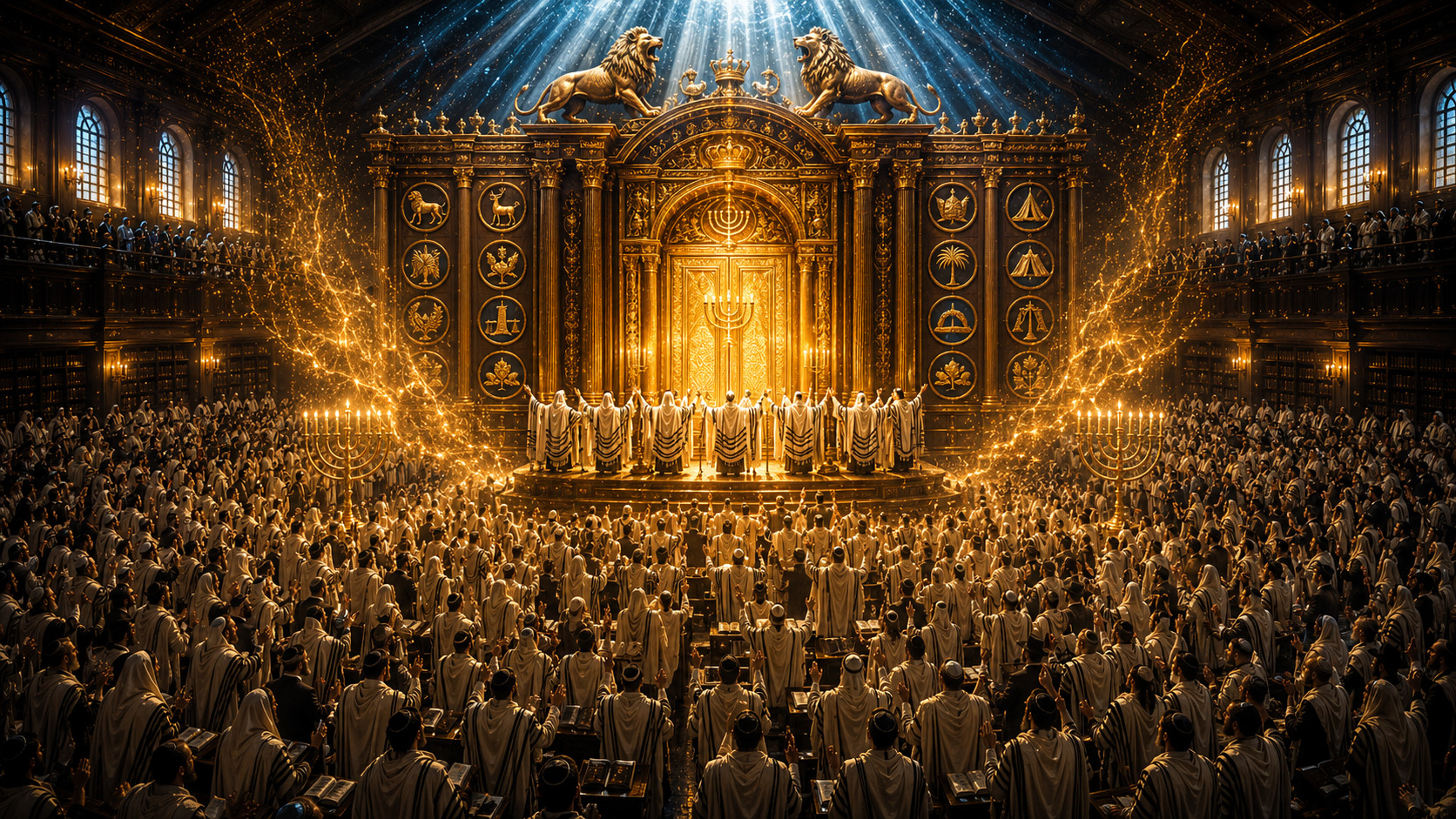
הָאַרְכִיטֶקְטוּרָה הַנִּסְתֶּרֶת שֶׁל הַתְּפִלָּה
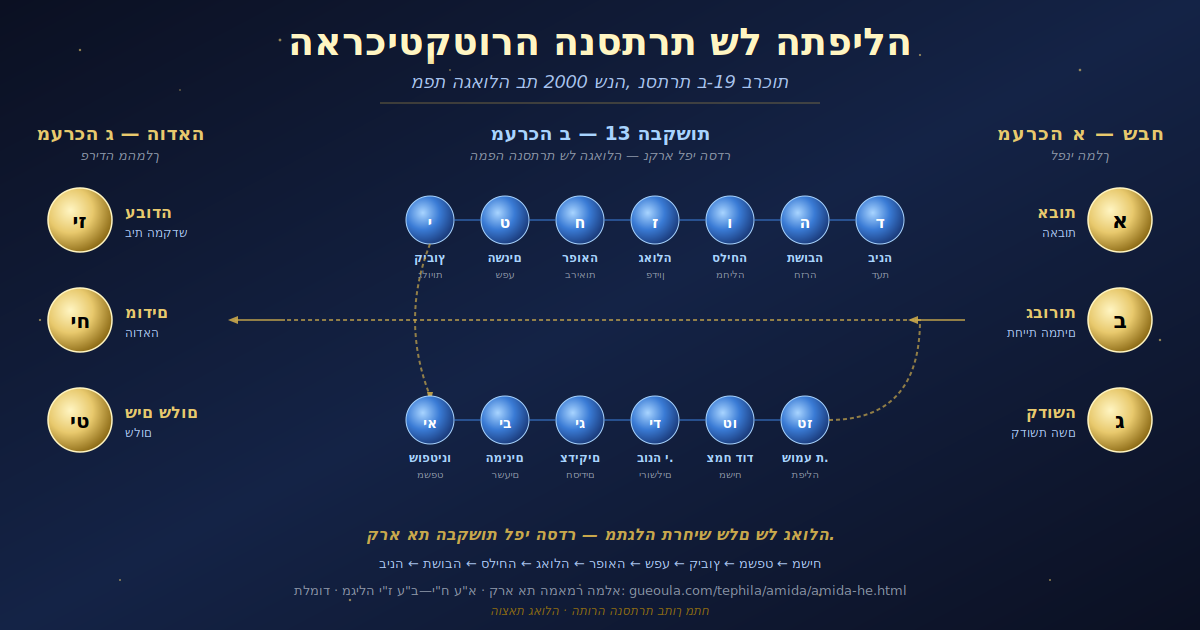
שלוש פעמים ביום, במשך אלפיים שנה, כל יהודי קורא תפילה של תשע עשרה ברכות. רובם חושבים שזו רשימת בקשות. זה לא. התלמוד חושף — בשקט, כמעט בדרך אגב — שהעמידה היא אחת מיצירות ההנדסה הרוחנית המתוחכמות ביותר שנוצרו אי פעם: מפה שלמה ומוצפנת של גאולת העולם.
העמידה אינה רשימת בקשות. היא מפה מוצפנת בת אלפיים שנה של גאולת העולם — כל ברכה לקוחה מפסוק, כל פסוק מוביל לבא אחריו.
שלוש מערכות: שבח (ג׳) → בקשות (י״ג) → הודאה (ג׳). כמו עבד הניגש לכיסא המלך.
שלוש עשרה האמצעיות הן תרחיש כרונולוגי של הגאולה: הבן → חזור → תיסלח → תיגאל → תירפא → קבל שפע → שוב הביתה → השב משפט → שפוט רשעים → רומם צדיקים → בנה ירושלים → קבל את המשיח → היוודע נשמע.
ו"שמונה עשרה" — יש בה תשע עשרה. הברכה ה-19 (המינים) נוספה על ידי שמואל הקטן. מסתיימת בשלום — כי אין כלי מחזיק ברכה אלא השלום.
פתח כל סידור. ספור את ברכות העמידה של ימי החול. תמצא תשע עשרה — ובכל זאת המסורת קוראת לה "שמונה עשרה". תעלומה ראשונה: למה שם שכבר לא מתאים למספר?
עכשיו הסתכל על הסדר: שבח. חכמה. תשובה. סליחה. גאולה. רפואה. ברכת השנים. קיבוץ גלויות. משפט. משפט הרשעים. הצדיקים. ירושלים. משיח. "שמע תפילה". עבודה. הודאה. שלום.
זה נראה כמו רשימה אקראית. זהו למעשה הטקסט המהונדס בקפידה הגדולה ביותר בכל הליטורגיה היהודית.
התלמוד (ברכות ל״ד ע״א) משווה את העמידה לעבד הניגש לכיסא. אינך פורץ פנימה צועק דרישות. אינך מתחיל בבקשה. אתה נכנס בכבוד, מנסח את בקשותיך בזהירות, ויוצא בהכרת תודה.
שלוש הברכות הראשונות — אבות, גבורות, קדושת השם — חולקות תכונה נדירה: הן אינן מבקשות דבר. הן הכרה טהורה.
אבות: "אלוקי אברהם אלוקי יצחק ואלוקי יעקב". התלמוד מצביע על תהילים כ״ט: "הבו לה' בני אלים" — האבות הם "בני האלים" שלימדו את האנושות להכיר בבורא.
גבורות — "אתה גיבור לעולם" — מציינת את הכוח העמוק מכולם: תחיית המתים. אותו כוח המביא גשם הוא הכוח המחיה מתים.
קח תשע עשרה. הורד את שלוש הראשונות (שבח) ואת שלוש האחרונות (הודאה) — הקבועות, אלה שאינן משתנות לעולם. מה נשאר?
העמידה אינה רק תפילה — היא מפה קוגניטיבית לכל שינוי גדול. קרא שוב את הסדר, אבל החל אותו על חייך שלך:
התלמוד (ברכות כ״ח ע״ב): אחרי חורבן הבית השני, ביבנה, שאל רבן גמליאל: "כלום יש אדם שיודע לתקן ברכת המינים?" האיום היה חריף — צדוקים, מלשינים — קרעו את הקהילה מבפנים.
חכם צעיר ובלתי ידוע כמעט קם. שמואל הקטן. הוא חיבר את הברכה. הרצף נשאר שלם, אבל עכשיו היו תשע עשרה.
לכן התפילה עדיין נקראת "שמונה עשרה". הארכיטקטורה המקורית הייתה קדושה. ה-19 הייתה הוספה כירורגית של חירום, לא עיצוב מחדש.
שלוש עשרה מידות הרחמים יורדות מלמעלה. שלוש עשרה הבקשות עולות מלמטה. חבר אותן:
רגע לפני קריאת שמע, הברכה חותמת: "הַבּוֹחֵר בְּעַמּוֹ יִשְׂרָאֵל בְּאַהֲבָה" — הוא בוחר בנו באהבה (אַהֲבָה = 13). מיד אחר כך: "שְׁמַע… ה' אֶחָד" — האחדות (אֶחָד = 13). ומיד: "וְאָהַבְתָּ" — ואהבת אתה בחזרה (13).
🎯 בְּדֹק אֶת עַצְמְךָ
חמש שאלות. לחץ על התשובה.
תּוֹצָאָה
שָׁלוֹם בַּיִת
"שים שלום" — השלום מתחיל בבית. גלה כרטיס שלום בית.
סְפָרִים
חכמת התורה בפורמט תריילר — הוצאת גאולה.
אֲנִי מַאֲשִׁים אֶת הָאֻמּוֹת
כמו המאמר הזה — תורה עמוקה נסתרת בתוך מתח. אמת קבורה, וכוחות המבקשים להשתיקה. איש אחד מול האומות.
📕 לקריאת הספר · ₪36.90
The Hidden Architecture of Jewish Prayer
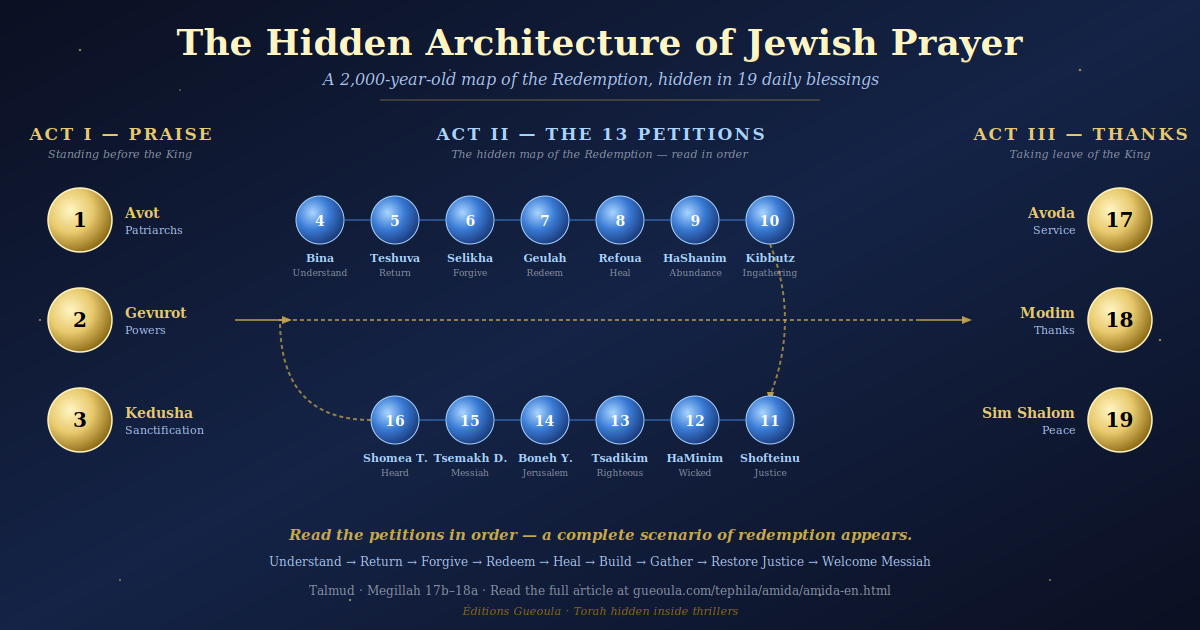
Three times a day, for two thousand years, every Jew has recited a prayer of nineteen blessings. Most assume it is a list of requests. It is not. The Talmud reveals — quietly, almost casually — that the Amida is one of the most sophisticated pieces of spiritual engineering ever produced: a complete, encrypted map of the Redemption of the world.
The Amida is not a list of requests. It is a 2,000-year-old encrypted map of the world's Redemption — every blessing drawn from a verse, every verse leading to the next.
Three acts: Praise (3) → Petitions (13) → Thanksgiving (3). Like a servant approaching the King's throne.
The thirteen middle blessings are a chronological blueprint of redemption: Understand → Return → Be forgiven → Be redeemed → Be healed → Receive abundance → Come home → Restore justice → Judge the wicked → Lift the righteous → Rebuild Jerusalem → Welcome the Messiah → Be heard.
And "The Eighteen" has nineteen — the 19th (against the heretics) was added by Shmuel HaKatan. It ends with peace — because no vessel holds blessing like peace.
Open any prayer book. Count the blessings of the weekday Amida. You will find nineteen — even though tradition calls it the "Shemoneh Esrei," meaning "The Eighteen." Already a mystery: why a name that no longer matches the count?
Now look at the order. Praise. Then a wisdom request. Then repentance. Then forgiveness. Then redemption. Then healing. Then prosperity. Then ingathering. Then justice. Then judgment. Then the righteous. Then Jerusalem. Then the Messiah. Then "hear my prayer." Then Temple service. Then thanksgiving. Then peace.
It looks like a random list. It is the most carefully engineered text in Jewish liturgy.
The Talmud (Berakhot 34a) compares the Amida to a servant approaching the throne. You do not burst in shouting demands. You do not start by asking for things. You enter with respect, you state your requests carefully, and you take leave with gratitude.
The first three blessings — Avot (Patriarchs), Gevurot (Powers), Kedushat HaShem (Sanctification) — share something rare in liturgy: they ask for nothing. They are pure recognition.
Avot opens with "God of Abraham, God of Isaac, God of Jacob." Why these three names? The Talmud points to Psalm 29: "Ascribe to God, sons of the mighty" — the Patriarchs first taught humanity to recognize the Creator.
Gevurot — the blessing of God's power — celebrates the deepest of all powers: resurrection of the dead. The same power that brings rain is the power that revives the dead. Both reverse the natural order.
Take nineteen. Remove the first three (praise) and the last three (thanksgiving) — the fixed ones, the ones that never change all year, not even on Shabbat. What remains?
A skeptic might ask: "Beautiful structure. But what does an ancient prayer architecture have to do with my life?"
Everything. The Amida is a cognitive map for any large change. Read the order again, but apply it to your own life:
The Talmud (Berakhot 28b) tells the story. After the destruction of the Second Temple, in Yavneh, Rabban Gamliel asked the assembled sages: "Is there anyone who knows how to compose a blessing against the heretics?" The threat was acute — Sadducees, informers were tearing the community apart from within.
A young, almost unknown sage stood up. Shmuel HaKatan — "Samuel the Small." He composed the blessing. The sequence remained intact, but now there were nineteen.
That's why the prayer is still called "Shemoneh Esrei" — even though we count nineteen. The original architecture was sacred. The 19th was an emergency surgical insertion, not a redesign.
Thirteen Attributes of Mercy descend from above. Thirteen petitions rise from below. Add them together:
Moments before the Shema, the blessing seals it: "HaBocher be'amo Yisrael be'ahava" הַבּוֹחֵר בְּעַמּוֹ יִשְׂרָאֵל בְּאַהֲבָה — He chooses us in love (Ahava = 13). Immediately after: "Shema… Hashem Echad" — the Oneness (Echad = 13). And at once: "Ve'ahavta" וְאָהַבְתָּ — and you shall love Him back (13).
🎯 Test Yourself
Five questions. Tap an answer.
Result
Shalom Bayit
"Grant peace" begins at home. Draw a Shalom Bayit card.
All the Parashot
Every shiur by M. Yéhouda Himi — Bereshit to Devarim and the festivals.
📚 All ParashotBooks
Torah wisdom in thriller form — Éditions Gueoula.

The Dream Thief
Like this article, our novels hide deep Torah inside a thriller. David Weiss has not dreamed in seven years — until someone learns to enter dreams and steal the World to Come.
📕 Read the book · $9.90
L'Architecture Cachée de la Téfila
Trois fois par jour, depuis deux mille ans, chaque Juif récite une prière de dix-neuf berakhot. La plupart pensent qu'il s'agit d'une liste de demandes. Ce n'en est pas une. Le Talmud révèle — discrètement, presque incidemment — que la Amida est l'une des œuvres d'ingénierie spirituelle les plus sophistiquées jamais produites : une carte complète, codée, de la Rédemption du monde.
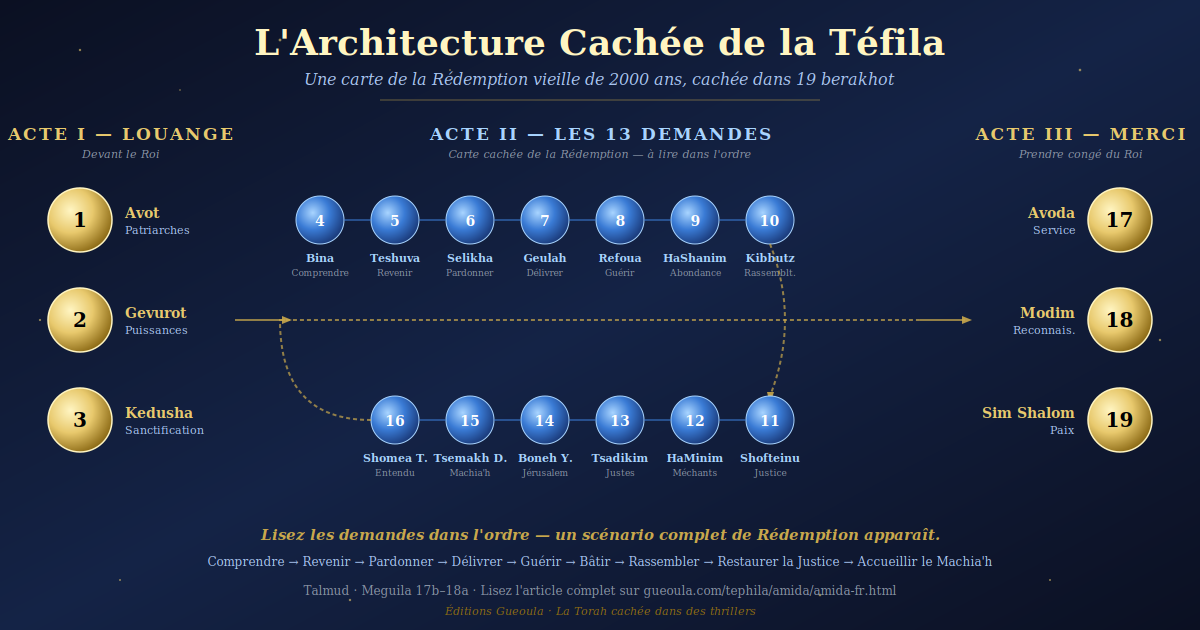
La Amida n'est pas une liste de demandes. C'est une carte codée, vieille de 2000 ans, de la Rédemption du monde — chaque berakha tirée d'un verset, chaque verset menant au suivant.
Trois actes : Louange (3) → Demandes (13) → Reconnaissance (3). Comme un serviteur s'approchant du trône du Roi.
Les treize du milieu forment un plan chronologique de la Rédemption : Comprendre → Revenir → Être pardonné → Être délivré → Être guéri → Recevoir l'abondance → Rentrer → Restaurer la justice → Juger les méchants → Élever les justes → Reconstruire Jérusalem → Accueillir le Machia'h → Être entendu.
Et "Dix-Huit" en a dix-neuf — la 19ème (contre les hérétiques) fut ajoutée par Chmouel HaKatan. Elle finit par la paix — car aucun récipient ne contient la bénédiction comme la paix.
Ouvrez n'importe quel siddour. Comptez les berakhot de la Amida des jours de semaine. Vous en trouverez dix-neuf — alors que la tradition l'appelle "Choumonè Essré", "Les Dix-Huit". Premier mystère : pourquoi un nom qui ne correspond plus au compte ?
Examinez ensuite l'ordre. Louange. Sagesse. Repentir. Pardon. Rédemption. Guérison. Prospérité. Rassemblement. Justice. Jugement. Les justes. Jérusalem. Machia'h. "Écoute ma prière". Service. Reconnaissance. Paix.
Cela ressemble à une liste aléatoire. C'est en réalité le texte le plus minutieusement architecturé de toute la liturgie juive.
Le Talmud (Berakhot 34a) compare la Amida à un serviteur s'approchant du trône. On n'entre pas en hurlant des demandes. On ne commence pas par réclamer. On entre avec respect, on formule ses requêtes avec soin, et on prend congé en remerciant.
Les trois premières berakhot — Avot (les Patriarches), Guevourot (les Puissances), Kedouchat HaShem (la Sanctification) — partagent une caractéristique rare : elles ne demandent rien. Elles sont pure reconnaissance.
Avot s'ouvre par "D-ieu d'Abraham, D-ieu d'Isaac, D-ieu de Jacob". Le Talmud renvoie au Psaume 29 : "Attribuez à D-ieu, fils des puissants" — les Patriarches ont les premiers enseigné à l'humanité à reconnaître le Créateur.
Guevourot — la puissance divine — célèbre la plus profonde des puissances : la résurrection des morts. La même puissance qui apporte la pluie ressuscite les morts. Toutes deux inversent l'ordre naturel.
Prenez dix-neuf. Retirez les trois premières (louange) et les trois dernières (reconnaissance) — les fixes, celles qui ne changent jamais de toute l'année, pas même à Chabbat. Que reste-t-il ?
Un sceptique pourrait dire : "Belle architecture. Mais qu'est-ce qu'une vieille structure de prière a à voir avec ma vie ?"
Tout. La Amida est une carte cognitive pour tout grand changement. Relisez l'ordre, mais appliquez-le à votre propre vie :
Le Talmud (Berakhot 28b) raconte l'histoire. Après la destruction du Second Temple, à Yavné, Rabban Gamliel demanda aux sages : "Y a-t-il quelqu'un qui sait composer une berakha contre les hérétiques ?" La menace était aiguë — Sadducéens, délateurs déchiraient la communauté de l'intérieur.
Un jeune sage presque inconnu se leva. Chmouel HaKatan — "Samuel le Petit". Il composa la berakha. La séquence resta intacte, mais il y en avait maintenant dix-neuf.
C'est pourquoi la prière s'appelle toujours "Choumonè Essré" — bien que nous en comptions dix-neuf. L'architecture originelle était sacrée. La 19ème fut une insertion chirurgicale d'urgence, pas une refonte.
Treize Attributs de Miséricorde descendent d'en haut. Treize demandes montent d'en bas. Additionnez-les :
Juste avant le Chéma, la brakha le scelle : "HaBohér be'amo Yisraël be'ahava" הַבּוֹחֵר בְּעַמּוֹ יִשְׂרָאֵל בְּאַהֲבָה — Il nous choisit par amour (Ahava = 13). Immédiatement après : "Chéma… Hachem Éhad" — l'Unité (Éhad = 13). Et aussitôt : "Ve'ahavta" וְאָהַבְתָּ — et tu aimeras en retour (13).
🎯 Teste-toi
Cinq questions. Clique sur une réponse.
Résultat
Chalom Bayit
"Donne la paix" commence à la maison. Tire une carte Chalom Bayit.
Guématria — Rav Menaché
Les secrets des lettres et des nombres, selon Rav Menaché zatsal.
🔢 Cours de GuématriaToutes les Parachiot
Tous les cours de M. Yéhouda Himi — de Béréchit à Dévarim et les fêtes.
📚 Toutes les ParachiotLivres
La sagesse de la Torah en format thriller — Éditions Gueoula.
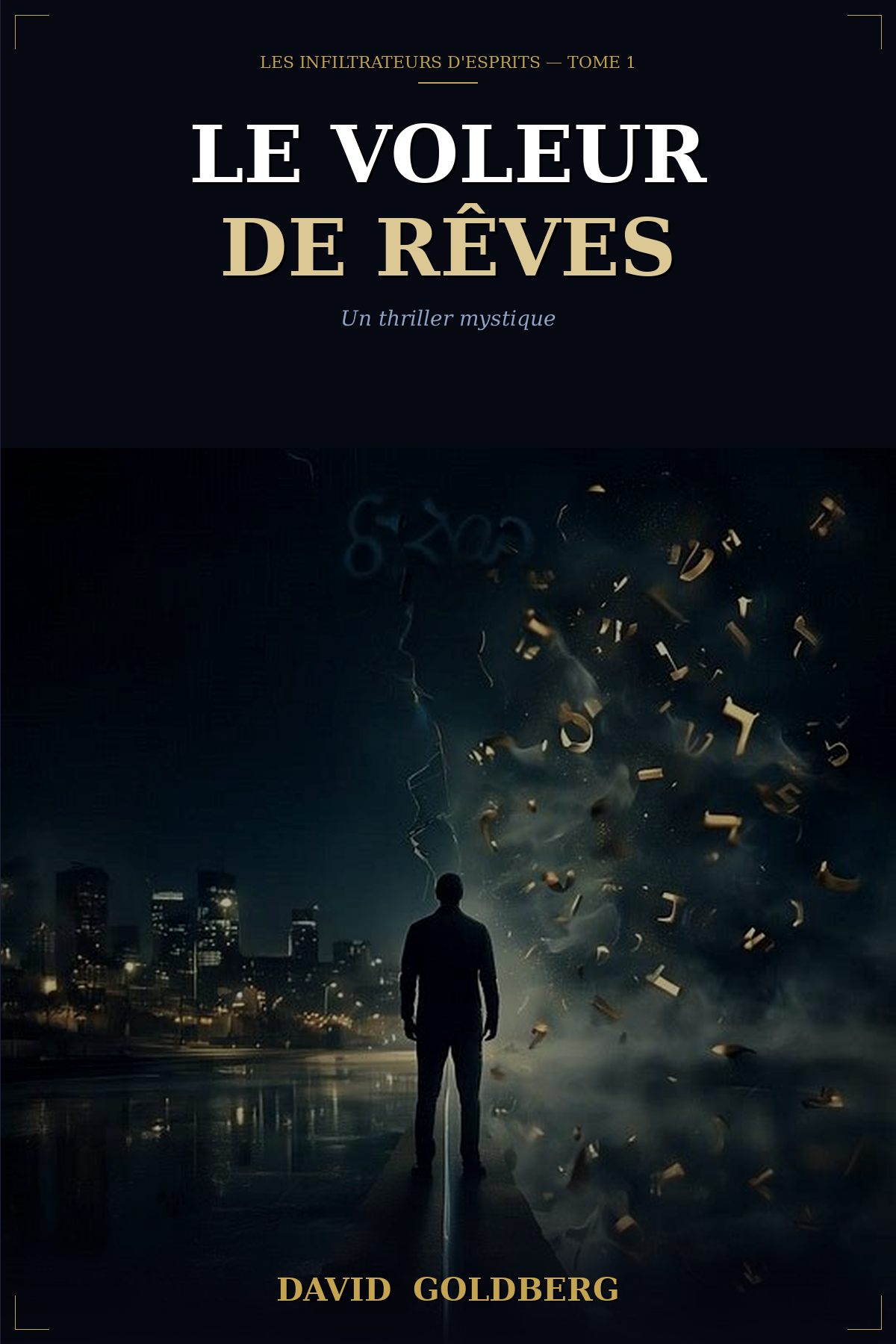
Le Voleur de Rêves
Comme cet article, nos romans cachent une Torah profonde dans un thriller. David Weiss n'a pas rêvé depuis sept ans — jusqu'au jour où quelqu'un peut entrer dans les rêves pour voler le Monde à Venir.
📕 Lire le livre · $9.90