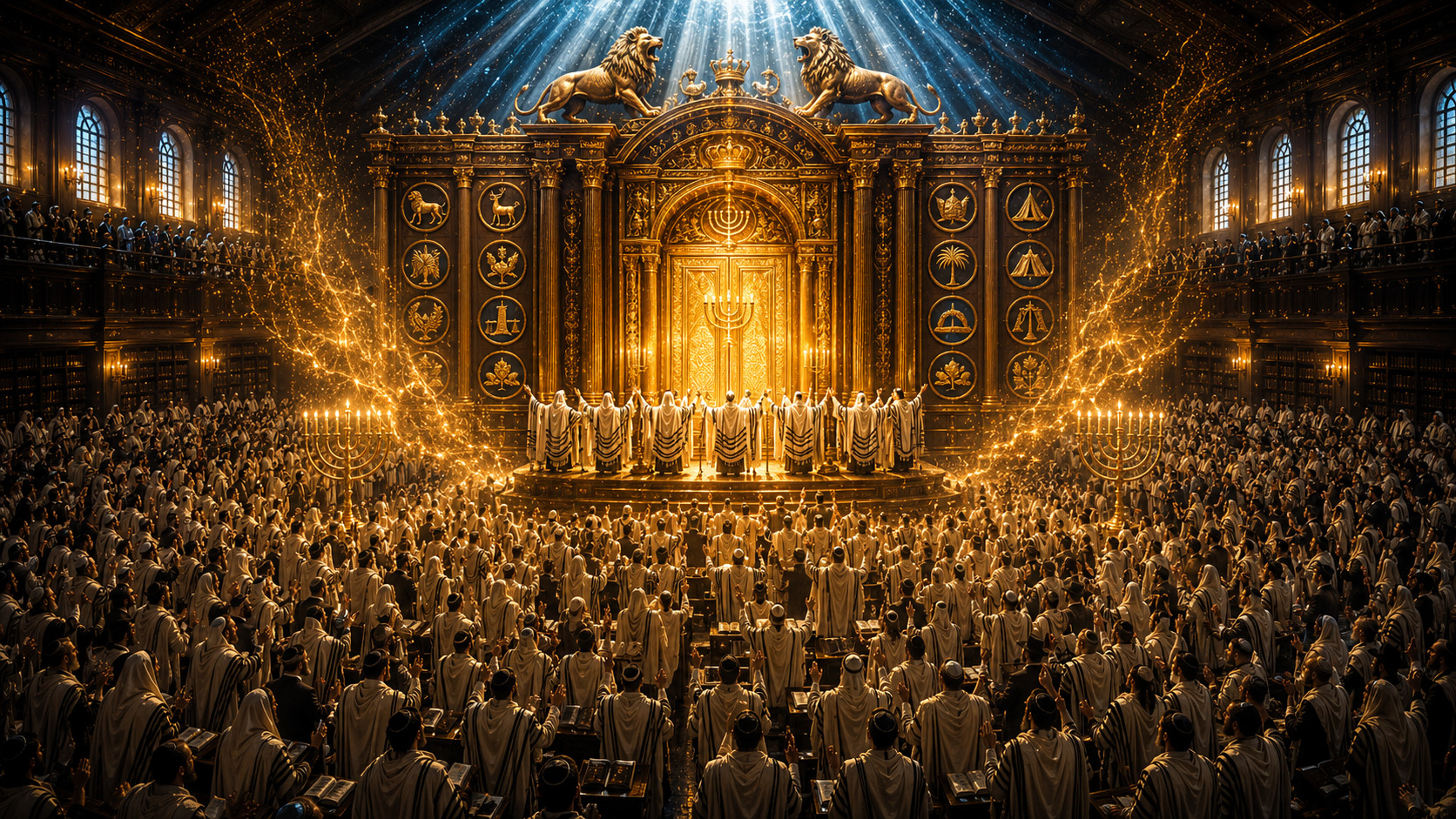
בית המדרש של פוניבז' מלא בחורים בטלית מתפללים — החום העולה מלמטה ותשובת השמים מלמעלה, מול ארון הקודש המוזהב
תלמוד · מגילה י״ז ע״ב · תפילה

הָאַרְכִיטֶקְטוּרָה הַנִּסְתֶּרֶת שֶׁל הַתְּפִלָּה

למה בדיוק 19 ברכות? למה בסדר הזה? העמידה אינה מה שאתה חושב.

שלוש פעמים ביום, במשך אלפיים שנה, כל יהודי קורא תפילה של תשע עשרה ברכות. רובם חושבים שזו רשימת בקשות. זה לא. התלמוד חושף — בשקט, כמעט בדרך אגב — שהעמידה היא אחת מיצירות ההנדסה הרוחנית המתוחכמות ביותר שנוצרו אי פעם: מפה שלמה ומוצפנת של גאולת העולם.

אָמַרְתָּ אֶת הַמִּלִּים הָאֵלֶּה אֶלֶף פְּעָמִים — וּמֵעוֹלָם לֹא יָדַעְתָּ מָה הֵן מְסַפְּרוֹת
דוד גולדברג · מגילה י״ז ע״ב · תפילה

העמידה אינה רשימת בקשות. היא מפה מוצפנת בת אלפיים שנה של גאולת העולם — כל ברכה לקוחה מפסוק, כל פסוק מוביל לבא אחריו.

שלוש מערכות: שבח (ג׳) → בקשות (י״ג) → הודאה (ג׳). כמו עבד הניגש לכיסא המלך.

שלוש עשרה האמצעיות הן תרחיש כרונולוגי של הגאולה: הבן → חזור → תיסלח → תיגאל → תירפא → קבל שפע → שוב הביתה → השב משפט → שפוט רשעים → רומם צדיקים → בנה ירושלים → קבל את המשיח → היוודע נשמע.

ו"שמונה עשרה" — יש בה תשע עשרה. הברכה ה-19 (המינים) נוספה על ידי שמואל הקטן. מסתיימת בשלום — כי אין כלי מחזיק ברכה אלא השלום.

📖 לַמַּאֲמָר הַמָּלֵא
א השאלה שאף אחד לא שואל
למה בדיוק תשע עשרה ברכות בעמידה? למה בסדר הזה? ומי החליט?

פתח כל סידור. ספור את ברכות העמידה של ימי החול. תמצא תשע עשרה — ובכל זאת המסורת קוראת לה "שמונה עשרה". תעלומה ראשונה: למה שם שכבר לא מתאים למספר?

עכשיו הסתכל על הסדר: שבח. חכמה. תשובה. סליחה. גאולה. רפואה. ברכת השנים. קיבוץ גלויות. משפט. משפט הרשעים. הצדיקים. ירושלים. משיח. "שמע תפילה". עבודה. הודאה. שלום.

זה נראה כמו רשימה אקראית. זהו למעשה הטקסט המהונדס בקפידה הגדולה ביותר בכל הליטורגיה היהודית.

התלמוד (מגילה י״ז ע״ב—י״ח ע״א) שואל ישירות: "מנין לשמונה עשרה ברכות? ומנין לסדר הזה?" תשובת חז"ל מהממת. כל ברכה לקוחה מפסוק מסוים. כל פסוק מוביל לבא אחריו בשרשרת של משמעות. וכל הרצף מספר סיפור אחד.
ב שלוש המערכות — קבלת פנים אצל המלך
דמיין שניתנה לך אודיינציה פרטית עם מלך. איך אתה מתנהג?

התלמוד (ברכות ל״ד ע״א) משווה את העמידה לעבד הניגש לכיסא. אינך פורץ פנימה צועק דרישות. אינך מתחיל בבקשה. אתה נכנס בכבוד, מנסח את בקשותיך בזהירות, ויוצא בהכרת תודה.

א
שבח — שלוש הראשונות
אתה נכנס לחדר הכיסא. עדיין לא מבקש דבר. מכיר במלך: בריתו עם האבות, כוחו על החיים והמוות, קדושתו.
ב
בקשות — שלוש עשרה האמצעיות
עכשיו אתה יכול לדבר. אבל מה שאתה מבקש, והסדר בו אתה מבקש, הוא עצמו הוראה. זהו לב העמידה.
ג
הודאה — שלוש האחרונות
אתה נפרד. אינך יוצא בשתיקה. אתה מודה למלך על מתנותיו היומיות, ועל המתנה שמכילה את כולן — השלום.
⭐ המבנה אינו עיטור דתי. זהו דגם להתקרבות לכל מפגש בעל סיכון גבוה — עם הקב"ה, עם בעל סמכות, עם הגורל עצמו. שבח. בקשה. הודאה. שלוש תנועות, יצירת מופת אחת.
ג מערכה ראשונה — לפני המלך (א-ג)

שלוש הברכות הראשונות — אבות, גבורות, קדושת השם — חולקות תכונה נדירה: הן אינן מבקשות דבר. הן הכרה טהורה.

אבות: "אלוקי אברהם אלוקי יצחק ואלוקי יעקב". התלמוד מצביע על תהילים כ״ט: "הבו לה' בני אלים" — האבות הם "בני האלים" שלימדו את האנושות להכיר בבורא.

גבורות — "אתה גיבור לעולם" — מציינת את הכוח העמוק מכולם: תחיית המתים. אותו כוח המביא גשם הוא הכוח המחיה מתים.

שלוש ברכות. אפס בקשות. למה? מפני שלפני שאתה מבקש דבר, עליך לזכור עם מי אתה מדבר. רוב התפילות מתחילות ב"אני רוצה". העמידה מתחילה ב"אתה הוא".
הַמִּסְפָּר שֶׁמַּסְתִּיר אֶת הַכֹּל — 13

קח תשע עשרה. הורד את שלוש הראשונות (שבח) ואת שלוש האחרונות (הודאה) — הקבועות, אלה שאינן משתנות לעולם. מה נשאר?
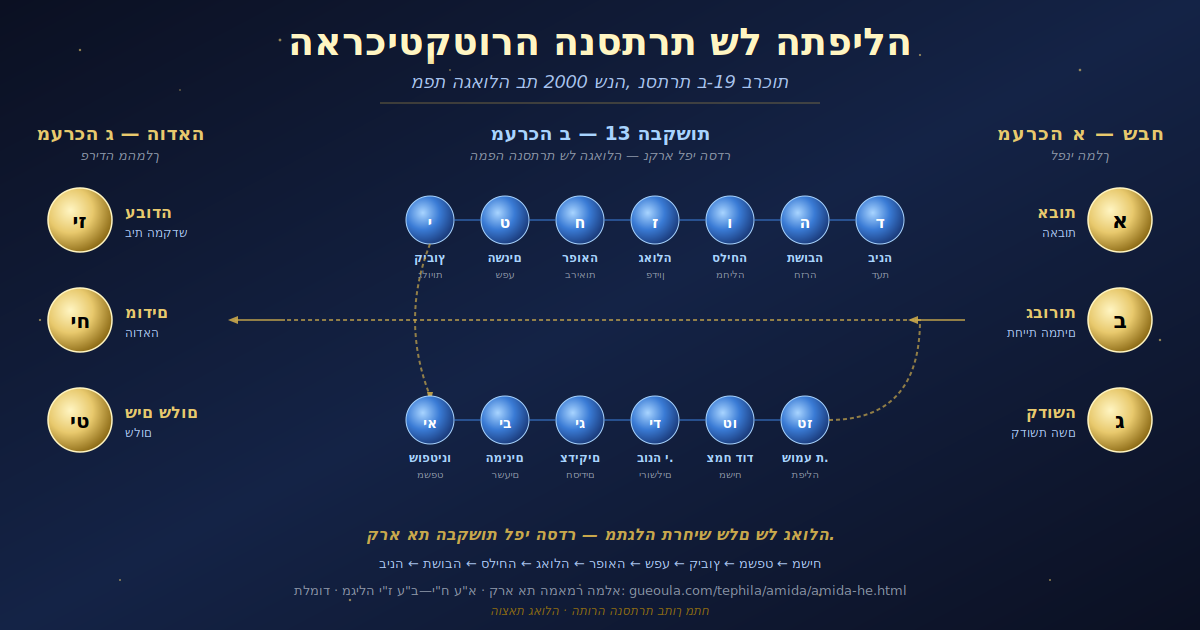
שלוש עשרה. וזה אינו מקרה. שלוש עשרה הן י״ג מידות הרחמים (שמות ל״ד:ו'-ז') — שלושה עשר צינורות הרחמים היורדים מלמעלה. שלוש עשרה הבקשות שלנו, העולות מלמטה, הן ההד האנושי המדויק שלהן.
⬥ ועוד: אֶחָד (1+8+4) = 13. אַהֲבָה (1+5+2+5) = 13. לב העמידה בנוי על מספר האחדות, האהבה, והרחמים. החום עולה מלמטה — הרחמים עונים מלמעלה. שלוש עשרה מול שלוש עשרה.
ד מערכה שנייה — המפה הנסתרת של הגאולה (ד-טז)
שלוש עשרה הברכות האמצעיות אינן רשימת משאלות. הן תרחיש כרונולוגי של איך הקב"ה יגאל את העולם. קרא אותן בסדר — וסיפור צץ.
ד
בִּינָה
"אתה חונן לאדם דעת." בלעדיה אין דבר אחר. אדם בלי הבנה אינו יכול לחזור בתשובה, להתפלל או לגדול. מקור: "וידעו תועי רוח בינה" (ישעיהו כ״ט:כ״ד).
ה
תְּשׁוּבָה
"השיבנו אבינו לתורתך." ברגע שהאדם מבין, הוא רואה מה עשה — וחוזר. "ולבבו יבין ושב ורפא לו". ההבנה תמיד קודמת לתשובה.
ו
סְלִיחָה
"סלח לנו אבינו כי חטאנו." מי שחזר יכול לבקש סליחה. "וישוב אל ה' וירחמהו… כי ירבה לסלוח" (ישעיהו נ״ה:ז'). הסדר מדויק: שיבה לפני סליחה.
ז
גְּאוּלָּה
"ראה נא בעניינו… וגאלנו." מי שנסלח יכול להיגאל. הברכה המכילה "שבור זרוע רשע" — פסק התלמוד על מפקיע השערים והטורף את העני.
ח
רְפוּאָה
"רפאנו ה' ונרפא." למה הרפואה אחרי הגאולה? סליחה מרפאת את הנפש. רפואה מרפאת את הגוף. הנפש קודם. הגוף בעקבותיה.
ט
בִּרְכַּת הַשָּׁנִים
"ברך עלינו את השנה הזאת." למה במקום התשיעי? כי דוד כתב על מפקיע השערים בפרק התשיעי בתהילים. כשהמחסנים גדושים — זרועו נשברת מאליה.
י
קִבּוּץ גָּלֻיּוֹת
"תקע בשופר גדול… וקבצנו." ברגע שיש שפע, הגלויות יכולות לשוב. "ואתם הרי ישראל… כי קרבו לבוא" (יחזקאל ל״ו:ח'). השפע קודם לשיבה.
יא
הָשִׁיבָה שׁוֹפְטֵינוּ
"השיבה שופטינו כבראשונה." לאחר שובם, אפשר להשיב את המשפט. "ואשיבה שופטיך כבראשונה" (ישעיהו א':כ״ו). תחילה העם, אחר כך בתי הדין.
יב
בִּרְכַּת הַמִּינִים
"ולמלשינים אל תהי תקווה." ברגע שהמשפט מושב, אפשר לשפוט את הרשעים. זוהי הברכה התשע עשרה — נוספה מאוחר יותר על ידי שמואל הקטן.
יג
צַדִּיקִים
"על הצדיקים… יהמו רחמיך." ברגע שהרשעים מסולקים, הצדיקים עולים. "תרוממנה קרנות צדיק" (תהילים ע״ה:י״א).
יד
בּוֹנֵה יְרוּשָׁלָיִם
"ולירושלים עירך ברחמים תשוב." "שאלו שלום ירושלים — ישליו אוהביך" (תהילים קכ״ב:ו'). אוהביה הם הצדיקים; עלייתם קוראת לבנייתה.
טו
אֶת צֶמַח דָּוִד
"את צמח דוד עבדך מהרה תצמיח." ברגע שירושלים נבנית, בא המשיח. "ובקשו את ה' אלוקיהם ואת דוד מלכם" (הושע ג':ה').
טז
שׁוֹמֵעַ תְּפִלָּה
"שמע קולנו ה' אלוקינו." ברגע שהמשיח בא, התפילה עולה ונשמעת. "ושמחתים בבית תפילתי" (ישעיהו נ״ו:ז').
⭐ קרא את שלוש עשרה אלה כמשפט אחד: הבן → חזור → תיסלח → תיגאל → תירפא → קבל שפע → חזור הביתה → השב משפט → שפוט רשעים → רומם צדיקים → בנה ירושלים → קבל את המשיח → היוודע נשמע. זוהי לא תפילה. זוהי תכנית גאולה.
ה מערכה שלישית — הסיום (יז-יט)
יז
עֲבוֹדָה
"רצה ה' אלוקינו בעמך ישראל." עבודת המקדש מושבת. הקשר בין שמיים לארץ מתחדש.
יח
מוֹדִים
"מודים אנחנו לך." אין יוצאים מן המלך בלי להכיר בניסים היומיים והנסתרים. "זובח תודה יכבדנני" (תהילים נ':כ״ג).
יט
שִׂים שָׁלוֹם
"שים שלום טובה וברכה." למה לסיים בשלום? "לא מצא הקב"ה כלי מחזיק ברכה לישראל אלא השלום." כל המתנות אינן שוות דבר ללא הכלי לקבלן.
מפת 19 הברכות — שלושה מערכות: שבח, בקשות, הודאה
תרשים: שלוש עשרה הברכות האמצעיות כרצף כרונולוגי של הגאולה
ו למה זה עדיין משמעותי בשנת תשפ״ו

העמידה אינה רק תפילה — היא מפה קוגניטיבית לכל שינוי גדול. קרא שוב את הסדר, אבל החל אותו על חייך שלך:

אתה רוצה לשנות משהו. העמידה נותנת לך את הסדר. תחילה הבן בכנות (בינה). הודה בחלקך (תשובה). סלח — לעצמך ולאחרים (סליחה). פעל לצאת מהמלכודת (גאולה). רפא את מה שנשבר (רפואה). בנה את המשאבים (השנים). החזר את מה שהתפזר (קיבוץ גלויות). השב סטנדרטים (שופטינו). כל צעד במקומו הנכון.
⬥ הפסיכולוגיה המודרנית גילתה מחדש במאה ה-20 את סדר השינוי: מודעות → קבלה → סליחה → פעולה → התאוששות → בניית משאבים → אינטגרציה → חיזוק. נדרשו לנו 2000 שנה כדי להדביק את מה שאנשי כנסת הגדולה הטמיעו בתפילה היומית.
ז הברכה התשע עשרה — למה ל"שמונה עשרה" יש תשע עשרה

התלמוד (ברכות כ״ח ע״ב): אחרי חורבן הבית השני, ביבנה, שאל רבן גמליאל: "כלום יש אדם שיודע לתקן ברכת המינים?" האיום היה חריף — צדוקים, מלשינים — קרעו את הקהילה מבפנים.

חכם צעיר ובלתי ידוע כמעט קם. שמואל הקטן. הוא חיבר את הברכה. הרצף נשאר שלם, אבל עכשיו היו תשע עשרה.

שמואל הקטן נקרא "הקטן" בגלל ענוותנותו יוצאת הדופן. רק הוא הורשה לחבר ברכה זו — מפני שרק אדם נטול עקבות של שנאה אישית יכול היה להיכתב אותה. ברכה נגד הרשעים יכולה להיכתב רק על ידי אדם שאין לו אויבים.

לכן התפילה עדיין נקראת "שמונה עשרה". הארכיטקטורה המקורית הייתה קדושה. ה-19 הייתה הוספה כירורגית של חירום, לא עיצוב מחדש.

כו הַשֵּׁם עַצְמוֹ — 13 + 13 = 26

שלוש עשרה מידות הרחמים יורדות מלמעלה. שלוש עשרה הבקשות עולות מלמטה. חבר אותן:

13 + 13 = 26 = י־ה־ו־ה (10+5+6+5). האהבה היורדת ועד האהבה העולה — סכומן הוא השם עצמו.

רגע לפני קריאת שמע, הברכה חותמת: "הַבּוֹחֵר בְּעַמּוֹ יִשְׂרָאֵל בְּאַהֲבָה" — הוא בוחר בנו באהבה (אַהֲבָה = 13). מיד אחר כך: "שְׁמַע… ה' אֶחָד" — האחדות (אֶחָד = 13). ומיד: "וְאָהַבְתָּ" — ואהבת אתה בחזרה (13).

⬥ אם אתה אוהב את מה שאתה עושה — מולך יש כוח שאוהב אותך. אהבה מלמעלה (13) ועוד אהבה מלמטה (13) = 26. החום העולה ותשובת השמים אינם רק נפגשים — סכומם הוא שמו.

🎯 בְּדֹק אֶת עַצְמְךָ

חמש שאלות. לחץ על התשובה.

1
למה התפילה נקראת "שמונה עשרה" אף שאומרים תשע עשרה ברכות?
אנשי כנסת הגדולה תיקנו 18. אחרי החורבן, ביבנה, נוספה ברכת המינים כהוספת חירום — לכן השם נשמר.
2
מהן שלוש המערכות של העמידה?
כמו עבד הניגש לכיסא המלך: נכנס בכבוד (שבח), מנסח בקשות (13), יוצא בהכרת תודה (הודאה).
3
למה הרפואה (ח) באה אחרי הגאולה (ז)?
התלמוד: הרפואה הרוחנית (סליחה) קודמת לרפואת הגוף. הנפש מטופלת ראשונה, הגוף בא בעקבותיה.
4
מי חיבר את ברכת המינים ולמה דווקא הוא?
שמואל הקטן, איש ענווה יוצאת דופן. ברכה נגד הרשעים יכולה להיכתב רק בידי מי שאין לו אויבים.
5
למה העמידה מסתיימת ב"שים שלום"?
"לא מצא הקב"ה כלי מחזיק ברכה לישראל אלא השלום." השלום הוא הכלי שמחזיק את כל שאר המתנות.

תּוֹצָאָה

📅 תרגול יומי — איך להשתמש במפה הזאת בתפילה שלך
שחרית
כשתגיע לבינה (הרביעית), עצור. בקש בהירות אחת ספציפית הדרושה לך היום. הבקשה הראשונה צריכה להיות לבינה.
מנחה
כשתגיע לגאולה → רפואה (ז→ח), שים לב לסדר: נפש לפני גוף. הבא לדעת פצע אחד — התחל מהשכבה הרוחנית.
ערבית
כשתגיע למודים (י״ח), נקוב בשלושה ניסים קטנים מהיום הזה דווקא. לא כלליים — ספציפיים.
שבת וחגים
שלוש עשרה האמצעיות מוחלפות בברכה אחת — אבל הארכיטקטורה נשארת. שבח → בקשה → הודאה. המבנה הוא ההוראה.
כל תפילה
לפני שאתה מתחיל, קח נשימה אחת ואמור לעצמך: "אני עומד לקרוא את מפת גאולת העולם." המילים לא ישתנו. היחס שלך אליהן ישתנה.
אַרְבָּעָה צְעָדִים מַעֲשִׂיִּים
🏠

שָׁלוֹם בַּיִת

"שים שלום" — השלום מתחיל בבית. גלה כרטיס שלום בית.

🔢

גִּימַטְרִיָּה — הרב מנשה

סודות האותיות והמספרים לפי הרב מנשה זצ"ל.

🔢 קורס גימטריה
📝

לִימוּד תּוֹרָה

העמק בתלמוד ובמפרשים על התפילה והברכות.

📝 בית המדרש
📚

כָּל הַפָּרָשִׁיּוֹת

כל שיעורי מ. יהודה חימי — מבראשית עד דברים ועד החגים.

📚 כל הפרשיות
📕

סְפָרִים

חכמת התורה בפורמט תריילר — הוצאת גאולה.
🌙

פֵּרוּשׁ חֲלוֹמוֹת

חלמת? בדוק את המשמעות לפי רב אלמולי.

🌙 פירוש חלומות
🎬

סִרְטוֹנִים

שיעורי וידאו על החגים, המנורה וסודות המשכן.

🎬 סרטונים
💡

תֵּיבַת רַעְיוֹנוֹת

רעיון או הצעה לאתר? שתף אותנו.

💡 תיבת רעיונות
🤝

מַעֲשֵׂר

תן את חלק המעשר שלך והשתתף בהפצת התורה.

🤝 מעשר
📨 קבלו מאמר חדש כל שבוע
מאמר, שיעור או פרק חדש — ישיר לתיבה. בלי ספאם. ביטול בלחיצה.
🕯️ הקדש את המאמר
לעילוי נשמת · לרפואת · להצלחת — דדיקציה תופיע במור ההקדשות.
🧱 למור ההקדשות ←
אני מאשים את האומות

אֲנִי מַאֲשִׁים אֶת הָאֻמּוֹת

תריילר רוחני · דוד גולדברג

כמו המאמר הזה — תורה עמוקה נסתרת בתוך מתח. אמת קבורה, וכוחות המבקשים להשתיקה. איש אחד מול האומות.

📕 לקריאת הספר · ₪36.90
The beit hamidrash of Ponevezh filled with young men in tallitot praying — heat rising from below, Heaven answering from above, before the golden Aron HaKodesh as the Cohanim bless the people
Talmud · Megillah 17b · Jewish Prayer

The Hidden Architecture of Jewish Prayer

Why exactly 19 blessings? Why this exact order? The Amida is not what you think.

Three times a day, for two thousand years, every Jew has recited a prayer of nineteen blessings. Most assume it is a list of requests. It is not. The Talmud reveals — quietly, almost casually — that the Amida is one of the most sophisticated pieces of spiritual engineering ever produced: a complete, encrypted map of the Redemption of the world.

You've said these words a thousand times. You never knew what they were telling you.
David Goldberg · Megillah 17b · Jewish Prayer

The Amida is not a list of requests. It is a 2,000-year-old encrypted map of the world's Redemption — every blessing drawn from a verse, every verse leading to the next.

Three acts: Praise (3) → Petitions (13) → Thanksgiving (3). Like a servant approaching the King's throne.

The thirteen middle blessings are a chronological blueprint of redemption: Understand → Return → Be forgiven → Be redeemed → Be healed → Receive abundance → Come home → Restore justice → Judge the wicked → Lift the righteous → Rebuild Jerusalem → Welcome the Messiah → Be heard.

And "The Eighteen" has nineteen — the 19th (against the heretics) was added by Shmuel HaKatan. It ends with peace — because no vessel holds blessing like peace.

📖 Read the full article
1 The Question Nobody Asks
Why are there exactly nineteen blessings in the Amida? Why are they in that specific order? And who decided?

Open any prayer book. Count the blessings of the weekday Amida. You will find nineteen — even though tradition calls it the "Shemoneh Esrei," meaning "The Eighteen." Already a mystery: why a name that no longer matches the count?

Now look at the order. Praise. Then a wisdom request. Then repentance. Then forgiveness. Then redemption. Then healing. Then prosperity. Then ingathering. Then justice. Then judgment. Then the righteous. Then Jerusalem. Then the Messiah. Then "hear my prayer." Then Temple service. Then thanksgiving. Then peace.

It looks like a random list. It is the most carefully engineered text in Jewish liturgy.

The Talmud (Megillah 17b–18a) asks the question directly: "From where do we know there are eighteen blessings? And from where do we know this exact order?" The answer the sages give is staggering. Each blessing is drawn from a specific verse. Each verse leads to the next by a chain of meaning. And the whole sequence tells one story.
2 The Three Acts — An Audience With the King
Imagine you have been granted a private audience with a king. How do you behave?

The Talmud (Berakhot 34a) compares the Amida to a servant approaching the throne. You do not burst in shouting demands. You do not start by asking for things. You enter with respect, you state your requests carefully, and you take leave with gratitude.

I
PRAISE — The First Three שבח
You enter the throne room. You do not yet ask for anything. You acknowledge the King: His covenant with the Patriarchs, His power over life and death, His holiness.
II
PETITIONS — The Middle Thirteen בקשות
Now you may speak. But what you ask, and the order in which you ask it, is itself a teaching. This is the heart of the Amida.
III
THANKSGIVING — The Final Three הודאה
You take leave. You do not exit silently. You thank the King for His daily gifts, and for the gift that contains all others — peace.
⭐ The structure is not religious decoration. It is a model for how to approach any high-stakes encounter — with God, with a person of authority, with destiny itself. Praise. Request. Thanks. Three movements, one masterpiece.
3 Act One — Standing Before the King (Blessings 1–3)

The first three blessings — Avot (Patriarchs), Gevurot (Powers), Kedushat HaShem (Sanctification) — share something rare in liturgy: they ask for nothing. They are pure recognition.

Avot opens with "God of Abraham, God of Isaac, God of Jacob." Why these three names? The Talmud points to Psalm 29: "Ascribe to God, sons of the mighty" — the Patriarchs first taught humanity to recognize the Creator.

Gevurot — the blessing of God's power — celebrates the deepest of all powers: resurrection of the dead. The same power that brings rain is the power that revives the dead. Both reverse the natural order.

Three blessings. Zero requests. Why? Because before you ask for anything, you must remember who you are speaking to. Most of human prayer fails at exactly this point — it begins with "I want." The Amida begins with "You are."
The Number That Hides Everything — 13

Take nineteen. Remove the first three (praise) and the last three (thanksgiving) — the fixed ones, the ones that never change all year, not even on Shabbat. What remains?
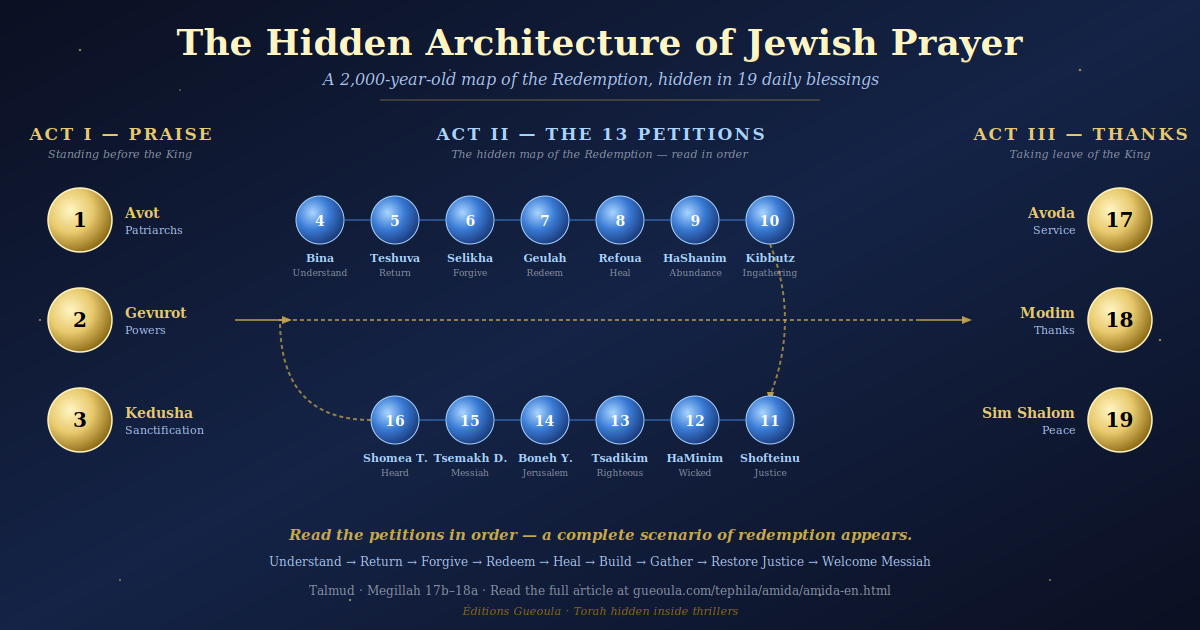
Thirteen. And that is no accident. Thirteen is the number of the Shelosh Esrei Middot — the Thirteen Attributes of Mercy (Shemot 34:6–7), the thirteen channels of Divine mercy that descend from above. Our thirteen petitions, rising from below, are their exact human echo.
⬥ And more: Echad אֶחָד — "One" — equals 1+8+4 = 13. Ahava אַהֲבָה — "Love" — equals 1+5+2+5 = 13. The beating heart of the Amida is built on the number of Unity, of Love, and of Mercy. Heat rises from below — mercy answers from above. Thirteen facing thirteen.
4 Act Two — The Hidden Map of Redemption (Blessings 4–16)
Now comes the heart. The thirteen middle blessings are not a wish list. They are a chronological scenario of how God will redeem the world. Read them in order, and a story appears.
4
בִּינָה Bina — Understanding
"You graciously grant man knowledge." Nothing else can happen without it. A person who lacks understanding cannot repent, pray, or grow. Source: "The spirits gone astray will know Bina" (Yeshayahu 29:24).
5
תְּשׁוּבָה Teshuva — Return
"Bring us back, our Father, to Your Torah." Once a person understands, they see what they have done — and they return. "His heart will understand, and he will return, and be healed." Understanding before repentance. Always.
6
סְלִיחָה Selikha — Forgiveness
"Forgive us, our Father, for we have sinned." A person who returns can now ask to be forgiven. "Let him return to God, who pardons abundantly" (Yeshayahu 55:7). Returning precedes pardon.
7
גְּאוּלָּה Geulah — Redemption
"Look upon our affliction… and redeem us." Once forgiven, a person can be delivered. This blessing contains "Break the arm of the wicked" — the Talmudic verdict on the predator of the poor.
8
רְפוּאָה Refoua — Healing
"Heal us, God, and we shall be healed." Why does healing come after redemption? Selikha heals the soul. Refoua heals the body. The soul is treated first. The body follows.
9
בִּרְכַּת הַשָּׁנִים Birkat HaShanim — Prosperity
"Bless this year for us." Why ninth? King David wrote about the price-gouger in the ninth Psalm. When the warehouses overflow, the speculator loses all leverage. His arm breaks itself.
10
קִבּוּץ גָּלֻיּוֹת Kibbutz Galuyot — Ingathering
"Sound the great shofar… and gather us." Once the world has abundance, the exiles can return. "Mountains of Israel… for they are near to come" (Yehezkel 36:8). Abundance precedes the return.
11
הָשִׁיבָה שׁוֹפְטֵינוּ Hashiva Shofteinu — Restoring the Judges
"Restore our judges as at first." Once the exiles are home, justice can be reinstated. "I will restore your judges as at the beginning" (Yeshayahu 1:26). First the people, then the courts.
12
בִּרְכַּת הַמִּינִים Birkat HaMinim — Against the Heretics
"And for the slanderers, may there be no hope." Once justice is restored, the truly wicked can be judged. This is the nineteenth blessing — added later by Shmuel HaKatan.
13
צַדִּיקִים Tsadikim — The Righteous
"Upon the righteous… may Your mercies stir." Once the wicked are removed, the righteous rise. "The horns of the righteous shall be exalted" (Tehillim 75:11).
14
בּוֹנֵה יְרוּשָׁלָיִם Boneh Yerushalayim — Rebuilder of Jerusalem
"Return in mercy to Jerusalem." "Pray for the peace of Jerusalem — they shall prosper who love you" (Tehillim 122:6). Those who love her are the righteous; their rise summons her rebuilding.
15
אֶת צֶמַח דָּוִד Et Tsemakh David — The Branch of David
"Speedily cause the offshoot of David to flourish." Once Jerusalem is rebuilt, the Messiah can come. "They shall seek God their God and David their king" (Hoshea 3:5).
16
שׁוֹמֵעַ תְּפִלָּה Shomea Tefila — He Who Hears Prayer
"Hear our voice, our God." Once the Messiah comes, prayer rises and is heard. "I will gladden them in My house of prayer" (Yeshayahu 56:7).
⭐ Read these thirteen as a sentence: Understand → Return → Be forgiven → Be redeemed → Be healed → Receive abundance → Come home → Restore justice → Judge the wicked → Lift the righteous → Rebuild Jerusalem → Welcome the Messiah → Be heard. This is not a prayer. It is a redemption blueprint.
5 Act Three — The Closing (Blessings 17–19)
17
עֲבוֹדָה Avoda — Service
"Be pleased, God, with Your people Israel and their prayer." The Temple service is restored. The connection between Heaven and earth is renewed.
18
מוֹדִים Modim — Thanksgiving
"We thank You." One does not leave the King without acknowledging the daily, hidden miracles. "He who offers thanksgiving honors Me" (Tehillim 50:23).
19
שִׂים שָׁלוֹם Sim Shalom — Grant Peace
"Grant peace, goodness and blessing." Why end with peace? "There is no vessel that holds blessing like peace." All the previous gifts mean nothing without the vessel to contain them.
Visual map of the 19 blessings — three acts: Praise, Petitions, Thanksgiving, with the 13 middle blessings as a redemption blueprint
The thirteen middle blessings, read in order, form a chronological map of the Redemption
6 Why This Still Matters in 2026

A skeptic might ask: "Beautiful structure. But what does an ancient prayer architecture have to do with my life?"

Everything. The Amida is a cognitive map for any large change. Read the order again, but apply it to your own life:

You want to change something. The Amida tells you the order. First understand honestly (Bina). Then admit your part (Teshuva). Then forgive — yourself and others (Selikha). Then act to escape the trap (Geulah). Then heal what was broken (Refoua). Then build resources (HaShanim). Then bring back what was scattered (Kibbutz Galuyot). Then re-establish standards (Shofteinu). Every step is in the right place.
⬥ Modern psychology rediscovered, in the 20th century, the order of behavioral change: awareness → acceptance → forgiveness → action → recovery → resource-building → integration → reinforcement. It took us 2,000 years to catch up with what the Anshei Knesset HaGedolah encoded into a daily prayer.
7 The 19th Blessing — Why "Eighteen" Has Nineteen
If the Anshei Knesset HaGedolah composed the Amida and called it "Shemoneh Esrei" — Eighteen — why do we recite nineteen blessings today?

The Talmud (Berakhot 28b) tells the story. After the destruction of the Second Temple, in Yavneh, Rabban Gamliel asked the assembled sages: "Is there anyone who knows how to compose a blessing against the heretics?" The threat was acute — Sadducees, informers were tearing the community apart from within.

A young, almost unknown sage stood up. Shmuel HaKatan — "Samuel the Small." He composed the blessing. The sequence remained intact, but now there were nineteen.

Shmuel HaKatan was named "the Small" for his extraordinary humility. Only he was permitted to compose this blessing — because only someone with no trace of personal hatred could be trusted to write it. The blessing against the wicked could only be authored by a man without enemies.

That's why the prayer is still called "Shemoneh Esrei" — even though we count nineteen. The original architecture was sacred. The 19th was an emergency surgical insertion, not a redesign.

26 The Name Itself — 13 + 13 = 26

Thirteen Attributes of Mercy descend from above. Thirteen petitions rise from below. Add them together:

13 + 13 = 26 = י־ה־ו־ה (10+5+6+5) — the four-letter Name of God. The love that descends and the love that rises: their sum is the Name itself.

Moments before the Shema, the blessing seals it: "HaBocher be'amo Yisrael be'ahava" הַבּוֹחֵר בְּעַמּוֹ יִשְׂרָאֵל בְּאַהֲבָה — He chooses us in love (Ahava = 13). Immediately after: "Shema… Hashem Echad" — the Oneness (Echad = 13). And at once: "Ve'ahavta" וְאָהַבְתָּ — and you shall love Him back (13).

⬥ If you love what you are doing — there is a Force facing you that loves you. Love from above (13) plus love from below (13) = 26. The heat that rises and the answer of Heaven do not merely meet — their sum is His Name.

🎯 Test Yourself

Five questions. Tap an answer.

1
Why is the prayer called "Shemoneh Esrei" (Eighteen) though we recite nineteen?
The Anshei Knesset HaGedolah composed 18. After the Temple's destruction, Birkat HaMinim was added as an emergency insertion — so the name was kept.
2
What are the three "acts" of the Amida?
Like a servant approaching the throne: enter with respect (Praise), state requests (13), take leave with gratitude (Thanksgiving).
3
Why does Healing (8) come after Redemption (7)?
Selikha heals the soul; Refoua heals the body. The spiritual layer is treated first, and the body follows.
4
Who composed Birkat HaMinim, and why him specifically?
Shmuel HaKatan, a man of extraordinary humility. A blessing against the wicked could only be authored by someone without enemies.
5
Why does the Amida end with Sim Shalom (peace)?
"There is no vessel that holds blessing like peace." Peace is the container that holds every other gift.

Result

📅 Daily Practice — How to Use This Map in Your Own Prayer
Shaharit (morning)
When you reach Bina (4th), pause. Ask for one specific clarity you need today. The day's first request should be for understanding.
Mincha (afternoon)
When you reach Geulah → Refoua (7→8), notice the order: soul before body. Bring one wound to mind — start with the spiritual layer.
Arvit (evening)
When you reach Modim (18th), name three small miracles from this exact day. Not generic — specific.
Shabbat & Festivals
The middle thirteen are replaced by a single blessing — but the architecture remains. Praise → request → thanks. The structure is the point.
Every prayer
Before you begin, take one breath and tell yourself: "I am about to recite the map of the world's redemption." The words won't change. Your relationship to them will.
Continue the Journey
🏠

Shalom Bayit

"Grant peace" begins at home. Draw a Shalom Bayit card.

🔢

Gematria — Rav Menashe

The secrets of letters and numbers, per Rav Menashe zatsal.

🔢 Gematria Course
📝

Torah Study

Go deeper into Talmud and the commentators on prayer.

📝 Beit HaMidrash
📚

All the Parashot

Every shiur by M. Yéhouda Himi — Bereshit to Devarim and the festivals.

📚 All Parashot
📕

Books

Torah wisdom in thriller form — Éditions Gueoula.

🌙

Dream Interpretation

Had a dream? Check its meaning per Rav Almoli.

🌙 Interpret
🎬

Videos

Video teachings on the festivals, the Menorah and the Mishkan.

🎬 Watch
💡

Idea Box

An idea or suggestion for the site? Share it with us.

💡 Idea Box
🤝

Maasser

Give your maasser and take part in spreading Torah.

🤝 Maasser
📨 One email a week
The new article, the new shiur, the new chapter — straight to your inbox. No spam. Unsubscribe anytime.
🕯️ Dedicate this article
In memory · For the healing · For the success of — your dedication appears on the wall.
🧱 See the wall of dedications →
The Dream Thief

The Dream Thief

A mystical thriller · David Goldberg

Like this article, our novels hide deep Torah inside a thriller. David Weiss has not dreamed in seven years — until someone learns to enter dreams and steal the World to Come.

📕 Read the book · $9.90
Le beith hamidrash de Poniovitch rempli de jeunes en talith en pleine prière — la chaleur qui monte d'en bas, la réponse du Ciel d'en haut, devant le Aron HaKodesh doré tandis que les Cohanim bénissent le peuple
Talmud · Meguila 17b · Prière Juive

L'Architecture Cachée de la Téfila

Pourquoi exactement 19 berakhot ? Pourquoi cet ordre précis ? La Amida n'est pas ce que vous croyez.

Trois fois par jour, depuis deux mille ans, chaque Juif récite une prière de dix-neuf berakhot. La plupart pensent qu'il s'agit d'une liste de demandes. Ce n'en est pas une. Le Talmud révèle — discrètement, presque incidemment — que la Amida est l'une des œuvres d'ingénierie spirituelle les plus sophistiquées jamais produites : une carte complète, codée, de la Rédemption du monde.

Vous avez prononcé ces mots mille fois. Vous n'avez jamais su ce qu'ils vous disaient.
David Goldberg · Meguila 17b · Prière Juive

La Amida n'est pas une liste de demandes. C'est une carte codée, vieille de 2000 ans, de la Rédemption du monde — chaque berakha tirée d'un verset, chaque verset menant au suivant.

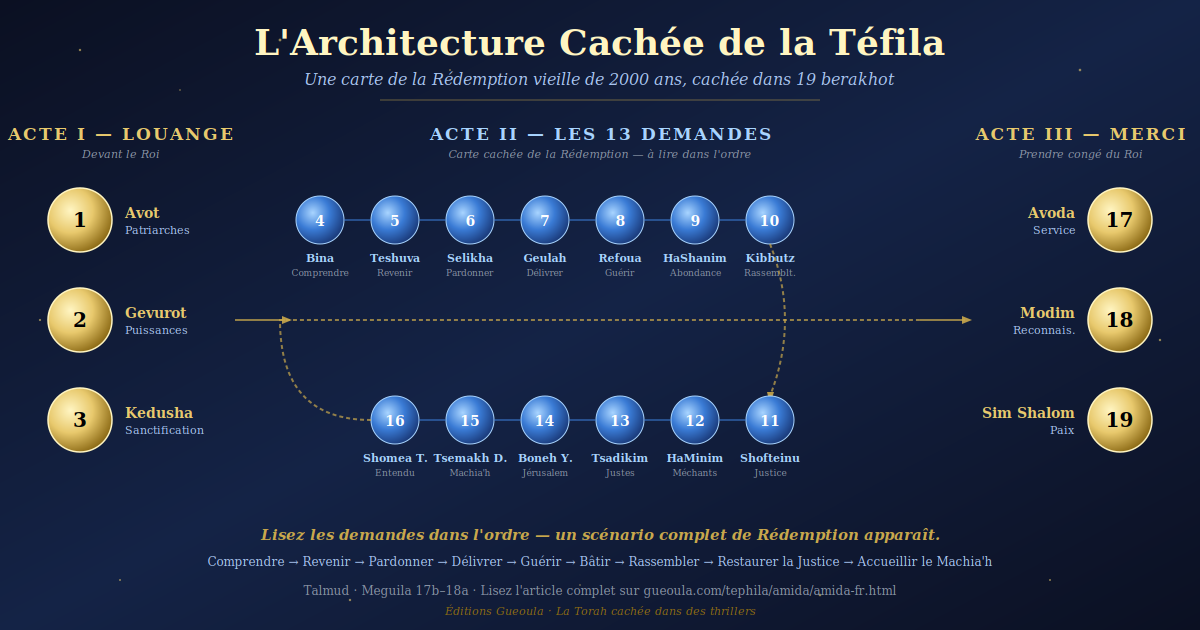
Trois actes : Louange (3) → Demandes (13) → Reconnaissance (3). Comme un serviteur s'approchant du trône du Roi.

Les treize du milieu forment un plan chronologique de la Rédemption : Comprendre → Revenir → Être pardonné → Être délivré → Être guéri → Recevoir l'abondance → Rentrer → Restaurer la justice → Juger les méchants → Élever les justes → Reconstruire Jérusalem → Accueillir le Machia'h → Être entendu.

Et "Dix-Huit" en a dix-neuf — la 19ème (contre les hérétiques) fut ajoutée par Chmouel HaKatan. Elle finit par la paix — car aucun récipient ne contient la bénédiction comme la paix.

📖 Lire l'article complet
1 La Question Que Personne Ne Pose
Pourquoi exactement dix-neuf berakhot dans la Amida ? Pourquoi cet ordre précis ? Et qui en a décidé ?

Ouvrez n'importe quel siddour. Comptez les berakhot de la Amida des jours de semaine. Vous en trouverez dix-neuf — alors que la tradition l'appelle "Choumonè Essré", "Les Dix-Huit". Premier mystère : pourquoi un nom qui ne correspond plus au compte ?

Examinez ensuite l'ordre. Louange. Sagesse. Repentir. Pardon. Rédemption. Guérison. Prospérité. Rassemblement. Justice. Jugement. Les justes. Jérusalem. Machia'h. "Écoute ma prière". Service. Reconnaissance. Paix.

Cela ressemble à une liste aléatoire. C'est en réalité le texte le plus minutieusement architecturé de toute la liturgie juive.

Le Talmud (Meguila 17b–18a) pose la question directement : "D'où sait-on qu'il y a dix-huit berakhot ? Et d'où sait-on cet ordre exact ?" La réponse des sages est stupéfiante. Chaque berakha est tirée d'un verset précis. Chaque verset mène au suivant par une chaîne de sens. Et la séquence entière raconte une seule histoire.
2 Les Trois Actes — Une Audience Royale
Imaginez qu'on vous accorde une audience privée avec un roi. Comment vous comportez-vous ?

Le Talmud (Berakhot 34a) compare la Amida à un serviteur s'approchant du trône. On n'entre pas en hurlant des demandes. On ne commence pas par réclamer. On entre avec respect, on formule ses requêtes avec soin, et on prend congé en remerciant.

I
LOUANGE — Les Trois Premières שבח
On entre dans la salle du trône. On ne demande encore rien. On reconnaît le Roi : Son alliance avec les Patriarches, Sa puissance sur la vie et la mort, Sa sainteté.
II
DEMANDES — Les Treize du Milieu בקשות
Maintenant, on peut parler. Mais ce qu'on demande, et l'ordre dans lequel on le demande, est lui-même un enseignement. C'est le cœur de la Amida.
III
RECONNAISSANCE — Les Trois Dernières הודאה
On prend congé. On ne sort pas en silence. On remercie le Roi pour Ses dons quotidiens, et pour le don qui contient tous les autres — la paix.
⭐ Cette structure n'est pas une décoration religieuse. C'est un modèle pour aborder n'importe quelle rencontre à enjeu majeur — avec D-ieu, avec une autorité, avec le destin lui-même. Louange. Requête. Reconnaissance. Trois mouvements, un chef-d'œuvre.
3 Acte Un — Devant le Roi (Berakhot 1–3)

Les trois premières berakhot — Avot (les Patriarches), Guevourot (les Puissances), Kedouchat HaShem (la Sanctification) — partagent une caractéristique rare : elles ne demandent rien. Elles sont pure reconnaissance.

Avot s'ouvre par "D-ieu d'Abraham, D-ieu d'Isaac, D-ieu de Jacob". Le Talmud renvoie au Psaume 29 : "Attribuez à D-ieu, fils des puissants" — les Patriarches ont les premiers enseigné à l'humanité à reconnaître le Créateur.

Guevourot — la puissance divine — célèbre la plus profonde des puissances : la résurrection des morts. La même puissance qui apporte la pluie ressuscite les morts. Toutes deux inversent l'ordre naturel.

Trois berakhot. Zéro demande. Pourquoi ? Parce qu'avant de demander quoi que ce soit, il faut se rappeler à qui l'on parle. La plupart des prières commencent par "je veux". La Amida commence par "Tu es".
Le Nombre Qui Cache Tout — 13

Prenez dix-neuf. Retirez les trois premières (louange) et les trois dernières (reconnaissance) — les fixes, celles qui ne changent jamais de toute l'année, pas même à Chabbat. Que reste-t-il ?
Treize. Et ce n'est pas un hasard. Treize est le nombre des Chéloch Essré Middot — les Treize Attributs de Miséricorde (Chémot 34:6-7), les treize canaux de la miséricorde divine qui descendent d'en haut. Nos treize demandes, qui montent d'en bas, en sont l'écho humain exact.
⬥ Et plus encore : Éhad אֶחָד — "Un" — vaut 1+8+4 = 13. Ahava אַהֲבָה — "Amour" — vaut 1+5+2+5 = 13. Le cœur battant de la Amida est bâti sur le nombre de l'Unité, de l'Amour et de la Miséricorde. La chaleur monte d'en bas — la miséricorde répond d'en haut. Treize face à treize.
4 Acte Deux — La Carte Cachée de la Rédemption (Berakhot 4–16)
Voici le cœur. Les treize berakhot du milieu ne sont pas une liste de souhaits. C'est un scénario chronologique de la façon dont D-ieu rachètera le monde. Lisez-les dans l'ordre, et une histoire apparaît.
4
בִּינָה Bina — L'Intelligence
"Tu accordes à l'homme le savoir." Rien d'autre ne peut survenir sans elle. Un homme sans compréhension ne peut ni se repentir, ni prier, ni grandir. "Les esprits égarés connaîtront la Bina" (Yéchayahou 29:24).
5
תְּשׁוּבָה Téchouva — Le Retour
"Ramène-nous, notre Père, à Ta Torah." Une fois que l'homme comprend, il voit ce qu'il a fait — et il revient. "Son cœur comprendra, il reviendra, et il sera guéri." La compréhension précède toujours le repentir.
6
סְלִיחָה Sélikha — Le Pardon
"Pardonne-nous, notre Père, car nous avons fauté." Celui qui revient peut demander pardon. "Qu'il revienne à D-ieu, qui pardonne abondamment" (Yéchayahou 55:7). Le retour précède le pardon.
7
גְּאוּלָּה Guéoula — La Rédemption
"Vois notre détresse… et délivre-nous." Une fois pardonné, on peut être délivré. La berakha qui contient "Brise le bras du méchant" — le verdict talmudique sur le prédateur du pauvre.
8
רְפוּאָה Réfoua — La Guérison
"Guéris-nous, D-ieu, et nous serons guéris." Pourquoi la guérison après la rédemption ? Sélikha guérit l'âme. Réfoua guérit le corps. L'âme d'abord. Le corps suit.
9
בִּרְכַּת הַשָּׁנִים Birkat HaChanim — Les Années
"Bénis pour nous cette année." Pourquoi en neuvième ? David a écrit sur le spéculateur dans le neuvième Psaume. Quand les entrepôts débordent, le spéculateur perd tout levier. Son bras se brise tout seul.
10
קִבּוּץ גָּלֻיּוֹת Kibboutz Galouyot — Le Rassemblement
"Sonne le grand chofar… et rassemble-nous." Une fois l'abondance venue, les exilés peuvent revenir. "Montagnes d'Israël… car ils sont près de venir" (Yéhezkel 36:8). L'abondance précède le retour.
11
הָשִׁיבָה שׁוֹפְטֵינוּ Hachiva Choftéinou — Restauration des Juges
"Rétablis nos juges comme jadis." Une fois les exilés revenus, la justice peut être réinstaurée. "Je rétablirai tes juges comme au commencement" (Yéchayahou 1:26). D'abord le peuple, ensuite les tribunaux.
12
בִּרְכַּת הַמִּינִים Birkat HaMinim — Contre les Hérétiques
"Et pour les calomniateurs, qu'il n'y ait pas d'espoir." Une fois la justice rétablie, les vrais méchants peuvent être jugés. C'est la dix-neuvième berakha — ajoutée plus tard par Chmouel HaKatan.
13
צַדִּיקִים Tsadikim — Les Justes
"Sur les justes… que Tes miséricordes s'éveillent." Une fois les méchants ôtés, les justes s'élèvent. "Les cornes du juste s'élèveront" (Tehilim 75:11).
14
בּוֹנֵה יְרוּשָׁלָיִם Boné Yérouchalayim — Reconstructeur de Jérusalem
"Reviens avec miséricorde dans Ta ville Jérusalem." "Demandez la paix de Jérusalem — ils prospéreront, ceux qui t'aiment" (Tehilim 122:6). Ceux qui l'aiment sont les justes ; leur élévation appelle sa reconstruction.
15
אֶת צֶמַח דָּוִד Et Tsemakh David — Le Rejeton de David
"Fais promptement éclore le rejeton de David." Une fois Jérusalem reconstruite, le Machia'h peut venir. "Ils chercheront l'Éternel leur D-ieu et David leur roi" (Hochéa 3:5).
16
שׁוֹמֵעַ תְּפִלָּה Choméa Téfila — Celui Qui Écoute la Prière
"Écoute notre voix, notre D-ieu." Une fois le Machia'h venu, la prière monte et est entendue. "Je les réjouirai dans Ma maison de prière" (Yéchayahou 56:7).
⭐ Lisez ces treize comme une phrase : Comprendre → Revenir → Être pardonné → Être délivré → Être guéri → Recevoir l'abondance → Rentrer chez soi → Restaurer la justice → Juger les méchants → Élever les justes → Reconstruire Jérusalem → Accueillir le Machia'h → Être entendu. Ce n'est pas une prière. C'est un plan de Rédemption.
5 Acte Trois — La Clôture (Berakhot 17–19)
17
עֲבוֹדָה Avoda — Le Service
"Sois agréé, D-ieu, par Ton peuple Israël et leur prière." Le service du Temple est restauré. La connexion entre le Ciel et la terre est renouvelée.
18
מוֹדִים Modim — La Reconnaissance
"Nous Te remercions." On ne quitte pas le Roi sans reconnaître les miracles quotidiens et cachés. "Celui qui offre une reconnaissance Me glorifie" (Tehilim 50:23).
19
שִׂים שָׁלוֹם Sim Chalom — Donne la Paix
"Donne la paix, le bien et la bénédiction." Pourquoi finir par la paix ? "Il n'y a pas de récipient capable de contenir la bénédiction comme la paix." Tous les dons précédents ne valent rien sans le contenant pour les recevoir.
Carte visuelle des 19 berakhot — trois actes : Louange, Demandes, Reconnaissance, les 13 du milieu formant le plan de la Rédemption
Les treize berakhot du milieu, lues dans l'ordre, forment une carte chronologique de la Rédemption
6 Pourquoi Cela Compte Encore en 2026

Un sceptique pourrait dire : "Belle architecture. Mais qu'est-ce qu'une vieille structure de prière a à voir avec ma vie ?"

Tout. La Amida est une carte cognitive pour tout grand changement. Relisez l'ordre, mais appliquez-le à votre propre vie :

Vous voulez changer quelque chose. La Amida vous donne l'ordre. D'abord comprendre honnêtement (Bina). Puis admettre votre part (Téchouva). Puis pardonner — à vous-même et aux autres (Sélikha). Puis agir pour échapper au piège (Guéoula). Puis guérir ce qui était brisé (Réfoua). Puis bâtir les ressources (HaChanim). Puis ramener ce qui était dispersé (Kibboutz Galouyot). Puis rétablir des standards (Choftéinou). Chaque étape est à sa place.
⬥ La psychologie moderne a redécouvert au 20ème siècle l'ordre du changement comportemental : prise de conscience → acceptation → pardon → action → récupération → reconstruction des ressources → intégration → renforcement. Il nous a fallu 2000 ans pour rattraper ce que les Anshei Knesset HaGuédolah avaient encodé dans la prière quotidienne.
7 La 19ème Berakha — Pourquoi "Dix-Huit" en a Dix-Neuf
Si les Anshei Knesset HaGuédolah ont composé la Amida et l'ont appelée "Choumonè Essré" — Dix-Huit — pourquoi récitons-nous aujourd'hui dix-neuf berakhot ?

Le Talmud (Berakhot 28b) raconte l'histoire. Après la destruction du Second Temple, à Yavné, Rabban Gamliel demanda aux sages : "Y a-t-il quelqu'un qui sait composer une berakha contre les hérétiques ?" La menace était aiguë — Sadducéens, délateurs déchiraient la communauté de l'intérieur.

Un jeune sage presque inconnu se leva. Chmouel HaKatan — "Samuel le Petit". Il composa la berakha. La séquence resta intacte, mais il y en avait maintenant dix-neuf.

Chmouel HaKatan était nommé "le Petit" en raison de son humilité extraordinaire. Lui seul était autorisé à composer cette berakha — parce que seul un homme sans aucune trace de haine personnelle pouvait être chargé de l'écrire. La berakha contre les méchants ne pouvait être composée que par un homme sans ennemis.

C'est pourquoi la prière s'appelle toujours "Choumonè Essré" — bien que nous en comptions dix-neuf. L'architecture originelle était sacrée. La 19ème fut une insertion chirurgicale d'urgence, pas une refonte.

26 Le Nom Lui-Même — 13 + 13 = 26

Treize Attributs de Miséricorde descendent d'en haut. Treize demandes montent d'en bas. Additionnez-les :

13 + 13 = 26 = י־ה־ו־ה (10+5+6+5) — le Nom de quatre lettres. L'amour qui descend et l'amour qui monte : leur somme est le Nom lui-même.

Juste avant le Chéma, la brakha le scelle : "HaBohér be'amo Yisraël be'ahava" הַבּוֹחֵר בְּעַמּוֹ יִשְׂרָאֵל בְּאַהֲבָה — Il nous choisit par amour (Ahava = 13). Immédiatement après : "Chéma… Hachem Éhad" — l'Unité (Éhad = 13). Et aussitôt : "Ve'ahavta" וְאָהַבְתָּ — et tu aimeras en retour (13).

⬥ Si tu aimes ce que tu fais — en face, il y a une Force qui t'aime. L'amour d'en haut (13) plus l'amour d'en bas (13) = 26. La chaleur qui monte et la réponse du Ciel ne se rencontrent pas seulement — leur somme est Son Nom.

🎯 Teste-toi

Cinq questions. Clique sur une réponse.

1
Pourquoi la prière s'appelle-t-elle "Choumonè Essré" (Dix-Huit) alors qu'on récite dix-neuf berakhot ?
Les Anshei Knesset HaGuédolah ont composé 18 berakhot. Après la destruction, Birkat HaMinim fut ajoutée en urgence — le nom fut conservé.
2
Quels sont les trois "actes" de la Amida ?
Comme un serviteur s'approchant du trône : entrer avec respect (Louange), formuler ses demandes (13), prendre congé en remerciant (Reconnaissance).
3
Pourquoi la Guérison (8) vient-elle après la Rédemption (7) ?
Sélikha guérit l'âme ; Réfoua guérit le corps. La couche spirituelle est traitée en premier, le corps suit.
4
Qui a composé Birkat HaMinim, et pourquoi lui précisément ?
Chmouel HaKatan, un homme d'humilité extraordinaire. Une berakha contre les méchants ne pouvait être écrite que par quelqu'un sans ennemis.
5
Pourquoi la Amida se termine-t-elle par Sim Chalom (la paix) ?
"Il n'y a pas de récipient capable de contenir la bénédiction comme la paix." La paix est le contenant qui reçoit tous les autres dons.

Résultat

📅 Pratique Quotidienne — Comment Utiliser Cette Carte dans Votre Téfila
Cha'harit (matin)
Quand tu arrives à Bina (4ème), arrête-toi. Demande une clarté précise dont tu as besoin aujourd'hui. La première requête du jour doit être pour la compréhension.
Min'ha (après-midi)
Quand tu arrives à Guéoula → Réfoua (7→8), remarque l'ordre : âme avant corps. Apporte à l'esprit une blessure — commence par la couche spirituelle.
Arvit (soir)
Quand tu arrives à Modim (18ème), nomme trois petits miracles de cette journée précise. Pas génériques — précis.
Chabbat & Fêtes
Les treize du milieu sont remplacées par une seule berakha — mais l'architecture reste. Louange → demande → reconnaissance. La structure est l'enseignement.
Chaque prière
Avant de commencer, prends une respiration et dis-toi : "Je m'apprête à réciter la carte de la Rédemption du monde." Les mots ne changeront pas. Ton rapport à eux changera.
Continue le voyage
🏠

Chalom Bayit

"Donne la paix" commence à la maison. Tire une carte Chalom Bayit.

🔢

Guématria — Rav Menaché

Les secrets des lettres et des nombres, selon Rav Menaché zatsal.

🔢 Cours de Guématria
📝

Étude de la Torah

Approfondis le Talmud et les commentateurs sur la prière.

📝 Beit HaMidrash
📚

Toutes les Parachiot

Tous les cours de M. Yéhouda Himi — de Béréchit à Dévarim et les fêtes.

📚 Toutes les Parachiot
📕

Livres

La sagesse de la Torah en format thriller — Éditions Gueoula.
🌙

Interprétation des Rêves

Un rêve ? Vérifie sa signification selon Rav Almoli.

🌙 Interpréter
🎬

Vidéos

Cours vidéo sur les fêtes, la Menora et les secrets du Michkan.

🎬 Regarder
💡

Boîte à idées

Une idée ou une suggestion pour le site ? Partage-la.

💡 Boîte à idées
🤝

Maasser

Donne ta part de maasser et participe à la diffusion de la Torah.

🤝 Maasser
📨 Un e-mail par semaine
Le nouvel article, le nouveau cours, le nouveau chapitre — directement dans ta boîte. Sans spam. Désinscription en un clic.
🕯️ Dédier cet article
À la mémoire · Pour la guérison · Pour le succès de — ta dédicace apparaît sur le mur.
🧱 Voir le mur des dédicaces →
Le Voleur de Rêves

Le Voleur de Rêves

Un thriller mystique · David Goldberg

Comme cet article, nos romans cachent une Torah profonde dans un thriller. David Weiss n'a pas rêvé depuis sept ans — jusqu'au jour où quelqu'un peut entrer dans les rêves pour voler le Monde à Venir.

📕 Lire le livre · 9,90 €