The 98 warnings of the tokhecha are covenantal pedagogy, not mere threat; even 'no one will buy' reveals that Israel, children of the King, is not for sale.
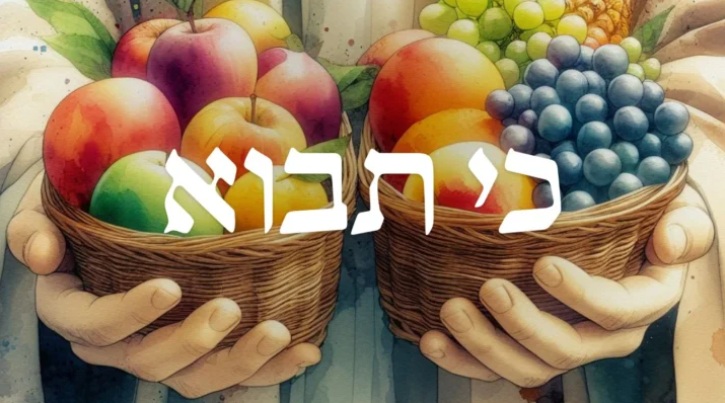
Bikkurim teach that success comes from Above: the Kohen's hands beneath the farmer's break the illusion of 'my own power and strength'.
Gematria links Amalek, doubt (safek), and bitterness (mar) — all equal to 240; the shofar of Rosh Hashanah is the antidote.
The real war against Amalek is fought in memory and thought: choosing daily which inner voices to host.
The 240 kabim of the mikveh and the 240 hours of the Ten Days of Teshuva form a 'mikveh of time'; after forty years, a mature heart finally unites reason and emotion for all of Israel.
The parashah lists ninety-eight fearsome warnings — the famous tokhecha. Yet the sages reveal their inner face: far from a mere list of threats, this is covenantal pedagogy — a harsh but loving way of reminding Israel what is at stake in its faithfulness.
Even this verse, which seems the depth of humiliation, hides a blessing: if no one buys, it is because Israel is simply not for sale. בני מלך, children of the King, are not traded in a marketplace.
The common custom is to read the tokhecha in a lowered voice, out of modesty before its harshness. Yet other teachers hold the opposite: raise the voice at the final verse — the very one declaring that "no one will buy" — because it is precisely there that redemption already quietly shows through: the realization that Israel belongs to Hashem alone.
The rite of bikkurim — bringing the first fruits of one's land to the Temple — recalls that success never comes from "my own power and the strength of my hand" (ko'hi ve'otzem yadi).
The Kohen's hands slide beneath the farmer's, under the basket he carries — a powerful image teaching that every flow of blessing comes from Above. And speaking aloud, as the verse demands, is done with a humble, lowly heart.
In this parashah, Amalek symbolizes doubt and the cooling of faith — the opposite of the enthusiasm that carried Israel out of Egypt.
This command does not order hatred of human beings: it is about erasing the memory of Amalek — the mental patterns that cool faith: cynicism, forgetfulness, discouragement, mockery of the good.
If Amalek = safek (doubt) = 240, then the 240 kabim of immersion and the 240 hours of the Aseret Yemei Teshuva form, together, a kind of mikveh of time. Studying every day during this period literally drains away doubt.
After forty years in the desert, a heart that understands is finally born — not because the Torah has changed, but because it is now claimed by all of Israel, and no longer by the tribe of Levi alone. Reason and emotion unite into responsible faithfulness.
At the "market" evoked by the tokhecha, no one pays for Israel — not out of contempt, but out of recognition: this people is simply not meant for slavery.
🎯 Test yourself
Five questions. Click an answer.
Result
Shalom Bayit — The Mouth at Home
My covenant of peace — peace begins at home. Reveal a Shalom Bayit card.
Gematria — Rav Ménaché
Shalom, Mashiah, Yisamech — secrets of the letters by Rav Ménaché zatsal.
🔢 Gematria CourseAll Parashot
All shiurim of M. Yéhouda Himi — from Bereshit to Devarim and the festivals.
📚 All ParashotBooks
Torah wisdom in thriller format — Éditions Gueoula.

Guardians of the Rift
Forty-nine gates open — the fiftieth hides in a single moment. An ancient secret resurfaces, and one man stands between the rift and the world. Drawn from Talmud and Kabbalah.
📖 Read the free excerpt · Book $9.90