"See" (רְאֵה) in the singular: the choice between blessing and curse is an intimate, personal decision, not a collective abstraction.
The unity of the place of worship (Beit Hamikdash) preserves the purity of divine service and forges the unity of the people of Israel.
True freedom comes through holy limits: Kashrut elevates the act of eating, and the ban on idolatry keeps our vision pure.
"You shall open your hand": Tzedaka, Shemita and support for the Levites translate spiritual vision into concrete generosity.
The reality we live is the fruit of what we choose to see and how we act upon it.
The parasha opens with a direct and personal call: "See, I place before you today the blessing and the curse". The use of the singular "See" (רְאֵה) teaches us that the fundamental choice of existence is not an abstract collective question, but an intimate, personal decision.
The Torah does not simply ask us to "know" or to "hear", but to "see". It calls us to develop a spiritual perception so clear that blessing and its opposite become tangible realities among which we must navigate. This vision is the first step toward a life of awareness and responsibility.
A major theme of Re'eh is the establishment of a single place chosen by Hashem for His service. The Torah commands the destruction of pagan altars and the ending of scattered divine service performed "in every place that you see".
This centralization of worship at the Beit Hamikdash (the Temple in Jerusalem) had a twofold purpose: to preserve the purity of divine service by distancing it from foreign influences, but above all, to forge the unity of the people of Israel. Gathering three times a year, the tribes connected not only to God, but also to one another, creating a spiritual and national heart.
The parasha warns us against the false freedom of "doing whatever is right in one's own eyes". True spiritual freedom is found in accepting divine limits that sanctify life.
The detailed laws of Kashrut (permitted and forbidden animals) teach us to elevate the most physical act – eating – into a conscious discipline. Likewise, the severe warnings against idolatry and false prophets call us to keep our spiritual vision pure and uncompromising.
These commandments are not constraints, but guardrails that allow us to stay on the path of blessing.
Spiritual vision must translate into concrete action. The parasha commands us to open our heart and our hand to our brother in need.
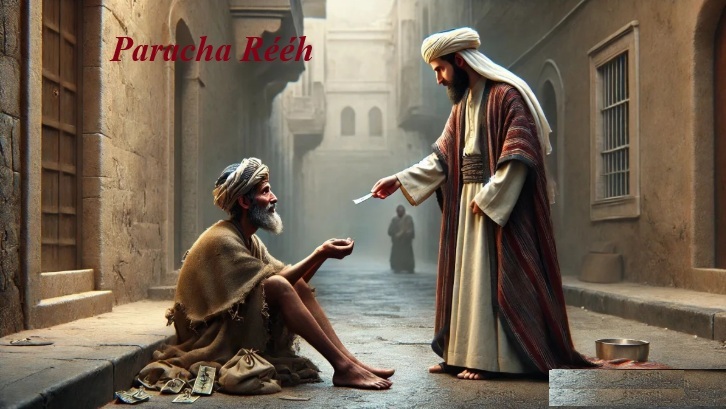
"You shall not harden your heart nor close your hand to your needy brother. But you shall surely open your hand to him." The laws of Tzedaka, of the Shemita year (cancellation of debts) and of support for the Levites are the social application of the command "See".
It is about "seeing" the suffering and need of the other and responding with an open heart and an open hand. Generosity is not an option, but the direct consequence of an authentic spiritual vision.
Parashat Re'eh is a guide for building a life of meaning. "Vision" is the connecting thread: it drives us to choose blessing, to unite in a holy place, to sanctify our daily life through clear limits, and to transform our society through compassion.
Ultimately, the parasha teaches us that the reality we experience is the fruit of what we choose to see and of how we act as a result.
🎯 Test yourself
Five questions. Click an answer.
Result
Shalom Bayit — The Mouth at Home
My covenant of peace — peace begins at home. Reveal a Shalom Bayit card.
Gematria — Rav Ménaché
Shalom, Mashiah, Yisamech — secrets of the letters by Rav Ménaché zatsal.
🔢 Gematria CourseAll Parashot
All shiurim of M. Yéhouda Himi — from Bereshit to Devarim and the festivals.
📚 All ParashotBooks
Torah wisdom in thriller format — Éditions Gueoula.
Guardians of the Rift
Forty-nine gates open — the fiftieth hides in a single moment. An ancient secret resurfaces, and one man stands between the rift and the world. Drawn from Talmud and Kabbalah.
📖 Read the free excerpt · Book $9.90