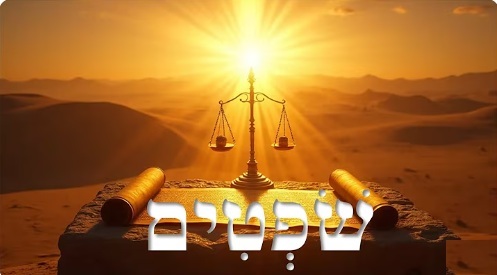
Elul is a crucial spiritual window, yet often underestimated. It is easy to fall into the trap of procrastination and wake up too late, losing a unique chance to rebalance our spiritual scales.
Limited window We have only 27 days between Elul and Yom Kippur to effect meaningful spiritual transformation. Every moment counts.
The procrastination trap Many "fall asleep" during Elul, realizing the urgency only at the last moment, which limits their ability to do deep Teshuva.
The power of one Mitzvah A single good deed, done with intention, can trigger a chain of thousands of other Mitzvot, creating a positive ripple effect.
Tzedaka as an accelerator When in doubt about a Tzedaka obligation, it is always better to give twice than not to give at all.
Our spiritual balance is in deficit. The time is for immediate action, not waiting.
2 The Foundations of Justice According to Torah
Parashat Shoftim is fundamental to understanding how to build a just society. These principles are not merely theoretical — they must apply to every individual and every level of society.
צֶדֶק צֶדֶק תִּרְדֹּף — "Justice, justice you shall pursue."Deuteronomy 16:20
Tzedek Tzedek Tirdof An active, proactive search for good, not mere passivity in the face of injustice.
Integrity of judges The Torah forbids any bribe, even symbolic, because corruption blinds even the wisest and most upright.
Reliable testimony The validity of a judgment rests on upright, Mitzvah-observing witnesses.
Responsible leadership Leaders exist to serve the people, not to pursue their own interests.
3 The People and the Search for Truth
When it is said, "You shall set judges and officers for yourself in all your gates," the verse writes "amekha" (your people) and not "Bnei Yisrael." The word "people" sometimes refers to the Erev Rav, the mixed multitude. The meaning: we must remain vigilant and search for truth without bias, including toward ourselves.
Seeing our own faults The Torah urges us to examine ourselves carefully. As the proverb says: "A man sees all the faults of others except his own." It is therefore crucial to have an outside view — a trusted friend or a Rav — capable of showing us our own shortcomings with benevolence. This is the foundation of genuine introspection and sincere Teshuva.
To see our own faults and do genuine Teshuva, we need an external mirror — a just and impartial gaze.
4 The Torah Model of Leadership: The King's Example
The Torah presents an ideal of leadership that contrasts sharply with contemporary models of power. The ideal king is one who remains humble and constantly connected to the Torah.
National origin The leader must come from the people he leads.
Moderate wealth Excessive accumulation of goods is forbidden, to prevent corruption and disconnection from the people.
Constant study The king must always have a Sefer Torah at his side, guiding his decisions.
Humility Even a king as great as David checked the laws of Nida like an ordinary citizen, illustrating the importance of humility.
Power without limits corrupts. The Torah establishes clear boundaries for just and upright leadership.
5 Yehoshua Ben Perachia and His Student: Forgiveness and Tolerance
This story illustrates an essential lesson about the importance of giving the benefit of the doubt and forgiveness — especially during the month of Elul.
Judge everyone favorably and know how to forgive Yehoshua Ben Perachia erred by not judging his student favorably and by rejecting his Teshuva. This tragic incident teaches us that we must always give others the benefit of the doubt and be ready to accept repentance, even if it is not perfect. During Elul, we must open our hearts to mercy and mutual forgiveness, so that G-d will also forgive us.
הֱוֵי דָן אֶת כָּל הָאָדָם לְכַף זְכוּת — "Judge every person favorably."Pirkei Avot 1:6
6 From Knowledge to Action: The Heart of the Message
The central message is clear: listening is not enough. Real spiritual transformation comes from concrete action. Elul is the opportunity to translate good intentions into deeds.
Spreading Torah Sharing a class, a Torah idea, can have an enormous impact and transform lives far beyond our immediate circle.
Personal domino effect A single motivated, action-oriented person can influence an average of four others, creating a virtuous circle.
Personal responsibility Every observant Jew has the duty to spiritually "adopt" less observant Jews nearby, guiding them on the path.
Strategic use of technology The internet and social media are powerful tools for spreading Torah wisdom and reaching a wider audience.
🎯 Test yourself
Five questions. Click an answer.
1
How many days does the teaching say separate Elul from Yom Kippur?
The text emphasizes that there are only 27 days between Elul and Yom Kippur to effect meaningful spiritual transformation.
2
What does "Tzedek Tzedek Tirdof" mean?
It is an active, proactive search for good, not mere passivity in the face of injustice.
3
What does the Torah say about a judge accepting even a symbolic bribe?
The Torah forbids any bribe, even symbolic, because corruption blinds even the wisest and most upright.
4
What quality does the Torah require of the ideal king?
The ideal king remains humble, comes from the people, keeps wealth moderate, and always has a Sefer Torah at his side.
5
What mistake did Yehoshua Ben Perachia make toward his student?
He erred by not judging his student favorably and rejecting his Teshuva — a tragic incident that teaches us to always give the benefit of the doubt.
Result
📅 Weekly Program for Elul
Sunday
Sunday — Identify your "outside judge": who tells you the truth?
Every week, straight to your inbox. No spam. One-click unsubscribe.
🕯️ Dedicate This Shiur
Dedicate this shiur for the days of Bein HaMetzarim — in memory, for healing or for success.
Guardians of the Rift
A spiritual thriller · David Goldberg
Forty-nine gates open — the fiftieth hides in a single moment. An ancient secret resurfaces, and one man stands between the rift and the world. Drawn from Talmud and Kabbalah.