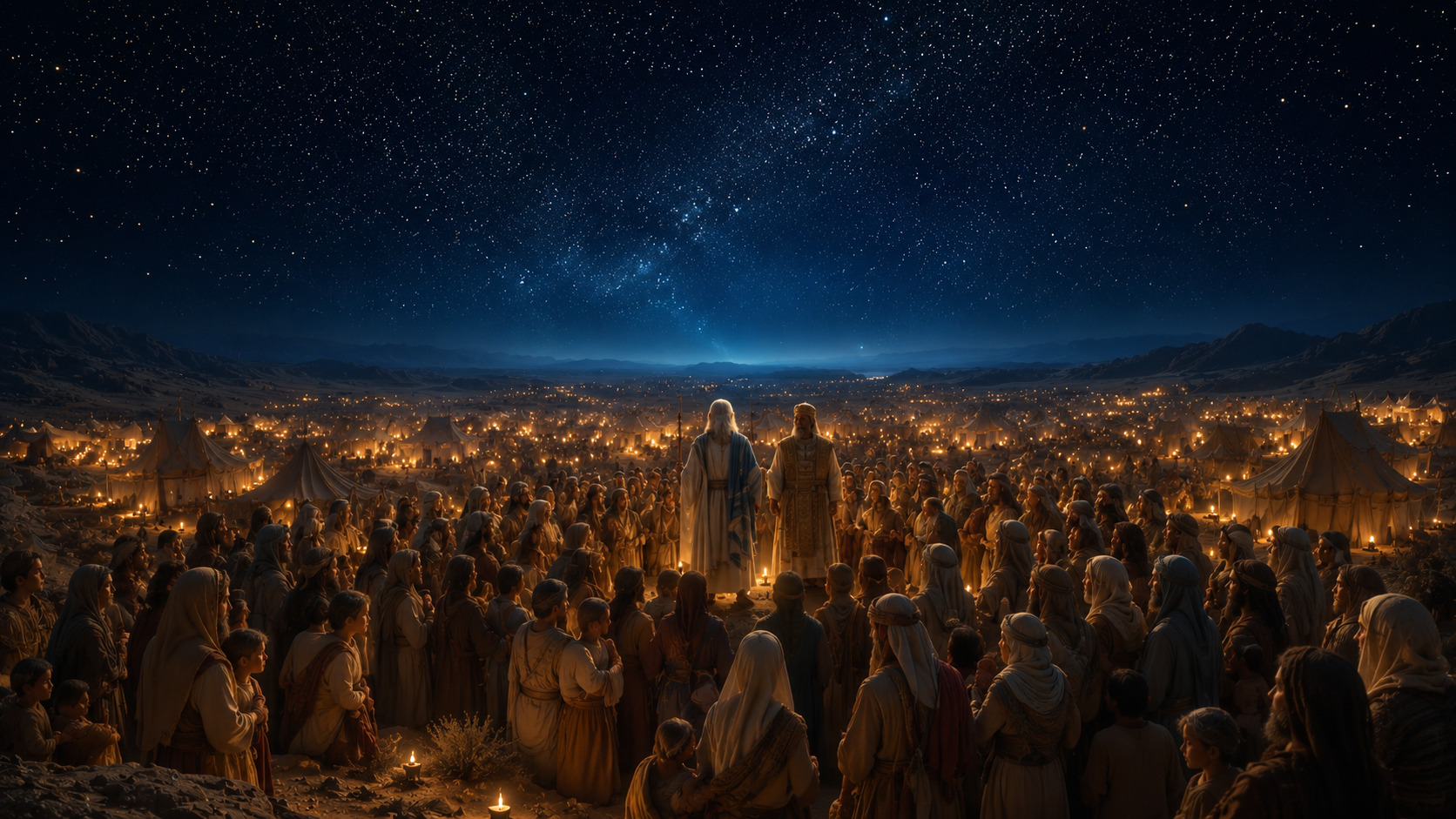
Parashat Chukat
Parashat Chukat · 5786
The Red Heifer, the Rock & the Death of Aaron
The law beyond reason — and the hidden drama of Parashat Chukat
Based on the shiur of M. Yéhouda Himi
Parashat Chukat opens the way no parasha dares to: with a command that has no reason. A flawless red cow is burned to ash, mixed with living water, and it purifies whoever touched death — while it defiles whoever prepares it. From there the parasha moves through the death of Miriam, the rock that cost Moshe the Land, the passing of Aaron, and a final secret about why we are partners of Heaven at all. Many doors, one parasha. We will open them one by one.
1 The Law With No Reason
We understand "do not steal." We even sense why we honour a father. But the red heifer? You burn a perfect cow to ash, sprinkle its water, and it purifies the one who touched a corpse — yet defiles the one who prepares it. No logic touches it. So why does the Torah call it not "the law of the cow," but the law of the whole Torah?
This is the statute of the Torah which the L-rd has commanded, saying: Speak to the Children of Israel, that they bring you a perfectly red cow…Bamidbar 19:2
There are three tiers of mitzvot. Edot — testimonies the heart already senses (honouring parents, Shabbat as witness). Mishpatim — civil laws reason demands, for no society stands without them (do not steal, do not murder). And chukim — decrees the mind cannot enter at all. The red heifer is the supreme chok: chukah chakakti, gezerah gazarti — "I have decreed it; you have no permission to question."
When you keep only what you understand, your service has a condition attached — and the one setting the condition is you. The chok removes the condition. It dethrones your verdict and seats His.
⭐ That is why it is "chukat haTorah," not "chukat haPara." The heifer is not one strange law among many. It is the posture that makes the entire Torah yours: bittul hasechel — the surrender of your own judgment.
2 Why Heaven Hides the Reasons
If a reason elevates us, why does the Torah almost never give one? It tried — exactly once — and the result is a warning carved into Scripture.
He shall not multiply wives for himself, that his heart turn not away; nor shall he greatly multiply silver and gold.Devarim 17:17
For the king, the Torah broke its silence. Why may he not multiply horses? Lest he send the people back to Egypt. Why not multiply wives? Lest they turn his heart. The reasons were printed in the open — and the wisest man who ever lived read them and said: I will multiply, and my heart will not turn. The Gemara (Sanhedrin 21b): "the reason of the verse was revealed — and he stumbled in it." R' Yishmael, certain he would not tilt the lamp on Shabbat, almost tilted it.
"Amarti achkimah — vehi rechokah mimeni." "I said I will outwit it — and it was far from me." Shlomo signs the verse: mimeni — because of me. I am the proof.
⭐ The reason is not hidden because there is none. It is hidden because the instant you hold it, you begin to bargain with it — "the reason doesn't apply to me." So Heaven keeps the reason, and gives you the command.
3 The Cure Made Before the Wound
The red heifer purifies corpse-impurity through the Mishkan and the kohanim. So when was it first taught? You would guess: at Sinai, with the Tabernacle. The Torah says otherwise — and the place it names has no Mishkan, no kohanim, no impurity yet.
There He set for them a statute and a law, and there He tested them.Shemot 15:25 — at Marah
Days after the splitting of the Sea, at the bitter waters of Marah — before the Golden Calf, before the Mishkan stood — Rashi says God handed Israel a few portions of Torah to begin learning: Shabbat, the red heifer, and civil law. The remedy for the calf was given before the calf was ever made. (Some read "para aduma" here as a copyist's slip — M. Himi holds the text stands: the heifer truly was first taught at Marah, and that is the point.)
The antidote was prepared before the poison was poured. The cure has an earlier date than the wound.
⭐ This is how Heaven works with you. The forgiveness is older than your sin. Before you ever fall, the way back has already been written into the Torah.
4 Let the Mother Clean Her Child
Miriam dies — and the Torah lays her death directly beside the red heifer. Rashi: as the offerings atone, so the death of the righteous atones. Fair. But then place her death beside the offerings. Why beside the heifer of all things?
And Miriam died there, and she was buried there. And there was no water for the congregation…Bamidbar 20:1–2
The Midrash on the heifer: "let the mother come and clean the mess of her child" — the cow atones for the calf. But the Calf hid a second, darker sin the Torah will not say aloud: the murder of Hur, son of Miriam, who stood against the mob and was killed. The Torah, out of mercy for Israel, leaves it in the Midrash and off the page.
The cow-mother cleans the calf. And Miriam — the literal mother of the murdered son — cleans, by her own death, her child's spilled blood. Two mothers, one atonement.
⭐ That is why her death sits beside the heifer and nowhere else. It is not "death of the righteous" in the abstract — it is a mother answering for a child, exactly like the cow.
5 Strike the Rock — Speak to the Rock
At Refidim, beside the Sea, God told Moshe: strike the rock. Forty years later, at Mei Meriva: speak to it. He struck — and lost the Land. If striking was right then, why was it a sin now?
Take the staff… and speak to the rock before their eyes, and it shall give forth its water.Bamidbar 20:8
Rashi: he struck twice because the first blow yielded only drops. M. Himi opens the deeper drama: when Miriam died, her well rolled away and hid among the other rocks. Moshe spoke — but to the wrong stone, and nothing came. He struck once to expose it — drops; then struck the true rock — a flood. The lesson underneath: a toddler who grabs a live socket you correct with a tap; a grown son you correct with a word. At the Sea, Israel was two years old. Now Israel was forty — a nation that had grown.
The Song of the Sea is "Az yashir Moshe" — Moshe leads, they repeat after him. The Song of the Well is "Az yashir Yisrael" — Moshe is not named. They compose it themselves.
⭐ You teach a child with a blow and a grown person with a word — chanoch lanaar al pi darko. Moshe corrected a matured people the way you correct an infant. That was the gap.
6 Why Moshe Sold His Own Entry
Whatever the exact mechanics at the rock — why did so small a thing cost Moshe and Aaron the entire Land? And why does Rashi insist it was "this alone"?
Because you did not believe in Me, to sanctify Me before the eyes of the Children of Israel — therefore you shall not bring this assembly into the Land.Bamidbar 20:12
The true reason they could not enter was the decree on the desert generation — and they belonged to it. But Heaven would not publicise that Moshe was barred "because of the spies." So Mei Meriva became the dignified, public reason — a handle to hold. And deeper still: had Moshe spoken and the rock obeyed, Israel would face a crushing kal vachomer — "a deaf, dumb rock obeys God; and you, stiff-necked ones, do not?" By striking instead, Moshe denied that accusation its witness.
He gave up the Land so that the rock could never testify against Israel. The sin at Mei Meriva was, at its root, an act of mesirut nefesh.
⭐ Moshe is sealed in Netzach — eternity. Had he entered and built the Temple, it could never fall — and Heaven knew it would one day have to let the Temple fall, rather than pour its anger on a generation. "Rav lach" — you have far more than the Land: first redeemer, and the last.
7 The Garments That Knew Their Owner
God tells Moshe: strip Aaron of the priestly garments and dress Elazar in them. Picture it on a mountaintop — eight garments, an aging father, a son of a different height. How do you undress one and robe the other, in order, in full dignity, with nothing exposed?
Strip Aaron of his garments and clothe Elazar his son in them; and Aaron shall be gathered and die there.Bamidbar 20:26
Sforno reads it plainly — it was done in natural order. Ramban reads a miracle: garments of the Shechina clothed Aaron underneath before a single thread was removed; and the holy garments fit themselves to Elazar's own measure — like the clothes that never wore out and grew with Israel for forty years in the desert.
Your garments are your measures. What you wear is what you have become. The priestly garments recognised their new owner and shaped themselves to him.
⭐ Aaron died by the divine kiss, robed in light before he was ever bared. The High Priesthood did not end on that mountain. It changed shoulders.
8 The Only Reason We Are His Partners
Aaron's death is told twice — here, and again in Masei with its exact date. Why repeat it? Because Masei is read at the start of Av — Aaron's yahrzeit, the man who "loved peace and pursued peace." His memorial Shabbat. And the road back to the Third Temple, lost to baseless hatred, is baseless love.
For I have known him, that he will command his children… to keep the way of the L-rd, to do righteousness and justice.Bereshit 18:19
At Sdom, God pauses: "Shall I hide from Avraham what I am about to do?" Why consult a man before judging a city? The verse answers: for I have known him — that he will command his children to keep the way of the L-rd. The one thing that makes Avraham a partner of Heaven is that he will hand the path on — to a son, to a household, to the generations.
The single thing that makes us partners of Heaven is that we transmit the Torah — rebbe to talmid, parent to child, friend to friend. Not as heirlooms. As living fire, passed hand to hand.
⭐ Cut the chain and the partnership ends. Keep it — teach one person one thing this week — and you pull the redemption one link closer.