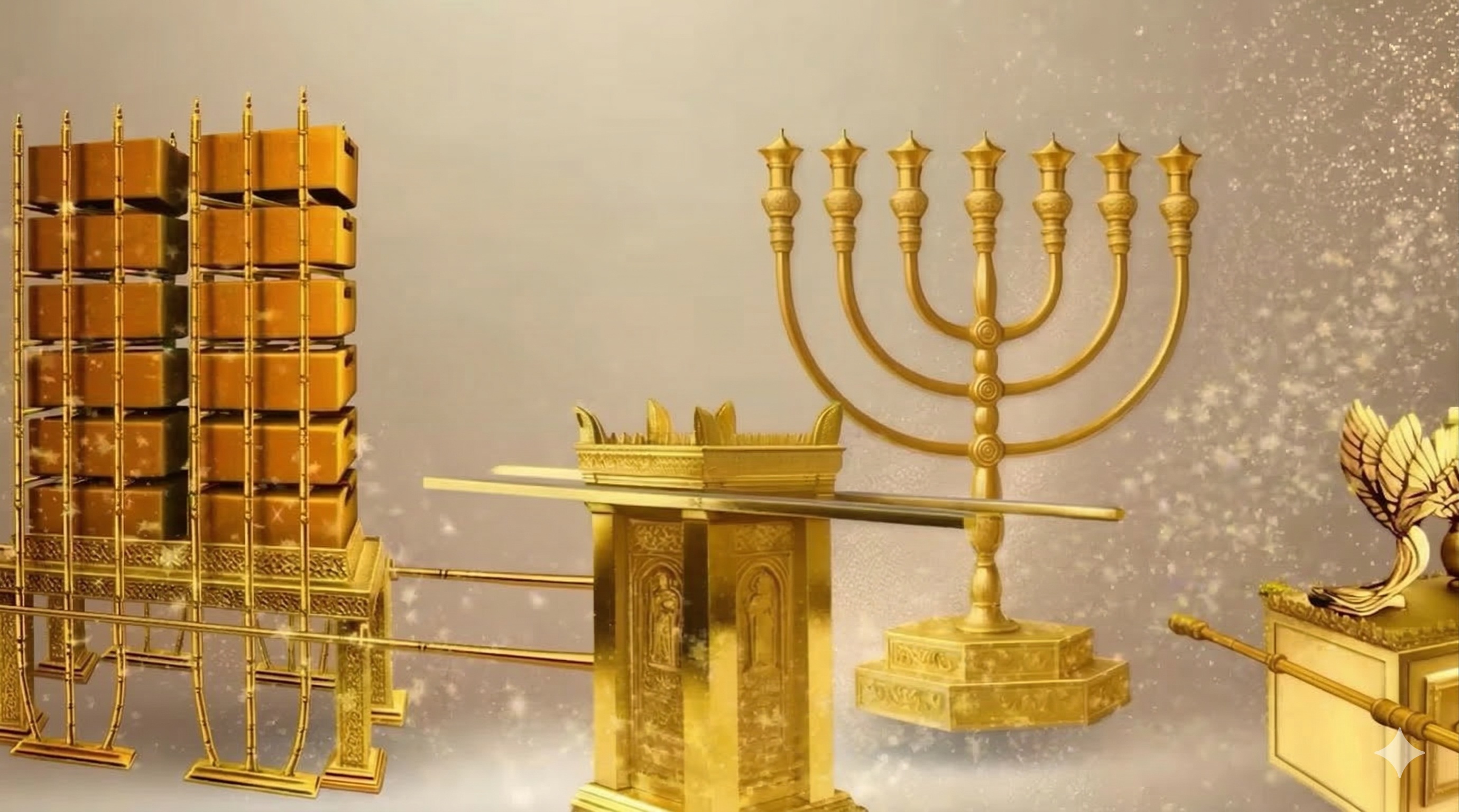
The Mishkan, Mirror of Creation
Parashat Vayakhel · The Mishkan, Mirror of Creation · Sefer Shemot · 5786
Shabbat, forgiveness, and the return of the Divine Presence
The Mishkan, Mirror of Creation
A shiur by M. Yéhouda Himi
Shabbat, forgiveness, and the return of the Divine Presence
A shiur by M. Yéhouda Himi · The Mishkan, Mirror of Creation · Sefer Shemot · 5785

Shabbat precedes the Mishkan to teach that its construction never overrides Shabbat, the source of the 39 forbidden labors.

Removing the Golden Calf reveals the Torah's “business as usual”: “Take for Me” becomes “Take from among you” — total forgiveness.

“You shall not kindle fire” also means the fire of quarrel: anger is equivalent to idolatry.

The end of Pekudei echoes Creation word for word (vayechulu / vatechal): the Mishkan mirrors Creation.

Without a Mishkan today, each of us becomes a sanctuary: “I will dwell among them,” within each person.

📖 Full Text
1 Why Shabbat Before the Mishkan?
The classic question Why does Parashat Vayakhel open with the commandment of Shabbat, before Moses commands Israel to build the Mishkan? What is the connection?
אֵלֶּה הַדְּבָרִים אֲשֶׁר-צִוָּה ה' לַעֲשֹׂת אֹתָם: שֵׁשֶׁת יָמִים תֵּעָשֶׂה מְלָאכָה, וּבַיּוֹם הַשְּׁבִיעִי יִהְיֶה לָכֶם קֹדֶשׁShemot 35:1-2

“These are the things the Lord commanded to do: six days work shall be done, but the seventh day shall be holy for you.” The classic answer: building the Mishkan does not override Shabbat. However great the enthusiasm to build, on Shabbat everything stops. And more: from here we learn the 39 prohibited labors — the very labors used to build the Mishkan are those forbidden on Shabbat.

Fire, the primal energy “You shall not kindle fire in any of your dwellings on the Sabbath day.” Fire is the foundation, the basic energy from which all work is born. Without fire there is no labor; so fire is singled out as the archetypal example of the whole category.

But there is a far deeper original interpretation here — and to reach it, we must perform a mental exercise.

2 Business as Usual — Without the Golden Calf
A thought experiment Imagine we remove from the Torah entirely all the sections about the sin of the Golden Calf. What would have happened? What was the intended order?

Moses ascended Sinai for 40 days and 40 nights. God taught him Teruma and Tetzaveh, all the details of the Mishkan. What was the very last thing God said before he descended?

“Nevertheless, you must keep My Sabbaths… it is a sign forever between Me and the children of Israel.” Then: “He gave Moses the two Tablets of Testimony.” And immediately: “The people saw that Moses was late in descending… Make us a god.”

So the last thing God commanded Moses before descending was the commandment of Shabbat — and what came right after was the Golden Calf. Remove that sin: Moses would have descended, assembled Israel, and told them first of all Shabbat, then continued to the building of the Mishkan, exactly as in Teruma.

Notice the striking precision. Teruma says: “Take for Me a donation”; Vayakhel says: “Take from among you a donation for God.” The same words. As if the Torah “cut out” the Golden Calf and “pasted” the sequence back from the very same point.

Business as usual The message: God says, “I have forgiven you wholeheartedly. No looking back. We continue from exactly where we stopped, as if nothing happened.” This is the true power of genuine forgiveness.
3 Do Not Kindle Fire — Do Not Ignite Quarrel
Why this fire? Of all 39 labors, why is only one singled out explicitly: “You shall not kindle fire”? What is special about it?

The Mussar masters reveal a profound reading: “You shall not kindle fire in any of your dwellings” — not only physical fire, but the fire of quarrel. Do not ignite the flame of anger on Shabbat.

On Shabbat, freed from weekday work, people sit, eat, and talk — and sometimes table conversation ends in argument. Precisely on Shabbatot and holidays, when everyone is together, tensions rise. So the Torah warns.

Anger and idolatry Before building the Mishkan, God warns: do not repeat the Golden Calf. Translated into daily life — anger is equivalent to idolatry. Do not kindle fire = do not get angry = do not worship idols on Shabbat.
4 The Mishkan Mirrors Creation
“Mishkan ha'Edut” Why does Pekudei say “Mishkan of Testimony” — a seemingly needless repetition? And what connects the Mishkan to the six days of Creation?
“Mishkan ha'Edut — for it comes to testify about the work of heaven upon earth, as it is said: I call heaven and earth as witnesses against you today.”

At the end of Pekudei is a breathtaking word-for-word parallel. Creation: “Vayechulu hashamayim veha'aretz” (heaven and earth were completed) — Pekudei: “Vatechal kol avodat Mishkan” (all the work of the Mishkan was completed). The same root. Creation: “God saw all that He had made” — Pekudei: “Moses saw all the work.” Creation: “God blessed the seventh day” — Pekudei: “Moses blessed them.”

The parallel is not coincidental: the Mishkan is a mirror of Creation. The seventh day, Shabbat, corresponds to the Mishkan itself.

Betzalel's wisdom The Talmud (Berakhot 55) teaches: “Betzalel knew how to combine the letters with which heaven and earth were created.” Building the Mishkan was literally a re-enactment of the act of Creation.
5 The Purpose of the Mishkan — Restoring the Presence
What does it repair? If the Mishkan mirrors Creation, what exactly was broken in Creation, and what does the Mishkan come to repair?

God created the world in six days and placed Adam in Eden. But already on the sixth day Adam sinned and caused damage: the Shechina, which had dwelt in the lower world, departed. From then until today, all of history is a journey to bring it back.

Israel descended to Egypt, endured its trials, was purified — and at Sinai reached the level of Adam before his sin, standing before God as a wholly pure people. What must they do then? Capture the departed Shechina and bring it into the Mishkan, drawing divine holiness down into the physical world.

“On the day of the inauguration of the Mishkan there was joy before God — like the day on which heaven and earth were created.”

Today, without a Mishkan, the Mishkan is within our hearts. “Make Me a sanctuary and I will dwell among them” — not “within it,” but “among them,” within each of us. The more we fill our hearts with Torah and mitzvot, the more we ourselves become the Mishkan.

Toward the Third Temple With God's help, when the Third Temple is built, the Shechina will descend and return, and there will be joy before God as on the day heaven and earth were created. Blessed is God forever, amen and amen.

🎯 Test yourself

Five questions. Click an answer.

1
According to the classic answer, why is Shabbat placed before the Mishkan?
However great the enthusiasm to build, on Shabbat everything stops; from here we learn the 39 forbidden labors.
2
Which phrase, identical to Teruma, appears in Vayakhel and signals “business as usual”?
Teruma: “Take for Me”; Vayakhel: “Take from among you” — as if the Golden Calf was removed and the sequence rejoined.
3
Beyond the literal sense, what does “you shall not kindle fire” refer to per the Mussar masters?
The fire of quarrel; anger is compared to idolatry, the Golden Calf translated into daily life.
4
Which word at the end of Pekudei echoes “Vayechulu” of Creation?
“Vatechal kol avodat hamishkan” shares the root of “Vayechulu hashamayim”: the Mishkan mirrors Creation.
5
What does the verse “I will dwell among them” (betocham) emphasize?
It says not “within it” but “among them”: each of us becomes a Mishkan by filling our heart with Torah and mitzvot.

Result

📅 Seven-Day Programme — Parashat Vayakhel
Sunday
Sunday — Study the final verses of Ki Tissa: what was the last thing God told Moses before he descended? What is the “last thing” you remember from every important conversation?
Monday
Monday — Compare “Take for Me” (Teruma) and “Take from among you” (Vayakhel). What does it mean to continue “as if nothing happened”? Who deserves “business as usual” from you?
Tuesday
Tuesday — Reflect on “do not kindle fire.” Which topic “ignites” every Shabbat at your table? Prepare a calm response in advance.
Wednesday
Wednesday — Read the final verses of Pekudei (vatechal, vayar, vayevarech) and feel the parallel with Creation. What in your life ended in a way that felt complete?
Thursday
Thursday — Study Betzalel and his knowledge of the letters with which heaven and earth were created. Which Hebrew letter resonates most with you, and why?
Friday
Friday — Before Shabbat begins, read “Make Me a sanctuary and I will dwell among them.” How can your home be a Mishkan? What one thing can you change this Shabbat?
Shabbat
Shabbat — Feel that you yourself fulfill the role of the Mishkan. By sanctifying Shabbat, the Shechina rests within you: the small mirror of the day heaven and earth were created.
Four Practical Steps
🏠

Shalom Bayit — The Mouth at Home

My covenant of peace — peace begins at home. Reveal a Shalom Bayit card.

🔢

Gematria — Rav Ménaché

Shalom, Mashiah, Yisamech — secrets of the letters by Rav Ménaché zatsal.

🔢 Gematria Course
📝

Torah Study

Dig deeper into the Baal HaTurim and Rashi on Parashat Devarim.

📝 Beith Hamidrach
📚

All Parashot

All shiurim of M. Yéhouda Himi — from Bereshit to Devarim and the festivals.

📚 All Parashot
📕

Books

Torah wisdom in thriller format — Éditions Gueoula.
🌙

Dream Interpretation

Did you dream? Check the meaning according to Rav Almoli.

🌙 Dreams
🎬

Videos

Video shiurim on the festivals, the Menorah and the secrets of the Mishkan.

🎬 Videos
💡

Idea Box

An idea, a remark, a suggestion for the site? Share it with us.

💡 Idea Box
🤝

Maasser

Give your Maasser and take part in spreading Torah.

🤝 Maasser
📨 Get the Weekly Shiur
Every week, straight to your inbox. No spam. One-click unsubscribe.
🕯️ Dedicate This Shiur
Dedicate this shiur for the days of Bein HaMetzarim — in memory, for healing or for success.
🧱 Wall of Dedications →
Guardians of the Rift

Guardians of the Rift

A spiritual thriller · David Goldberg

Forty-nine gates open — the fiftieth hides in a single moment. An ancient secret resurfaces, and one man stands between the rift and the world. Drawn from Talmud and Kabbalah.

📖 Read the free excerpt · Book $9.90