In Parashat Yitro we read of the Ma'amad Har Sinai, the giving of the Torah. Yet the Torah is given only to one who shows humility (Anava).
The central thread From the first verse to the last, the theme of humility accompanies every episode of the Parasha. Let us follow it, scene by scene.
This shiur is dedicated to the neshamot of Yitzhak ben Rachel, Shalom ben Tzur ben Nekhia, and Ben Shir.
2 Moshe the Waiter — Humility in Action
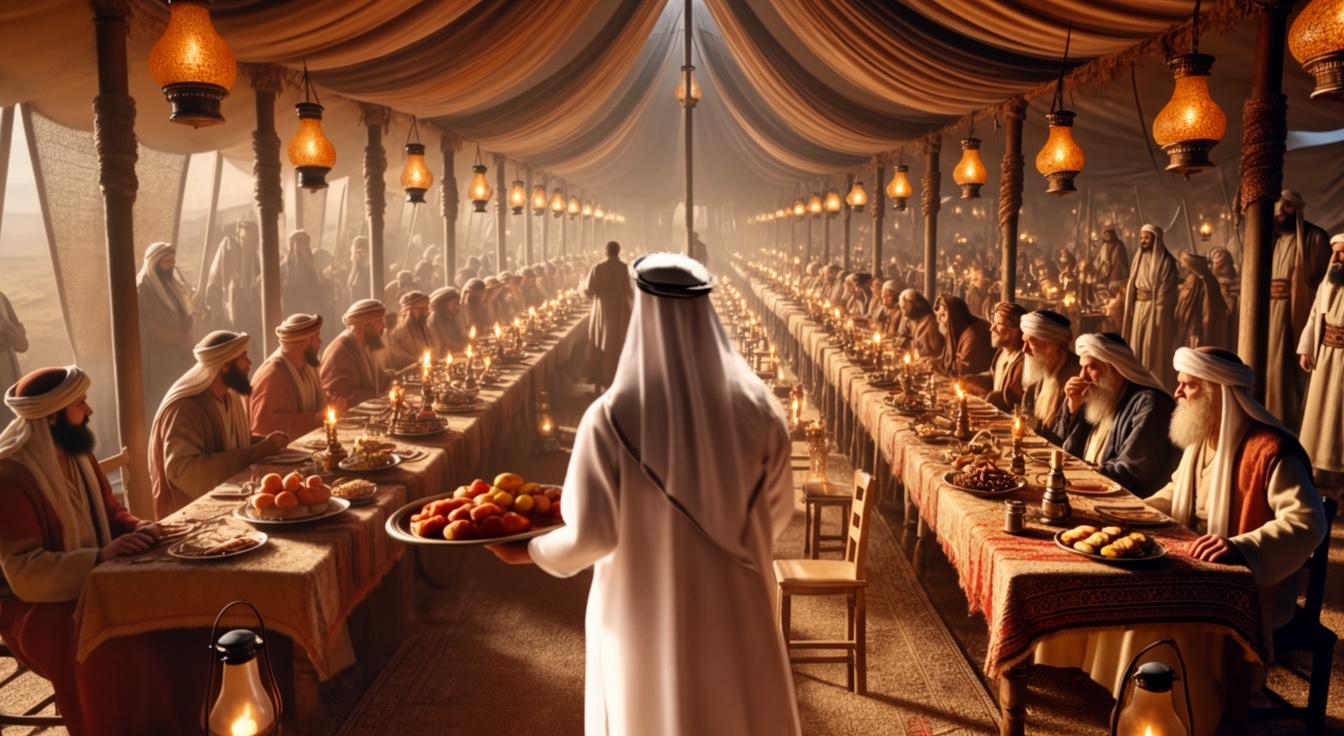
The Parasha is called "Yitro" because this priest of Midian, Moshe's father-in-law, heard all that had happened — the splitting of the sea, the war against Amalek, all the miracles — and came with Tzipporah and the children. Moved by Hashem's kindnesses, he offered sacrifices and made a feast.
"And Aharon and all the elders of Israel came to eat bread with Moshe's father-in-law before God."
Who is missing from this feast? Moshe! He is the one who welcomed Yitro; he should be at the head of the table. Where has he gone?
Rashi answers: Moshe was standing and serving them! No more, no less — Moshe Rabbeinu was the waiter at the meal.
The level of humility The leader of Israel, to whom Hashem speaks face to face, became a waiter at his father-in-law's table. This is how far true humility reaches.
The next day Yitro sees Moshe judging the people from morning to night and says: "What you are doing is not good; you will exhaust yourself." Moshe could have replied that even at 120 "his eye did not dim," that he managed alone. Instead he listens and appoints leaders of 10, 50, 100 and 1000.
Listening despite one's knowledge Moshe knew Hashem Himself would later command these very appointments (Devarim). He could have said, "I need no priest of Midian." Yet he accepts the advice with submission and does all Yitro said.
3 The Dispute of the Mountains and the Secret of Sinai
The Midrash tells that the mountains argued over which one Hashem would give the Torah upon. Tavor: "I am tall!" Hermon: "I am white and beautiful, as for a wedding!" Carmel: "I am green and lush!" Har Sinai, however, stayed silent.
Where is the humility? Sinai is a small mountain with no height, beauty or greenery. What merit is there in staying silent when one has nothing to say? Like an unattractive person who simply doesn't step onto the stage at a beauty contest.
The true secret At the start of Sefer Shemot, at the burning bush, Moshe stood on Har Chorev — which is Har Sinai. There the mountain heard the divine promise.
"So that you shall serve God on this mountain." The word תַּעַבְדוּן, with a final Nun, hints at the 50 days after which Israel would receive the Torah. Sinai therefore already knew it held the promise — and still it stayed silent.
True humility This is not the humility of one who has nothing, but of one who has everything, a real advantage, and yet chooses to remain silent.
4 "Moshe Kibel Torah MiSinai" and the Humility of Hashem
מֹשֶׁה קִבֵּל תּוֹרָה מִסִּינַי — "Moshe received the Torah from Sinai."
A strange phrasing One would expect "beSinai" (at Sinai). "MiSinai" means "from Sinai," as though the mountain handed him the Torah with its own hands.
The deep meaning Moshe possesses all his Torah through the lesson learned from Sinai: humility. The Torah attests: "the man Moshe was the most humble of all men" (Bamidbar 12:3). This is why he transmits the Torah to Israel.
From whom can we learn the pinnacle of humility? From Hashem Himself.
Hashem, who has no body and no form, "descends" (kavyachol) from His greatness to rest His Shechinah upon the mountain and give the Torah to Israel. Who is more humble than the Master of the Universe, who agrees to lower Himself to grant this immense gift to His people?
5 The First Mitzvah: The Altar of Earth
After the Ma'amad Har Sinai, with the thunder, lightning and smoke, what will be the first Mitzvah after the Ten Commandments? One expects Shabbat, Tefillin, or "Build Me a Sanctuary of gold and silver."
מִזְבַּח אֲדָמָה תַּעֲשֶׂה לִּיShemot 20:21
Earth! The humblest material in nature, found everywhere. No gold, no magnificent Sanctuary. "You saw My greatness? Make Me an altar of the most modest material there is."
And if you make an altar of stones, do not even hew them: take them as they are, rough and imperfect. The material is worth nothing — humility is what counts.
6 The Steps of the Altar — Respecting Others
The last verse of the Parasha holds a surprising Mitzvah. The altar was five cubits high; to ascend it one used a Kevesh (a gentle ramp), not steps.
If the Kohen climbed steps he would lift his leg, and the stones of the floor would "see" his nakedness and be "embarrassed."
Can a stone feel? Does a stone have eyes? What sense is there in sparing the modesty of the inanimate?
Kal vachomer If the Torah cares for the honor of the domem (the inanimate), how much more should you imagine what your fellow feels when you humiliate him.
Ambition and the fall Chazal add: one who climbs in rank (ma'alot) and tramples those beneath him will end with תִּגָּלֶה עֶרְוָתְךָ — his shame exposed, collapsing all at once. The Parasha begins and ends with humility.
7 The Gematria: Anava versus Samael
Anava = 131 On the side of Kedushah, Anava (humility) equals 131. But "ze le'umat ze asa Elokim": facing holiness, God created impurity as its mirror.
The name of the Sitra Achra, סמא״ל (Samael), also equals 131.
The teaching One who does not practice humility lets the Sitra Achra seize him. To repel it, cultivate Anava, of equal value. The more humble we are, the more room we leave for the Shechinah and the nearer we draw the Redemption.
בָּרוּךְ ה׳ לְעוֹלָם אָמֵן וְאָמֵן — may Hashem grant us always to live in Kedushah and humility.
🎯 Test yourself
Five questions. Click an answer.
1
According to Rashi, where was Moshe during the feast of Aharon and the elders with Yitro?
Rashi teaches that Moshe stood and served the guests — humility in action.
2
Why was the Torah given specifically on Har Sinai?
Sinai, having heard the promise at the burning bush (Har Chorev), had a real advantage yet stayed silent — true humility.
3
What does the phrase 'Moshe kibel Torah miSinai' teach according to the shiur?
'MiSinai' (from Sinai) teaches that Moshe possessed his Torah through humility, of which Sinai was the teacher.
4
What is the first Mitzvah commanded after the Ten Commandments?
'Mizbeach adama taaseh li' — an altar of the humblest material, earth, to teach humility.
5
What is the gematria of Anava, and what does the shiur set against it?
Anava = 131 = Samael: practicing humility repels the Sitra Achra and makes room for the Shechinah.
Result
📅 A Seven-Day Programme — Parashat Yitro
Sunday
Sunday: Reread Parashat Yitro, tracing every scene where humility appears, from Yitro's feast to the steps of the altar.
Monday
Monday: Like Moshe the waiter, quietly perform a humble service for someone — serve at the table, clear dishes, help unnoticed.
Tuesday
Tuesday: Like Moshe heeding Yitro, accept a piece of advice without defending yourself, even from someone you deem less learned.
Wednesday
Wednesday: Practice the humility of Har Sinai — stay silent once where you could have claimed credit or had the last word.
Thursday
Thursday: Study the verses of the Mizbeach Adama and reflect that God prefers the humblest material over gold; cut one prideful expense.
Friday
Friday: Guard another's honor (the kal vachomer from the stones) — humiliate no one, and mend a hurtful word before Shabbat.
Shabbat
Shabbat: Contemplate the gematria Anava = 131, resolve to give the Shechinah more room, and give thanks for the gift of the Torah.
Four Practical Steps
🏠
Shalom Bayit — The Mouth at Home
My covenant of peace — peace begins at home. Reveal a Shalom Bayit card.
🔢
Gematria — Rav Ménaché
Shalom, Mashiah, Yisamech — secrets of the letters by Rav Ménaché zatsal.
Every week, straight to your inbox. No spam. One-click unsubscribe.
🕯️ Dedicate This Shiur
Dedicate this shiur for the days of Bein HaMetzarim — in memory, for healing or for success.
Guardians of the Rift
A spiritual thriller · David Goldberg
Forty-nine gates open — the fiftieth hides in a single moment. An ancient secret resurfaces, and one man stands between the rift and the world. Drawn from Talmud and Kabbalah.