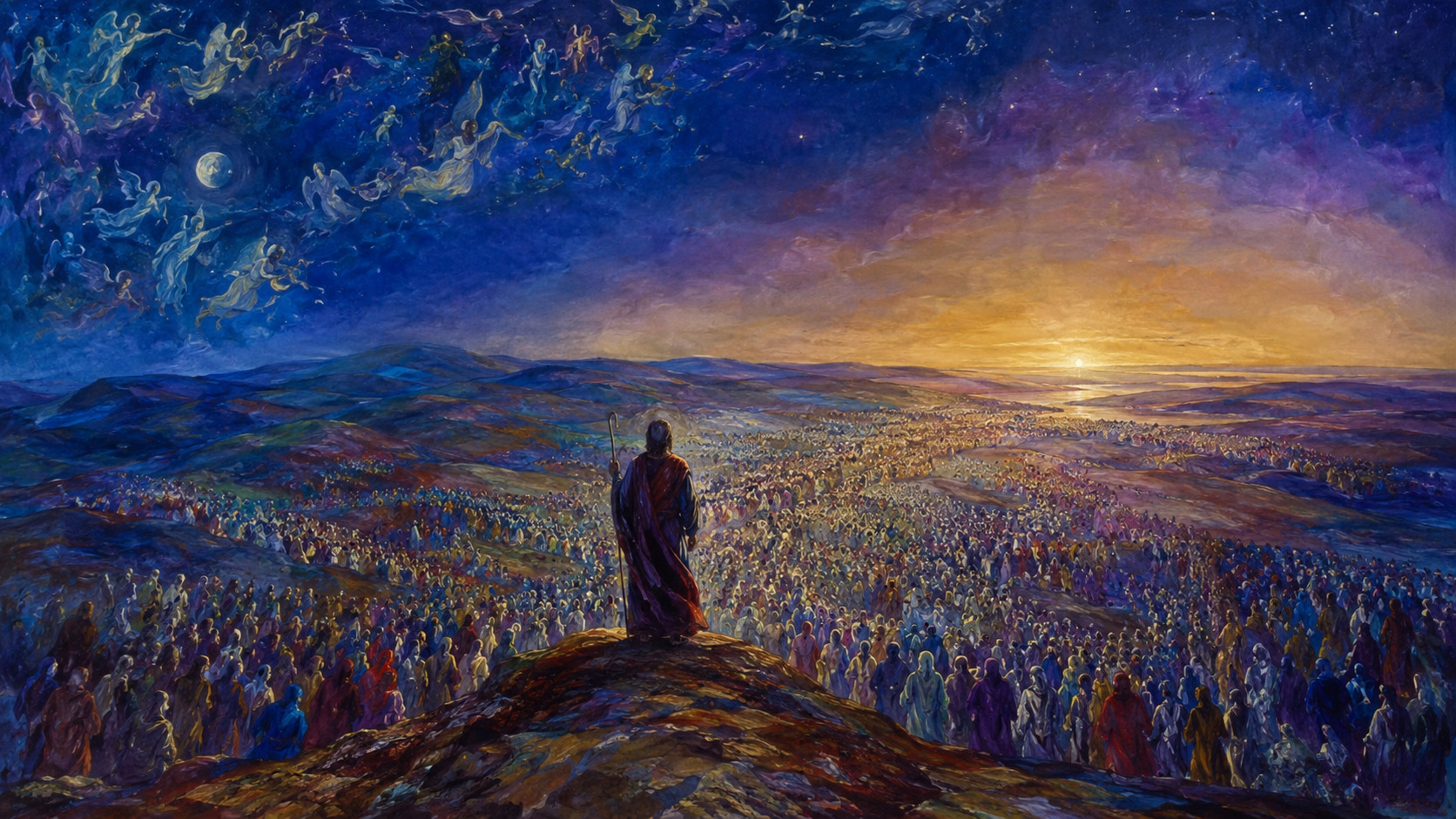
Trilingual study · Parashat Devarim · Shabbat Chazon
Why Devarim before Tisha B'Av. The three haftarot of affliction cover mouth, ear and eye (Divrei, Shim'u, Chazon) — every sense, to grasp the churban. And "Eikha esa levadi" echoes "Eikha yashva badad."
The secret of "alone." Aharon has just died (Rosh Chodesh Av). For six months Moshe stands alone — without the ohev shalom. Sinat chinam destroyed; Aharon's ahavat chinam will rebuild.
The war no one remembers. After Aharon dies the Clouds withdraw, Arad attacks, part of the people flee toward Egypt — eight stations back. Levi resists: ~60,000 fall at Moserah. The new dor repeats the spies' sin, "on steroids."
Moshe's delicacy. Even the harshest rebuke, by mere hints (place-names) — chas al kevodam.
Chazon: seeing in the dark. The Berditchever: on Shabbat Chazon, the soul is shown the Third Temple. The darker it gets, the brighter the spark. The parable of the suit in the glass cabinet.
"Zot ashiv el libi." Because I take the Torah to heart, I have the strength to keep hoping. Israel cannot be destroyed: the Ein Sof dwells within it.
In the shiur: the three haftarot · Eikha esa levadi · Rashi (tarchanin, apikorsin) · Aharon ohev shalom · the Moserah war · "on steroids" · the Berditchever & the suit · Zot ashiv el libi · the Devarim segula (the ה and rebirth)
📖 Read the full shiur →Shabbat Chazon: the mouth, the ear, the eye
We open Chumash Devarim. Chazal arranged that Parashat Devarim always falls before Tisha B'Av — the Shabbat called Shabbat Chazon, after its haftara: "Chazon Yeshayahu ben Amotz."
Listen to the first word of each: Divrei Yirmeyahu — speech, the mouth. Shim'u — hearing, the ear. Chazon — vision, the eye. We embrace every central sense to understand the churban — and, with God's help, to find the way out toward something new.
The hidden story: the war of Moserah
Open Devarim chapter 10: a passage seems to erupt from nowhere, between the Luchot. "Bnei Yisrael journeyed from Beerot Bnei-Yaakan to Moserah; there Aharon died…"
Rashi: this is "yet more of the rebuke." When Aharon dies (year 40), the Clouds of Glory withdraw. The king of Arad attacks: no more "iron dome." Seized by panic, part of the people try to return to Egypt — retreating eight stations.
"On steroids": the new dor repeats the sins
Moshe does not reproach the fathers' sins — he shows that the children fell into the very same ones.
Avoda zara: the golden calf ⇢ Baal Peor. Meriva: the waters of Refidim ⇢ the waters of Chukat. The man: the complaints resume. The spies: and here is Moserah — the spies' sin "on steroids."
The verses' nuance: "poked avon avot al banim" (when sons continue their fathers' path) vs "ish be-cheto yumat" (each for his own sin). Here it is they themselves — not only their parents.
"Eikha": the red thread, and 36 days of rebuke
Why Devarim specifically before Tisha B'Av? One hint: Moshe says "Eikha esa levadi torchachem" — echoing "Eikha yashva badad," the opening of Megillat Eikha, and "Eikha hayta le-zona" of the haftara. Eikha, Eikha, Eikha.
Moshe's whole address lasts 36 days (from Rosh Chodesh Shevat to 7 Adar) — hinted by "Eleh ha-devarim": Eleh = gematria 36. A rebuke — but one that opens with the sin of the spies, precisely because it is "the matter of the day": their sin is what earned us Tisha B'Av.
Rashi: "Eikha esa levadi"
What does Moshe reproach? Rashi unpacks the verse.
Torchachem — you were tarchanin, litigious: one would see his opponent about to win and cry "I have more witnesses, more proofs!" — trial court, appeal, supreme court, retrial… endlessly.
Mas'achem — apikorsin, suspicious: Moshe leaves his tent early? "He quarreled at home." Late? "He's plotting against us."
Rivchem — complainers.
"Levadi": the true secret — Aharon's absence
One word doesn't fit: levadi, "alone." Since Yitro, Moshe no longer judged alone. Why "alone" now?
Because Aharon has just died — on Rosh Chodesh Av (end of Massei). For six months Moshe stands alone, without Aharon. And Aharon was the ohev shalom ve-rodef shalom: the one who loved peace and pursued it, drawing people close.
Moshe's delicacy, and a people come of age
"Eleh ha-devarim" — devarim = hard words. Yet see the delicacy: Moshe names only places (Bamidbar, Ba-Arava, mol Suf, Tofel, Lavan, Di-Zahav…), each a veiled hint at a sin, chas al kevodam — to guard their honor. ("Di-zahav": to a Jew, "gold" instantly evokes the calf.)
Chazon: seeing in the dark (the Berditchever)
Rabbi Levi Yitzchak of Berditchev: on Shabbat Chazon, the soul of every Jew is shown (mar'in) the Third Beit Ha-Mikdash.
The deeper we enter the dark of the churban, the clearer the image of the Third Temple. Like a candle in daylight, invisible; only in darkness is its light seen. The more you darken, the brighter the point.
The parable of the suit: a father gives his son a fine suit, which he ruins; a second, ruined again. The third he locks in a glass cabinet: "Look — it is yours, but you will wear it only when you are worthy." First Temple, Second Temple… and the Third, visible, waiting.
"Zot ashiv el libi": the Torah, source of hope
Megillat Eikha (3:21): "Zot ashiv el libi, al ken ochil" — Zot is the Torah; "ochil," from le-yachel, to hope. Because I take the Torah to heart, I have the strength to keep hoping.
The nations taunt Israel throughout exile: "Your God has forsaken you — inquisitions, pogroms, the Shoah… He will never return to you." A terrible doubt.
But Israel enters the Beith Haknesset, opens the Torah, and reads there "ve-natati mishkani be-tochechem" — My dwelling will be among you. The churban is written there; so is the consolation.
Closing segula. Devarim is the 5th chumash; the letter ה (= 5) carries the koach ha-holada — the power to give birth ("be-hei bera'am"). To read Devarim before Tisha B'Av is to be reborn: sad over the churban, yet glad to be sad — for the deeper the mourning, the brighter the spark of the Third Temple.
🎯 Test yourself
5 questions on the shiur. Click an answer to see the explanation.
Result
🕊️ Aharon's legacy
The Temple fell through sinat chinam. Today, perform one act of ahavat chinam: reconcile two people, or release a grudge. That is rebuilding.
🔎 Judging in suspicion
Find ONE case where you judged someone "as an apikoros" (like Moshe leaving his tent). Invent the favorable explanation.
📖 The forgotten story
Read Devarim 10:6-7 with Rashi. Weigh what Chazal chose to hide and to transmit. Share it at your Shabbat table.
🕯️ Seeing in the dark
On Tisha B'Av, don't "sleep through" the fast. Live it fully: deep mourning is what makes the spark of the Third Temple visible.
✨ Zot ashiv el libi
This week, when the world seems dark, open a word of Torah. Note what hope it restores. The Torah is what keeps us standing.
Shalom Bayit — The Mouth at Home
What do you whisper to your children? To your spouse? Reveal a Shalom Bayit card.
Gematria — Rav Menashe
Hidden connections in the names according to Rav Menashe zatsal.
🔢 Gematria CourseTorah Study
Dig deeper into the commentary of Rashi and the Zohar on the parashah of the week.
📝 Beith HamidrachAll Parashot
All shiurim of M. Yéhouda Himi — from Bereshit to Devarim and the festivals.
📚 All ParashotBooks
Torah wisdom in thriller format — Éditions Gueoula.
Dream Interpretation
Did you dream of a doe? Of an Ark? Check the meaning according to Rav Almoli.
🌙 DreamsPartners of the Redemption
Every page, every translation — built on Torah love. You are our partners.
💛 Become a Partner
Guardians of the Rift
Moserah was a rift torn through Israel from within — baseless hatred splitting brother from brother. In Guardians of the Rift, a rift between worlds opens in the Sinai, and one young scholar learns he is among the few who must seal it before everything pours through. Start free.
📖 Read the free extract → 📕 Get the book · $9.90