1 Berosh Galei — RaShBI Hidden in the Exodus
When Israel left Egypt, the Torah says "with a high hand" (beyad rama). Onkelos translates: berosh galei — openly, head held high, in the middle of the day. But beneath that translation, a name is hiding.
And the Children of Israel went out with a high hand, before the eyes of all Egypt.Shemot 14:8 / Bamidbar 33:3
The Egyptians expected Israel to flee like thieves in the night. It didn't happen. Israel organized themselves, and toward morning — in broad daylight — they marched out in two columns, while the Egyptians threw rice and candies on them. Not an escape. A victory parade. Onkelos translates: berosh galei — openly revealed.
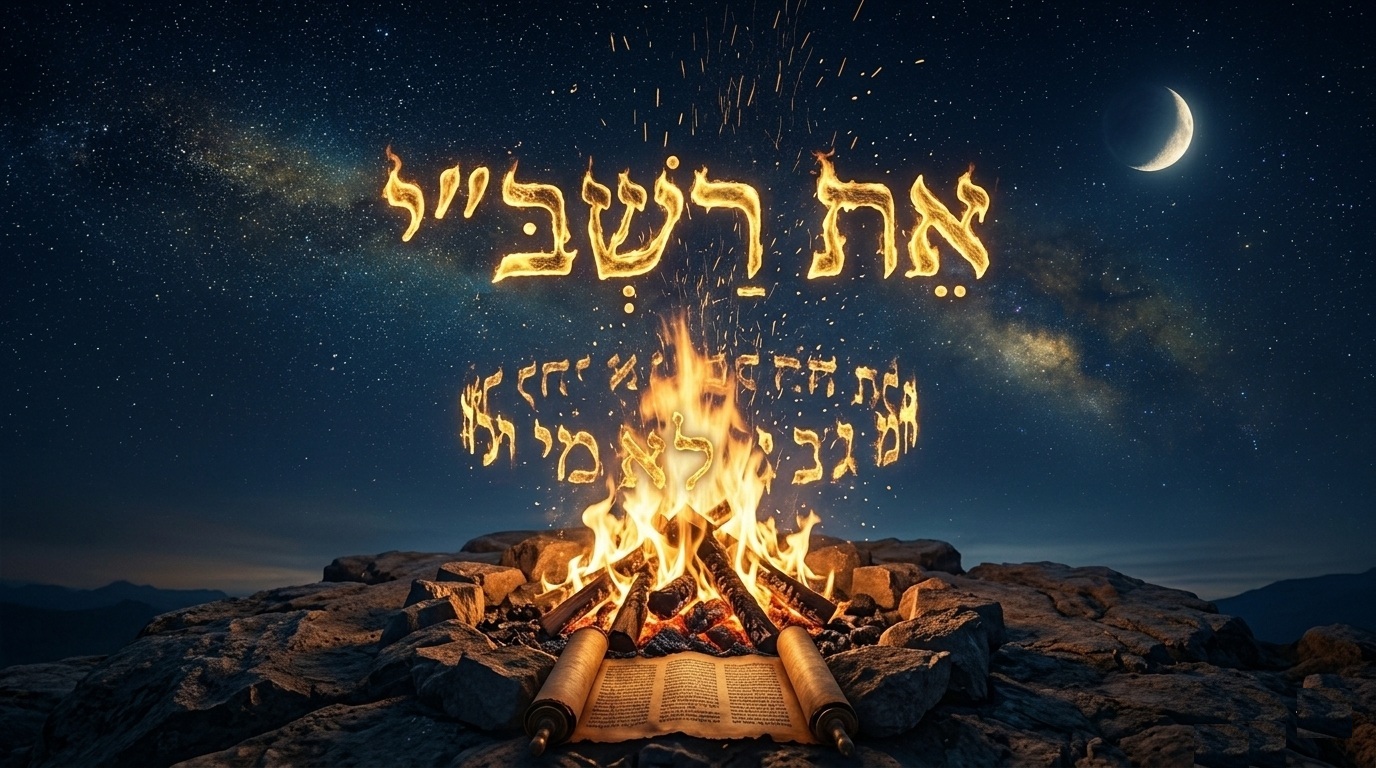
Look at the letters of berosh galei: ב־ר־י־ש ג־ל־י. Hidden inside is the name RaShBI — ר־ש־ב־י. And the word "galei" itself means revelation. RaShBI = the revelation of the Torah's inner light. The code tells you: the redemption from Egypt carries the seed of the final redemption inside it. And that seed is named Rabbi Shimon bar Yochai.
⭐ This is the secret of "As in the days you came out of Egypt, I will show wonders" (Micha 7:15). The same God who redeemed Israel from Egypt is the One who will redeem us now. And in the middle — RaShBI, the bridge. Moshe led the first redemption. RaShBI leads the last.
2 Lag BaOmer = Moshe — Three Hundred Forty-Five
Why specifically the 33rd day of the Omer? Why not the day before? Why not the day after? The number itself is the code.
The Chatam Sofer brings this code: the words "Lag BaOmer" are written without a vav — ל־ג ב־ע־מ־ר. Calculate the gematria: 30+3+2+70+40+200 = 345. Now calculate the gematria of "Moshe": 40+300+5 = 345. Exactly the same number.
🔷 RaShBI is a spark of Moshe Rabbeinu. Just as Moshe received the Written Torah at Sinai — RaShBI reveals the Inner Torah, the secrets given at Sinai but hidden until his generation. The Zohar isn't a new Torah. It's the same Torah, from a different angle.
Lag BaOmer isn't just the day RaShBI passed away. It's the day Moshe returns to the world through him. When you open the Zohar, the speaker isn't merely a 2nd-century Tana. It's Moshe Rabbeinu, from another side of himself.
⭐ This is why only RaShBI gets a bonfire. Other tzadikim — one candle. RaShBI gets a roaring blaze. Because Moshe wasn't kindled in a candle. He was kindled in the Burning Bush.
3 "Ki Lo Tishakach Mipi Zar'o" — The Final Letters Spell Yochai
In Mesechet Shabbat 138b, a frightening debate is recorded: the sages declare the Torah will eventually be forgotten from Israel. RaShBI rises to his feet and shouts: God forbid!
For it shall not be forgotten from the mouth of his offspring.Devarim 31:21
Tana'im sit at the table. They say: the Torah will eventually be forgotten. RaShBI jumps up: "God forbid that Torah should be forgotten from Israel!" He brings the proof: "Ki lo tishakach mipi zar'o." All the sages had heard this verse a thousand times. None of them saw it. RaShBI saw.
Read the final letters of each word: "Ki lo tishakach mipi zar'o". The letters: י־א־ח־י־ו. Rearrange them: Yochai. RaShBI's father, hidden inside the very promise that the Torah will never be forgotten.
🔷 The other sages thought the verse referred only to Parashat Ha'azinu. RaShBI rose and read it as covering the entire Torah. Why was he the only one? Because in him, in the offspring of Yochai, the promise lives. Yochai's offspring = RaShBI = the guarantor that Torah cannot be forgotten.
⭐ If the Torah were going to be forgotten — RaShBI himself wouldn't exist. The very fact of RaShBI is living proof that the Torah cannot disappear. He doesn't just learn Torah. He is the Torah's insurance policy.
4 "Bereshit" = "Et RaShBI" — The Code of the First Verse
The first three words of the Torah. "Bereshit bara Elokim." Beneath them — the name of RaShBI is hidden, in the exact same gematria as the promise that Torah cannot be forgotten.
In the beginning, God created the heavens and the earth.Bereshit 1:1
The word "Bereshit" — six letters: ב־ר־א־ש־י־ת. Rearrange those same letters: אֵ־ת ר־שׁ־בִּ־"י. "Et RaShBI" — the RaShBI. Who created? "Bara Elokim." Whom? "Et RaShBI."
Calculate the gematria of "Bereshit bara Elokim" = 913 + 203 + 86 = 1,202. Now calculate "Ki lo tishakach mipi zar'o" = 30 + 31 + 728 + 130 + 283 = 1,202. The same number, exactly.
🔷 Both verses tell the same story. God created the world — and in the same act, created RaShBI, the man who would guarantee the Torah could not be forgotten. There is no universe without Torah. There is no Torah without RaShBI. This is the kernel of creation.
⭐ This is the secret of "If not for My covenant day and night, I would not have set the laws of heaven and earth" (Yirmiyahu 33:25). Just as heaven and earth endure — so does Torah. And the axis that connects them? Et RaShBI. He was created with creation itself.
5 Three "Havu" · Seven "Kol" — Ten Sefirot in Kabbalat Shabbat
Every Friday night we say "Mizmor LeDavid." Without realizing it, we recite the entire Kabbalah. Three times "Havu" — seven times "Kol Hashem."
Give to Hashem, sons of the mighty · Give to Hashem glory and strength · Give to Hashem the glory of His name.Tehilim 29:1-2
Three "Havu" correspond to the three upper Sefirot: Keter, Chokhmah, Binah. Then seven "Kol Hashem" correspond to the seven lower Sefirot: Chesed, Gevurah, Tiferet, Netzach, Hod, Yesod, Malkhut. Exactly ten Sefirot.
Kol Hashem 1 · Chesed — "Kol Hashem al ha-mayim" — water = Chesed. Kol Hashem 2 · Gevurah — "Kol Hashem ba-koach" — strength = Gevurah. Kol Hashem 3 · Tiferet — "Kol Hashem be-hadar" — splendor of all colors = Tiferet. Kol Hashem 4 · Netzach — "Kol Hashem shover arazim" — Moshe who broke the cedars = Netzach.
The fifth "Kol Hashem" — save it for the next card. Because there, the day we're celebrating is hidden: Lag BaOmer.
6 Lag BaOmer = Hod sheBeHod — The Voice That Hews Flames of Fire
Lag BaOmer always falls on the fifth week, fifth day of the Omer count. Count: the fifth Sefirah from Chesed is Hod. The fifth day within Hod is Hod sheBeHod.
Five Sefirot from Chesed: Chesed, Gevurah, Tiferet, Netzach, Hod. Five days within the week: Sunday, Monday, Tuesday, Wednesday, Thursday/fifth. Hod sheBeHod. Always. Every year.
🔷 Now go back to "Mizmor LeDavid" of Friday night. The fifth "Kol Hashem". Read: "Kol Hashem chotzev lahavot esh" — the voice of Hashem hews flames of fire. This is Lag BaOmer. This is the bonfire of Meron. This is the fire of Torah.
"From His right hand a fiery law to them" (Devarim 33:2). Torah was given in fire. RaShBI returned the fire to the world. Hod sheBeHod isn't an academic Sefirah — it's a flame. Lag BaOmer is the night when this flame breaks through from heaven into earth.
⭐ That's why we light bonfires. Not candles — bonfires. Every spark that scatters is a Hod that lights up an individual soul. You light a memorial candle for RaShBI, but you're not really lighting it for him. You're lighting the Hod that lives inside you.
7 Shimon bar Yochi = Shabbat — Seven Hundred and Two
In the Gemara, RaShBI's name is written without an aleph: "Shimon bar Yochi." Not Yochai — Yochi. Why? Because that's how the gematria reveals itself.
Shimon = 466. Bar = 202. Yochi (without aleph) = 34. Total: 702. Now calculate the gematria of "Shabbat": ש+ב+ת = 300+2+400 = 702. Shimon bar Yochi = Shabbat.
Shabbat is entirely holiness. Shabbat is entirely rest. Shabbat is entirely the revelation of hidden faces. RaShBI is Shabbat in human form. That's why he, and he alone, knows the secrets of Torah.
🔷 RaShBI's hilula is a Shabbat meal. The bonfire isn't an ordinary fire — it's a Shabbat candle multiplied a thousand times. Other tzadikim get a candle. RaShBI gets a bonfire. Because Shabbat = 702 = Shimon bar Yochi.
⭐ Remember this next Friday. When you light Shabbat candles, you are lighting RaShBI. When you say "Mizmor LeDavid" — count three "Havu," seven "Kol." That's the code of the ten Sefirot. That's the code of RaShBI.
8 Yochai's Dream — The Dry Forest and the Vial
How does such a great soul enter the world? Not through ordinary birth. Not from an ordinary drop of water. The story begins long before the birth.
Yochai, RaShBI's father, and his wife Sarah were childless for many years. Just like Sarah Imeinu. One Rosh Hashana, Yochai falls asleep and dreams a strange dream. He sees a forest of dry trees — no fruit, nothing. He leans against one tree — it too is dry.
💜 Suddenly an angel appears with a pitcher of water. The angel walks tree to tree, watering some. The trees that get watered — immediately sprout fruit. The trees that don't — remain barren. The angel arrives at Yochai's tree. He doesn't water it. He keeps walking. Yochai is crushed in the dream. But then the angel stops.
🔷 The angel pulls out a small vial from his pocket. He pours something different — not water — around Yochai's tree. In a single instant, the tree explodes with fruit.
Yochai wakes up shaken. He goes to Rabbi Akiva. Rabbi Akiva: "This forest — the barren women of Israel. The water — ordinary birth. But for you, water wasn't enough. The vial — those are the tears your wife Sarah cried. And from those tears, a great child will come to Israel."
⭐ RaShBI was not born from an ordinary drop of water. He was born from a vial of tears. That is why he has the power to reveal secrets — because he himself is a secret, born from prayer. Every tear of a mother is a vial. And every such vial can give birth to a tree that saves an entire forest.
9 From Amram's Humility to RaShBI's Mesirut Nefesh — One Chain
The Torah says of Moshe: "And the man Moshe was very humble, more than any man on the face of the earth." What makes a man so humble? The answer is in the family.
Pharaoh decrees: every Hebrew boy must be cast into the Nile. Amram, the head of the Sanhedrin, rises and proclaims a mass divorce. "If our sons are being killed, there is no point in bringing children into the world." Every father in Israel listens to him. All across Egypt, divorces begin.
💜 Suddenly the door opens. A six-year-old girl walks in. It's Miriam, Amram's daughter. She approaches her father in front of the entire Sanhedrin and says: "Father, you are worse than Pharaoh. He decreed only against the boys. You decree against the girls too." The whole Sanhedrin watches. The Av Beit Din, the head of all of them, is shamed by a six-year-old girl.
Any other father would say: "Take her out!" Amram listened. He thought for a moment. Then he stood up and said: "Your words are accepted. I retract." He took Yocheved back, and from her came Moshe Rabbeinu. That is the humility of Amram — and it was planted in Moshe.
⭐ RaShBI = a spark of Moshe. A great soul cannot enter the world without parental self-sacrifice. Amram's humility → Moshe. Sarah's tears → RaShBI. And their mesirut nefesh was planted in RaShBI himself — who could live 13 years in a cave without compromising on a single letter of the Torah.
🔷 This code isn't only about them. Your child too, your soul too, was born from a vial of tears and from a father's humility. Remember this when you search for meaning. You are not random. You are the result of a self-sacrifice you did not see.
10 The Fire That Cannot Be Extinguished — Why Meron Is Not Missing
In recent years we haven't merited the great Meron lighting. Many ask: is the fire of Torah dying down? The answer is exactly the opposite.
Throw a board into a bonfire to put it out. What happens? Sparks scatter in every direction. Each spark ignites another fire. Every attempt to extinguish = a wider blaze. This isn't philosophy. It's the nature of fire.
Today there are RaShBI bonfires in every Jerusalem, every Tel Aviv, every New York, every Paris. The fire didn't shrink — it expanded. RaShBI himself cooperates with the multiplication: instead of "everyone come to one mountain," the light scatters across a thousand places.
🔷 Secular kids gather wood on Shabbat without realizing it. On Saturday night, they light memorial candles for RaShBI without knowing his name. But the fire knows them. Every Jew, believer or distant, is connected to one great fire. Esh dat. The fiery law.
⭐ Remember this year. Even if you're not in Meron, the fire you light is the same fire. If you learn one page of Zohar on the day of the hilula — you've lit a bonfire. If you say "for the merit of the tzadik Rabbi Shimon bar Yochai" — you've lit a bonfire. The redemption doesn't depend on one mountain. It depends on every spark.