נאום מוטה גור · 7 ביוני 1967
"כאלפיים שנה היה הר הבית אסור ליהודים, עד אשר באתם אתם הצנחנים והחזרתם אותו לחיק האומה. הכותל המערבי אליו פורם כל לב שוב בידינו. יהודים רבים שמו נפשם בכפם לאורך ההיסטוריה הארוכה שלנו על מנת להגיע לירושלים ולחיות בה. שירי געגועים לאין ספור הביאו את הכמיהה העמוקה הפורמת בלב היהודי כלפי ירושלים. בעתכם נפלה הזכות הגדולה להשלים את המעגל, להחזיר לעם את בירתו ומרכז קודשו. ירושלים היא שלכם לנצח."
— מוטה גור, מפקד הצנחנים, לאחר שחרור הר הבית1 · כדכד — המחלוקת של שני המלאכים
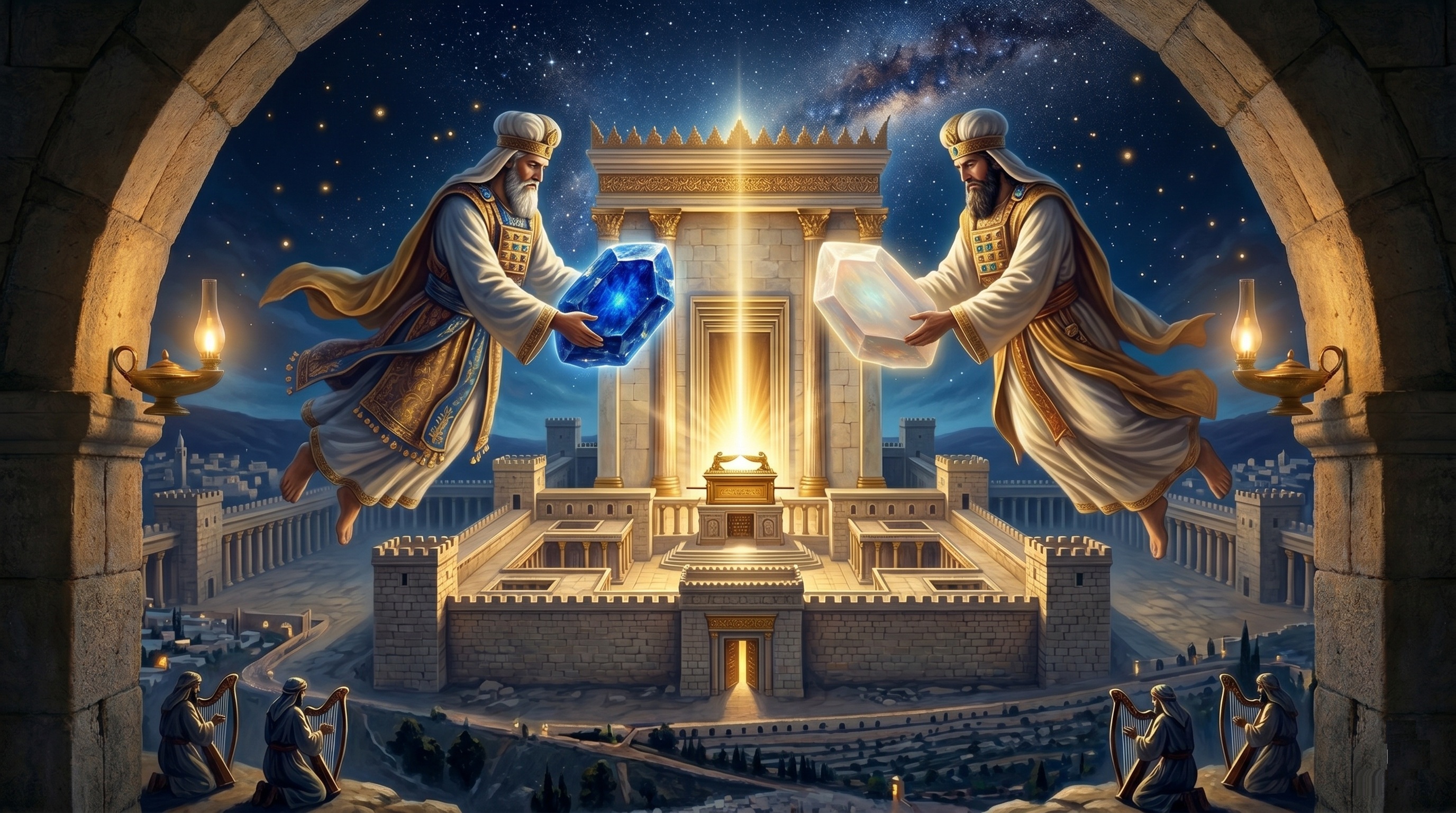
אומר רבי שמואל בר נחמני: פליגי תרי מלאכי ברקיעא. נחלקו שני מלאכים בשמים מאיזה סוג אבן יקרה יבנו את חלונות ירושלים לעתיד לבוא. גבריאל אמר שוהם. מיכאל אמר ישפה. אמר להם הקדוש ברוך הוא: "כדן וכדן" — גם זה וגם זה. וזהו לשון "כדכד" — שתי פעמים "כד".
2 · שוהם וישפה — יוסף ובנימין
שתי האבנים האלה הן השורה הרביעית של חושן המשפט, כנגד יוסף ובנימין — שני בני רחל. למה אבן ישפה כנגד בנימין? כי "ישפה" = "יש פה". כשהאחים האשימוהו: "גנב בן גנבת, כמו אמך רחל שגנבה את התרפים", היה לו פה לענות — והוא שתק. בשכר השתיקה הזאת זכה שבית המקדש ייבנה בנחלתו: "ידיד ה' ישכון לבטח עליו, ובין כתפיו שכן" (דברים לג, יב).
3 · ירושלים = יראה + שלם
מיכאל = חסד (ימין) = משיח בן דוד, מלכות בשלום.
גבריאל = גבורה (שמאל) = משיח בן יוסף, פלטפורמה ומלחמה מקדימה.
שם העיר "ירושלים" מורכב משתי מילים: ירו (לשון יראה — "ה' יראה" של עקדת יצחק, בראשית כב, יד) ושלם (השם הקדום של העיר, מימי מלכיצדק מלך שלם). יראה = גבורה. שלם = חסד. ירושלים = שני הכוחות יחד, כמו בריאת העולם: בראשית א' אלוקים בלבד (דין), בראשית ב' השם אלוקים (דין ורחמים).
4 · שבועת ה' על ימינו (תהלים קלז)
הלוויים שהוגלו לבבל, כשנבוכדנצר ציווה עליהם לנגן לפניו ולפני עבודה זרה בכינוריהם — נשכו וקטעו את אצבעותיהם, שלא יוכלו לנגן. נבוכדנצר הרג מהם רבים, אך הם שמחו שלא חיללו את שיר השם. באותה שעה נשבע הקדוש ברוך הוא בעצמו: "אם אשכחך ירושלים — תשכח ימיני". מידה כנגד מידה: הלוויים הקריבו את אצבעותיהם לכבוד ירושלים, והקדוש ברוך הוא נשבע על ימינו שלו.
Chalom Bayit — Construire une relation apaisée
Que « chuchotes-tu » à tes enfants ? à ton conjoint ? Découvre une carte Chalom Bayit.
Gématria — Hayah, Havah, Haïm
Les connexions cachées entre Havah, hayah, naissance et rédemption selon le Rav Ménashé zatsal.
🔢 Cours de GématriaInterprétation des Rêves
Tu as rêvé d’un bébé, d’une lumière ou d’un repas ? Découvre l’interprétation selon les sources classiques.
🌙 RêvesPartenaires de la Rédemption
Chaque page, chaque traduction — construits sur l’amour de la Torah. Vous êtes nos partenaires.
💛 Je Veux Être Partenaire
שומרי הסדק
סוד עתיק התגלה. ארבעים ותשע שערים נפתחים. השער החמישים מסתתר ברגע אחד — ורגע זה כבר כאן.
📕 קבל את הספר חינםMota Gur's Address · June 7, 1967
"For some two thousand years the Temple Mount was forbidden to the Jews — until you, the paratroopers, came and returned it to the bosom of the nation. The Western Wall, toward which every heart yearns, is again in our hands. Many Jews risked their lives throughout our long history to reach Jerusalem and live in her. Countless songs of longing carried the deep yearning in the Jewish heart for Jerusalem. To you has fallen the great privilege of completing the circle, of returning to the nation its capital and the center of its holiness. Jerusalem is yours forever."
— Mota Gur, paratroopers commander, after the liberation of the Temple Mount1 · Kadkhod — The Dispute of Two Angels
Rabbi Shemuel bar Nahmani teaches: two angels in heaven disagreed. From which precious stone would the windows of the rebuilt Jerusalem be made? Gavriel said Shoham (beryl). Mikhael said Yashpeh (jasper). The Holy One, blessed be He, settled the dispute: "kaden u-khaden" — this one AND that one. This is the meaning of "kadkhod" — twice "kad", twice "this".
2 · Shoham and Yashpeh — Yossef and Binyamin
These two stones form the fourth row of the Hoshen Mishpat, corresponding to Yossef and Binyamin — the two sons of Rachel. Why is Yashpeh associated with Binyamin? Because Yashpeh = "yesh peh" ("he has a mouth"). When his brothers accused him of stealing the goblet — "thief, son of a thief, just like your mother Rachel who stole the Terafim from Lavan" — Binyamin had a mouth to defend himself, and he remained silent. As a reward for that silence, the Beit HaMikdash was built in his portion of land: "The beloved of Hashem shall dwell securely upon Him; He hovers over him all day long, and dwells between his shoulders" (Devarim 33:12).
3 · Yerushalayim = Yiru + Shalem
Mikhael = Hessed (right side) = Mashiah ben David, kingship in peace.
Gavriel = Guevoura (left side) = Mashiah ben Yossef, the preparatory platform.
The name "Yerushalayim" is built from two words: Yiru (from the root yirah — "Hashem yireh" of the Akedat Yitzhak, Bereshit 22:14) and Shalem (the ancient name of the city, from the days of Malki-Tsedek melekh Shalem). Yirah = Guevoura. Shalem = Hessed. Jerusalem unites both forces, just as the world was created: in Bereshit 1, Elokim alone (strict judgment); in Bereshit 2, Hashem Elokim (judgment AND mercy).
4 · God's Oath Upon His Right Hand (Tehilim 137)
When the Leviim were exiled to Babylon, Nevuhadnetzar commanded them to play their lyres before him and before his idols, as they had done in the Beit HaMikdash. To prevent themselves from obeying, the Leviim bit off their own fingers so they could no longer play. Nevuhadnetzar killed many of them, but they rejoiced that they had not desecrated the song of Hashem. At that very moment the Holy One Himself swore an oath: "If I forget thee, O Jerusalem, let MY right hand forget her cunning." Measure for measure: the Leviim sacrificed their fingers for the honor of Jerusalem — and the Holy One swore upon His own right hand.
Chalom Bayit — Construire une relation apaisée
Que « chuchotes-tu » à tes enfants ? à ton conjoint ? Découvre une carte Chalom Bayit.
Gématria — Hayah, Havah, Haïm
Les connexions cachées entre Havah, hayah, naissance et rédemption selon le Rav Ménashé zatsal.
🔢 Cours de GématriaInterprétation des Rêves
Tu as rêvé d’un bébé, d’une lumière ou d’un repas ? Découvre l’interprétation selon les sources classiques.
🌙 RêvesPartenaires de la Rédemption
Chaque page, chaque traduction — construits sur l’amour de la Torah. Vous êtes nos partenaires.
💛 Je Veux Être PartenaireGuardians of the Rift
An ancient secret has surfaced. Forty-nine gates have opened. The fiftieth hides in a single moment — and that moment is here. The novel that grips you on page one and never lets go.
📖 Read the Free ChaptersDiscours de Mota Gur · 7 juin 1967
"Pendant près de deux mille ans, le Mont du Temple fut interdit aux Juifs — jusqu'à ce que vous, les parachutistes, le rameniez dans le sein de la nation. Le Mur occidental, vers lequel chaque cœur se tend, est à nouveau entre nos mains. De nombreux Juifs ont risqué leur vie tout au long de notre longue histoire pour atteindre Jérusalem et y vivre. Des chants de nostalgie sans nombre ont porté l'aspiration profonde du cœur juif vers Jérusalem. À vous est échu le grand privilège de compléter le cercle, de rendre à la nation sa capitale et le centre de sa sainteté. Jérusalem est à vous pour toujours."
— Mota Gur, commandant des parachutistes, après la libération du Mont du Temple1 · Kadkhod — la dispute des deux anges
Rabbi Shemouel bar Nahmani enseigne : deux anges au ciel étaient en désaccord. De quelle pierre précieuse seraient faites les fenêtres de la Jérusalem reconstruite ? Gavriel disait Shoham (béryl). Mikhaël disait Yashpeh (jaspe). Le Saint béni soit-Il a tranché : "kaden ou-khaden" — celle-ci ET celle-là. Tel est le sens de "kadkhod" — deux fois "kad", deux fois "celle-ci".
2 · Shoham et Yashpeh — Yossef et Binyamin
Ces deux pierres forment la quatrième rangée du Hoshen Mishpat, correspondant à Yossef et Binyamin — les deux fils de Rachel. Pourquoi Yashpeh correspond-elle à Binyamin ? Parce que Yashpeh = "yesh peh" ("il a une bouche"). Lorsque ses frères l'accusèrent du vol du gobelet — "voleur fils de voleuse, comme ta mère Rachel qui a volé les Terafim à Lavan" — Binyamin avait une bouche pour se défendre, et il s'est tu. En récompense de ce silence, le Beit HaMikdash fut construit dans sa portion : "Le bien-aimé de Hachem habitera en sécurité auprès de Lui ; Il le couvre à toute heure et réside entre ses épaules" (Devarim 33, 12).
3 · Yerushalayim = Yiru + Shalem
Mikhaël = Hessed (droite) = Mashiah ben David, la royauté dans la paix.
Gavriel = Guevoura (gauche) = Mashiah ben Yossef, la plateforme préparatoire.
Le nom "Yerushalayim" est composé de deux mots : Yiru (de la racine yirah — "Hachem yireh" de l'Akedat Yitzhak, Bereshit 22, 14) et Shalem (le nom ancien de la ville, du temps de Malki-Tsedek melekh Shalem). Yirah = Guevoura. Shalem = Hessed. Jérusalem unit les deux forces, exactement comme à la création du monde : dans Bereshit 1, Elokim seul (la mesure de rigueur) ; dans Bereshit 2, Hachem Elokim (rigueur ET miséricorde).
4 · Le serment d'Hachem sur Sa main droite (Tehilim 137)
Lorsque les Léviim furent exilés à Babel, Nevoukhadnetsar leur ordonna de jouer de la harpe devant lui et devant ses idoles, comme ils le faisaient dans le Beit HaMikdash. Pour se l'interdire physiquement, les Léviim se sont mordu et coupé les doigts, afin de ne plus pouvoir jouer. Nevoukhadnetsar en fit tuer beaucoup, mais ils se réjouissaient de ne pas avoir profané le chant d'Hachem. À cet instant, le Saint béni soit-Il en personne jura : "Si je t'oublie Yerushalayim, que MA main droite m'oublie." Mesure pour mesure : les Léviim ont sacrifié leurs doigts pour l'honneur de Yerushalayim — et le Saint béni soit-Il a juré sur Sa propre main droite.
Chalom Bayit — Construire une relation apaisée
Que « chuchotes-tu » à tes enfants ? à ton conjoint ? Découvre une carte Chalom Bayit.
Gématria — Hayah, Havah, Haïm
Les connexions cachées entre Havah, hayah, naissance et rédemption selon le Rav Ménashé zatsal.
🔢 Cours de GématriaInterprétation des Rêves
Tu as rêvé d’un bébé, d’une lumière ou d’un repas ? Découvre l’interprétation selon les sources classiques.
🌙 RêvesPartenaires de la Rédemption
Chaque page, chaque traduction — construits sur l’amour de la Torah. Vous êtes nos partenaires.
💛 Je Veux Être Partenaire
Les Gardiens de la Faille
Un secret ancien refait surface. Quarante-neuf portes se sont ouvertes. La cinquantième se cache dans un seul instant — et cet instant est arrivé.
📖 Lire les premiers chapitres gratuitsא · פתיחה — נאום מוטה גור, יוני 1967
בעזרת השם, לכבוד יום ירושלים נאמר רעיון, אך תחילה נכנס לאווירה. הנה קטע מנאום שאמר מוטה גור ביוני 1967, מיד לאחר שחרור הר הבית:
נכנס עם הרגש הזה אל הלימוד, אך מיד נביט בדברים החזקים והטובים של תורה.
ב · הפסוק בישעיהו — סוד המילה "כדכד"
יש פסוק בישעיהו פרק נד, המתנבא על בניינה של ירושלים לעתיד לבוא:
המילה "כדכד" היא מילה יוצאת דופן בלשון הקודש: כ"ף-דל"ת, כ"ף-דל"ת — מילה אחת, "כדכד". רק הכ"ף הראשונה דגושה (כי בגד-כפ"ת בראש המילה), והשנייה רפויה. למה התורה כותבת את המילה הזאת פעמיים? מה היא רומזת?
ג · בבא בתרא — שני המלאכים שחלקו
אומר רבי שמואל בר נחמני (בבא בתרא): פליגי תרי מלאכי ברקיעא — נחלקו שני מלאכים בשמים. על מה?
גבריאל אמר: שוהם. מיכאל אמר: ישפה. ואז הקדוש ברוך הוא, ששומע את הוויכוח, התערב ואמר: "להוי כדן וכדן" — שיהיה גם כזה וגם כזה. וזהו "כדכד" — שתי פעמים "כד", כלומר גם זה וגם זה.
ד · אבני החושן — המקור של שוהם וישפה
מאיפה לקוחות האבנים האלה? מהחושן של כהן גדול. שתים-עשרה אבנים בארבע שורות, כנגד שנים-עשר השבטים:
שורה א: אודם · פטדה · ברקת
שורה ב: נופך · ספיר · יהלום
שורה ג: לשם · שבו · אחלמה
שורה ד: תרשיש · שוהם · ישפה
השורה הרביעית, האחרונה, היא כנגד השבטים האחרונים: יוסף ובנימין — שני בני רחל. שוהם כנגד יוסף, ישפה כנגד בנימין. וכאן מתחיל הסוד.
ה · ישפה = "יש פה" — סוד שתיקתו של בנימין
למה אבן ישפה כנגד בנימין? המילה "ישפה" מורכבת משתי מילים: יש פה — היה לו פה.
כשהאחים גילו את הגביע באמתחתו של בנימין, הם נפלו עליו: "גנב בן גנבת! אתה גנב כמו אמך, רחל גנבה את התרפים מלבן, ואתה גנבת את הגביע!" בנימין היה יכול לענות, היה לו פה לטעון — אבל הוא שתק. בשכר השתיקה הזאת זכה להתברך:
"בין כתפיו שכן" — השכינה תשרה בנחלתו, ולא בנחלת יהודה. שם, בחלקו של בנימין, ייבנה בית המקדש.
ו · מיכאל וגבריאל — חסד וגבורה
עתה נחזור לשני המלאכים. גבריאל — מלשון גבורה. מיכאל — שר ישראל, כנגד חסד.
גבריאל אמר שוהם — כנגד יוסף, כנגד משיח בן יוסף, שמכין את הפלטפורמה ונלחם.
מיכאל אמר ישפה — כנגד בנימין, ובנחלתו ייבנה הבית, כנגד משיח בן דוד, מלכות בשלום.
זאת המחלוקת העמוקה: האם ירושלים תיבנה בגבורה (משיח בן יוסף, מלחמה מקדימה) או בחסד (משיח בן דוד, מלכות בשלום)? תשובת הקדוש ברוך הוא: כדן וכדן — שניהם יחד.
ז · המקבילה — בריאת העולם
הקדוש ברוך הוא אמר: "אני אבנה את ירושלים כמו שבראתי את העולם." מה הכוונה?
בפרק א' של בראשית כתוב: "בראשית ברא אלוקים" — שם אלוקים בלבד, מידת הדין. ביקש הקדוש ברוך הוא לברוא את העולם בדין, ראה שאין העולם יכול לעמוד, שיתף עמו מידת הרחמים.
לכן בפרק ב' כתוב: "ביום עשות ה' אלוקים ארץ ושמים" — שני שמות יחד, ה' אלוקים, רחמים ודין. וכך עומד העולם.
גם ירושלים: לא בחסד לבד, ולא בגבורה לבד. בשניהם יחד.
ח · שם העיר — "ירו" + "שלם"
המורכבות הזאת רמוזה בעצם השם של העיר. "ירושלים" — שתי מילים: ירו ושלם.
שלם — השם הקדום של ירושלים. כשאברהם חזר ממלחמת ארבעת המלכים, יצא לקראתו מלכיצדק מלך שלם (בראשית יד, יח). שלם = שלום = חסד.
ירו — מלשון יראה. בעקדת יצחק, אברהם קרא למקום "ה' יראה" (בראשית כב, יד). יראה = גבורה.
ירושלים = ירו + שלם = יראה + שלום = גבורה + חסד. שם העיר עצמו מכריז שהיא בנויה משני הכוחות יחד. ובית המקדש, שנמצא בלב העיר, הוא המקום שבו השלום יורד לכל העולם — אך "דיר באלק" אם מכניסים שם דבר טמא, הכול נחרב. צריך גם יראה וגם שלום.
ט · תהלים קלז — הלוויים שקטעו אצבעותיהם
במזמור קלז של תהלים, דוד המלך כותב ברוח הקודש את גורל הלוויים בגלות:
הלוויים יוצאים אחרי חורבן הבית, ונבוכדנצר מוליך אותם לבבל. בחנייה אחת, על שפת נחל, הוא דורש מהם: "מה אתם בוכים? תתארגנו, אני רוצה שתנגנו לפניי ולפני עבודה זרה בכינוריכם, כמו שהייתם עושים בבית המקדש."
הלוויים מסרבים. כדי לא ליפול בניסיון, הם נשכו את אצבעותיהם וקטעו אותן — שלא יוכלו לנגן. ענו לנבוכדנצר: "איך נשיר את שיר ה' על אדמת נכר? אין לנו עוד אצבעות."
נבוכדנצר הרג מהם רבים — "טילי טילים של הרוגים". אך הם היו שמחים שלא חיללו את שיר השם לפני עבודה זרה.
י · שבועת ה' וסוד "שראשי נמלא טל"
אנחנו רגילים לחשוב שמי שאומר "אם אשכחך ירושלים תשכח ימיני" הוא דוד המלך, או עם ישראל. אבל המדרש מחדש: באותה שעה, כשהלוויים קטעו את אצבעותיהם, הקדוש ברוך הוא בכבודו ובעצמו נשבע:
מידה כנגד מידה: הלוויים שלטו בעצמם וקטעו את אצבעות ידם הימנית למען כבוד ירושלים. הקדוש ברוך הוא נשבע על ימינו שלו — כביכול.
ובשיר השירים: "שראשי נמלא טל" — מה זה? אומר הקדוש ברוך הוא: כל זמן שבית המקדש חרב, אני בעצמי בגלות עמכם. כמו עם ישראל שאין לו בית — כך אני ראשי מלא טל, אין לי גג מעליי. אני יושב בגלות יחד אתכם.
וזאת הגאולה השלמה: כששני הכוחות מתחברים — חסד וגבורה, משיח בן יוסף ומשיח בן דוד, יראה ושלם, מיכאל וגבריאל. אז ייבנה בית המקדש השלישי במהרה בימינו אמן.
1 · Opening — Mota Gur's Address, June 1967
With Hashem's help, in honor of Yom Yerushalayim let us share an idea. But first let us enter the atmosphere. Here is a passage from the speech delivered by Mota Gur in June 1967, immediately after the liberation of the Temple Mount:
We enter the learning carrying that emotion — and turn immediately to the strong and beautiful words of Torah.
2 · The Verse in Yeshayahu — The Secret of "Kadkhod"
In the prophet Yeshayahu, chapter 54, there is a verse prophesying the rebuilding of Jerusalem in the future:
The word kadkhod (כדכד) is a strange Hebrew word: kaf-dalet, kaf-dalet — written as one single word, "kadkhod". Only the first kaf carries a daguesh (because beged-kefet letters at the start of a word are hardened), while the second kaf is soft. Why does Scripture write this syllable twice? What is it hinting at?
3 · Baba Batra — The Two Angels Who Disagreed
Rabbi Shemuel bar Nahmani teaches (Baba Batra): "pligi terei malakhei birkiya" — two angels in heaven disagreed. About what?
Gavriel said: Shoham. Mikhael said: Yashpeh. The Holy One, blessed be He, listening to the dispute, intervened and ruled: "lehevi kaden u-khaden" — let it be this one AND that one. And this is the word "kadkhod" — twice "kad", meaning this AND that, together.
4 · The Stones of the Hoshen — Origin of Shoham and Yashpeh
Where do these stones come from? From the Hoshen Mishpat of the Kohen Gadol. Twelve stones in four rows, corresponding to the twelve tribes:
Row 1: Odem · Pitdah · Bareket
Row 2: Nofekh · Sapir · Yahalom
Row 3: Leshem · Shevo · Ahlamah
Row 4: Tarshish · Shoham · Yashpeh
The fourth row, the final row, corresponds to the last tribes: Yossef and Binyamin — the two sons of Rachel. Shoham for Yossef, Yashpeh for Binyamin. And here the secret begins.
5 · Yashpeh = "Yesh Peh" — The Secret of Binyamin's Silence
Why does the stone Yashpeh correspond to Binyamin? The word Yashpeh is built from two words: yesh peh — "he had a mouth".
When the brothers found Yossef's goblet in Binyamin's sack, they fell upon him: "Thief, son of a thief! You're a thief just like your mother — Rachel stole the Terafim from Lavan, and you stole the goblet!" Binyamin could have answered. He had a mouth to defend himself. But he stayed silent. As a reward for that silence, he merited this blessing:
"And dwells between his shoulders" — the Shekhinah will rest in his portion of the Land, not in Yehuda's portion. There, in Binyamin's territory, the Beit HaMikdash will be built.
6 · Mikhael and Gavriel — Hessed and Guevoura
Now we return to the two angels. Gavriel — from the root guevoura (strength, severity). Mikhael — the prince of Israel, corresponding to hessed (kindness).
Gavriel said Shoham — corresponding to Yossef, corresponding to Mashiah ben Yossef, who prepares the platform and wages the preparatory battle.
Mikhael said Yashpeh — corresponding to Binyamin, in whose territory the Temple will be built, corresponding to Mashiah ben David, kingship in peace.
This is the deep dispute: will Jerusalem be built by guevoura (Mashiah ben Yossef, preparatory war) or by hessed (Mashiah ben David, kingship in peace)? The Holy One's answer: kaden u-khaden — both together.
7 · The Parallel — The Creation of the World
The Holy One declared: "I will build Jerusalem just as I created the world." What does this mean?
In Bereshit chapter 1 it is written: "In the beginning Elokim created" — only the name Elokim, the attribute of strict judgment. The Holy One first sought to create the world through judgment alone, saw that the world could not endure on judgment alone, and joined to it the attribute of mercy.
Therefore in chapter 2 it is written: "On the day Hashem Elokim made earth and heaven" — both names together, Hashem Elokim, mercy AND judgment. And thus the world stands.
Jerusalem is the same: not by hessed alone, not by guevoura alone. By both together.
8 · The Name of the City — "Yiru" + "Shalem"
This very duality is encoded in the city's name. "Yerushalayim" — two words: Yiru and Shalem.
Shalem — the ancient name of Jerusalem. When Avraham returned from the war of the four kings, he was met by Malki-Tsedek melekh Shalem (Bereshit 14:18). Shalem = shalom = peace = hessed.
Yiru — from the root yirah (awe, fear). At the Akedat Yitzhak, Avraham named the place "Hashem yireh" (Bereshit 22:14). Yirah = guevoura.
Yerushalayim = Yiru + Shalem = Yirah + Shalom = Guevoura + Hessed. The very name of the city declares that she is built of two forces together. And the Beit HaMikdash, at the heart of the city, is the place where peace descends into the whole world — but beware: if anything impure is brought in, everything collapses. Both yirah AND shalem are required, together.
9 · Tehilim 137 — The Leviim Who Severed Their Fingers
In Tehilim 137, David HaMelekh writes with ruah hakodesh the fate of the Leviim in exile:
The Leviim are exiled after the destruction of the Beit HaMikdash, and Nevuhadnetzar leads them toward Babylon. At one stopping point, on the bank of a river, he orders them: "Why do you sit and weep? Prepare yourselves — I want you to play before me and before my idols on your lyres, just as you used to play in the Beit HaMikdash."
The Leviim refuse. To physically prevent themselves from yielding, they bit off their own fingers and severed them — so they could no longer play. They answered Nevuhadnetzar: "How shall we sing the song of Hashem on foreign soil? We no longer have fingers."
Nevuhadnetzar killed many of them — heap upon heap of slain. But they rejoiced that they had not profaned the song of Hashem before idolatry.
10 · God's Oath and the Secret of "My Head Is Drenched With Dew"
We are accustomed to think that the one who says "If I forget thee, O Jerusalem, let my right hand forget her cunning" is David HaMelekh, or the people of Israel. But the Midrash reveals: at that very moment, when the Leviim severed their own fingers, the Holy One, blessed be He, in His own Glory, swore an oath:
Measure for measure: the Leviim mastered themselves and severed the fingers of their right hand for the honor of Jerusalem. The Holy One swore — as it were — upon His own right hand.
And in Shir HaShirim: "For my head is drenched with dew." What does this mean? The Holy One says: as long as the Beit HaMikdash lies in ruins, I Myself am in exile with you. Just as Israel has no house — so My head is filled with dew, I have no roof. I sit in exile together with you.
And this is the complete Redemption: when the two forces unite — hessed and guevoura, Mashiah ben Yossef and Mashiah ben David, Yirah and Shalem, Mikhael and Gavriel. Then the Third Beit HaMikdash will be built, speedily in our days, amen.
1 · Ouverture — discours de Mota Gur, juin 1967
Avec l'aide d'Hachem, en l'honneur de Yom Yerushalayim, énonçons une idée. Mais entrons d'abord dans l'atmosphère. Voici un extrait du discours prononcé par Mota Gur en juin 1967, immédiatement après la libération du Mont du Temple :
Nous entrons dans l'étude avec cette émotion — et nous tournons aussitôt vers les paroles puissantes et belles de la Torah.
2 · Le pasuk de Yeshayahu — le secret du mot "kadkhod"
Dans le prophète Yeshayahu, chapitre 54, on trouve un pasuk qui prophétise la reconstruction de Jérusalem dans l'avenir :
Le mot kadkhod (כדכד) est un mot étrange en lashon hakodesh : kaf-dalet, kaf-dalet — écrit comme un seul mot, "kadkhod". Seul le premier kaf porte un daguesh (car les lettres beged-kefet en début de mot sont dures), tandis que le second kaf est doux. Pourquoi le texte écrit-il cette syllabe deux fois ? Que veut-il sous-entendre ?
3 · Baba Batra — les deux anges en désaccord
Enseigne Rabbi Shemouel bar Nahmani (Baba Batra) : "pligi terei malakhei birkiya" — deux anges au ciel étaient en désaccord. Sur quoi ?
Gavriel disait : Shoham. Mikhaël disait : Yashpeh. Le Saint béni soit-Il, écoutant la dispute, intervint et trancha : "lehevi kaden ou-khaden" — que ce soit celle-ci ET celle-là. Tel est le mot "kadkhod" — deux fois "kad", c'est-à-dire celle-ci ET celle-là, ensemble.
4 · Les pierres du Hoshen — l'origine de Shoham et Yashpeh
D'où viennent ces pierres ? Du Hoshen Mishpat du Kohen Gadol. Douze pierres en quatre rangées, correspondant aux douze tribus :
Rangée 1 : Odem · Pitdah · Bareket
Rangée 2 : Nofekh · Sapir · Yahalom
Rangée 3 : Leshem · Shevo · Ahlamah
Rangée 4 : Tarshish · Shoham · Yashpeh
La quatrième rangée, la dernière, correspond aux derniers shevatim : Yossef et Binyamin — les deux fils de Rachel. Shoham pour Yossef, Yashpeh pour Binyamin. Et c'est ici que commence le secret.
5 · Yashpeh = "Yesh Peh" — le secret du silence de Binyamin
Pourquoi la pierre Yashpeh correspond-elle à Binyamin ? Le mot Yashpeh est composé de deux mots : yesh peh — "il avait une bouche".
Lorsque les frères trouvèrent le gobelet de Yossef dans le sac de Binyamin, ils se jetèrent sur lui : "Voleur, fils de voleuse ! Tu es voleur comme ta mère — Rachel a volé les Terafim à Lavan, et toi tu as volé le gobelet !" Binyamin pouvait répondre. Il avait une bouche pour se défendre. Mais il s'est tu. En récompense de ce silence, il mérita cette bénédiction :
"Et réside entre ses épaules" — la Shekhinah résidera dans sa portion de la Terre, et non dans la portion de Yehouda. Là, dans le territoire de Binyamin, sera construit le Beit HaMikdash.
6 · Mikhaël et Gavriel — Hessed et Guevoura
Retournons maintenant aux deux anges. Gavriel — de la racine guevoura (rigueur, force). Mikhaël — le prince d'Israël, correspondant au hessed (bonté).
Gavriel disait Shoham — correspondant à Yossef, correspondant à Mashiah ben Yossef, qui prépare la plateforme et mène la lutte préparatoire.
Mikhaël disait Yashpeh — correspondant à Binyamin, dans le territoire de qui sera construit le Temple, correspondant à Mashiah ben David, royauté dans la paix.
Telle est la dispute profonde : Jérusalem sera-t-elle construite par la guevoura (Mashiah ben Yossef, guerre préparatoire) ou par le hessed (Mashiah ben David, royauté dans la paix) ? La réponse du Saint béni soit-Il : kaden ou-khaden — les deux ensemble.
7 · Le parallèle — la création du monde
Le Saint béni soit-Il a déclaré : "Je bâtirai Jérusalem comme J'ai créé le monde." Qu'est-ce que cela veut dire ?
Au chapitre 1 de Bereshit il est écrit : "Au commencement Elokim créa" — uniquement le nom Elokim, la mesure de rigueur. Le Saint béni soit-Il voulut d'abord créer le monde par la rigueur seule, vit que le monde ne pouvait subsister par la rigueur seule, et lui adjoignit la mesure de miséricorde.
C'est pourquoi au chapitre 2 il est écrit : "Au jour où Hachem Elokim fit terre et cieux" — les deux noms ensemble, Hachem Elokim, miséricorde ET rigueur. Et c'est ainsi que le monde tient.
Pour Jérusalem c'est pareil : ni par le hessed seul, ni par la guevoura seule. Par les deux ensemble.
8 · Le nom de la ville — "Yiru" + "Shalem"
Cette dualité même est inscrite dans le nom de la ville. "Yerushalayim" — deux mots : Yiru et Shalem.
Shalem — le nom ancien de Jérusalem. Lorsqu'Avraham revint de la guerre des quatre rois, à sa rencontre vint Malki-Tsedek melekh Shalem (Bereshit 14, 18). Shalem = shalom = paix = hessed.
Yiru — de la racine yirah (crainte, respect). À l'Akedat Yitzhak, Avraham nomma le lieu "Hachem yireh" (Bereshit 22, 14). Yirah = guevoura.
Yerushalayim = Yiru + Shalem = Yirah + Shalom = Guevoura + Hessed. Le nom même de la ville proclame qu'elle est bâtie de deux forces ensemble. Et le Beit HaMikdash, au cœur de la ville, est le lieu d'où la paix descend dans le monde entier — mais attention : si l'on y introduit quoi que ce soit d'impur, tout s'effondre. Il faut à la fois yirah ET shalem, ensemble.
9 · Tehilim 137 — les Léviim qui coupèrent leurs doigts
Dans le Tehilim 137, David HaMelekh écrit avec rouah hakodesh le sort des Léviim en exil :
Les Léviim sortent après la destruction du Beit HaMikdash, et Nevoukhadnetsar les conduit vers Babel. À une halte, sur la berge d'un fleuve, il leur ordonne : "Pourquoi pleurez-vous ? Préparez-vous — je veux que vous jouiez devant moi et devant mes idoles sur vos kinor, comme vous le faisiez dans le Beit HaMikdash."
Les Léviim refusent. Pour se l'interdire physiquement, ils se sont mordu les doigts et les ont coupés — afin de ne plus pouvoir jouer. Ils répondirent à Nevoukhadnetsar : "Comment chanterons-nous le chant d'Hachem sur une terre étrangère ? Nous n'avons plus de doigts."
Nevoukhadnetsar en fit tuer beaucoup — monticule sur monticule de morts. Mais ils étaient joyeux de n'avoir pas profané le chant d'Hachem devant l'idolâtrie.
10 · Le serment d'Hachem et le secret de "ma tête est emplie de rosée"
Nous avons l'habitude de penser que celui qui dit "Si je t'oublie, Yerushalayim, que ma main droite m'oublie" est David HaMelekh, ou le peuple d'Israël. Mais le Midrash révèle : à cet instant-là, lorsque les Léviim coupèrent leurs propres doigts, le Saint béni soit-Il en Sa propre Gloire prêta serment :
Mesure pour mesure : les Léviim se sont maîtrisés et ont coupé les doigts de leur main droite pour l'honneur de Yerushalayim. Le Saint béni soit-Il jura — pour ainsi dire — sur Sa propre main droite.
Et dans Shir HaShirim : "Car ma tête est emplie de rosée." Que signifie cela ? Le Saint béni soit-Il dit : tant que le Beit HaMikdash est en ruine, Je suis Moi-même en exil avec vous. Tout comme Israël n'a pas de maison — Ma tête est emplie de rosée, Je n'ai pas de toit. Je siège en exil avec vous.
Et c'est cela la Gueoula complète : lorsque les deux forces se rejoignent — hessed et guevoura, Mashiah ben Yossef et Mashiah ben David, Yirah et Shalem, Mikhaël et Gavriel. Alors sera construit le troisième Beit HaMikdash, bimhera beyameinou amen.