Why is Vayikra the new Genesis? What does a soul experience in the womb — and why does a newborn cry?
Based on the shiur of M. Yéhouda Himi
Why does Parashat Tazria follow Shemini? What is the connection between Sefer Vayikra and the Creation of the world? And what is the real reason a newborn cries — not the light in the delivery room, but something far deeper. Three themes: Vayikra as the new Genesis, brit mila on the eighth day, and the great secret of the soul inside the womb.
1 Why Does “When a Woman Gives Birth” Follow Shemini?
Rabbi Shmlai asks: why does the Torah address the laws of animals, beasts, and birds before the laws of the human being? Isn’t the human being the crown of Creation?
When a woman gives birth to a male child Leviticus 12:2
Rashi cites Rabbi Shmlai’s answer: “Just as the creation of the human being came after all the animals, beasts, and birds in the six days of Creation — so too, the laws of the human being are taught after the laws of animals, beasts, and birds.”
The human being is the last creature of the six days. Not because he is less important — precisely because he is the most important. G-d prepared everything first, as a host prepares the table before the honored guest arrives.
Just as G-d prepared the entire world before creating the human being — so the Torah prepares everything (animals, birds, purity and impurity) before arriving at the laws of birth and human life.
2 Sefer Vayikra — The New Genesis
What was G-d’s original intention when He created the world? And why is Sefer Vayikra, in reality, a new Book of Genesis?
G-d created the world in six days. His goal: to bring the Divine Presence — the Shekhina — down into the world below. On the sixth day, the human being was created, and the Shekhina descended. But then the human being sinned — and with each great sin, the Shekhina rose one heaven higher.
Adam sinned → Heaven 1. Cain murdered → Heaven 2. The generation of Enosh, the Flood, Babel, Nimrod, Sodom → until the Shekhina had withdrawn to the seventh heaven. Then seven righteous men brought her back, one heaven at a time: Abraham, Isaac, Jacob, Levi, Kehat, Amram — and Moses, son of Amram, brought her down for good.
And the glory of G-d rested upon Mount Sinai Exodus 24:16
The Shekhina had returned to earth. G-d declared: this must never be lost again. “Build a Mishkan” — a permanent dwelling that can always hold the Divine Presence.
3 The Tabernacle = A Recreation of the World
What is the connection between the construction of the Mishkan and the creation of heaven and earth? And what does this teach us about Sefer Vayikra?
At the end of Sefer Shemot, when the Mishkan was completed, the verses are astonishingly parallel to the verses of Creation:
“And all the work of the Mishkan was completed” ↔ “And the heaven and earth were completed”
“And the children of Israel did everything that G-d had commanded” ↔ “And G-d made”
⭐ The Mishkan is a recreation of the world. We are standing at a new sixth day of Creation — and what was created on the sixth day? The human being. That is why Sefer Vayikra opens: “And He called to Moses” — and immediately: “Adam — a person — who brings an offering.” The Zohar explains: why Adam and not ish or nasi? Because with the inauguration of the Mishkan, we have returned to Genesis.
And He called to Moses, and G-d spoke to him from the Tent of Meeting, saying Leviticus 1:1
4 Three Books Would Have Been Enough
Why do we have five books of the Torah and not three? What changed G-d’s original plan?
Had it not been for the sin of the spies, Israel would have entered the Land directly after Sefer Vayikra. There would be no Sefer Bamidbar. No Sefer Devarim. Only Bereshit, Shemot, Vayikra — and then Israel enters the Land. The final verse of Vayikra confirms it: “These are the commandments that G-d commanded Moses to the children of Israel at Mount Sinai” — from Sinai, straight to the Land.
Sefer Vayikra was the book with which Israel was supposed to enter the Land. It was the original ending of the Torah. Two entire books — Bamidbar and Devarim — were added only because of the sin of the spies.
⭐ That is why the “Reproof” appears twice: Parashat Bechukotai (Vayikra) — for the planned entry into the Land. Parashat Ki Tavo (Devarim) — for the actual entry, forty years later. The second reproof was a reminder, because the generation that would enter was not the generation that heard the first one.
5 Brit Mila — Why on the Eighth Day?
If, according to the holy Zohar, the Jewish soul only enters the child on the day of the brit — why wait eight days? Why not perform the brit immediately and sanctify the child at once?
And on the eighth day, the flesh of his foreskin shall be circumcised Leviticus 12:3
Medically: Doctors have discovered — in a fact only the Creator could have engineered — that it is only on the eighth day that the human body produces the clotting substance that allows a wound to heal safely. Before that day, circumcision can be life-threatening.
Spiritually: So that the child must pass through one Shabbat before entering the covenant. Shabbat gives him a “booster” — a dose of spiritual strength — so that he can face everything life will demand of him.
6 The Child in the Womb — The Great Secret
What happens inside the womb? And what does a newborn child truly feel when it is born — and why does it really cry?
Rabbi Shmlai taught a breathtaking principle:
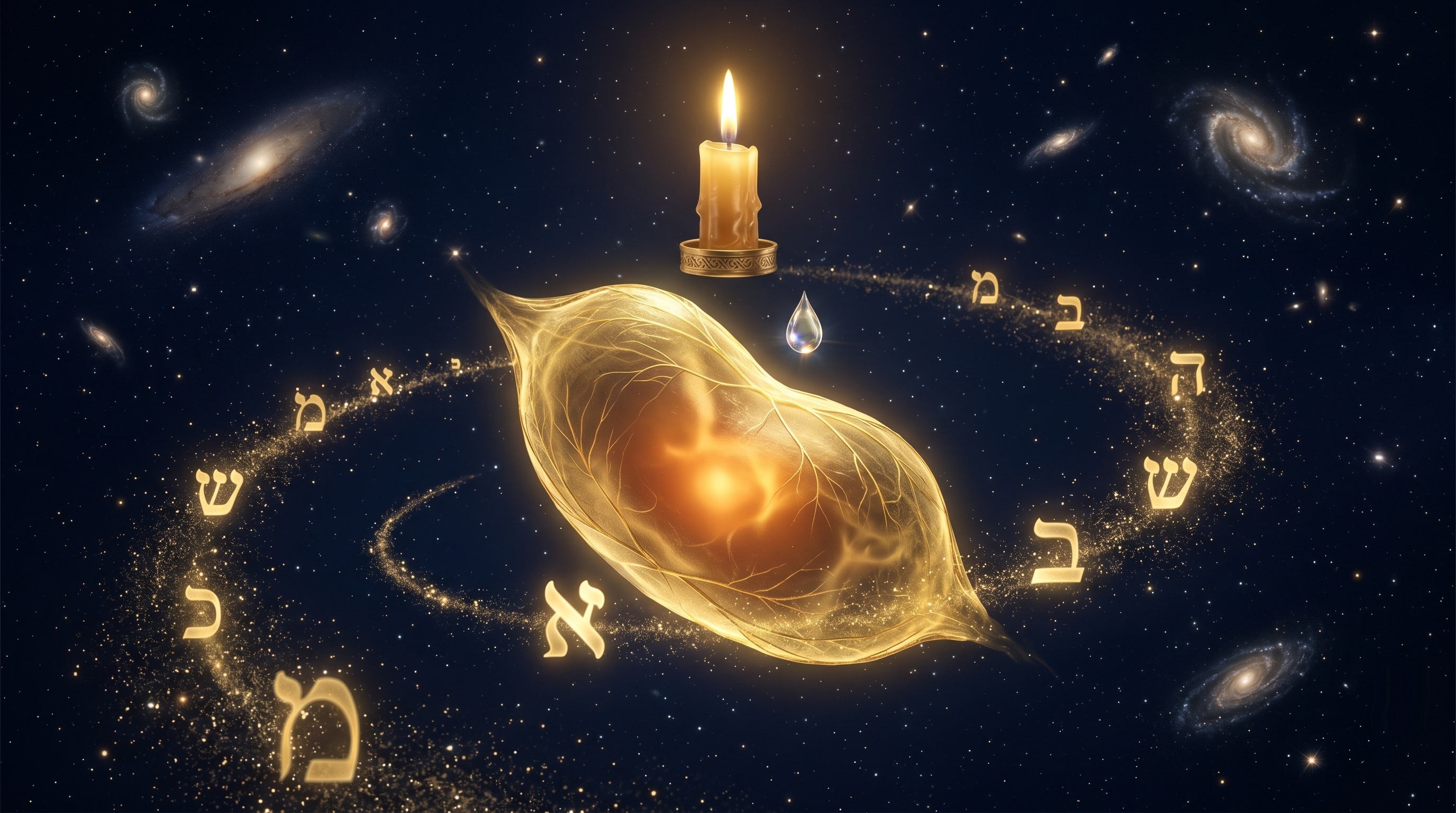
🔷 While the child is inside its mother’s womb, it resembles a folded parchment, its head between its knees. It eats what its mother eats. It drinks what its mother drinks. And a candle burns above its head — and it gazes and sees from one end of the world to the other. And it is taught the entire Torah.
There are no days in which a person dwells in greater goodness than those days.
The greatest moment of your existence was when you were in the womb. But when the child emerges into the world — an angel comes and strikes its lips — and it forgets everything. All the Torah. All the vision. All the joy.
⭐ The child cries not because the light blinds it. The child cries because it is grieving — mourning the moment when everything was taken from it in an instant. All that wealth, all that knowledge, all that closeness to G-d — gone.
7 Shalom Zakhar — Why Chickpeas?
Why is a “Shalom Zakhar” held on Friday night before the brit? And why are chickpeas and round foods served — the traditional food of mourners?
“Shalom Zakhar” does not mean “hello, male child.” Its true meaning: Shalom = consolation. Zakhar = you will remember. We are consoling the grieving child and telling him: do not despair. What the angel took from you — you can reclaim.
That is why we eat round foods — the wheel turns. That is why we eat mourner’s food. Because the child is in mourning. And who consoles a mourner? “Shabbat will console you.” That is why the brit is on the eighth day — so the child passes one Shabbat first, and receives consolation.
⭐ The great secret: every person who studies Torah in their lifetime is not learning something new. They are remembering. They are recovering what they knew in the womb. The flame that burned above their head is still there, buried deep. Torah study is not acquisition — it is self-redemption.
8 📅 Weekly Program — Parashat Tazria
Sunday
Read Leviticus 12:1–8. Ask yourself: what is the “candle” that once burned above your head? What did you know as a child that seems lost?
Monday
Think of the Mishkan as a new world. Where is your personal “Mishkan” — the place where you feel the Divine Presence is real?
Tuesday
Read the final verses of Sefer Vayikra. Ask: what would your life have looked like without your own “spy sin” — the moment you held back from entering?
Wednesday
Today, when you study Torah — say to yourself: “I am not learning something new. I am remembering.” One second with that thought changes everything.
Thursday
Think of a baby born recently near you. That child once knew everything. Its crying is grief, not fear. What it needs — is consolation.
Friday Night
Before Shabbat, take one moment: “Master of the Universe, let us remember together. This Shabbat — let it console what I have lost, and return what was taken from me.”
Shabbat
During the Torah reading of Tazria in the Beith Haknesset — pause at the words “When a woman gives birth.” Behind every birth — a soul that descended from on high and chose to come. Including yours.
Go Further
🏠
Shalom Bayit
20 levels. One question per card. No answers — only mirrors. Click to discover a new Shalom Bayit card.
🔢
Gematria — The Candle Above
What is the secret of the candle that burns above the soul in the womb? Hidden connections according to Rav Ménashé zatsal.
Friday Night · Parashat Tazria 5786 · Based on the shiur of M. Yéhouda Himi
That is the secret of Parashat Tazria. The Midrash reveals: while the child is in the womb, a candle burns above its head. It sees from one end of the world to the other. It is taught the entire Torah. “There are no days in which a person dwells in greater goodness than those days.” But when it emerges into the world — an angel strikes its lips — and it forgets everything. The child does not cry because of the light. It cries because of what it has lost.
That is why brit mila is on the eighth day: so that the child passes one Shabbat first. “Shabbat will console you.” That is why at a Shalom Zakhar we eat round foods — mourner’s food, for the wheel turns — and we whisper to the child: do not cry. What was taken from you, you can reclaim. Every Torah you will learn is not new knowledge. It is memory. It is self-redemption.
This Shabbat, let us enter with one thought: every time I study Torah — I am remembering. Good Shabbat.
Vayikra — The New Genesis
Shabbat Morning · Parashat Tazria · M. Yéhouda Himi
Sefer Vayikra is the new Book of Genesis. When the Mishkan was completed at the end of Exodus, the verses echo Creation itself: “And all the work of the Mishkan was completed” mirrors “And the heaven and earth were completed.” “And Moses blessed them” mirrors “And G-d blessed.” We stand at a new sixth day of Creation. And what was created on the sixth day? The human being.
That is why Vayikra opens: “And He called to Moses.” This book is not only a code of laws — it is a new chapter in human history. And we, children born into forgetting, arrived in this world to open a new page. Shabbat Shalom.