Vayishlach —
The Small Jug of Oil, from Yaakov to Chanukah
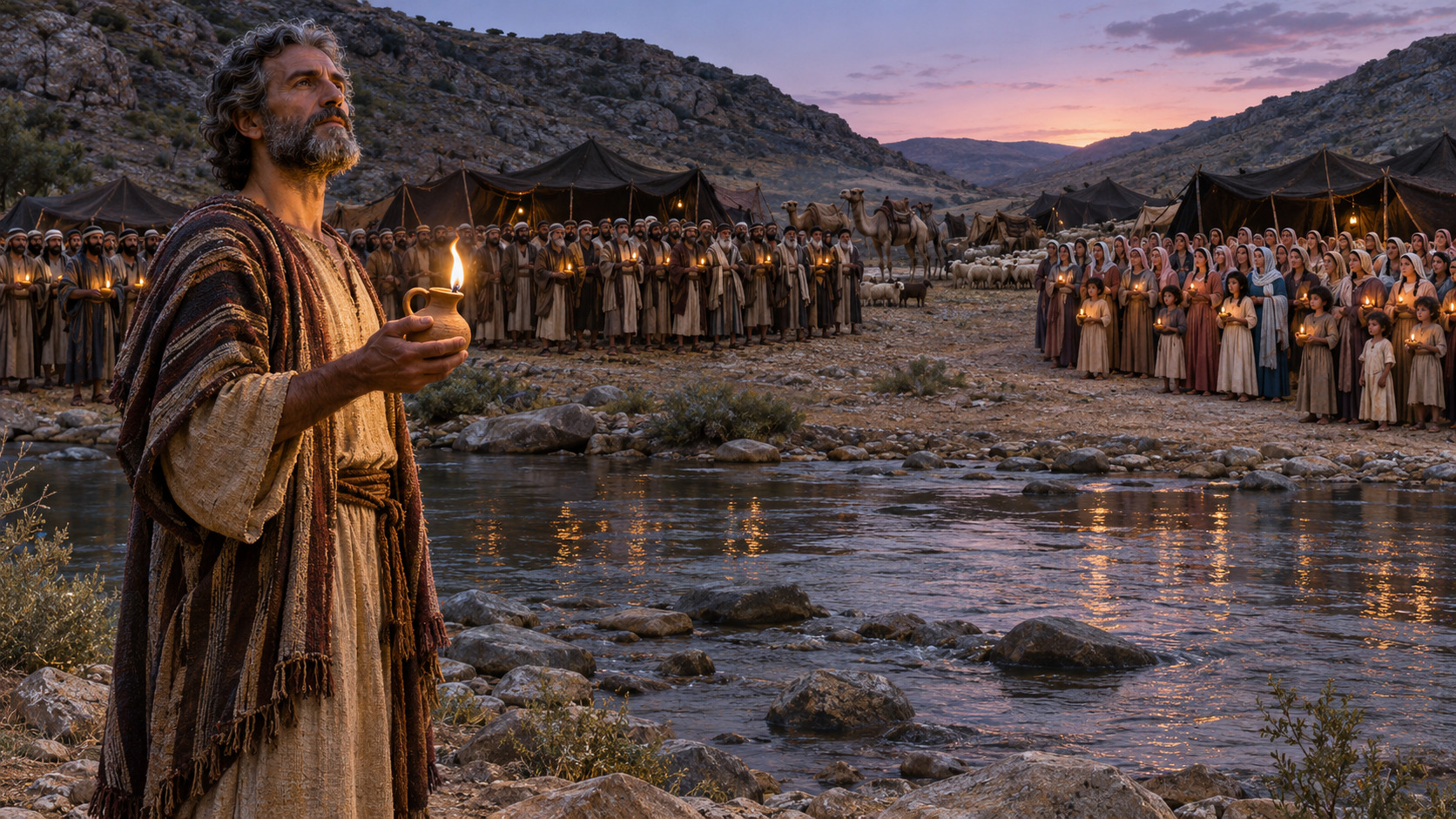
14 Kislev. Yesterday: the meeting of Yaakov and Esav prepares the Kohen Gadol’s service on Yom Kippur. Today: “Yaakov was left alone” — yet everyone had crossed the ford of Yabbok. Rashi: he had forgotten small jugs and went back for them. Why, when he had just sent 580 animals to Esav? “The righteous value their money more than their body”: the tzaddik elevates even his possessions, and leaves no spark of holiness to Esav’s angel — like Moshe: “not a hoof shall remain.” And Chanukah: “you risked your life for a small jug for Me, I will repay your children with a small jug.” The jug sealed with the Kohen Gadol’s seal: Yaakov, the first Kohen Gadol. The fight was over that jug: Esav wanted the Torah forgotten, Yavan wanted to darken Israel’s eyes; he strikes the thigh — the knees of Torah scholars. Finally Dina, hidden in a chest: why Yaakov was faulted, and what Hashem brought out of it.
Words of Torah do good when they are shared. Send this shiur to your family and friends on WhatsApp.
📲 Send on WhatsApp👥 Join the Gueoula groupToday, with Hashem’s help, is 14 Kislev; let us continue with Parashat Vayishlach.
Yesterday we spoke about the meeting of Yaakov and Esav, and we said that Yaakov is in fact laying the groundwork for what will one day, with Hashem’s help, be the service of the Kohen Gadol on Yom Kippur. The Kohen Gadol takes the two goats; the goat, the “sa’ir,” reminds us of Esav, who is hairy. For every year Esav’s angel comes to accuse the people of Israel: why does Hashem do good to Israel and atone for their sins? So the Kohen confesses all of Israel’s sins on the goat’s head, so they cling well; the goat feels good, as if he were finally “blessed” with all of Israel’s sins — but in the end, they send him to Azazel, into the desert.
That is exactly what happens with Esav at the end of the meeting: Esav goes to Seir. And Yaakov, where does he go? To Sukkot. That is what happens after Yom Kippur: we celebrate Sukkot once all our sins are atoned. And there is also the hint “I will appease his face (achaperah panav) with the minchah”: “achaperah” is Kippur; “minchah” is the hour when the Kohen finishes the service, and Israel’s sins are forgiven.
Along the same line, let us continue this idea. In chapter 32, verse 25: “Yaakov was left alone, and a man wrestled with him until the break of dawn.” There is a difficulty here. Two verses earlier it says: “He rose that night and took his two wives, his two maidservants and his eleven children, and crossed the ford of Yabbok. He took them and brought them across the stream, and brought across what was his.”
From these two verses it is clear that everyone crossed the stream of Yabbok. So how can the next verse say “Yaakov was left alone, and a man wrestled with him until the break of dawn”? He should not be alone! If he brought everyone across, he should be with everyone. That is the difficulty.
Rashi answers this difficulty: what does “Yaakov was left alone” mean? He had forgotten small jugs (pachim ketanim) and went back for them. What are “pachim”? The word is spelled peh, kaf, yud, mem; singular “pach.” Not a garbage can, but a jug of oil — like the jug of oil the Kohen Gadol found on Chanukah.
And we always read this parashah in the month of Kislev, close to Chanukah. So you ask: what is the connection between these small jugs — the little cups you fill with oil to light a flame — and Chanukah?
But first we must ask: why does Yaakov go back for small jugs? How much do those little cups cost today? A shekel? Half a shekel? A minute ago we saw Yaakov organizing a minchah for his brother Esav: he sent him 580 head of sheep and cattle. 580! And now you are counting pennies? Fine, you forgot — keep going! Why do you need to go back for them?
Our Sages say: from here we learn that the righteous value their money more than their body. And you say, how can that be? On the contrary — I would have said that for a tzaddik, material things don’t matter; the last thing a tzaddik cares about is his money. And here we see not only that our Sages say their money is dear to them, but even more than their body!
More than their body — why? Because the tzaddik refines his body with his holiness; but he is on such a high level that he manages to refine even his material things, even his possessions.
So what was in those small jugs? Yaakov our father understands that if Hashem gave him these possessions — including these little cups in which one puts oil to light lamps — then there are sparks of holiness in them too. And those sparks of holiness he cannot leave behind. Why? Because the sitra achra, Esav’s angel, could come and draw from that holiness and gain strength to do even more evil in the world. So, to leave him no chance, he does not leave him even small jugs.
Where did we learn this about the Children of Israel too? When they are about to leave Egypt, Pharaoh says: no problem, I am letting you go, go. Moshe our teacher says: we will go “with our young and our old,” and also our sheep and cattle — “not a hoof shall remain.” Even the hoof, what is at the bottom of the animal’s foot, we will take that too.
You would say: what’s the problem? Let a hoof stay! But Moshe our teacher tells Pharaoh: we are going to take out all the sparks of holiness that are in Egypt — not only in our bodies, but also in the sheep and cattle, and even in the hoof; we will take it too, so that no spark of holiness remains in Egypt. That is why Yaakov goes back for small jugs.
But we asked: what is the connection to Chanukah? There is a beautiful Midrash — I prepared it in advance, so as not to say it from memory. It says this, in the name of the Maharshal: Hashem said to Yaakov: “You risked your life for a small jug for Me; I Myself will repay your children with a small jug — the sons of the Chashmona’im,” for whom a miracle was done through a small jug.
Why was it risking his life? Because now that Yaakov goes back, he is alone, so he is exposed and vulnerable. And indeed, what happens when he is there alone? That is where Esav’s angel comes and tries to fight him.
See the connection! In the merit of the self-sacrifice of Yaakov our father, who would not give up that small jug, a miracle was done, and the people of Israel merited, in the days of Yavan, in the days of the Chashmona’im, that one jug was found.
Now notice what is hinted there: it was not just a small jug. It was a small jug sealed with the seal of the Kohen Gadol. A hint: who is the first Kohen Gadol we have in the people of Israel? Yaakov our father! According to all we learned, he is the one who actually performs the service with Esav: he is the Kohen Gadol.
So this small jug bears his seal: Yaakov’s self-sacrifice left a seal for all generations, and in its merit Hashem gives that jug of oil — in the merit of the jug of oil that Yaakov our father would not give up.
From this we understand what the fight of Esav’s angel with Yaakov was about: that jug of oil! What does the verse say? “Yaakov was left alone.” Now that he is alone and has gone back for small jugs, what does Esav fight him over? That he should not take that jug of oil. That is Esav’s fight with Yaakov: you came to take the jug of oil? Now I’ll trip you up, so you won’t take it.
Why? If you take the jug of oil, I know that the Torah will never be forgotten from Israel. And that is what Esav wanted to do: to make the Torah forgotten from Israel.
The exile of Yavan we learn from the very beginning of the Torah. First verse: “In the beginning God created the heavens and the earth.” And in the second verse, notice: “The earth was tohu and bohu, and darkness on the face of the deep.” Our Sages say this hints at the four exiles. “Tohu” is the exile of Babylon. “Bohu” is the exile of Persia. “And darkness” is the exile of Yavan, who sought to darken the eyes of Israel: Yavan did not say to destroy, kill and wipe out all the Jews; they wanted people not to engage in Torah — to darken the eyes of Israel. “On the face of the deep” — who is that? The exile of Rome.
But the Torah already reassures us in that second verse: “and the spirit of God hovered over the face of the waters” — that is the spirit of Mashiach, with Hashem’s help. The whole of history is written in the second verse of the Torah.
So Yavan sought to darken the eyes of Israel. What is the opposite — what drives out darkness? The small jug with oil in it, with which you light the lamp: that is what drives out darkness. Esav’s fight was to darken the eyes of Israel — and Yaakov wrestled with him.
Esav’s angel did not succeed in his fight. But what did he manage to do? He managed to land a blow below the belt: “He saw that he could not prevail against him, and he touched the socket of his thigh, and the socket of Yaakov’s thigh was dislocated as he wrestled with him.” These are the knees of the Torah scholars.
So that is where we must strengthen the Torah scholars, who are the knees of the people of Israel — strengthen them, so that the Torah is never forgotten from Israel. All this we learn from that struggle.
The verse just before is very, very interesting. What does it say? “He rose that night and took his two wives, his two maidservants and his eleven children.” How many children does Yaakov have? Not eleven: twelve! Dina! “And he crossed the ford of Yabbok.”
Our Sages ask: he also had Dina! Doesn’t she count? Dina, the daughter of Yaakov! It should have said: “he took his eleven children and his daughter Dina.” So did he leave her behind? Where is she? (From the audience: in a box!) Very good.
The Midrash — our Sages — says: and where was Dina? He put her in a chest — a nicer word, “teivah,” not “box” — and locked it. What was Yaakov afraid of? And from whom did he learn the idea, by the way? From Avraham, who also put Sarah in a chest so the Egyptians would not see her.
He said: this wicked one, Esav, has a haughty eye; let him not set his eyes on her, see her and take her from me. He wanted to protect her: I am keeping her in a chest so that Esav won’t take her. What did he fear? That he would take her and she would go astray.
No one wanted to marry Esav. Who was meant for him at first? Leah. And it says “Leah’s eyes were tender.” Why? From all her crying: everyone knew the elder would go to the elder and Rachel to the younger. She said: they are going to marry me to Esav! She cried until her eyelashes fell out — that is why “Leah’s eyes were tender.” No one wanted to marry him.
But what does the Midrash say? For this Yaakov was punished: he withheld her from his brother — perhaps she would have brought him back to the good — and she fell into the hands of Shechem. In other words, there is a complaint here against Yaakov our father: how could you not give her? Yaakov our father was expected to give Dina to Esav, and so she would bring him back to the good.
But then, why is there no complaint against Leah? Why not against Leah, and yes about Dina? There is a big difference — and with this I will finish.
Leah — who is her father? Lavan. What interests him is idolatry, right? True righteousness in Israel does not interest him — and that is exactly what Esav wants. If Esav marries Leah and pressures her to worship idols too, like his wives — Machalat daughter of Yishmael, Basemat daughter of Elon the Hittite, all of them — Leah would have no chance of holding out against him, because she has no one behind her. Her backing is Lavan the Aramean.
But Dina — who is her backing? Yaakov our father! Had he given her to Esav and Esav tried to influence her, she would have gone to her father: “Abba, tell your brother to stop confusing me; I want to be righteous and stay righteous!” There would have been someone to stand behind her.
Indeed, when Shechem son of Chamor took her, what did they do? A brit milah! They were even ready to undergo brit milah for her. So wouldn’t Esav have done teshuvah for her? Surely he would have done teshuvah for her! That is why the complaint is made against Yaakov our father: he should have given her… and Shechem son of Chamor took her.
But Hashem runs His world as He runs it. We already learned, two shiurim ago, that this whole detour was so that the spark of Rabbi Akiva, which was in Shechem son of Chamor, would pass to Dina and from there be redeemed later.
And we added that there is also “and the land is wide (rachavat) before them”: “rachavat” hints at Rabbi Chanina ben Teradyon, whose spark was also hidden in Shechem son of Chamor. That is why Hashem arranged everything so that it would come out through Dina. Blessed is Hashem forever, amen and amen.
Genèse / Genesis / בראשית 32,23–33
Rachi sur Genèse / Rashi on Genesis / רש״י על בראשית 32,23
Rachi sur Genèse / Rashi on Genesis / רש״י על בראשית 32,25
Exode / Exodus / שמות 10,24–26
Genèse / Genesis / בראשית 1,1–2
Béréchit Rabba / Bereshit Rabbah / בראשית רבה 2,4
Genèse / Genesis / בראשית 29,16–17
Words of Torah do good when they are shared. Send this shiur to your family and friends on WhatsApp.
📲 Send on WhatsApp👥 Join the Gueoula groupTest yourself
Five questions on the shiur. Choose an answer.
Result
Shalom Bayit — The Mouth at Home
My covenant of peace — peace begins at home. Reveal a Shalom Bayit card.
Gematria — Rav Ménaché
Shalom, Mashiah, Yisamech — secrets of the letters by Rav Ménaché zatsal.
🔢 Gematria CourseTorah Study
Go deeper into Rashi on Genesis 32:23 and 32:25: Dina in the chest and the small jugs — then Genesis 1:2 with Bereshit Rabbah 2:4: the four exiles.
📝 Beith HamidrachAll Parashot
All shiurim of M. Yéhouda Himi — from Bereshit to Devarim and the festivals.
📚 All ParashotBooks
Torah wisdom in thriller format — Éditions Gueoula.
Guardians of the Rift
Forty-nine gates open — the fiftieth hides in a single moment. An ancient secret resurfaces, and one man stands between the rift and the world. Drawn from Talmud and Kabbalah.
📖 Read the free excerpt · Book $9.90