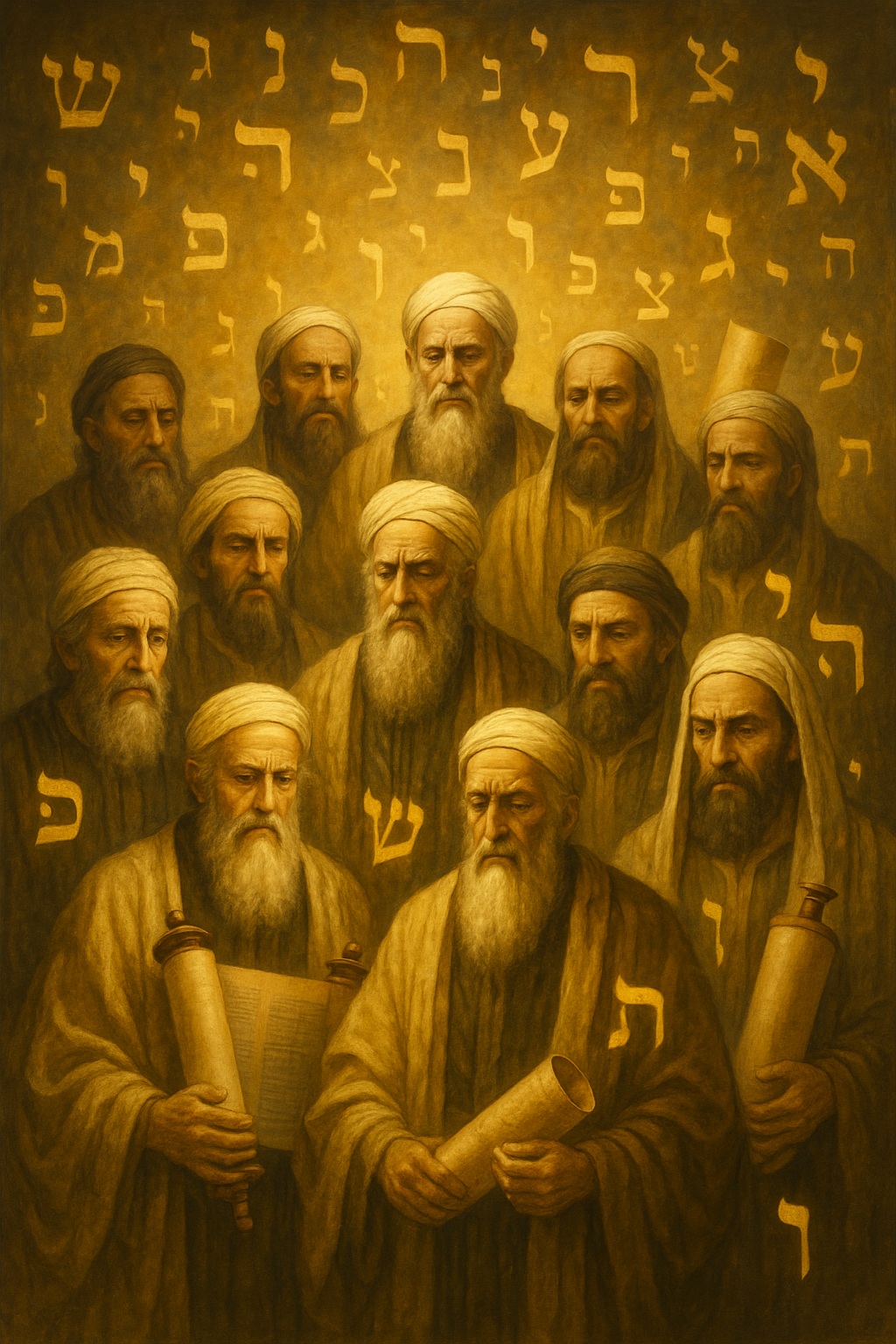
The Roman emperor challenges the Sages: why was the sale of Joseph never punished?
Rabbi Ishmael ben Elisha ascends to the sixth heaven and learns from Gabriel that ten Sages are doomed to die, atoning for the sale of Joseph.
He discovers the celestial altar where Michael daily offers the souls of the righteous to atone for Israel.
The martyrs are ten because a capital tribunal needs ten judges; the Holy One completes the count, and Rabbi Akiva atones for His portion.
In the Holy of Holies, G-d asks Rabbi Ishmael to bless Him: that mercy overcome anger.
Our task: to please the Creator and thereby draw down abundance and redemption.
The Roman emperor sought a pretext to persecute the Sages of Israel. Feigning interest in Torah study, he approached them with an apparently legitimate question.
The Sages realize the gentile is right, at least on the surface. Yet they also understand that this accusation has fallen upon them from heaven as a divine decree, and they resolve to verify whether there is truth in the matter.
The Sages turn to Rabbi Ishmael ben Elisha, then High Priest and one of the first Tannaim. They tell him: go up and ask whether this is a true decree, or whether we are merely being persecuted now.
Arriving at the sixth heaven, Rabbi Ishmael meets the archangel Gabriel, who asks why he has come up.
To the question "why?", Gabriel answers: because of the sale of Joseph by his brothers. The emperor believed he was inventing a new charge; he was only an instrument, a channel for the decree already pronounced.
For the attribute of justice accuses each day before the Throne of Glory: have You not written a single letter in vain in Your Torah? The tribes who sold Joseph have not yet been punished, neither they nor their descendants.
Since he was already up there, Rabbi Ishmael walked through the firmament and saw an altar close to the Throne of Glory. He asked Gabriel what is sacrificed on it, with no bulls, rams, or fire.
The priest of this altar is Michael, the Great Prince, the Prince of Israel. Each day the souls of the righteous are offered upon the altar beside the Throne of Glory, to atone for the people of Israel, day after day.
To condemn Joseph, the brothers formed a capital tribunal, which requires ten judges. A tenth had to be added to the count: the Holy One, blessed be He, who took part in the sale. For there was in any case a decree that Israel descend to Egypt; it was brought about through the sale of Joseph.
Who comes to atone for the Holy One, blessed be He? Rabbi Akiva, the tenth martyr. The Zohar explains that each of the ten martyrs corresponds to one of the tribes, and Rabbi Akiva to the portion of the Holy One, blessed be He.
Rabbi Ishmael was brought into the celestial Holy of Holies. There, as if the Shekhina were speaking, the Holy One, blessed be He, said to him: "Ishmael, My son, bless Me." Anyone would have fainted: I, bless the Holy One, blessed be He?
"May it be Your will that Your mercy suppress Your anger, that Your mercy be revealed upon Your attributes, that You deal with Your children in mercy and enter for them beyond the strict letter of the law." We recite this blessing every morning.
If the Holy One, blessed be He, is always joyful, He wills only to do us good. Our role is to be good children: to give Him no cause for anger, and thereby to do good to Him. All our work here below is to please the Creator.
When we please the Holy One, blessed be He, abundance descends: blessing, success, health, and complete redemption, with the help of G-d, speedily in our days. Amen!
🎯 Test yourself
Five questions. Click an answer.
Result
Shalom Bayit — The Mouth at Home
My covenant of peace — peace begins at home. Reveal a Shalom Bayit card.
Gematria — Rav Ménaché
Shalom, Mashiah, Yisamech — secrets of the letters by Rav Ménaché zatsal.
🔢 Gematria CourseAll Parashot
All shiurim of M. Yéhouda Himi — from Bereshit to Devarim and the festivals.
📚 All ParashotBooks
Torah wisdom in thriller format — Éditions Gueoula.
Guardians of the Rift
Forty-nine gates open — the fiftieth hides in a single moment. An ancient secret resurfaces, and one man stands between the rift and the world. Drawn from Talmud and Kabbalah.
📖 Read the free excerpt · Book $9.90