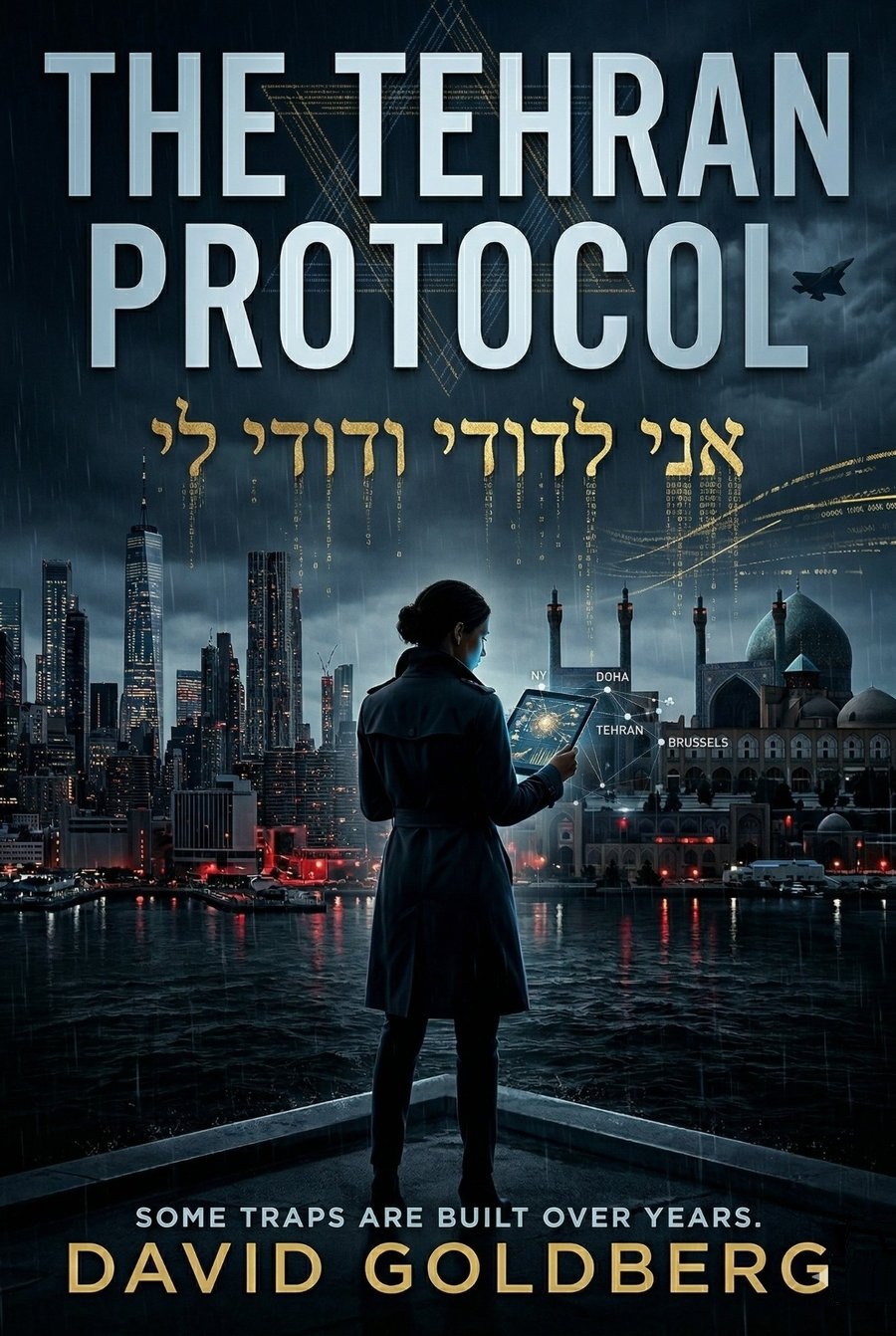
The Tehran Protocol
★ Free Preview — Chapter One
▸ Classified — Eyes Only

They buried the truth
in 3,000-year-old code.
Someone just dug it up.

Now everyone wants him dead.
"The thriller Daniel Silva never dared write."
Get the Full Novel → $4.99
↓ Scroll down to read Chapter 1 free
Chapter One
Silence Radio
The Last Signal

23:42 — Iranian Airspace, Province of Ilam — 29,800 ft

The cockpit of the F-15E had stopped being a machine twenty seconds ago. Now it was a coffin — titanium and glass, traveling at nine hundred kilometers an hour through a sky that had no intention of giving it back.

Major Jack Miller had flown two hundred and fourteen combat missions. He knew what a missile lock felt like before the display registered it — a frequency you felt in your teeth, a vibration that bypassed language. He knew the difference between being hunted and being studied. He knew the difference between a system failure and a system being walked through by something that understood it better than its designers had intended.

This was the third thing.

The Iranian defense grid wasn't trying to kill him. It was doing something the Pentagon had spent eleven billion dollars insisting was impossible: it was walking through his avionics the way a skilled lockpick walks through a deadbolt — not forcing anything, just relocating all the tumblers, quietly, one by one, in the dark, with the patience of someone who has been practicing on this exact lock for a very long time. The altimeter had drifted first. Subtle — two hundred feet of disagreement with reality. Then the INS. Then the datalink. Now every instrument on his panel was spinning freely in its own private universe, a mechanical choir singing a requiem he hadn't commissioned for an audience he couldn't see.

He had forty seconds. Maybe thirty-five. The terrain below was mountains he couldn't see in the dark, rising toward him at a rate that was either manageable or not, and without the altimeter the question was unanswerable, which was the point. This was designed. Someone had designed this moment — this exact configuration of confusion and altitude and darkness and disappearing instruments — and they had designed it from a position of knowing, in advance, the precise shape of the problem it would create.

"Starship One, Raptor Control. Your telemetry is degraded. Confirm position."

He pressed transmit. Got nothing. Not static — the silence that tells you the signal never left the room. Not interference. Absence. The radio was on, the power was live, the transmission sequence was executing correctly by every indicator he had left. The signal simply wasn't going anywhere. They were inside his aircraft. Not physically. Something worse than physically. They were inside the protocols.

Miller wasn't a philosophical man. He'd grown up in Tulsa, played football badly, found the only place he felt fully calibrated was above the cloud line at seventeen in a Cessna 172 with a borrowed headset and a chart that was six months out of date and an instructor who believed that uncertainty was the first thing you had to make friends with before you could fly anything seriously. He'd made friends with uncertainty. He'd spent twenty years making friends with it in increasingly expensive and dangerous machines. He didn't pray with any consistency. He didn't believe in signs. He believed in physics and preparation and the principle that every problem has a shape and if you find the shape before it finds you, you have a chance.

The problem's shape right now: someone had spent months or years mapping every system in this aircraft, had waited until he was at exactly this altitude over exactly this terrain on exactly this heading, and had executed their protocol so cleanly that he had perhaps thirty seconds before the mountain below decided the question his altimeter couldn't.

One thought arrived with the force of incoming ordnance: Someone knew exactly where I would be.

Not the aircraft type. Not the general route. The aircraft, the mission, the window. Someone had been inside the planning cycle. The thought wasn't panic — it was information, arriving with the cold clarity that well-trained minds produce under terminal pressure, information he filed immediately in the debrief-folder he kept in the back of his consciousness: the folder for things that would matter if he survived, the folder he had been adding to for twenty years and had never yet had reason to doubt would get used.

"I'm punching out!"

He said it to a dead radio. A declaration for the record, though there was no record left. A habit of twenty years — you announce the action, you create the documentary trail, even when the trail ends here. He grabbed the ejection handle — yellow and black, textured rubber for cold-weather gloves, worn smooth in one spot on the right side from the number of times he'd rested his hand there during long missions, not pulling, just resting, just aware — and pulled.

The charge fired. The canopy shattered outward with a sound like the world's largest window being broken by someone who had been wanting to break it for a very long time. Air at thirty thousand feet arrived like a wall built of frozen razors — a hundred and fifty kilograms of deceleration in a tenth of a second, his body going from nine hundred kilometers per hour to approximately zero in a duration that has no comfortable human analogy. His visor fogged. His vision compressed to a grey tunnel with a bright point at the center that took two seconds to resolve back into the night sky and the mountains and the stars.

For three seconds he saw only stars. He smelled propellant and altitude and his own fear, which wasn't the dramatic thing people imagine but a cold, metabolic clarity — the adrenal system doing exactly what it was designed to do, stripping the world down to the one question that mattered: where is the ground?

The chute opened at twelve thousand feet. The violence stopped as though it had never happened — sudden silence, the harness biting into his thighs, the canopy above him blooming dark against the darker sky. He could see nothing below. Mountains, somewhere. He had a rough heading from the last reliable instrument reading. He had a survival radio. He had fourteen rounds in the Beretta on his right hip. He had the training, which was the most important thing, and the training said: assess, orient, act.

He assessed. He was alive. He was descending in hostile territory at a rate that would put him on the ground in approximately four minutes. The aircraft hadn't exploded on impact yet, which meant it had gone into the mountain at an angle that scattered rather than concentrated the force. There would be debris visible on thermal imaging within the hour. The IRGC ground teams would have a search radius and a search team activated before he touched down.

He oriented. North was behind him. The border was approximately sixty kilometers in that direction, which was sixty kilometers of Iranian mountain terrain in the dark, which wasn't something he was going to cover on foot with any confidence of making it before the search teams found his thermal signature. He had the survival radio but using it would create a signal the IRGC direction-finding equipment would register within minutes of his first transmission.

He acted. He pulled on the right riser, adjusting his descent trajectory toward a dark band below that his pilot's eye read as a valley floor — more ground truth, harder landing, but a valley floor gives you movement options that a ridgeline doesn't. He checked his watch: 23:47. Five minutes since the instruments had gone. The mission timeline was already irrelevant. The only timeline now was the one between his boots hitting the ground and the first sound of boots that weren't his.

He drifted down into a darkness that was absolute, over mountains he had never stood on, toward people who had been waiting for him. Not for him precisely. For the aircraft that had been lured into this valley at this hour by a system that had been built, over months or years, for exactly this purpose. The aircraft was incidental. What they wanted was inside it. What they wanted, he would understand much later, was something that had been quietly stolen from American avionics over a period of scheduled test pulses at two-hour intervals, piece by piece, with the patience of people who understood that the most valuable thefts are the ones that take long enough that no one notices until the thing is gone.

— ✦ — 01:15 — Langley, Virginia — Operations Center, Sub-Level 3

The green dot vanished at 01:14:58 Eastern. In the room watching it disappear — no windows, recycled air, the institutional despair of fluorescent light on grey carpet that Langley had never quite been able to resolve despite three renovation cycles — eleven people said nothing for four seconds, which in that room was geological time.

Marcus Thorne, Deputy Director of Operations, stood with his arms folded and watched the empty coordinates as though they might reconsider. Sixty-one years old, built like a man who had once been athletic and chosen the work over the gym two decades ago and not regretted it. His face was Washington's face — the physiognomy of a man who has been competent, contained, and tired in a way that sleep no longer addresses, for long enough that the competence and the tiredness have become indistinguishable from each other. He had been in this room, or rooms like it, for thirty years. He had watched dots vanish before. The dots always meant something. This one meant something .

To his left, holding an empty paper coffee cup that he had finished twenty minutes ago and hadn't yet put down, stood a man who technically shouldn't have been in the room. Ari Ben-Levi was forty-four, Israeli, and carried the stillness of someone whose profession is knowing things before they are confirmed — not the stillness of patience but the stillness of a man who has already processed the next three steps and is waiting for the room to catch up. His suit was good. His eyes hadn't moved from the display since the dot went dark.

Classified · Eyes Only · Compartment LAZARUS Subject: F-15E Strike-7 / Maj. John T. Miller / Mission KESTREL-9

Status: SIGNAL LOST — 23:42:17 local / Province of Ilam, Iran

Assessment: Electronic intrusion confirmed (preliminary) — SIGINT Node 4

IRGC ground assets: estimated 18 minutes from last known coordinates

SAR Package BRAVO: on standby, awaiting authorization "It's a trap, Marcus." Ben-Levi's voice carried the flat tone he used for everything — weather forecasts, operational assessments, the death of colleagues. A quality that might be mistaken for indifference by someone who didn't know that the flatness was the form his discipline took, the way a very good surgeon's hands don't shake. "Your systems were penetrated before wheels-up. Someone walked that aircraft directly into a pen."

"We don't leave pilots." Thorne said it the way he said everything now — not as a conviction forged in this moment but as a reflex, a phrase carved into him by thirty years of institutional catechism that he recited as automatically as his name.

"I'm not asking you to leave him. I'm asking you not to send more." Ben-Levi set the empty cup on the nearest console. "Not until you understand what you're sending them into. The operation is called Mir'or. We've had the intelligence for nine days. Someone on your side received it and filed it."

The word filed landed in the room with a weight that its four letters shouldn't have been able to carry. Thorne heard it. He absorbed it. He said nothing, because nothing he could say in the next thirty seconds wouldn't constitute either a lie or an admission, and he needed more than thirty seconds to understand which of those he was actually in.

From the far side of the room, an analyst named Chen spoke quietly to her monitor without looking up. Her voice had the tone of someone delivering the meteorological forecast for a catastrophe: "White House is active, sir. Truth Social, incoming."

Every screen in the room pulled the same post simultaneously. Some because the monitoring software was configured to do so. Some because people had simply pulled out their phones. Thorne read it. Read it again. Processed the gap between the reality in this room and the reality being assembled, in real time, for public consumption — a gap so wide it had its own structural integrity, its own weight-posture capacity, the kind of gap you could build a policy on if you didn't look at it too carefully.

He turned to Ben-Levi. "Does Jerusalem know the full scope?"

The Israeli considered his answer for exactly as long as it deserved — not the performative pause of someone buying time, the genuine pause of someone deciding how much of the truth the situation required. "Jerusalem knows what it always knows. there's one person who mapped the intrusion protocol three weeks ago. A former 8200 analyst. Her report landed at Langley. It was received."

"And filed."

"Opened for eighteen seconds and filed."

The room had been running on the low-grade background noise of professional emergency — keyboards, the cooling system, someone's chair — and for two seconds even that stopped. Then Chen said: "Search and Rescue BRAVO is asking for authorization, sir."

Thorne closed his eyes for two seconds. Two seconds of darkness in a room full of lights. When he opened them he was looking at a screen showing an empty coordinate, a missing pilot, a message the president had already turned into something else. "Where is she?"

"New York," Ben-Levi said. "She's been in New York for four days."

"Doing what?"

Ben-Levi looked at him with the expression of a man delivering a correction that can't be delivered kindly: "Doing what your analysts should have been doing three weeks ago. Finding out who buried her report and why."

— ✦ — 03:00 — New York City — Gracie Mansion, South Lawn

Mayor Dominic Caruso had started his press conference an hour ahead of schedule, which told you everything about the kind of man he was. Not impatient — strategic. Someone who understood that the person who shapes the morning's narrative owns the day, and that owning the day in New York City, when you were planning to own the decade, was the kind of compound interest that built careers rather than just occupied them.

He stood before his microphones with the Hudson enormous and grey behind him, the predawn light turning his silver hair into something that photographed as statesmanlike, his expression calibrated to the precise frequency between measured concern and principled authority. He had come up through Brooklyn — the parish fundraisers, the union halls, the New York political apprenticeship that teaches you to be simultaneously a man of the people and a man who understands that the people are managed. He wasn't a stupid man. He was a man who had constructed, over twenty-five years, a version of himself that was so consistently performed it had become, in most respects, actual.

The Qatari network fund underwriting three of his campaign's largest donors wasn't a secret, technically. It was a fact that existed in the financial disclosure documents filed with the city's ethics board, correctly, within the legal parameters, in the language that legal parameters provide for facts you need to exist without being understood. Fourteen hundred pages of correctly filed documents that, taken individually, meant nothing in , and that, assembled by someone who knew what they were looking at, told a story that the mayor of New York City wouldn't have chosen to have told.

No one had assembled them yet. Until four days ago, no one had been looking.

"This administration," Caruso told the microphones and the cameras and the two dozen journalists who had dragged themselves to Gracie Mansion at three in the morning because a three AM press conference always means something, "won't allow New York City to become a staging ground for foreign military adventurism. The families of this city — Muslim families, Arab families, every community that has been targeted by federal surveillance in the name of security theater — deserve a mayor who will stand in the gap between federal overreach and their constitutional rights."

Near the back of the press pool, third row from the left, a woman in a charcoal blazer was writing on a yellow legal pad in pencil, which was already unusual enough to be notable in a room where everyone else was typing. She wasn't writing down the speech. She was writing: Prepared phrase. "Stand in the gap" — handler language. The metaphor is military. Find who wrote this.

Her press badge said Rachel Stein, Tribune. It was technically genuine — built on actual bylines, actual sources, two years of actual journalism that had established her as a real person in this ecosystem. The best cover is the one that doesn't need maintenance. The name on the badge was a working name. Her real name — the one her parents had given her in a hospital in Jerusalem in September, a name from Psalms, a name that means the doe of the morning light finding its way through darkness — was Ayelet.

— ✦ — 04:30 — Safe House, Midtown Manhattan — Floor 31

Daniel Rosen hadn't slept in thirty-one hours. This wasn't unusual. He hadn't slept for longer stretches in worse conditions for less important reasons, and his body had learned over twenty years to treat sleep as a negotiable resource rather than a requirement. He stood at the window of an apartment that had been a safe house for six years and looked at the city's grid with the detachment of a man who has looked at forty-two cities from forty-two windows and attached to none of them. New York was very good at not requiring attachment. It offered itself as permanent spectacle and asked nothing in return, which suited him.

Thirty-eight years old. Built like someone who had decided at nineteen that his body was a professional instrument and had maintained it accordingly — no wasted mass, the physical economy of a fighter who has moved past display into function. Three years with the Sayeret Matkal, where he had learned that violence performed correctly was almost always quiet. Then Unit 504, the kind of work that produced no public record and a very set of private ones. Then the quiet transition to a framework that didn't appear on any organizational chart, that communicated through channels that weren't listed in any directory, that operated in the spaces between the declared structures of three different intelligence services without technically belonging to any of them.

He owned seventeen books. He had read fourteen of them. The remaining three he carried without reading — a history of the 1973 war he kept meaning to finish, a collected speeches of Ben-Gurion he had acquired with genuine intentions, and a slim volume of Yehuda Amichai poems given to him eighteen months ago by a woman in Vienna whose name he remembered the way you remember things you don't examine — in glimpses, in the peripheral vision of sleep, in the sensation of having been seen by someone and not having known how to respond to it. She had said: Amichai understood soldiers better than soldiers understand themselves. Read it when you're ready.

He hadn't been ready. He wasn't ready now. The book sat spine-out between a Kissinger and a Ronen Bergman, its spine uncracked, its pages holding whatever they held, waiting.

His encrypted phone vibrated once. The message was four lines. He read it twice.

Secure Channel ALEPH-7 · 04:31:02 EST KESTREL IS LIVE. F-15E DOWN OVER ILAM — PILOT STATUS UNKNOWN.

NEW YORK ASSET: AYELET SHAMIR / COVER: RACHEL STEIN / TRIBUNE

LOCATION: RIVINGTON ST, LOWER EAST SIDE

DIRECTIVE: LOCATE. OBSERVE ONLY. DO NOT APPROACH. PROTECT.

She doesn't know you exist. He read the name twice. He had heard it once before — eleven months ago, in a debrief in a building in Tel Aviv that smelled of stale coffee and the anxiety of people who have found something they weren't looking for, spoken by a signals intelligence officer with the reverence reserved for colleagues who have done something you can't fully categorize. Shamir found it in a routine audit. Sixty-three pages. She built the entire technical case from a seventeen-millisecond anomaly that two automated systems had already dismissed as noise. He had asked: Who authorized her to do the analysis? The answer had been: No one. She was auditing something else. She found this on the way.

The file he'd been handed had a final line, almost parenthetical, the kind of detail that gets included because a thorough briefing officer includes everything: Subject strictly shomeret negiah. Non-negotiable personal protocol. Factor into all contact planning.

At the time, Rosen had read it and moved on. Irrelevant.

He picked up his jacket — dark, unstructured, the kind that disappears on a street at four in the morning — and checked the left interior pocket where the third hidden compartment sat against his ribs. Empty. He didn't carry weapons in New York unless the of the assignment required it. This was observation. Observation required other tools.

He went to the door. Four floors below, somewhere south of here, a woman in a charcoal blazer was walking home from a press conference with a legal pad under her arm and more information than any one person should be carrying alone through a city where someone had already decided she was a problem worth managing.

He had no idea what was about to begin. He had no idea that the man he would eventually become — the one standing under a chuppah in Jerusalem with broken-open eyes and a ring that had spent three days in his jacket pocket waiting for the right moment — was already there, inside him, patient. The way a flame waits inside an unlit match: not absent, not theoretical. Present. Waiting for the friction that makes it actual.

He went out into the city. The signal was dead. The pilot was falling. And somewhere in the architecture of a trap that had been three years in construction, two people who had never met were already moving toward the same point on the map.

He went out into the city. The signal was dead. The pilot was falling.

"The flame was already there,
inside him, patient.
The way a flame waits inside an unlit match —
not absent. Present.
Waiting for the friction that makes it actual."

THE TEHRAN PROTOCOL

gueoula.com
Full novel · $4.99 · David Goldberg · Éditions Gueoula
Discover the Full Novel →