Talmud · Megillah 17b · Jewish Prayer
The Hidden Architecture of Jewish Prayer
Why exactly 19 blessings? Why this exact order? The Amida is not what you think.
Inspired by a study with Rabbi Shimon Atelan — based on Talmud Megillah 17b–18a
Three times a day, for two thousand years, every Jew has recited a prayer of nineteen blessings. Most assume it is a list of requests. It is not. The Talmud reveals — quietly, almost casually — that the Amida is one of the most sophisticated pieces of spiritual engineering ever produced. It is a complete, encrypted map of the Redemption of the world. Every blessing is drawn from a verse. Every verse links to the next. And together they form a single, hidden narrative that has been recited unknowingly by millions, every single day, since Ezra the Scribe.
1 The Question Nobody Asks
Why are there exactly nineteen blessings in the Amida? Why are they in that specific order? And who decided?
Open any prayer book. Count the blessings of the weekday Amida. You will find nineteen — even though tradition calls it the "Shemoneh Esrei," meaning "The Eighteen." Already a mystery: why a name that no longer matches the count?
Now look at the order. Praise. Then a wisdom request. Then repentance. Then forgiveness. Then redemption. Then healing. Then prosperity. Then ingathering of exiles. Then justice. Then judgment of the wicked. Then the righteous. Then Jerusalem. Then the Messiah. Then "hear my prayer." Then Temple service. Then thanksgiving. Then peace.
It looks like a random list. It is the most carefully engineered text in Jewish liturgy.
The Talmud (Megillah 17b–18a) asks the question directly: "From where do we know there are eighteen blessings? And from where do we know this exact order?" The answer the sages give is staggering. Each blessing is drawn from a specific verse. Each verse leads to the next by a chain of meaning. And the whole sequence tells one story.
2 The Three Acts — An Audience With the King
Imagine you have been granted a private audience with a king. How do you behave?
The Talmud (Berakhot 34a) compares the Amida to a servant approaching the throne. You do not burst in shouting demands. You do not start by asking for things. You enter with respect, you state your requests carefully, and you take leave with gratitude.
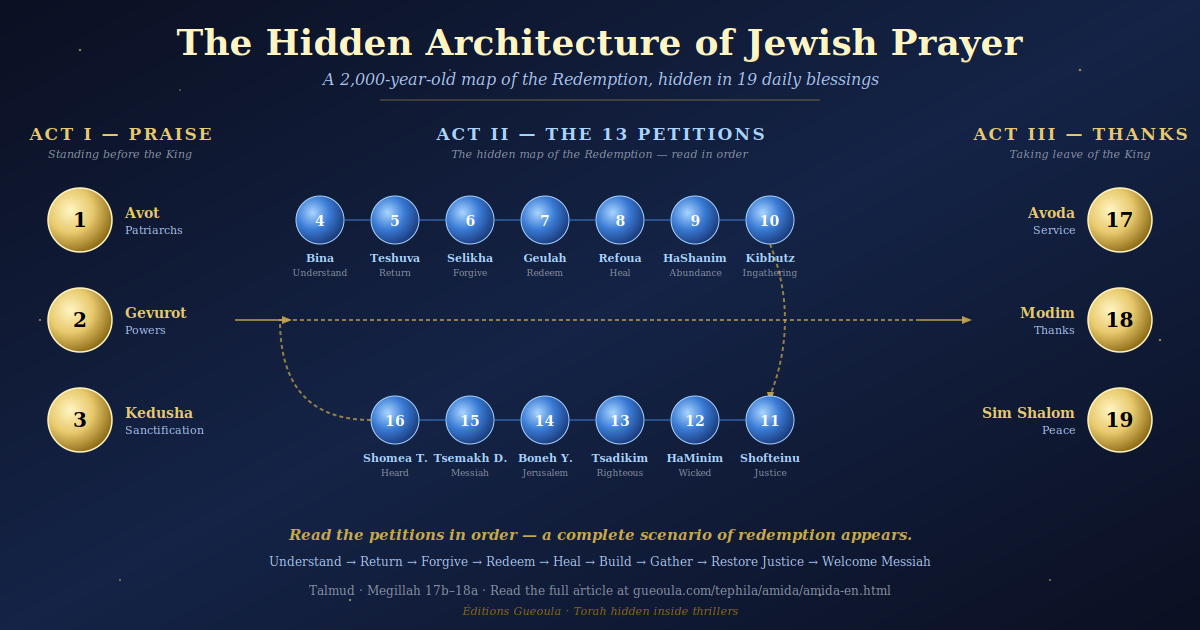
The Amida is built in exactly that shape:
I
PRAISE — The First Three שבח
You enter the throne room. You do not yet ask for anything. You acknowledge the King: His covenant with the Patriarchs, His power over life and death, His holiness.
II
PETITIONS — The Middle Thirteen בקשות
Now you may speak. But what you ask, and the order in which you ask it, is itself a teaching. This is the heart of the Amida — and the most extraordinary piece of architecture.
III
THANKSGIVING — The Final Three הודאה
You take leave. You do not exit silently. You thank the King for His service, for His daily gifts, and for the gift that contains all others — peace.
⭐ The structure is not religious decoration. It is a model for how to approach any high-stakes encounter — with God, with a person of authority, with destiny itself. Praise. Request. Thanks. Three movements, one masterpiece.
3 Act One — Standing Before the King (Blessings 1–3)
The first three blessings — Avot (Patriarchs), Gevurot (Powers), Kedushat HaShem (Sanctification of the Name) — share something rare in liturgy: they ask for nothing. They are pure recognition.
Avot opens with "Blessed are You, God of Abraham, God of Isaac, God of Jacob." Why these three names? The Talmud points to Psalm 29: "Ascribe to God, sons of the mighty" — Abraham, Isaac and Jacob were the eighteen of the Psalm, "the sons of the mighty," who first taught humanity to recognize the Creator.
Gevurot — the blessing of God's power — opens with "You are mighty forever." It celebrates the deepest of all powers: resurrection of the dead. The Maharsha explains: the same power that brings rain (from Tehillim — "He gives rain") is the power that revives the dead. Both reverse the natural order.
Kedushat HaShem — sanctification — closes the first act. After acknowledging the King's lineage and His power, you acknowledge His holiness: He is set apart from all you can imagine.
Three blessings. Zero requests. Why? Because before you ask for anything, you must remember who you are speaking to. Most of human prayer fails at exactly this point — it begins with "I want." The Amida begins with "You are."
4 Act Two — The Hidden Map of Redemption (Blessings 4–16)
Now comes the heart. The thirteen middle blessings are not a wish list. They are a chronological scenario of how God will redeem the world. Read them in order, and a story appears.
The sages of the Talmud, in Megillah 17b, walk through the sequence and reveal — link by link — that each blessing flows logically into the next. Below is the full map. Read it slowly. You may have prayed these words a thousand times without knowing what they were telling you.
5 The Thirteen-Step Map, Decoded
4
בִּינָה Bina — Understanding
"You graciously grant man knowledge." Why begin with intelligence? Because nothing else can happen without it. A person who lacks understanding cannot repent, cannot pray, cannot grow. The source verse: "The spirits gone astray will know Bina" (Yeshayahu 29:24).
5
תְּשׁוּבָה Teshuva — Return
"Bring us back, our Father, to Your Torah." Once a person understands, they see what they have done — and they return. The Talmud links this to Yeshayahu 6:10: "And his heart will understand (yavin), and he will return (vashav), and be healed." Understanding before repentance. Always.
6
סְלִיחָה Selikha — Forgiveness
"Forgive us, our Father, for we have sinned." A person who returns can now ask to be forgiven. Source: "Let the wicked abandon his way… and let him return to God, who pardons abundantly" (Yeshayahu 55:7). The order is exact: returning precedes pardon.
7
גְּאוּלָּה Geulah — Redemption
"Look upon our affliction… and redeem us." Once forgiven, a person can be delivered. This is the blessing that contains "Break the arm of the wicked" — the Talmudic verdict on the price-gouger and predator of the poor.
8
רְפוּאָה Refoua — Healing
"Heal us, God, and we shall be healed." The Talmud asks a piercing question: why does healing come after redemption? The answer: Selikha heals the soul. Refoua heals the body. The soul is treated first. The body follows.
9
בִּרְכַּת הַשָּׁנִים Birkat HaShanim — The Years (Prosperity)
"Bless this year for us." Why is this in ninth position? Because King David wrote about the price-gouger in the ninth Psalm. The defeat of the predator of the poor comes through abundance — when the warehouses overflow, the speculator loses all leverage. His arm breaks itself.
10
קִבּוּץ גָּלֻיּוֹת Kibbutz Galuyot — Ingathering of the Exiles
"Sound the great shofar for our freedom… and gather us." Once the world has abundance, the exiles can return to the Land. Source: "You, mountains of Israel, you shall give your branches and bear your fruit for My people Israel — for they are near to come" (Yehezkel 36:8). Abundance precedes the return.
11
הָשִׁיבָה שׁוֹפְטֵינוּ Hashiva Shofteinu — Restoration of the Judges
"Restore our judges as at first." Once the exiles are home, justice can be reinstated. Source: "I will restore your judges as at the beginning… afterwards you shall be called the City of Justice" (Yeshayahu 1:26). You cannot impose justice on chaos. First the people, then the courts.
12
בִּרְכַּת הַמִּינִים Birkat HaMinim — Against the Heretics
"And for the slanderers, may there be no hope." Once justice is restored, the truly wicked can be judged. This is the nineteenth blessing — added later by Shmuel HaKatan (we'll see why in a moment).
13
צַדִּיקִים Tsadikim — The Righteous
"Upon the righteous and upon the pious… may Your mercies stir." Once the wicked are removed, the righteous rise. Source: "All the horns of the wicked I will cut off — but the horns of the righteous shall be exalted" (Tehillim 75:11).
14
בּוֹנֵה יְרוּשָׁלָיִם Boneh Yerushalayim — Rebuilder of Jerusalem
"Return in mercy to Jerusalem Your city." Why does Jerusalem follow the righteous? Because "Pray for the peace of Jerusalem — they shall prosper who love you" (Tehillim 122:6). Those who love Jerusalem are the righteous; their rise summons her rebuilding.
15
אֶת צֶמַח דָּוִד Et Tsemakh David — The Branch of David
"Speedily cause the offshoot of David Your servant to flourish." Once Jerusalem is rebuilt, the Messiah, the descendant of David, can come. Source: "Afterwards the children of Israel shall return and seek God their God and David their king" (Hoshea 3:5).
16
שׁוֹמֵעַ תְּפִלָּה Shomea Tefila — He Who Hears Prayer
"Hear our voice, our God." Once the Messiah comes, prayer rises and is heard. Source: "I will bring them to My holy mountain and gladden them in My house of prayer" (Yeshayahu 56:7).
⭐ Read these thirteen as a sentence: Understand → Return → Be forgiven → Be redeemed → Be healed → Receive abundance → Come home → Restore justice → Judge the wicked → Lift the righteous → Rebuild Jerusalem → Welcome the Messiah → Be heard. This is not a prayer. It is a redemption blueprint.
6 Act Three — The Closing (Blessings 17–19)
The Amida ends as it began — without requests. After the long petition sequence, you take leave of the King.
17
עֲבוֹדָה Avoda — Service
"Be pleased, God, with Your people Israel and their prayer." The Temple service is restored. The connection between Heaven and earth is renewed.
18
מוֹדִים Modim — Thanksgiving
"We thank You." One does not leave the King without acknowledging the daily, hidden miracles. Source: "He who offers thanksgiving honors Me" (Tehillim 50:23).
19
שִׂים שָׁלוֹם Sim Shalom — Grant Peace
"Grant peace, goodness and blessing." Why end with peace? The Talmud answers: "There is no vessel that holds blessing like peace." All the previous gifts mean nothing without the vessel to contain them.
7 Why This Still Matters in 2026
A skeptic might ask: "Beautiful structure. But what does an ancient prayer architecture have to do with my life?"
Everything. Because the Amida is not only a prayer — it is a cognitive map for any large change. Read the order again, but apply it to your own life:
You want to change something — a habit, a relationship, a career, a country. The Amida tells you the order. First understand the situation honestly (Bina). Then admit your part (Teshuva). Then forgive — yourself and others (Selikha). Then act to escape the trap (Geulah). Then heal what was broken (Refoua). Then build the resources you need (HaShanim). Then bring back what was scattered — relationships, energy, focus (Kibbutz Galuyot). Then re-establish standards (Shofteinu). And so on. Every step is in the right place.
The sages did not invent this order arbitrarily. They observed how transformation actually works — at the level of a soul, a family, a nation, a world — and they encoded it into a text that an unschooled Jew could recite three times a day, every day, for the rest of history. Hiding wisdom in a habit. That is genius.
⬥ Modern psychology rediscovered, in the 20th century, the order of behavioral change: awareness → acceptance → forgiveness → action → recovery → resource-building → integration → reinforcement. It took us 2,000 years to catch up with what the Anshei Knesset HaGedolah encoded into the daily prayer of an obscure desert people.
8 The 19th Blessing — Why "Eighteen" Has Nineteen
If the Anshei Knesset HaGedolah composed the Amida and called it "Shemoneh Esrei" — Eighteen — why do we today recite nineteen blessings?
The Talmud (Berakhot 28b) tells the story. After the destruction of the Second Temple, in Yavneh, Rabban Gamliel asked the assembled sages: "Is there anyone who knows how to compose a blessing against the heretics?" The threat was acute — Sadducees, early Christians, informers were tearing the Jewish community apart from within.
A young, almost unknown sage stood up. Shmuel HaKatan — "Samuel the Small." He composed the blessing. It was inserted as the twelfth blessing. The sequence remained intact, but now there were nineteen.
There is a profound irony here. Shmuel HaKatan was named "the Small" because of his extraordinary humility. Only he was permitted to compose this blessing — because only someone with no trace of personal hatred could be trusted to write it. The blessing against the wicked could only be authored by a man without enemies.
That's why the prayer is still called "Shemoneh Esrei" — Eighteen — even though we count nineteen. The original architecture was sacred. The 19th was an emergency surgical insertion, not a redesign.
📅 Daily Practice — How to Use This Map in Your Own Prayer
Shaharit (morning)
When you reach Bina (4th), pause. Ask for one specific clarity you need today. The day's first request should be for understanding.
Mincha (afternoon)
When you reach Geulah → Refoua (7→8), notice the order: soul before body. Bring one wound to mind that needs healing — start with the spiritual layer.
Arvit (evening)
When you reach Modim (18th), name three small miracles from this exact day. Not generic — specific. The Sages call this "the daily miracles we are unaware of."
Shabbat & Festivals
The middle thirteen are replaced by a single blessing — but the architecture remains. Praise → request → thanks. Notice it. The structure is the point.
Every prayer
Before you begin, take one breath and tell yourself: "I am about to recite the map of the world's redemption." The words won't change. Your relationship to them will.
Continue the Journey
🎁
Free Novel — The Guardians of the Rift
Like this article, our novels hide deep Torah inside thrillers. Get the full novel free — delivered as EPUB + PDF.
📚
Discover All Our Books
Spiritual thrillers and Torah-based fiction by Yéhouda BEN DANAN. Each novel is a Trojan horse for authentic wisdom.
📚 See the Catalog
📜
Daily Halakha
Practical Sephardic rulings (Yalkut Yossef). Every law is either MOUTTAR or ASSOUR — no ambiguity, ever.
📜 Learn the Halakha
📖
Weekly Parasha by M. Himi
Receive a deep teaching on the weekly Torah portion — trilingual, illustrated, Sephardic tradition.
📖 This Week's Shiur
✉️
Stay in the Loop
One email per week — the new article, the new shiur, the new chapter. Unsubscribe anytime.