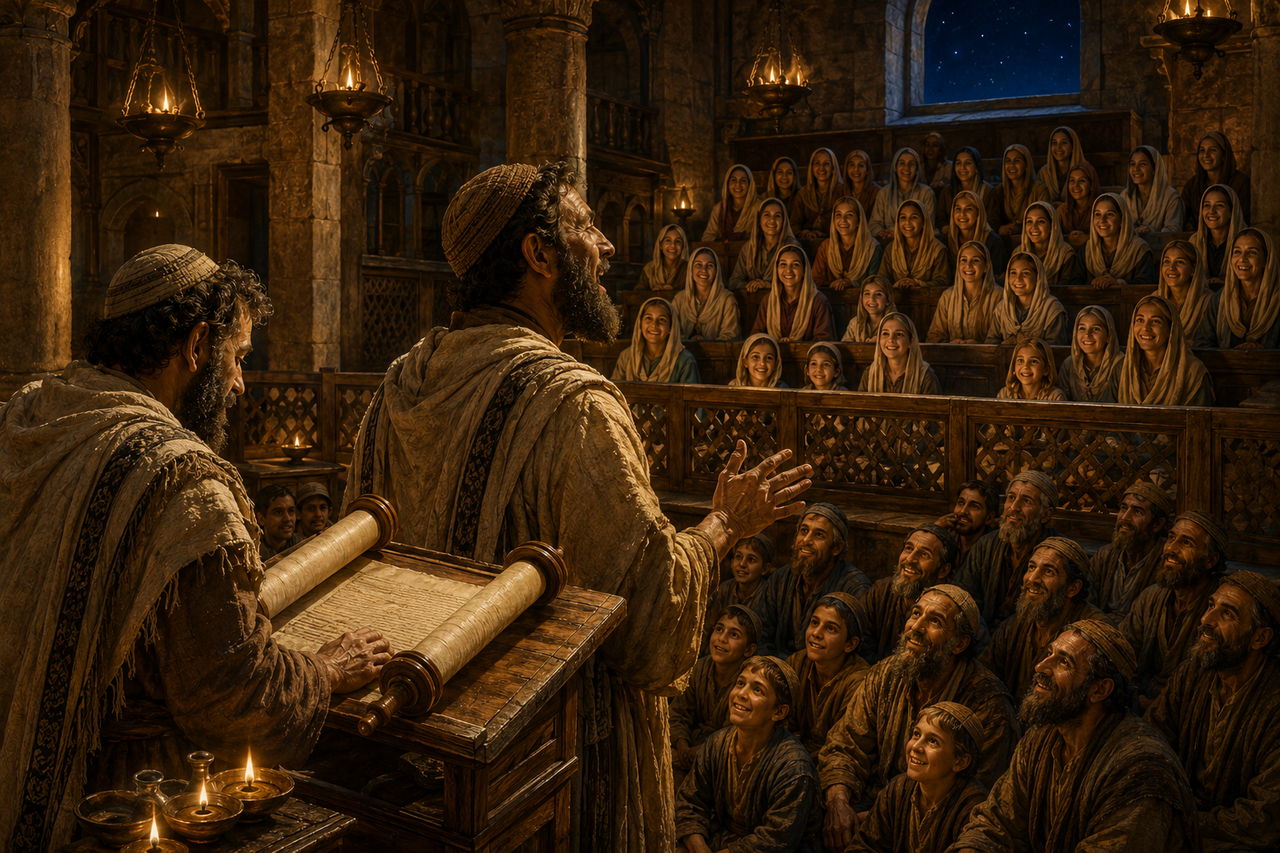
In the days of the Mishnah a meturgeman rendered every verse aloud into Aramaic, the spoken language of the Jews, so the assembly could follow. Some passages were a problem. The Beraita sorts them into three groups.
Where the line falls. In every case of the first group the argument that gets rejected is the same one: honour. The honour of Abraham, of Yehudah, of David, of the tribe of Binyamin, of Israel. Every time, it loses.
The only three passages withheld from translation are withheld not because they embarrass but because they are easily misunderstood: the plain sense is false, or it suggests something false about God.
Shame does not censor. Error censors.
📖 To the full shiurThe Mishnah assumes a practice that has since vanished. In the era of the Mishnah and Gemara the spoken language of the Jews was Aramaic. A meturgeman stood beside the reader and rendered the Torah and Prophets aloud, verse by verse, so the assembly could understand.
The whole sugya turns on that point of contact: not what the text says, but what is made audible to those with no direct access to it. The question is never "is this verse true?" but "what happens when a mixed assembly hears it in the clear?"
Nearly every case follows the same movement, and you must see it to understand the page. The Beraita states a case. The Gemara immediately objects: פְּשִׁיטָא — obviously, why teach this? Then it answers: מַהוּ דְּתֵימָא — "you might have said…", laying out the objection a reasonable person could have raised.
1 · Ma'aseh Bereshit Genesis 1 One might have feared that translation opens the door to metaphysical speculation — what is above, below, before, after (Chagigah 11b). Read and translated: speculative risk is not enough.
2 · Lot and his two daughters Genesis 19:31-36 After Sodom the daughters believe humanity has been wiped out; they make their father drunk and conceive by him. Objection: the honour of Abraham, their great-uncle. Rejected — the Meiri: a righteous man and a wicked one are not bound together, even by blood. Another reading (Menachem Meshiv Nefesh): they acted out of concern for the survival of the species, and from them descend Ruth and then David.
3 · Tamar and Yehudah Genesis 38 Objection: the honour of Yehudah, forefather of the monarchy. Rejected — and the reversal is total: the passage is in truth his praise, for he admitted his fault publicly.
4 · First account of the Golden Calf Exodus 32:1-20 Objection: it disparages Israel. Rejected.
5 · Curses and blessings Leviticus 26 · Deuteronomy 27-28 A serious objection (Rashi): hearing the curses translated, the assembly might conclude that punishment is inevitable and give itself over to the pleasures of this world. Rejected. The blessings are named alongside them because the two form a single subject (Maharsha).
6 · Warnings and punishments Objection: people would keep the mitzvot out of fear of punishment rather than out of reverence. Rejected — the Ritva: one who observes out of fear still fulfils the commandments completely. The Bach has the reverse version, out of love and not out of fear.
7 · Amnon and Tamar II Samuel 13 Read and translated — in the verses where the text writes simply Amnon.
8 · Avshalom II Samuel 16:21-22 Public relations with his father's concubines. Objection: the honour of David. Rejected.
9 · The concubine at Giv'ah Judges 19 Objection: the honour of the tribe of Binyamin. Rejected.
10 · "Make known to Jerusalem her abominations" Ezekiel 16 Read and translated — and the Beraita states this case precisely in order to rule against R' Eliezer.
11 · Ma'aseh Reuven Genesis 35:22 Reuven moves Bilhah's bed. The Sages (Shabbat 55b) warn that the plain sense is false: he was defending his mother Leah's honour, and his piety was such that a minor lapse is counted against him as a major one. It is read — but not translated, since those who do not know Hebrew would grasp only the letter. R' Chanina ben Gamliel, officiating at Kavul, instructed the translator to render only the end of the verse: and the sons of Yaakov were twelve. The Sages praised him.
12 · Second account of the Golden Calf Exodus 32:21-25 Aharon's answer to Moses — I threw the gold into the fire and this calf came out — leads the ignorant to think the calf made itself, and therefore had a reality of its own. That is an error about the nature of the idol, not an embarrassment.
13 · Birkat Kohanim Numbers 6:24-26 "May Hashem lift His face toward you" suggests divine favouritism — see the box below.
The ministering angels protest before God: it is written in Your Torah (Deut. 10:17) that You show no favouritism — yet You instruct the Kohanim to bless Israel with May Hashem lift His face toward you.
The answer: how should I not favour them? I wrote you shall eat, you shall be satisfied, and you shall bless Hashem your God (Deut. 8:10) — the Torah obliges Birkat Hamazon only after satiety, and they are exacting with themselves to the point of reciting it over an olive's or an egg's bulk.
So the favour is real, but it is earned: it answers a voluntary stringency. Translating the blessing without that key would suggest arbitrary partiality.
14 · Amnon son of David II Samuel 13 Where the text writes simply Amnon, it is read and translated: the sin remains an individual's. Where it writes Amnon son of David, translating would reflect on the king. The Bach and the Hagahot HaGra emend to read but not translated, in line with our Mishnah.
15 · The Merkavah Ezekiel 1 The vision of the divine chariot: the Chayot, the ofanim, the firmament, the likeness of a throne and, above it, the likeness of a human figure. The founding text of Ma'aseh Merkavah, which the Mishnah in Chagigah restricts to a single mature student at a time. Reading it as a haftarah would expose the highest esoteric material to an unprepared assembly. R' Yehudah permits it — and the halakhah follows him: it is the haftarah of the first day of Shavuot, the day of the revelation at Sinai.
16 · Ezekiel 16, per R' Eliezer alone The chapter is an allegory: Jerusalem is a child abandoned at birth, whom God takes in, raises, marries and adorns with royal jewels — and who then prostitutes herself. She uses the gold He gave her to serve idols; she gives herself to Egyptians, Assyrians, Chaldeans; she is worse than a harlot, for she pays her lovers instead of being paid; she sacrifices her children to idols; measured against Sodom and Samaria, she is declared worse than both.
He did nothing wrong. לְאַפּוֹקֵי מִדְּרַבִּי אֱלִיעֶזֶר is a standard technical formula, applied to dozens of Tannaim: it means the Beraita states this case in order to fix the halakhah against a dissenting view. It carries no suggestion of misconduct.
The disagreement is substantive. R' Eliezer holds that publicly exposing Jerusalem's shame wrongs the honour of Israel. The Beraita holds that the value of prophetic rebuke outweighs it, and that the passage was written precisely to be heard.
The Gemara records the incident: a man was reading this chapter before R' Eliezer, who told him to go and investigate the abominations of his own ancestry; a blemish was found there. The Ritva notes that his fault was not the reading itself but failing to consult the rabbinic authority present.
The last part of the sugya shifts register. It is no longer about what is said but about how it sounds. The Beraita's rule: every verse written in coarse terms is read in decent ones — and the status invoked is considerable: according to the Sefer HaEshkol and the Seder HaSedarim, a halakhah leMoshe miSinai.
| Written | Read | Reason |
|---|---|---|
| yishgalena | yishkavena | Deut. 28:30 — a brutal verb for the sexual act, replaced by "he shall lie with her". |
| ba'apolim | batehorim | Deut. 28:27 — both words denote the anus, but the second stays allusive. |
| chiryonim | divyonim | II Kings 6:25 — the famine during the siege of Shomron. Avoiding an explicit statement that Jews ate dove's dung. |
| choreihem meimei shineihem | tzo'atam meimei ragleihem | II Kings 18:27 — Ravshakeh taunting the besieged: their excrement, their urine. |
| lemacharaot | lemotzaot | II Kings 10:27 — the temple of Baal turned into latrines. |
R' Yehoshua ben Korchah disputes the last case. Here, he says, lemacharaot is read exactly as written — because the coarseness is not an accident of the text, it is the message: the degradation of the idol. To soften it would be to spare idolatry.
Hence the general rule that closes the chapter. Rav Nachman: all mockery is forbidden, except mockery of idolatry, which is permitted. Proof from Isaiah 46:1 — Bel crouches, Nevo is crushed: the idols cannot even hold in their own bowels. R' Yannai adds Hosea 10:5 — the priests who rejoiced in the idol's glory now mourn its burden.
The sugya closes with one further halakhah, to be handled with care: one whose reputation is tarnished may be shamed; one whose reputation is excellent may be praised, and blessings rest on the head of the one who praises him. The Chafetz Chaim (Kelal 7, Be'er Mayim Chaim 8) sharply narrows the first half: it applies only to someone who transgresses constantly and whose reputation is deserved; where there is only rumour, relying on it is forbidden.
Take stock. Of sixteen passages, thirteen are read and ten are fully translated, despite the incest, rape, idolatry and betrayal they report. The only three withheld from translation are withheld for one traceable reason: they are easily misunderstood. Reuven, because the plain sense is false. The second Golden Calf account, because it suggests the idol had a reality of its own. Birkat Kohanim, because it would imply a partial God.
The Talmud accepts that the text may soil. It refuses that it should mislead.
Shame is not grounds for censorship — doctrinal error is. And when something must be withheld after all, what is withheld is the name, not the fact: Amnon stays, "son of David" goes.
What the page leaves open must be left open: the Ritva's objection. Every act of censorship points at what it hides. That is a real tension, raised twice, never resolved.
On that point the sugya says something few religious traditions are willing to say: the founding narrative keeps its disgraces, and they are read aloud.
Check what you have grasped
Five questions on Megillah 25a–25b. One answer each.
Result
The sugya does not go down in one swallow: it advances by objections. This breakdown follows its movement rather than the order of the pages.
Separate the fact from the name
The sugya does not withhold Amnon's crime — it withholds “son of David”. Before reporting a fault, ask whether the person's name is genuinely needed for the point.
Hear the Tokhachah unsoftened
The curses are read and translated despite the risk of demoralising. At Ki Tavo, stay present for the reading rather than stepping out.
Do not rely on rumour
The Chafetz Chaim sharply narrows the licence to shame someone of tarnished reputation: it holds only where the reputation is deserved, never for rumour, however widespread.
HalakhahCarry on in the tractate
This shiur closes the chapter Hakoré Omèd. The other classes of the tractate are gathered in the section index.
Tractate MegillahShalom Bayit — The mouth at home
What do you whisper to your children? To your spouse? Draw a Shalom Bayit card.
Gematria — Rav Menashe
Hidden connections inside names, according to Rav Menashe zatsal.
🔢 Gematria classesAll the Parashot
Every class by Mr Yehouda Himi — from Bereshit to Devarim, and the festivals.
📚 All the ParashotBooks
Torah wisdom in thriller form — Éditions Gueoula.

J'accuse the Nations
An eternal testimony before the conscience of the world. A book that unsettles, awakens and transforms.
📕 Read the 1st chapter — free