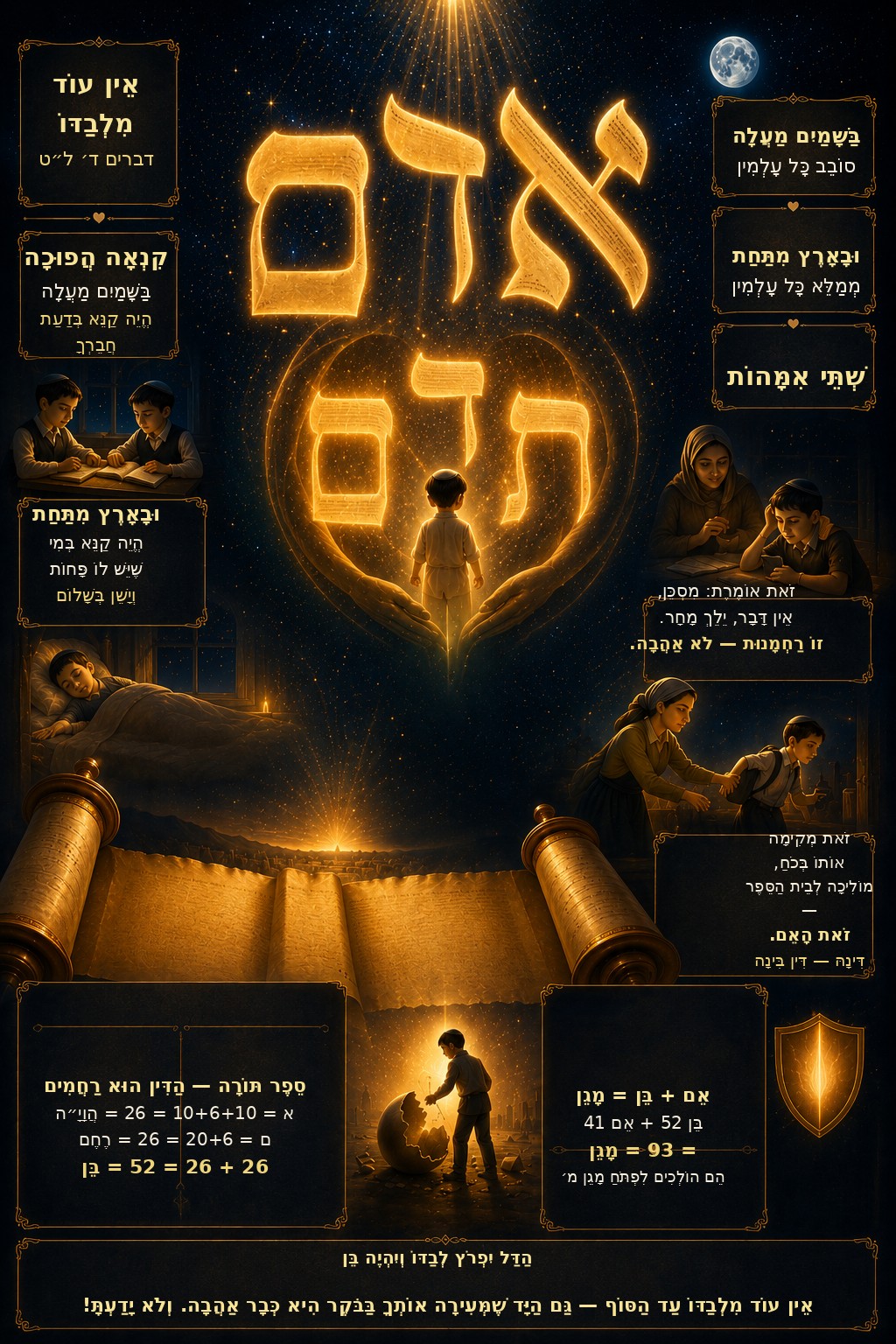
דברים ד׳ ל״ט מַסְתִּיר הוֹכָחָה: הַדִּין שֶׁל הַקָּדוֹשׁ־בָּרוּךְ־הוּא הוּא רַחֲמָיו בְּתַחְפֹּשֶׂת.
הַמִּלָּה אָדָם — א, ד, ם — מַצִּיבָה אֶת הָאוֹת הָעֲנִיָּה (הַד, הַדַּל) בֵּין הָאוֹת הָרִאשׁוֹנָה וְהָאַחֲרוֹנָה שֶׁל אֱלֹהִים. פָּרֵק אוֹתָן: כָּל אַחַת שָׁוָה 26 = הֲוָיָ״ה, שֵׁם הָרַחֲמִים. יַחַד — 52 = בֵּן. הָאָדָם, מְעֹרָה מֵחֶסְרוֹנוֹ, הוּא בֵּן אָהוּב חָבוּק בֵּין שְׁתֵּי רַחֲמִים.
וְהַם הַסְּגוּרָה הִיא רֶחֶם — שֹׁרֶשׁ רַחֲמִים. הַיִּסּוּרִים אֵינָם הֶעְדֵּר הָאַהֲבָה, אֶלָּא הוֹכָחָתָהּ. מִדְּרָשָׁה שֶׁל הָרַב סַעֲדִיָה בַּנְיוֹן זצ״ל.
Deuteronomy 4:39 hides a proof: God's judgment is His mercy in disguise.
The word Adam — Aleph, Dalet, Mem — frames the poorest letter (the ד, the dal, the pauper) between the first and last letters of Elohim. Decode those two letters and each equals 26 = the Tetragrammaton, the Name of Mercy. Together, 52 = Ben, "son." Man, stripped of his lack, is a beloved son cradled between two mercies.
And the closed ם is a rechem, a womb — the root of rachamim, mercy. Suffering is not the absence of love, but its proof. From a drasha of Rav Saadia Benayon zatsal.
Devarim 4, 39 cache une preuve : le din de Hashem est Sa miséricorde déguisée.
Le mot Adam — Aleph, Dalet, Mem — encadre la lettre la plus pauvre (le ד, le dal, le pauvre) entre la première et la dernière lettre d'Elohim. Décompose ces deux lettres : chacune vaut 26 = הויה, le Nom de la miséricorde. Ensemble, 52 = Ben, « fils ». L'homme, dépouillé de son manque, est un fils aimé bercé entre deux miséricordes.
Et le ם fermé est un rechem, une matrice — la racine de rakhamim. Les épreuves ne sont pas l'absence d'amour, mais sa preuve. D'une drasha de Rav Saadia Benayon zatsal.
אִשָּׁה כּוֹתֶבֶת אֵלַי: אֲנִי סוֹבֶלֶת לִרְאוֹת אוֹתוֹ סוֹבֵל. הִיא אֵינָהּ מְנַתַּחַת — הִיא חָשָׁה, בְּתוֹךְ מֵעֶיהָ, קְלִפָּה שֶׁהָאִישׁ שֶׁהִיא אוֹהֶבֶת עֲדַיִן לֹא שָׁבַר. הִיא רוֹצָה לִשְׁבֹּר אוֹתָהּ בִּמְקוֹמוֹ — וְאֵינָהּ יְכוֹלָה. הַחְזֵק אוֹתָהּ בְּלִבְּךָ עַד הַמִּלָּה הָאַחֲרוֹנָה: דֶּרֶךְ הָאִשָּׁה הַזֹּאת נִכָּנֵס, וְעָלֶיהָ נִסְגֹּר. כִּי הַשְּׁאֵלָה שֶׁלָּהּ הִיא הַשְּׁאֵלָה שֶׁל כֻּלָּנוּ: אֵיךְ אוֹהֲבִים בֶּאֱמֶת?
א׳ אֵין עוֹד מִלְבַדּוֹ
וְיָדַעְתָּ הַיּוֹם וַהֲשֵׁבֹתָ אֶל־לְבָבֶךָ כִּי ה׳ הוּא הָאֱלֹהִים בַּשָּׁמַיִם מִמַּעַל וְעַל־הָאָרֶץ מִתָּחַת אֵין עוֹד.
עֲצֹר רֶגַע עַל מִלָּה אַחַת: אֵין עוֹד. מֹשֶׁה כְּבָר אָמַר אוֹתָהּ אַרְבָּעָה פְּסוּקִים קֹדֶם (ד׳ ל״ה). לָמָּה לַחֲזֹר? וְהַתּוֹרָה — הֲרֵי אֵין בָּהּ מִלָּה מְיֻתֶּרֶת, לֹא אוֹת אַחַת.
אֶלָּא שֶׁאֵלּוּ שְׁתֵּי דְּרָגוֹת. הָרִאשׁוֹן שׁוֹלֵל אֱלוֹהַּ אַחֵר: אֵין עוֹד אֵל. זֶה מוֹנוֹתֵאִיזְם. אֲבָל הַשֵּׁנִי הַזֶּה — אַחֲרֵי "בַּשָּׁמַיִם מִמַּעַל וְעַל־הָאָרֶץ מִתָּחַת" — אוֹמֵר דָּבָר עָמֹק לְאֵין עֲרֹךְ. הַנֶּפֶשׁ הַחַיִּים לְרַבֵּנוּ חַיִּים מִוּוֹלוֹז'ִין (שער ג׳) מְנַסֵּחַ אוֹתוֹ בְּחֲרִיפוּת: "אֵין עוֹד" — אֵין מְצִיאוּת אַחֶרֶת. לֹא רַק שֶׁאֵין אֵל שֵׁנִי; אֵין קִיּוּם עַצְמָאִי כְּלָל מִחוּץ אֵלָיו.
שְׁאַל אֶת עַצְמְךָ עַכְשָׁו: הַכֶּסֶף שֶׁאֵין לְךָ, הַחוֹזֶה שֶׁאֵין בְּיָדְךָ לְשַׁלֵּם, הַלַּחַץ שֶׁמּוֹחֵץ אוֹתְךָ — הַאִם יֵשׁ לָהֶם מְצִיאוּת מִשֶּׁלָּהֶם? הַפָּסוּק עוֹנֶה: לֹא. הַכֹּל הוּא הוּא, נִסְתָּר בְּלִבּוּשׁ שֶׁל חֹמֶר.
וְשִׂים לֵב לִשְׁנֵי הַפְּעָלִים: וְיָדַעְתָּ — בָּרֹאשׁ. וַהֲשֵׁבֹתָ אֶל־לְבָבֶךָ — אֶל הַלֵּב. מַדּוּעַ שְׁנַיִם? כִּי לָדַעַת בַּמֹּחַ קַל; לְהוֹרִיד אֶת זֶה לַלֵּב — זוֹ עֲבוֹדָה שֶׁל חַיִּים. וּבְלִי לִמּוּד — כָּתוּב בְּמַפֹרָשׁ — פָּשׁוּט לֹא רוֹאִים.
ב׳ "בַּשָּׁמַיִם מִמַּעַל" — לָמָּה לוֹמַר זֹאת?
עַכְשָׁו שְׁאֵלָה שֶׁתִּפְתַּח הַכֹּל. הַשָּׁמַיִם לְמַעְלָה — כֻּלָּנוּ יוֹדְעִים. הָאָרֶץ לְמַטָּה — כֻּלָּנוּ יוֹדְעִים. אִם כֵּן, לָמָּה הַפָּסוּק טוֹרֵחַ לוֹמַר מִמַּעַל וְמִתָּחַת? הֲרֵי אֵין מִלָּה בְּחִנָּם!
הַתְּשׁוּבָה: מִמַּעַל וּמִתָּחַת אֵינָם מְתָאֲרִים אֶת מְקוֹם הַשָּׁמַיִם וְהָאָרֶץ — אֶלָּא אֶת יַחֲסוֹ שֶׁל הַקָּדוֹשׁ־בָּרוּךְ־הוּא אֲלֵיהֶם. קְרָא מֵחָדָשׁ, כְּשֶׁאַתָּה מַצְמִיד אֶת הַמִּלָּה אֵלָיו וְלֹא אֲלֵיהֶם:
בַּשָּׁמַיִם מִמַּעַל — הוּא לְמַעְלָה אֲפִלּוּ מִן הַשָּׁמַיִם. הַגָּבוֹהַּ בְּיוֹתֵר, הָרוּחָנִי בְּיוֹתֵר — וְהוּא מֵעָלָיו עוֹד, מַקִּיף אוֹתוֹ מִבַּחוּץ. זֶהוּ סוֹבֵב כָּל עָלְמִין — הַטְּרַנְסְצֶנְדֶּנְצְיָה.
וְעַל־הָאָרֶץ מִתָּחַת — הוּא אֲפִלּוּ מִתַּחַת לָאָרֶץ. הַחֹמֶר הַנָּמוּךְ בְּיוֹתֵר, הַקְּלִפָּה הָעָבָה בְּיוֹתֵר — וְהוּא שָׁם, מְמַלֵּא אוֹתָהּ מִבִּפְנִים. זֶהוּ מְמַלֵּא כָּל עָלְמִין — הָאִימָּנֶנְצְיָה.
וְ"אֵין עוֹד" חוֹתֵם: אֵין כָּאן שְׁנֵי אֱלוֹהוּת, אֶחָד לְמַעְלָה וְאֶחָד לְמַטָּה. אוֹתוֹ אֶחָד מַמָּשׁ — סוֹבֵב וּמְמַלֵּא כְּאַחַת. וְעַכְשָׁו הָבֵן: רֹב הָאֲנָשִׁים חָשִׁים אוֹתוֹ "לְמַעְלָה" (בַּתְּפִלָּה, בַּשָּׁמַיִם — קַל) וּמְאַבְּדִים אוֹתוֹ "לְמַטָּה" (בַּחֹמֶר, בַּכֶּסֶף, בַּמַּחֲלָה). הָעֲבוֹדָה הָאֲמִתִּית שֶׁל דּוֹרֵנוּ אֵינָהּ לַעֲלוֹת אֶל הַסּוֹבֵב — אֶלָּא לְגַלּוֹת אֶת הַמְמַלֵּא בְּתוֹךְ הָאָרֶץ. מִתָּחַת.
ג׳ דְּרַשַׁת הַקִּנְאָה
הָרַב קָרָא בַּפָּסוּק הַזֶּה — תַּחֲזִיק חָזָק — לִמּוּד עַל הַקִּנְאָה. הַצִּבּוּר הִתְקוֹמֵם: הֲרֵי הַקִּנְאָה מִדָּה הוֹרֶסֶת! הַקִּנְאָה וְהַתַּאֲוָה וְהַכָּבוֹד מוֹצִיאִין אֶת הָאָדָם מִן הָעוֹלָם (אבות ד׳)!
הֵשִׁיב הָרַב: בְּכָל לְבָבְךָ — בִּשְׁנֵי יְצָרֶיךָ. אֲפִלּוּ יֵצֶר הַקִּנְאָה נִבְרָא לַעֲבוֹדַת ה׳. אֵין דָּבָר בָּאָדָם שֶׁנִּבְרָא לְחִנָּם — צָרִיךְ רַק לָדַעַת לְהַפְנוֹתוֹ.
בַּשָּׁמַיִם מִמַּעַל — קַנֵּא בָּרוּחָנִיּוּת. חָבֵר בֶּן־גִּילְךָ יוֹדֵעַ יוֹתֵר מִמְּךָ? קַנֵּא בּוֹ! זֶה מֻתָּר: קִנְאַת סוֹפְרִים תַּרְבֶּה חָכְמָה (ב״ב כ״א). וְלָמָּה מֻתָּר? כִּי אֵינְךָ נוֹטֵל מִמֶּנּוּ כְּלוּם — תּוֹרָתוֹ אֵינָהּ פּוֹחֶתֶת כְּשֶׁאַתָּה חוֹמֵד אוֹתָהּ. אַדְּרַבָּה, הַקִּנְאָה דּוֹחֶפֶת אוֹתְךָ לִפְתֹּחַ סְפָרִים, וְנַעֲשֵׂיתֶם שְׁנֵי עֲשִׁירִים.
וְעַל־הָאָרֶץ מִתָּחַת — וְכָאן הַהִתְהַפְּכוּת הַגְּאוֹנִית. הַקִּנְאָה הָרְגִילָה מַבִּיטָה תָּמִיד לְמַעְלָה: בְּמִי שֶׁיֵּשׁ לוֹ יוֹתֵר. אֲבָל הָרַב אוֹמֵר: בַּחֹמֶר, הַפֵּךְ אֶת מַבָּטְךָ לְמַטָּה, מִתָּחַת — קַנֵּא בְּמִי שֶׁיֵּשׁ לוֹ פָּחוֹת וְיָשֵׁן בְּשַׁלְוָה! וְשִׂים לֵב מְדֻיָּק בְּמַה אַתָּה מְקַנֵּא: לֹא בְּעָנְיוֹ — בְּשַׁלְוָתוֹ. אֵיזֶהוּ עָשִׁיר? הַשָּׂמֵחַ בְּחֶלְקוֹ (אבות ד׳). גַּם כָּאן אֵינְךָ גּוֹזֵל מִמֶּנּוּ דָּבָר — הַשַּׁלְוָה שֶׁלּוֹ נִשְׁאֶרֶת שְׁלֵמָה.
וְזֶה הַחוּט שֶׁמַּחֲזִיק הַכֹּל: שְׁתֵּי הַקִּנְאוֹת מֻתָּרוֹת כִּי אֵינָן עַל דָּבָר שֶׁתּוּכַל לִגְזֹל מֵהַזּוּלַת. לֹא תַחְמֹד רוֹצֶה אֶת מַה שֶּׁיֵּשׁ לַשֵּׁנִי. קִנְאַת הָרַב רוֹצָה לִהְיוֹת כָּמוֹהוּ. הַחֶמְדָּה גּוֹזֶלֶת; הַקִּנְאָה מְרוֹמֶמֶת. אוֹתָהּ מִדָּה עַצְמָהּ — רַעַל אוֹ תְּרוּפָה, לְפִי הַכִּוּוּן.
ד׳ מִי הֶעָשִׁיר בֶּאֱמֶת? — אָדָם וְאַרְבַּע הַמַּמְלָכוֹת
נִבְחַן אֶת "הַשָּׂמֵחַ בְּחֶלְקוֹ" עַד הַסּוֹף. שְׁאֵלָה: מִי הֶעָשִׁיר בַּבְּרִיאָה? רוּחָנִית הַסֻּלָּם עוֹלֶה דּוֹמֵם ← צוֹמֵחַ ← חַי ← מְדַבֵּר, וְהָאָדָם בָּרֹאשׁ. אֲבָל מָדַד אֶת הָעֹשֶׁר אַחֶרֶת: עָשִׁיר = מִי שֶׁאֵינוֹ צָרִיךְ כְּלוּם. וְאָז הַסֻּלָּם מִתְהַפֵּךְ לְגַמְרֵי!
הַחַי אוֹכֵל וְיָשֵׁן שָׂבֵעַ, בְּלִי חֲרָדָה לְמָחָר — אֲבָל עֲדַיִן צָרִיךְ לְחַפֵּשׂ מָזוֹן. הַצּוֹמֵחַ שָׁרוּשׁ בַּמָּקוֹם, אֵינוֹ צָרִיךְ אֲפִלּוּ לְחַפֵּשׂ — רַק לְהַמְתִּין שֶׁיֵּרֵד הַגֶּשֶׁם; עָשִׁיר מִן הַחַי. הַדּוֹמֵם אֵינוֹ צָרִיךְ אֲפִלּוּ מַיִם — הֶעָשִׁיר מִכֻּלָּם. וְהָאָדָם? מְחַפֵּשׂ תָּמִיד, לְעוֹלָם אֵינוֹ שָׂבֵעַ — הֶעָנִי שֶׁבַּבְּרִיאָה. פִּסְגַּת הַהֲוָיָה הִיא שְׁפַל הָעֹשֶׁר.
אָ֫דָ֫ם
וּשְׁמוֹ חוֹרֵת זֹאת בְּדִיּוּק. הַבֵּט: הָא וְהָם הֵן הָאוֹת הָרִאשׁוֹנָה וְהָאַחֲרוֹנָה שֶׁל אֱלֹהִים. וּבֵינֵיהֶן, לְבַדָּהּ בַּתָּוֶךְ, הַד — הַדַּל, הֶעָנִי. הָאָדָם הוּא מַמָּשׁ הַדַּל הַכָּלוּא בֵּין שְׁנֵי כְּתָלִים. וּכְבָר רָמְזוּ חֲזַ״ל בָּאָלֶף־בֵּית: הַג רָץ אַחֲרֵי הַד — גְּמוֹל דַּלִּים (שבת ק״ד) — הֶעָשִׁיר רָץ אַחֲרֵי הֶעָנִי לָתֵת לוֹ. הָאָדָם בָּנוּי עָנִי מֵעֶצֶם בְּרִיאָתוֹ. וְאָדָם עוֹלֶה 45 = מ״ה, שֵׁם הַתִּקּוּן. זְכֹר אֶת הַמִּסְפָּר הַזֶּה.
ה׳ חַבֵּר אֶת הָאָלֶף וְהַמֵּם — אֵיזוֹ מִלָּה?
עַכְשָׁו נַסֵּה בְּעַצְמְךָ: הָסֵר אֶת הַד מִן הַתָּוֶךְ, וְחַבֵּר אֶת שְׁתֵּי הָאוֹתִיּוֹת שֶׁנִּשְׁאֲרוּ. א + ם. אֵיזוֹ מִלָּה קִבַּלְתָּ?
אֵם
מַה שֶּׁחָשַׁבְנוּ לִשְׁנֵי כְּתָלִים שֶׁל "דִּין" אֵינוֹ מְאַיֵּת "דִּין" כְּלָל — אֶלָּא אֵם. וְאֵין זֶה מִשְׂחַק אוֹתִיּוֹת. הַאִם שַׂמְתָּ לֵב מֵאַיִן הָאוֹתִיּוֹת בָּאוּ? מֵאֱלֹהִים. וֶאֱלֹהִים, בַּסְּפִירוֹת, הוּא בְּדִיּוּק שֵׁם הָאֵם: הוּא בִּינָה, הַנִּקְרֵאת אִמָּא עִילָאָה — הָאֵם הָעֶלְיוֹנָה. אָז הָאוֹתִיּוֹת שֶׁנִּשְׁאֲלוּ מֵאֱלֹהִים כְּדֵי לְהַקִּיף אֶת הָאָדָם לֹא יָכְלוּ לְאַיֵּת אֶלָּא דָּבָר אֶחָד — וְהֵן מְאַיְּתוֹת בְּדִיּוּק אֶת מַה שֶּׁהַשֵּׁם הַזֶּה מְיַצֵּג. הַצּוּרָה וְהַתֹּכֶן חוֹפְפִים.
וְעוֹד מַתָּנָה שֶׁהַלָּשׁוֹן נוֹתֶנֶת: אם נִקְרֵאת גַּם אֵם וְגַם אִם — אוֹתָן אוֹתִיּוֹת. הָאָדָם תָּלוּי בֵּין שְׁתֵּיהֶן: הוּא בֶּן־אֵם בִּתְנַאי (אִם) שֶׁיֵּדַע. אִם רָאָה — יֵשׁ לוֹ אֵם. אִם לֹא — נִשְׁאָר דַּל בּוֹדֵד בָּעוֹלָם.
ו׳ שְׁתֵּי הָאִמָּהוֹת — מִי אוֹהֶבֶת?
יֶלֶד בִּלָּה אֶת הַלַּיְלָה מוּל הַמָּסָךְ. בַּבֹּקֶר הוּא מְנֻפָּץ. אֵם אַחַת מַבִּיטָה בּוֹ וְאוֹמֶרֶת: "מִסְכֵּן… לֹא נוֹרָא, יֵלֵךְ מָחָר." אֵם שְׁנִיָּה מְקִימָה אוֹתוֹ בְּכֹחַ, רוֹחֶצֶת בְּכֹחַ, מַלְבִּישָׁה בְּכֹחַ, גּוֹרֶרֶת אוֹתוֹ לְבֵית הַסֵּפֶר נֶגֶד רְצוֹנוֹ. עַכְשָׁו שְׁאַל אֶת עַצְמְךָ בְּכֵנוּת: אֵיזוֹ מֵהֶן אוֹהֶבֶת אֶת הַיֶּלֶד?
הָרִאשׁוֹנָה אוֹמֶרֶת "מִסְכֵּן" וּמַנִּיחָה אוֹתוֹ דַּל. זוֹ אֵינָהּ אַהֲבָה — זוֹ רַחֲמָנוּת, וְהָרַחֲמָנוּת מְוַתֶּרֶת. הִיא מַפְקִירָה אוֹתוֹ בַּקְּלִפָּה שֶׁל לֵילוֹ. הַשְּׁנִיָּה כּוֹפָה עָלָיו — וְהִיא הָאֵם. דִּינָהּ אֵינוֹ דִּין מוֹחֵץ; הוּא דִּין שֶׁל בִּינָה: דִּינִין מִתְעָרִין מִינָּהּ — דִּין הַנּוֹלָד מֵאֵם, שֶׁכָּל תַּכְלִיתוֹ אַחַת: שֶׁיֵּלֵךְ הַיֶּלֶד.
וְעַכְשָׁו הַסְּחַרְחֹרֶת: הַיִּסּוּרִים אֵינָם הֶעְדֵּר אַהֲבָתוֹ שֶׁל הַקָּדוֹשׁ־בָּרוּךְ־הוּא — אֶלָּא הוֹכָחָתָהּ. כִּי אֶת אֲשֶׁר יֶאֱהַב ה׳ יוֹכִיחַ, וּכְאָב אֶת בֵּן יִרְצֶה (משלי ג׳); כַּאֲשֶׁר יְיַסֵּר אִישׁ אֶת בְּנוֹ ה׳ אֱלֹהֶיךָ מְיַסְּרֶךָּ (דברים ח׳). מְתַקְּנִים רַק אֶת מִי שֶׁאוֹהֲבִים.
הַיֶּלֶד, בַּצָּהֳרַיִם, עֲדַיִן אֵינוֹ יוֹדֵעַ שֶׁנֶּאֱהַב בַּבֹּקֶר. הוּא יֵדַע בַּיּוֹם שֶׁיַּעֲמֹד עַל רַגְלָיו. וְזוֹ בְּדִיּוּק עֲבוֹדַת הַמִּתָּחַת: לְזַהוֹת אֶת הָאַהֲבָה בְּתוֹךְ הַכְּפִיָּה, אֶת הָאֵם בְּתוֹךְ הַדִּין.
ז׳ חוֹתַם הָאוֹתִיּוֹת — סוֹף סוֹף, הַדִּין הוּא רַחֲמִים
הִקַּפְנוּ אֶת הָאָדָם בְּדִין (אֱלֹהִים). עַכְשָׁו בּוֹא נִרְאֶה מִמַּה עָשׂוּי הַדִּין הַזֶּה. פָּרֵק אֶת הָא: יוּ״ד לְמַעְלָה, יוּ״ד לְמַטָּה, וָא״ו בַּאֲלַכְסוֹן הַמְחַבֵּר בֵּינֵיהֶן. חַשֵּׁב: 10 + 6 + 10 = 26 = הֲוָיָ״ה — שֵׁם הָרַחֲמִים.
עֲצֹר עַל הַסְּחַרְחֹרֶת: הָאוֹת שֶׁשָּׁאַלְנוּ מֵאֱלֹהִים (דִּין) בְּנוּיָה כֻּלָּהּ מִשֵּׁם הָרַחֲמִים. זֶהוּ הַפָּסוּק בְּעַצְמוֹ: ה׳ הוּא הָאֱלֹהִים — הֲוָיָה הִיא אֱלֹהִים. וּשְׁנֵי הַיּוּדִי״ן, אֶחָד לְמַעְלָה וְאֶחָד לְמַטָּה, וְהַוָּא״ו יוֹרֵד לְקָשְׁרָם: מִמַּעַל וּמִתָּחַת בְּאוֹת אַחַת.
וְעַכְשָׁו הַם. אַתָּה, בְּעֵין שֶׁל סוֹפֵר, כְּבָר יוֹדֵעַ: בְּסֵפֶר תּוֹרָה הַמֵּ״ם הַסּוֹפִית הִיא כ שֶׁנִּסְגֶּרֶת בְּו דְּבוּקָה. חַשֵּׁב: כ(20) + ו(6) = 26 = הֲוָיָ״ה. שׁוּב! וּצְפֵה בְּצוּרָתָהּ הַסְּגוּרָה: הִיא מְצַיֶּרֶת רֶחֶם — וְרֶחֶם הוּא בְּדִיּוּק שֹׁרֶשׁ רַחֲמִים. הָאוֹת שֶׁצּוּרָתָהּ בֶּטֶן, מִסְפָּרָהּ אַהֲבָה.
א = 26 · ם = 26 · 26 + 26 = 52 = בֵּן
אָז שְׁנֵי הַכְּתָלִים שֶׁחָשַׁבְנוּ לָהֶם "אֱלֹהִים" הֵם פַּעֲמַיִם הֲוָיָ״ה. הָאָדָם אֵינוֹ כָּלוּא בֵּין שְׁנֵי דִּינִין — הוּא חָבוּק בֵּין שְׁתֵּי רַחֲמִים. וְ־52 הוּא בֵּן — וְגַם שֵׁם ב״ן, שֵׁם הַבֵּרוּר, הָעֲבוֹדָה שֶׁל מַטָּה. הָסֵר אֶת הַדַּל מִן הַתָּוֶךְ, וּמַה שֶּׁנִּשְׁאָר מִצְטָרֵף לְבֵּן. הָאָדָם, מְעֹרָה מֵחֶסְרוֹנוֹ, הוּא בֵּן — וְלֹא יָדַע. מ״ה (45) מוּקָף בְּב״ן (52), כִּי מְלַאכְתּוֹ שָׁם, מִתָּחַת.
הַדִּין אֵינוֹ קַיָּם לְצַד רַחֲמָיו. הַדִּין הוּא רַחֲמָיו — כְּפִי שֶׁרוֹאֶה אוֹתָם יֶלֶד שֶׁעֲדַיִן יָשֵׁן.
ח׳ אֵם + בֵּן = מָגֵן
וְכָאן אֲנִי מְתַקֵּן אֶת עַצְמִי — הָאֱמֶת קוֹדֶמֶת לָרֹשֶׁם. אָמַרְתִּי פַּעַם: אֵם(41) + בֵּן(52) = 93 = גַּן. הַסְּכוּם נָכוֹן; הַמִּלָּה שְׁגוּיָה: גַּן עוֹלֶה 53, לֹא 93. הַמִּלָּה הָאֲמִתִּית בְּ־93 הִיא מָגֵן. וְהִיא אֲמִתִּית יוֹתֵר: הָאֵם וְהַבֵּן יַחַד אֵינָם עוֹשִׂים גַּן — אֶלָּא מָגֵן. הַם הַסְּגוּרָה שֶׁל הָאֵם, בְּהִפָּתְחָהּ אֶל הַבֵּן, נַעֲשֵׂית הַמ הַפְּתוּחָה שֶׁל מָגֵן: הַקְּלִפָּה שֶׁמְּגִנָּה הוֹפֶכֶת לְחוֹמַת מָגֵן.
וְלָכֵן הָאֵם קְשׁוּרָה בַּבֵּן: הִיא עֲשׂוּיָה מִמַּה שֶּׁמַּקִּיף אוֹתוֹ. הָסֵר אֶת הָאֵם — נִשְׁאָר ד עֵירֹם, חִסָּרוֹן בְּלִי שֵׁם. הִיא הַהוֹפֶכֶת אֶת הַדַּל לְאָדָם. הִיא קְשׁוּרָה בּוֹ לֹא בְּרֹךְ אֶלָּא בְּמִבְנֶה, וּבְרֶחֶם: נְשָׂאַתּוּ בִּפְנִים. פֵּרוּד הַגּוּף לֹא הִתִּיר מֵעוֹלָם אֶת קֶשֶׁר הַבֶּטֶן.
וְשׁוּב אֶל הָאִשָּׁה שֶׁבַּפֶּתַח. אֲנִי סוֹבֶלֶת לִרְאוֹת אוֹתוֹ סוֹבֵל — זֶה הָיָה רֶחֶם, לֹא נִתּוּחַ. הִיא חָשָׁה בְּמֵעֶיהָ קְלִפָּה שֶׁלֹּא שָׁבַר. וְטָעֲתָה בְּאַחַת בִּלְבַד: שֶׁתּוּכַל לִשְׁבֹּר אוֹתָהּ בִּמְקוֹמוֹ. אֵין אֵם יוֹלֶדֶת אֶת בְּנָהּ פַּעֲמַיִם. הִיא נוֹשֵׂאת, דּוֹחֶפֶת, מְקִימָה בַּבֹּקֶר — אֲבָל אֶת הַכֹּתֶל הָאַחֲרוֹן, הַדַּל שׁוֹבֵר לְבַדּוֹ כְּדֵי לִהְיוֹת בֵּן.
אֵין עוֹד מִלְבַדּוֹ עַד הַסּוֹף: אֲפִלּוּ הַיָּד הַמְנַעֶרֶת אוֹתְךָ בַּשַּׁחַר, אֲפִלּוּ זְרוֹעַ הָאֵם הַכּוֹפָה — הוּא, וְהִיא כְּבָר אַהֲבָה. לֹא הֻקַּפְתָּ מֵעוֹלָם בְּדִין. הֻקַּפְתָּ בְּאַהֲבָה — וְלֹא יָדַעְתָּ.
A woman writes to me: I suffer to see him suffer. She isn't analyzing — she feels, in her own body, a shell the man she loves has not yet broken. She wants to break it for him — and she cannot. Hold her in your mind until the last word: we enter through this woman, and on her we will close. Because her question is everyone's question: what does it actually mean to love?
I. Ein Od Milvado — the One with no outside
"Know this day, and lay it upon your heart, that the Lord is God in the heavens above and upon the earth below; there is none else." (Deuteronomy 4:39)
Stop on two words: there is none else. Moses already said them four verses earlier (4:35). Why repeat? And the Torah wastes no word — not a single letter.
Because these are two levels. The first denies another god: there is no other deity. That is basic monotheism. But this second one — coming right after "in the heavens above and upon the earth below" — says something infinitely deeper. The Nefesh HaChaim of Rav Chaim of Volozhin (Gate 3) puts it with terrible precision: "there is none else" means there is no other existence. Not merely no second God — no independent reality at all outside of Him.
So ask yourself, now: the money you don't have, the contract you can't pay, the stress crushing you — do they have any reality of their own? The verse answers: no. All of it is Him, veiled in a costume of matter.
And notice the two verbs: you shall know — in the head. You shall bring it back to your heart — down to the heart. Why two? Because knowing in the mind is easy; bringing it down to the heart is the labor of a lifetime. And without study — the verse says it plainly — you simply do not see.
II. "In the heavens above" — why say it at all?
Here is the question that unlocks everything. The sky is above — we all know that. The earth is below — we all know that. So why does the verse bother to say above and below? There are no filler words in the Torah.
The answer: above and below do not describe where the sky and earth sit — they describe His relation to each. Read it again, attaching the word to Him, not to them:
In the heavens above — He is above even the sky. The highest, the most spiritual thing there is — and He is higher still, encompassing it from outside. This is סוֹבֵב כָּל עָלְמִין, transcendence: the One who surrounds all worlds.
Upon the earth below — He is even beneath the earth. The lowest matter, the thickest shell — and He is there, filling it from within. This is מְמַלֵּא כָּל עָלְמִין, immanence: the One who fills all worlds.
And "there is none else" seals it: not two Gods, one above and one below. The very same One — surrounding and filling at once. Now understand: most people feel Him "above" (in prayer, in the heavens — easy) and lose Him "below" (in matter, in money, in illness). The real work of our generation is not to climb to the transcendent — it is to reveal the immanent within the earth. Below.
III. The drasha on envy
The Rav read this verse — brace yourself — as a teaching on envy. The crowd objected: but envy is a destroyer! Envy, desire and honor drive a man from the world (Avot 4:21)!
He answered: with all your heart — with both your inclinations. Even the drive of envy was created to serve Heaven. Nothing in man was made for nothing — you only have to know where to aim it.
In the heavens above — envy in the realm of the spirit. Your peer knows more Torah than you? Envy him! This is permitted: the envy of scholars increases wisdom (Bava Batra 21a). And why permitted? Because you take nothing from him — his Torah does not shrink when you covet it. On the contrary, your envy drives you to open your books, and now you are two rich men instead of one.
Upon the earth below — and here is the brilliant reversal. Ordinary envy always looks up: at the one who has more. But the Rav says: in matter, turn your gaze down, below — envy the one who has less and sleeps in peace! And notice precisely what you envy: not his poverty — his serenity. Who is rich? He who rejoices in his portion (Avot 4:1). Here too you seize nothing from him — his peace stays whole.
And this is the thread that holds it all: both envies are permitted because neither is for something you could tear from another. Do not covet wants what the other owns. The Rav's envy wants to become like him. Covetousness steals; envy elevates. The very same trait — poison or medicine, depending on which way it points.
IV. Who is truly rich? — Adam and the four kingdoms
Let's test "rejoicing in one's portion" to the end. Question: who is the richest creature in Creation? Spiritually the ladder rises mineral, vegetable, animal, speaker — with man at the top. But measure wealth differently: rich = the one who needs nothing. And the ladder flips completely.
The animal eats and sleeps full, with no dread of tomorrow — but it still has to hunt. The plant, rooted in place, doesn't even hunt — it only waits for the rain; richer than the animal. The mineral doesn't even need water — richest of all. And man? Forever searching, never sated — the poorest creature in Creation. The summit of being is the floor of wealth.
אָ֫דָ֫ם
And his name engraves exactly this. Look: the א and the ם are the first and last letters of Elohim. And between them, alone in the middle, the ד — the dal, the poor one. Man is literally the pauper enclosed between two walls. The Sages sealed it in the alphabet itself: the ג runs after the ד — the giver runs after the poor (Shabbat 104a) — the rich man chasing the pauper to give to him. Man is built poor by construction. And אָדָם equals 45 = מ״ה, the Name of rectification. Remember that number.
V. Join the Aleph and the Mem — what word?
Now try it yourself: remove the ד from the center and join the two remaining letters. א + ם. What word do you get?
אֵם
What we took for two walls of "severity" spells no "severity" at all — it spells Em, mother. And this is no letter-game. Did you notice where the letters came from? From Elohim. And Elohim, among the sefirot, is precisely the Name of the Mother: it is בִּינָה, called אִמָּא עִילָאָה — the Supernal Mother. So the letters borrowed from Elohim to frame man could spell only one thing — and they spell exactly what that Name represents. Form and content coincide. The Name signs itself.
And one more gift the language hands you: אם reads both em (mother) and im (if) — the same letters. Man hangs between the two: he is a Mother's child on condition (im) that he knows it. If he sees it, he has a Mother. If not, he stays a pauper alone in the world.
VI. The two mothers — which one loves?
A child spent the night on screens. By morning he's wrecked. One mother looks at him and says: "poor thing… never mind, he'll go tomorrow." A second mother lifts him by force, washes him by force, dresses him by force, drags him to school against his will. Now ask yourself honestly: which of them loves the child?
The first says "poor thing" and leaves him a pauper. That is not love — it is pity, and pity yields. She abandons him to the shell of his night. The second forces him — and she is the mother. Her severity is not a crushing severity; it is the severity of Binah: דִּינִין מִתְעָרִין מִינָּהּ — a judgment born of a mother, whose entire purpose is one thing: that the child walk.
And now the vertigo: suffering is not the absence of His love — it is its proof. For whom the Lord loves, He corrects, as a father the son he cherishes (Proverbs 3:12); as a man chastens his son, so the Lord your God chastens you (Deuteronomy 8:5). We correct only what we love.
The child, at noon, does not yet know he was loved at dawn. He will know it the day he stands on his own feet. And that is exactly the work of below: to recognize the love inside the constraint, the Mother inside the judgment.
VII. The seal of the letters — at last, judgment IS mercy
We framed man in judgment (Elohim). Now let's see what that judgment is made of. Decompose the א: a yod above, a yod below, a vav on the diagonal joining them. Count: 10 + 6 + 10 = 26 = the Tetragrammaton — the Name of Mercy.
Sit with the vertigo: the letter we borrowed from Elohim (judgment) is built entirely out of the Name of Mercy. This is the verse itself: ה׳ הוּא הָאֱלֹהִים — Havaya is Elohim. And the two yods, one above and one below, with the vav descending to bind them: above and below in a single letter.
And now the ם. You, with a scribe's eye, already know: in a Torah scroll the final mem is a כ (kaf) sealed by an attached ו (vav). Count: כ(20) + ו(6) = 26 = the Tetragrammaton. Again! And look at its closed shape: it draws a רֶחֶם — a womb — and rechem is the very root of רַחֲמִים, mercy. The letter whose shape is a womb carries the number of love.
א = 26 · ם = 26 · 26 + 26 = 52 = בֵּן (son)
So the two walls we mistook for "Elohim" are twice the Tetragrammaton. Man is not clamped between two severities — he is cradled between two Mercies. And 52 is Ben, son — also the Name ב״ן, the Name of extraction, the work below. Remove the pauper from the center, and what remains adds up to son. Man, stripped of his lack, is a son — and did not know it. מ״ה (45) framed by ב״ן (52), because his labor is there, below.
Judgment does not exist beside His mercy. Judgment is His mercy — as seen by a child still asleep.
VIII. Mother + Son = Shield
And here I correct myself — truth before effect. I once said: אם(41) + בן(52) = 93 = garden. The sum is right; the word is wrong: גן equals 53, not 93. The true word at 93 is מָגֵן — shield. And it is truer: mother and son together make not a garden but a shield. The mother's closed ם, opening onto the son, becomes the open מ of magen: the shell that protects becomes the rampart that guards.
And this is why the mother is bound to the son: she is made of what encloses him. Remove the mother and only a bare ד remains — a lack with no name. She is what turns the pauper into a man. She is bound to him not by tenderness but by structure, and by womb: she carried him within. The body's separation never undid the bond of the belly.
And back to the woman at the door. I suffer to see him suffer — that was womb, not analysis. She felt in her belly a shell he had not broken. And she erred in one thing only: believing she could break it in his place. No mother births her child twice. She carries, pushes, lifts him at dawn — but the last wall, the pauper must break alone, to become a son.
Ein od milvado, all the way down: even the hand that shakes you awake, even the mother's arm that compels you — it is Him, and it is already love. You were never framed in severity. You were framed in love — and you did not know it.
Une femme m'écrit : je souffre de le voir souffrir. Elle ne fait pas d'analyse — elle sent, dans son ventre, une coquille que l'homme qu'elle aime n'a pas encore brisée. Elle veut la briser à sa place — et elle ne le peut pas. Garde-la à l'esprit jusqu'au dernier mot : c'est par elle qu'on entre, et c'est sur elle qu'on referme. Car sa question est celle de tous : qu'est-ce qu'aimer, vraiment ?
I. Ein Od Milvado — le Un sans dehors
« Sache-le aujourd'hui, et fais-le redescendre à ton cœur : l'Éternel est Dieu, dans les cieux en haut et sur la terre en bas ; il n'y a rien d'autre. » (Devarim 4, 39)
Arrête-toi sur deux mots : il n'y a rien d'autre. Moshé les a déjà dits quatre versets plus haut (4, 35). Pourquoi répéter ? Et la Torah ne gaspille aucun mot — pas une seule lettre.
C'est qu'il y a deux niveaux. Le premier nie un autre dieu : pas d'autre divinité. C'est le monothéisme de base. Mais ce second — juste après « dans les cieux en haut et sur la terre en bas » — dit quelque chose d'infiniment plus profond. Le Néfech haḤaïm de Rav Ḥaïm de Volojine (Chaar 3) le formule avec une précision redoutable : « il n'y a rien d'autre » signifie qu'il n'y a pas d'autre existence. Non seulement pas de second Dieu ; aucune réalité autonome hors de Lui.
Alors demande-toi, maintenant : l'argent que tu n'as pas, le contrat que tu ne peux plus payer, le stress qui t'écrase — ont-ils une réalité propre ? Le verset répond : non. Tout cela, c'est Lui, voilé dans un costume de matière.
Et remarque les deux verbes : tu sauras — dans la tête. Tu le feras redescendre à ton cœur — jusqu'au cœur. Pourquoi deux ? Parce que savoir dans la tête est facile ; le faire descendre au cœur est le travail d'une vie. Et sans étude — le verset le dit clairement — on ne voit tout simplement pas.
II. « Dans les cieux en haut » — pourquoi le dire ?
Voici la question qui ouvre tout. Le ciel est en haut — nous le savons tous. La terre est en bas — nous le savons tous. Alors pourquoi le verset prend-il la peine de dire en haut et en bas ? Il n'y a pas de mot de remplissage dans la Torah.
La réponse : en haut et en bas ne décrivent pas où siègent le ciel et la terre — ils décrivent Son rapport à chacun. Relis en collant le mot à Lui, et non à eux :
Dans les cieux en haut — Il est au-dessus même du ciel. La chose la plus haute, la plus spirituelle — et Il est plus haut encore, l'englobant du dehors. C'est סוֹבֵב כָּל עָלְמִין, la transcendance : Celui qui entoure tous les mondes.
Sur la terre en bas — Il est jusque sous la terre. La matière la plus basse, la coquille la plus épaisse — et Il y est, la remplissant du dedans. C'est מְמַלֵּא כָּל עָלְמִין, l'immanence : Celui qui emplit tous les mondes.
Et « il n'y a rien d'autre » scelle : pas deux Dieux, un en haut, un en bas. Le même Un — entourant et emplissant à la fois. Comprends maintenant : la plupart Le sentent « en haut » (dans la prière, dans le ciel — facile) et Le perdent « en bas » (dans la matière, l'argent, la maladie). Le vrai travail de notre génération n'est pas de monter au סובב — c'est de révéler le ממלא dans la terre. En bas.
III. La drasha sur la jalousie
Le Rav a lu ce verset — accroche-toi — comme un enseignement sur la jalousie. L'assemblée s'est récriée : mais la jalousie est destructrice ! La jalousie, le désir et l'honneur font sortir l'homme du monde (Avot 4, 21) !
Il répondit : de tout ton cœur — de tes deux penchants. Même le yétser de la jalousie a été créé pour servir le Ciel. Rien dans l'homme n'a été créé pour rien — il faut seulement savoir où le diriger.
Dans les cieux en haut — sois jaloux dans le domaine de l'esprit. Ton égal connaît plus de Torah que toi ? Sois jaloux de lui ! C'est permis : la jalousie des sages accroît la sagesse (Bava Batra 21a). Et pourquoi permis ? Parce que tu ne lui prends rien — sa Torah ne diminue pas quand tu la convoites. Au contraire, ta jalousie te pousse à ouvrir tes livres, et vous voilà deux riches au lieu d'un.
Sur la terre en bas — et voici le renversement génial. La jalousie ordinaire regarde toujours vers le haut : celui qui a plus. Mais le Rav dit : dans la matière, retourne ton regard vers le bas — sois jaloux de celui qui a moins et dort en paix ! Et remarque précisément ce dont tu es jaloux : pas de sa pauvreté — de sa sérénité. Quel est le riche ? Celui qui se réjouit de sa part (Avot 4, 1). Là encore, tu ne lui arraches rien — sa paix reste entière.
Et voici le fil qui tient tout : les deux jalousies sont permises parce qu'aucune ne porte sur un objet qu'on arracherait à l'autre. Lo taḥmod veut ce que l'autre possède. La jalousie du Rav veut être comme lui. La ḥemda vole ; la kinah élève. La même midah — poison ou remède, selon la direction.
IV. Qui est vraiment riche ? — Adam et les quatre règnes
Poussons « se réjouir de sa part » jusqu'au bout. Question : qui est la créature la plus riche ? Spirituellement l'échelle monte minéral, végétal, animal, parlant — l'homme au sommet. Mais mesure la richesse autrement : riche = celui qui n'a besoin de rien. Et l'échelle se retourne entièrement.
L'animal mange et dort repu, sans angoisse du lendemain — mais il doit encore chasser. Le végétal, enraciné, ne chasse même pas — il attend seulement la pluie ; plus riche que l'animal. Le minéral n'a même pas besoin d'eau — le plus riche de tous. Et l'homme ? Toujours en recherche, jamais rassasié — le plus pauvre de la Création. Le sommet de l'être est le fond de la richesse.
אָ֫דָ֫ם
Et son nom grave exactement cela. Regarde : le א et le ם sont la première et la dernière lettre d'Elohim. Et entre eux, seul au milieu, le ד — le dal, le pauvre. L'homme est littéralement le pauvre enserré entre deux murs. Ḥazal l'avaient scellé dans l'alphabet lui-même : le ג court après le ד — גומל דלים (Shabbat 104a) — le riche qui poursuit le pauvre pour lui donner. L'homme est bâti pauvre par construction. Et אָדָם vaut 45 = מ״ה, le Nom du tikoun. Retiens ce nombre.
V. Assemble le Aleph et le Mem — quel mot ?
Essaie maintenant toi-même : ôte le ד du centre et assemble les deux lettres qui restent. א + ם. Quel mot obtiens-tu ?
אֵם
Ce que nous prenions pour deux murs de « rigueur » n'épelle aucune « rigueur » — cela épelle Em, la mère. Et ce n'est pas un jeu de lettres. As-tu remarqué d'où viennent les lettres ? D'Elohim. Et Elohim, dans les sefirot, c'est précisément le Nom de la Mère : c'est בִּינָה, appelée אִמָּא עִילָאָה — la Mère suprême. Alors les lettres empruntées à Elohim pour encadrer l'homme ne pouvaient épeler qu'une chose — et elles épellent exactement ce que ce Nom représente. La forme et le fond coïncident. Le Nom se signe lui-même.
Et un dernier cadeau que la langue te tend : אם se lit em (mère) et im (si) — les mêmes lettres. L'homme est suspendu entre les deux : il est enfant d'une Mère à condition (im) qu'il le sache. S'il le voit, il a une Mère. Sinon, il reste un pauvre seul au monde.
VI. Les deux mamans — laquelle aime ?
Un enfant a passé la nuit devant les écrans. Au matin, il est fracassé. Une maman le regarde et dit : « le pauvre… c'est pas grave, il ira demain. » Une seconde maman le lève de force, le lave de force, l'habille de force, le traîne à l'école contre son gré. Maintenant demande-toi honnêtement : laquelle des deux aime l'enfant ?
La première dit « le pauvre » et le laisse dal. Ce n'est pas de l'amour — c'est de la pitié, et la pitié cède. Elle l'abandonne à la coquille de sa nuit. La seconde le contraint — et c'est elle la mère. Son din n'est pas un din qui écrase ; c'est le din de Bina : דִּינִין מִתְעָרִין מִינָּהּ — un jugement né d'une mère, dont le seul but est une chose : que l'enfant marche.
Et voici le vertige : les épreuves ne sont pas l'absence de Son amour — elles en sont la preuve. Celui qu'il aime, l'Éternel le corrige, comme un père le fils qu'il chérit (Michlé 3, 12) ; comme un homme corrige son fils, l'Éternel ton Dieu te corrige (Devarim 8, 5). On ne corrige que ce qu'on aime.
L'enfant, à midi, ne sait pas encore qu'il a été aimé le matin. Il le saura le jour où il tiendra debout. Et c'est exactement le travail du en bas : reconnaître l'amour dans la contrainte, la Mère dans le din.
VII. Le sceau des lettres — enfin, le din est rakhamim
Nous avons encadré l'homme de din (Elohim). Voyons maintenant de quoi ce din est fait. Décompose le א : un yod en haut, un yod en bas, un vav en diagonale qui les relie. Compte : 10 + 6 + 10 = 26 = הויה — le Nom de la miséricorde.
Reste sur le vertige : la lettre empruntée à Elohim (le din) est entièrement construite à partir du Nom de la miséricorde. C'est le verset lui-même : ה׳ הוּא הָאֱלֹהִים — Havaya est Elohim. Et les deux yods, l'un en haut, l'autre en bas, avec le vav qui descend les nouer : מִמַּעַל et מִתָּחַת en une seule lettre.
Et maintenant le ם. Toi, avec ton œil de sofer, tu le sais déjà : dans un Sefer Torah, le mem final est un כ fermé par un ו collé. Compte : כ(20) + ו(6) = 26 = הויה. Encore ! Et regarde sa forme close : elle dessine un רֶחֶם — une matrice — et rechem est précisément la racine de רַחֲמִים, la miséricorde. La lettre dont la forme est un ventre porte le nombre de l'amour.
א = 26 · ם = 26 · 26 + 26 = 52 = בֵּן (le fils)
Alors les deux murs que nous prenions pour « Elohim » sont deux fois הויה. L'homme n'est pas serré entre deux rigueurs — il est bercé entre deux Miséricordes. Et 52, c'est Ben, le fils — aussi le Nom ב״ן, le Nom du birour, le travail d'en bas. Ôte le pauvre du centre, et ce qui reste s'additionne en fils. L'homme, dépouillé de son manque, est un fils — et il ne le savait pas. מ״ה (45) encadré de ב״ן (52), parce que sa tâche est là, en bas.
Le din n'existe pas à côté de Sa miséricorde. Le din est Sa miséricorde — vue par un enfant qui dort encore.
VIII. אם + בן = מגן
Et ici je me reprends — la vérité passe avant l'effet. J'avais dit : אם(41) + בן(52) = 93 = jardin. La somme est juste ; le mot est faux : גן vaut 53, pas 93. Le vrai mot à 93, c'est מָגֵן — le bouclier. Et c'est plus vrai : la mère et le fils réunis ne font pas un jardin — ils font un bouclier. Le ם fermé de la mère, en s'ouvrant sur le fils, devient le מ ouvert de magen : la coquille qui protège devient le rempart qui garde.
Et voilà pourquoi la mère est attachée au fils : elle est faite de ce qui l'enserre. Retire la mère, il ne reste qu'un ד nu, un manque sans nom. C'est elle qui change le pauvre en homme. Elle est liée à lui non par tendresse mais par structure, et par rechem : elle l'a porté dedans. La séparation du corps n'a jamais défait le lien du ventre.
Et reviens à la femme du début. Je souffre de le voir souffrir — c'était du rechem, pas de l'analyse. Elle sentait dans son ventre une coquille qu'il n'avait pas brisée. Et elle se trompait sur une seule chose : croire qu'elle pouvait la briser à sa place. Une mère ne naît pas son enfant deux fois. Elle porte, elle pousse, elle lève de force au matin — mais le dernier mur, le pauvre doit le rompre seul pour devenir un fils.
Ein od milvado, jusqu'au bout : même la main qui te secoue à l'aube, même le bras de la mère qui te contraint — c'est Lui, et c'est déjà l'amour. Tu n'as jamais été encadré de rigueur. Tu as été encadré d'amour — et tu ne le savais pas.
1. מַהוּ פֵּרוּשׁ "אֵין עוֹד" לְפִי הַנֶּפֶשׁ הַחַיִּים?
2. כַּמָּה שָׁוָה הָא בְּפֵרוּקָהּ (יוּ״ד־וָא״ו־יוּ״ד)?
3. מַה נִּשְׁאָר כְּשֶׁמְּסִירִים אֶת הַד מֵאָדָם, וּמַה מְּלַמֶּדֶת הַגִּימַטְרִיָּה?
1. According to the Nefesh HaChaim, what does "ein od" mean?
2. Decomposed (yod-vav-yod), what is the value of the א?
3. Remove the ד from Adam — what remains, and what does the gematria teach?
1. Selon le Néfech haḤaïm, que signifie « ein od » ?
2. Décomposé (yod-vav-yod), que vaut le א ?
3. Ôte le ד d'Adam — que reste-t-il, et qu'enseigne la gematria ?
תּוֹכְנִית שֶׁל שִׁבְעָה יָמִים
- יוֹם א׳: לִלְמֹד אֶת הַפָּסוּק ד׳ ל״ט בְּעַל־פֶּה. לְהִתְבּוֹנֵן בִּשְׁנֵי "אֵין עוֹד".
- יוֹם ב׳: סוֹבֵב / מְמַלֵּא — לִמְצֹא אוֹתוֹ בְּתוֹךְ דְּאָגָה חָמְרִית אַחַת הַיּוֹם.
- יוֹם ג׳: אַרְבַּע הַמַּמְלָכוֹת — לְתַרְגֵּל שָׂמֵחַ בְּחֶלְקוֹ פַּעַם אַחַת.
- יוֹם ד׳: לִכְתֹּב אֶת אוֹתִיּוֹת אָדָם, לִרְאוֹת אֶת שְׁתֵּי הַ־26.
- יוֹם ה׳: לְלַמֵּד אָדָם אֶחָד אֶת מָשָׁל "שְׁתֵּי הָאִמָּהוֹת".
- יוֹם ו׳: לְהַקְדִּישׁ אֶת הַשִּׁעוּר לְעִלּוּי נִשְׁמַת הָרַב סַעֲדִיָה בַּנְיוֹן זצ״ל.
- שַׁבָּת: לִרְאוֹת קֹשִׁי אֶחָד כַּיָּד הַמְרִימָה — אֵין עוֹד מִלְבַדּוֹ.
A Seven-Day Practice
- Day 1: Learn Deuteronomy 4:39 by heart. Sit with the two "ein od."
- Day 2: Sovev / memale — find Him inside one material worry today.
- Day 3: The four kingdoms — practice rejoicing in your portion once.
- Day 4: Write the letters of Adam; see the two 26s with your own eyes.
- Day 5: Teach one person the parable of the two mothers.
- Day 6: Dedicate the study to the memory of Rav Saadia Benayon zatsal.
- Shabbat: See one hardship as the hand that lifts you — ein od milvado.
Un programme de sept jours
- Jour 1 : Apprendre Devarim 4, 39 par cœur. S'asseoir avec les deux « ein od ».
- Jour 2 : Sovev / memale — Le trouver dans un souci matériel aujourd'hui.
- Jour 3 : Les quatre règnes — pratiquer se réjouir de sa part une fois.
- Jour 4 : Écrire les lettres d'Adam ; voir les deux 26 de tes yeux.
- Jour 5 : Enseigner à une personne le mashal des deux mamans.
- Jour 6 : Dédier l'étude לעילוי נשמת du Rav Saadia Benayon zatsal.
- Chabbat : Voir une épreuve comme la main qui te relève — ein od milvado.
Chalom Bayit — La bouche à la maison
Mon alliance de paix — la paix commence à la maison.
🃏 Carte Chalom BayitGuématria — Rav Menaché
Connexions cachées dans les noms selon Rav Menaché zatsal.
🔢 Cours de guématriaToutes les Parachiot
Tous les cours de M. Yéhouda Himi — de Béréchit à Devarim et les fêtes.
📚 Toutes les Parachiot
J'accuse les Nations
Les nations jettent le doute sur la lignée d'Israël. Un homme se lève pour témoigner de la vérité — et découvre le prix du Nom qu'il porte.
📕 Lire le livre · $9.90