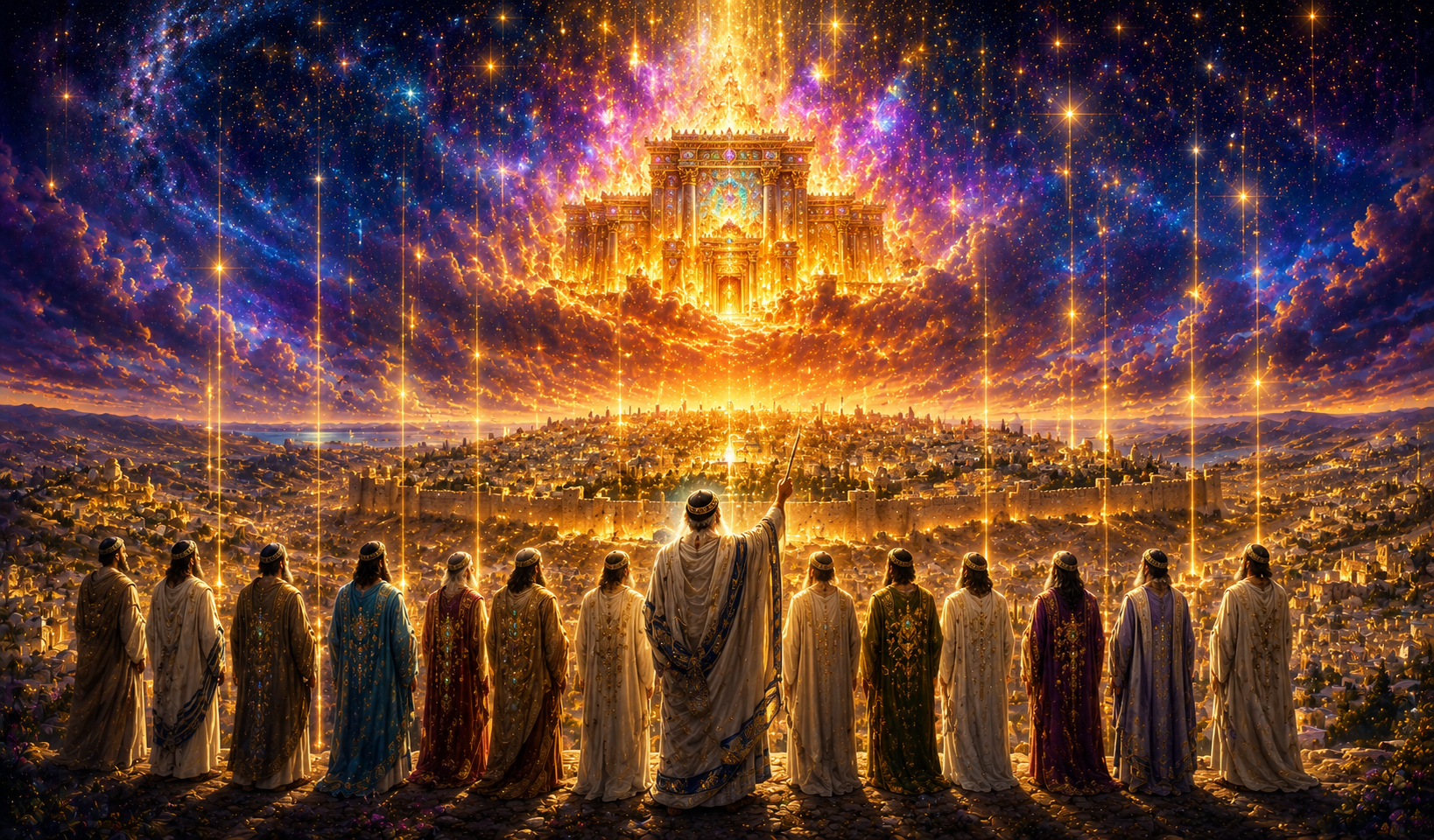
How did the spies scout the land with no maps and no experience? The Arizal reveals: the souls of the tribes joined the princes through the secret of ibbur.
Yosef entered Menashe, and Moshe (prince of Levi, who is not sent) placed his soul into Yehoshua — hence the added yud.
Then: the two planes (earthly and divine), why Moshe did not enter the land, and a bonus on tzitzit — 32 threads matching the teeth and the three pillars.
Moshe sends them — “Go up here into the Negev and climb the mountain” — as if it is obvious they know where to go. Yet they had been slaves in Egypt, having left barely a year earlier, with no idea what the Land of Israel even was. There was no Waze, no maps, no drones. So how could they possibly scout it?
Several precise difficulties: why does the Torah repeat “they were all men, heads of the children of Israel,” after it already said “one man each for his father’s tribe… every one a prince”? Why is Yosef attached specifically to Menashe (“the tribe of Yosef, the tribe of Menashe”) and not to Ephraim? And why does the tribe of Levi send no one at all?
The Arizal (Sha’ar HaPesukim) reveals: the Holy One foresaw that the spies would slander the land, while Moshe sent them for the sake of Heaven. He therefore decreed that the souls of the tribes themselves — literally the “children of Israel,” the sons of Yaakov — would join these princes through the secret of ibbur (soul-impregnation), to help them and keep them from falling completely. This is the meaning of “heads of the children of Israel” — literally the tribes.
Gilgul (reincarnation): a soul enters a newborn, starts from zero, and grows with the child until its rectification is complete. Ibbur (impregnation): part of a soul joins a living person and gives him strength and help. We taste this every Shabbat as the “extra soul” — the Zohar describes a wind before Shabbat that causes souls to fall from the Tree of Life and join every Jew; at the close of Shabbat we smell spices, a last sip of that extra soul before it ascends.
Yosef’s soul came as ibbur into his firstborn Menashe — hence “the tribe of Yosef, the tribe of Menashe,” and nothing of Yosef remained for Ephraim. The tribe of Levi sends no spy, “for Hashem is his portion”: Levi has no need to scout the land. Moshe’s own soul (the prince of Levi) was therefore free, and he placed it as ibbur into Hoshea bin Nun. This is the yud he added — Yehoshua — and so both questions are answered at once.
In gilgul the soul remains with the person all his life until the rectification. But ibbur has a drawback: when the lofty soul of the tzaddik that has joined sees its host doing foolish things, it leaves. “I came to help you do better — not to do nonsense.” When the spies sinned and slandered the land, the souls of the tribes departed from them — and that is the bitter end of the story.
There are two planes: the earthly causes we see, and the divine plan. Moshe does not enter the land — and it is for his good: “Rav lach” — you have far more than you ask for. Moshe is from the sefira of Netzach, and whatever he touches becomes eternal; had he built the Temple it could never be destroyed, and were the people to sin, the wrath would have fallen upon them, God forbid. Better that he wait beneath the Throne of Glory as the final redeemer, for the complete redemption and an eternal Third Temple. We do not know Hashem’s reckonings — our task is to be wholehearted in faith.
The parasha ends with tzitzit. Its placement is not only because of “you shall not stray” (echoing the spies) but because of the wood-gatherer who desecrated Shabbat: in Tanna deBei Eliyahou he transgressed because he had no tzitzit to remind him. The tzitzit has 32 threads, corresponding to the 32 teeth (16 upper, 16 lower). “Your teeth are like a flock of ewes” — the 16 weekly aliyot to the Torah, and the 16 daily offerings. Three pillars: Torah (upper teeth), Avoda (lower teeth), and acts of kindness (the smile — “teeth whiter than milk”). Binding the four tzitziyot to the heart is a good heart, chessed. Thus tzitzit on Shabbat gathers Torah, Avoda and Chessed — the three pillars upon which the world stands.
🎯 Test Yourself
Five questions on the shiur
🔭 An Inner Gaze
When you meet a difficulty, remember there is a hidden divine plane — not only the visible causes.
🤝 Kindness and a Smile
Do kindness with a smile — “teeth whiter than milk.” The smile is a pillar of chessed.
🧵 Intention in Tzitzit
When you hold the tzitzit, intend to gather Torah, Avoda and Chessed to the heart.
🕯️ The Extra Soul
Receive Shabbat with joy — and taste the extra soul that joins you.
Shalom Bayit — The Mouth at Home
What do you whisper to your children? To your spouse? Reveal a Shalom Bayit card.
Gematria — Rav Menashe
Hidden connections in the names according to Rav Menashe zatsal.
🔢 Gematria CourseTorah Study
Dig deeper into the commentary of Rashi and the Zohar on the parashah of the week.
📝 Beith HamidrachAll Parashot
All shiurim of M. Yéhouda Himi — from Bereshit to Devarim and the festivals.
📚 All ParashotBooks
Torah wisdom in thriller format — Éditions Gueoula.
Dream Interpretation
Did you dream of a doe? Of an Ark? Check the meaning according to Rav Almoli.
🌙 Dreams
Guardians of the Rift
Forty-nine gates open — the fiftieth hides in a single moment. An ancient secret resurfaces, and one man stands between the rift and the world. Drawn from Talmud and Kabbalah.
📖 Read the free excerpt · Book $9.90