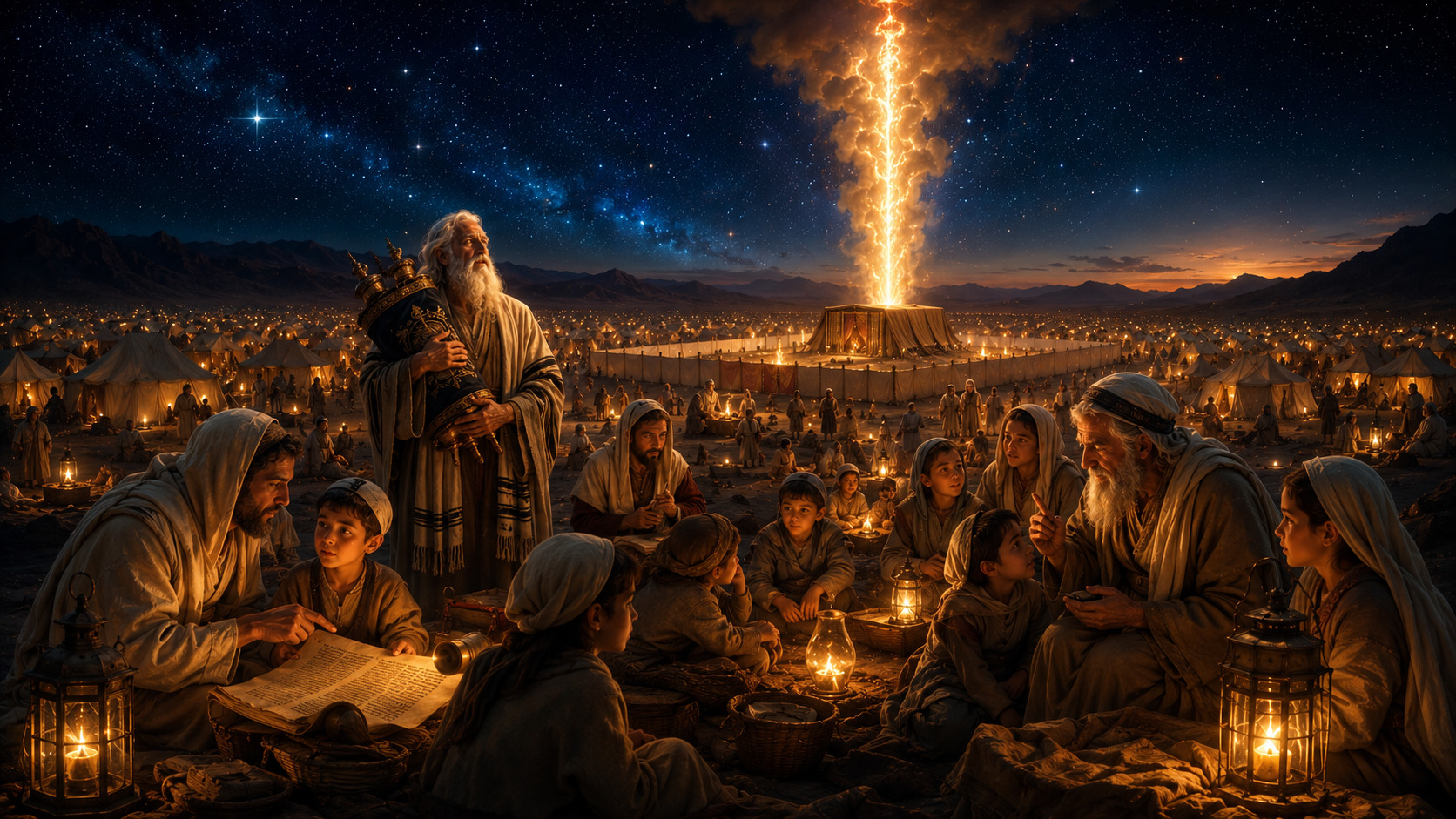
Chukat leaps straight to the fortieth year (Miriam’s death, Kadesh), but between the sin of the spies (year 2) and here lie 38 years the Torah passes over in near silence. The decree: everyone aged twenty and up would die in the wilderness — the dor hamidbar, the generation of the desert.
The chiddush (Rashi, Devarim 2:17): throughout those 38 years, while Israel was nezufim — in disfavor — the Torah never says “vayedaber” but only “vayomer”; the divine word did not come to Moshe in the language of affection, face to face. Only “when the men of war had finished dying” does “vayedaber Hashem elai” return. And what did the generation do? It turned the punishment into education — raising the dor de’ah, the generation of knowledge, who would not repeat the sin, and who found the courage to enter and to fight (Sihon, Og).
📖 Read the full shiurThe 38-Year Leap
Chukat opens: “the whole congregation came to the wilderness of Tzin in the first month, and the people stayed in Kadesh; and Miriam died there.” This is the fortieth year. But the spies were year two. What happened to the years in between?
Between the sin of the spies and Miriam’s death lies a gap of 38 years — and the Torah leaps over it almost in silence. From the spies, the text jumps to the fortieth year: Miriam’s death, the rock of Merivah, Aharon’s death, the wars of Sihon and Og. Nearly four decades, and barely a word.
The Torah, which records every journey and encampment, draws a veil over 38 years. The silence itself is the question.
וַיָּבֹאוּ בְנֵי יִשְׂרָאֵל... מִדְבַּר צִן... וַתָּמָת שָׁם מִרְיָם · Bamidbar 20:1
The Decree of the Desert
Why this 38-year silence? What sentence hangs over the generation?
After the spies, the decree fell: everyone counted from age twenty and up would not enter the Land; they would die in the wilderness over forty years, “according to the number of days you scouted the land — a year for each day.” That generation, the dor hamidbar, was condemned to fade away in the sand.
✦ The 38 years are the years of dying. Not a single blow, but a slow farewell — an entire generation waiting to pass so the next could enter.
בְּמִסְפַּר הַיָּמִים אֲשֶׁר תַּרְתֶּם אֶת הָאָרֶץ... שָׁנָה לַשָּׁנָה · Bamidbar 14:34
When the Divine Word Fell Silent
What changed in heaven during those 38 years? Listen to a single shift in one word.
In Devarim, Moshe recalls: “and it was, when all the men of war had finished dying… that Hashem spoke to me.” Rashi reveals the secret hidden in the verb: from the sin of the spies until this moment, the Torah never says vayedaber (and He spoke) to Moshe, only vayomer (and He said). Throughout all 38 years that Israel was nezufim — in disfavor — the divine word did not come to Moshe in the language of affection, face to face, with a settled mind. Only when the generation had finished dying did “vayedaber Hashem elai” return — the loving, face-to-face speech restored.
✦ This is the true weight of those years: not only a generation dying in the sand, but the very intimacy between God and Moshe dimmed — held back — until the disfavor passed. The 38 silent years were silent in heaven too.
וַיְהִי כַאֲשֶׁר תַּמּוּ... אַנְשֵׁי הַמִּלְחָמָה לָמוּת... וַיְדַבֵּר ה׳ אֵלַי לֵאמֹר · Devarim 2:16-17
A Generation Waiting to Die
Imagine it from inside. What is it like to live 38 years under such a sentence?
Each man over twenty knew: I will not enter. As Chazal describe, every year on Tisha b’Av they would dig their graves and lie down in them; in the morning, some did not rise. They wandered in circles, knowing the Land they longed for would belong to their children, not to them. A generation living, year by year, toward its own end.
To labor a lifetime for a harvest you will never eat — and to keep laboring anyway. That was their portion.
Turning Punishment into Education
So what did they do with those 38 years? The Torah is silent — but the answer can be read in the generation that emerged.
They could have despaired. Instead — and this we learn from their fruit — they turned the sentence into a mission. “If we cannot enter,” they decided, “our children will.” They poured those years into raising the next generation: teaching Torah morning and night, “and you shall teach them to your children,” forming sons and daughters who would not repeat the sin of the spies — who would believe, and be brave enough to enter.
✦ The deepest answer to a punishment one cannot undo: make sure it ends with you. They could not repair their own fate, so they built a generation that would not need to.
Dor De’ah — the Generation of Knowledge
Why is the generation that emerged from the desert called dor de’ah — the generation of knowledge?
The children raised in those 38 years became the dor de’ah. They grew up under the cloud of glory, fed by the manna, drinking from Miriam’s well, learning Torah every single day from the mouths of the generation that had failed — and had turned its failure into their schooling. They knew exactly what their parents had lost, and why. That knowledge became their strength.
A father who cannot reach the summit himself, and so spends his life teaching his child every step of the path. The child who climbs carries the father with him.
From the Classroom to the Battlefield
How do we see that this education actually worked?
At the end of Chukat, the proof arrives. The same people whose parents trembled before the inhabitants of the Land now march out to war against Sihon king of the Emori and Og king of Bashan — giants — and defeat them. Where did this courage come from? From 38 years of being taught: do not fear, the Land is yours, you will enter. The generation that the spies’ fear had condemned raised a generation that fear could not stop.
וַיֵּצֵא סִיחֹן... וַיִּלָּחֶם בְּיִשְׂרָאֵל... וַיַּכֵּהוּ יִשְׂרָאֵל לְפִי חָרֶב · Bamidbar 21:23-24
A Punishment Becomes a Mission
What is the eternal lesson of the 38 silent years?
The Torah’s silence is itself the teaching. A generation that could not enter the Land refused to let its failure be the end of the story. They took a punishment they could not lift and made it the foundation of everything that followed: the dor de’ah, the entry into the Land, the wars won, the Torah carried forward. The verb vayedaber returned only when they had finished their work — and what they left behind was a people ready to come home.
✦ This is the secret of the desert generation: not the years they lost, but what they made of them. When you cannot undo your own failure, build the generation that will redeem it. That is how silence becomes legacy.
🎯 Test Yourself
5 questions on the shiur. Tap an answer.
🏜️ Plant for a harvest you won’t eat
Begin one thing whose payoff belongs to the next generation, not to you.
🤍 Restore the “vayedaber”
Repair one relationship where warmth has cooled into mere words.
📚 Teach the dor de’ah
Pass on one piece of Torah or wisdom to someone younger this week.
⚔️ Raise fighters, not fearers
Name one fear you’re handing down — and replace it with one act of courage.
Shalom Bayit — The Mouth at Home
What do you whisper to your children? To your spouse? Reveal a Shalom Bayit card.
Gematria — Rav Menashe
Hidden connections in the names according to Rav Menashe zatsal.
🔢 Gematria CourseTorah Study
Dig deeper into the commentary of Rashi and the Zohar on the parashah of the week.
📝 Beith HamidrachAll Parashot
All shiurim of M. Yéhouda Himi — from Bereshit to Devarim and the festivals.
📚 All ParashotBooks
Torah wisdom in thriller format — Éditions Gueoula.
Dream Interpretation
Did you dream of a doe? Of an Ark? Check the meaning according to Rav Almoli.
🌙 Dreams
J’accuse the Nations
The most dangerous plots are the ones you never see coming. A buried truth, powers that want it silenced — and one man standing against the nations.
📕 Read the Book · $9.90