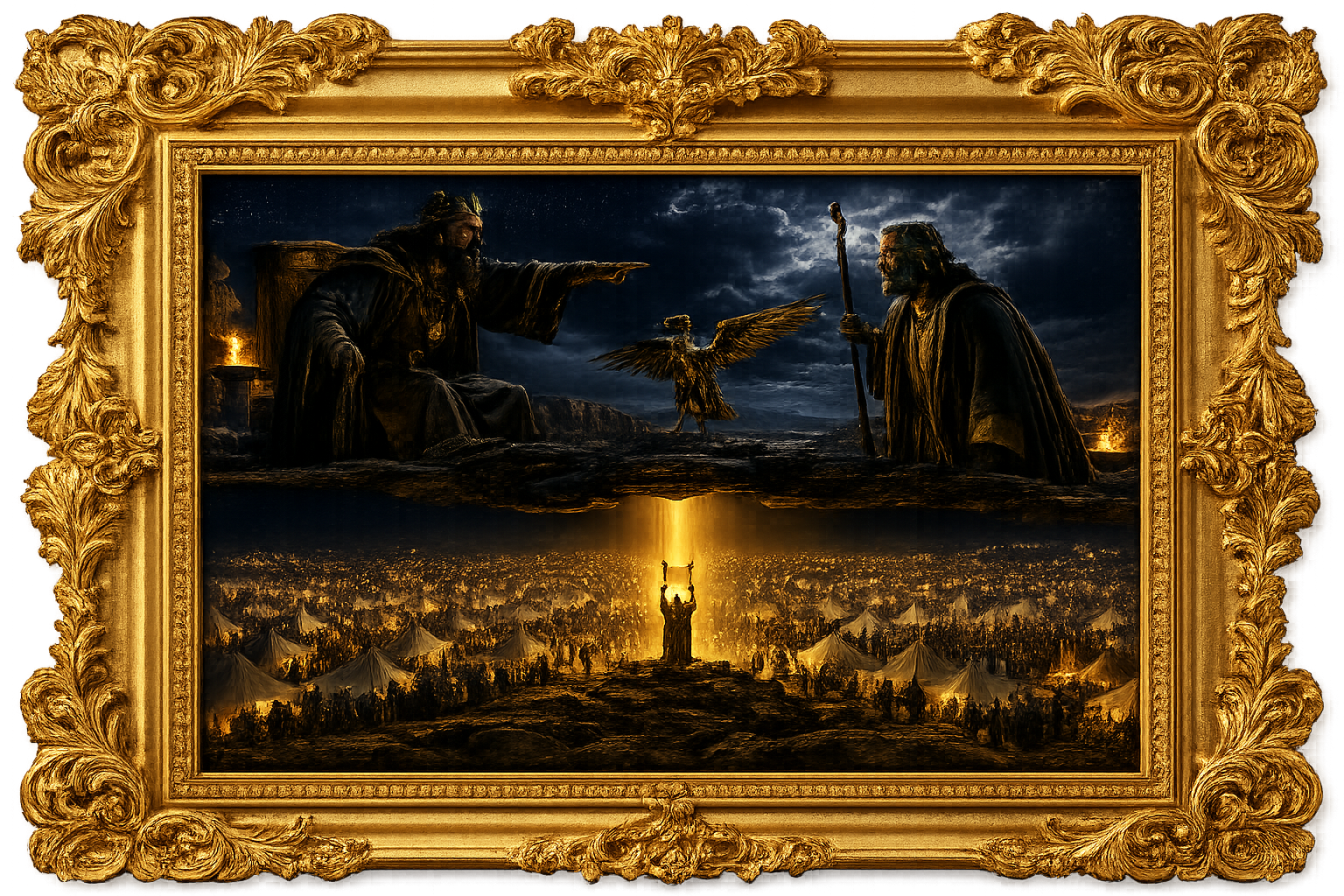
"וַיַּרְא בָּלָק בֶּן צִפּוֹר" — למה "וירא" ולא "וישמע"? הזוהר הקדוש מסביר: הוא ראה במשקפת חוכמה, חזון ממש. אבל "בן ציפור" ממש — היה לו כתב"מ מתכתי: ראש זהב, פה כסף, כנפי נחושת, מוטען על ידי השמש והירח. ממש דרון. כתוב בזוהר לפני 1800 שנה.
פירוש נוסף: בלק היה בנו של יתרו — ויתרו נקרא "ציפור". ולהבין מה "ציפור" — לומדים פרשת צרעת הבתים: הבית = בית המקדש. 7 ימי הסגר = 70 שנות גלות בבל. "ונתץ את הבית" = חורבן בית שני — 2000 שנות גלות. לטהרה: שתי ציפורים — משיח בן יוסף (שחוט) + משיח בן דוד (חי). ציפור = משיח.
ואז הכל מובן: בלק ראה בנבואה שממנו יצא מלך המשיח — בלק → עגלון → רות → בועז → עובד → ישי → דוד המלך. וקרא לבלעם לקלל כדי לחסל את השורש. ובלעם ענה: "מה אקוב לא קבה אל" — אי אפשר. ו"לא יתחשב בגויים" — בתחיית המתים, עם ישראל שיקום יהיה הרוב המוחלט.
הפרשה פותחת: "וַיַּרְא בָּלָק בֶּן צִפּוֹר אֵת כָּל אֲשֶׁר עָשָׂה יִשְׂרָאֵל לָאֱמֹרִי." רש"י מסביר שהוא ראה את נצחונות ישראל על סיחון ועוג. אבל מיד השאלה: למה "וירא" ולא "וישמע"? אצל יתרו: "וישמע יתרו כהן מדיין." אז למה בלק — ראה?
שלוש דוגמאות בתורה:
ב. "נִשְׁקְפָה בְּעַד הַחַלּוֹן אֵם סִיסְרָא וַתְּיַבֵּב" שופטים ה:כח — ראייה רוחנית.
ג. כשיוסף היה בבית פוטיפר — חז"ל אומרים שראה דמות יעקב אביו בחלון ונרתע. איזה חלון פיזי? אלא חלון החוכמה — חיזיון.
כך ראה בלק בעיני רוחו מה שעשה ישראל לסיחון ועוג. אבל הזוהר מגלה הרבה יותר על המילים "בן ציפור."
הזוהר אומר תחילה: היה לבלק ציפור שבה היה מקשקש בעשב, מעיף באוויר, לוחש לחשים — והיא הייתה מצפצפת ומחזירה לו מידע. זה נשמע כמו ציפור חיה. אבל הזוהר ממשיך ומתאר משהו שונה לחלוטין:
הראש — זהב
הפה (המקור) — כסף
הכנפיים — נחושת, מעורב בכסף (כנראה קולטנים)
הגוף — זהב, ועל הנוצות נקודות כסף
הרגליים — זהב
גוף ממתכת ממש. לא ציפור עם נוצות רגילות. כתב"מ.
איך הטעינו אותו? שבעה ימים: ביום — פותחים חלון כך שהשמש תטעין את הכנפיים. בלילה — הירח מטעין אותו. ומקטרים לפניו קטורת כטקס.
ההפעלה: לוקחים את הלשון שלו, מנקבים בה חור, ומכניסים שם מחט של זהב — ממש כמו מחט פטיפון. ואז: "והיא מדברת גדולות מאליה."
הזוהר מגלה משמעות שנייה: בלק היה בנו הביולוגי של יתרו. ויתרו — לפני שחזר בתשובה — היה לו שבעה שמות. אחד מהם: ציפור. בלק = "בן ציפור" ממש.
פסוק זה אמר דוד המלך על יתרו. כמו ציפור שעזבה את קנה הישן ומצאה בית חדש — כך יתרו עזב את כל הדתות שהיה מחובר אליהן ומצא את עם ישראל. "דרור כן לה" — "קיני" = יתרו הקיני.
כשבנו בלק לקח דרך אחרת — הלך למואב, המליכוהו עליהם. אבל כדי להבין מה ראה בלק ולמה הוא הגיב כפי שהגיב — עלינו ללמוד קטע מפרשת מצורע: צרעת הבתים.
הפשט: כי האמורים הטמינו זהב בקירות, הצרעת גרמה לשבור קירות ולמצוא אוצרות. אבל זה לא מתיישב עם הצרעת כעונש. לכן יש פה סוד גדול.
"ונתתי נגע צרעת בבית" → בית המקדש יטמא
"ובא אשר לו הבית" → הקב"ה (בעל הבית האמיתי)
"והגיד לכהן" → ירמיהו הכהן "מן הכהנים אשר בענתות" ירמיהו א:א — הקב"ה בא לירמיהו ואומר: לך תראה מה עושים בבית המקדש — "כוונים למלכת השמיים" עבודה זרה ממש בתוך הקירות
"והסגיר את הבית שבעת ימים" → שבעים שנות גלות בית ראשון (יום = שנה)
"והשליכו אל מחוץ לעיר אל מקום טמא" → גלות בבל — חורבן בית ראשון
"ולקחו אבנים אחרות... ועפר אחר" → בניית בית שני בימי עזרא ונחמיה
"ואם ישוב הנגע ופרח" → בבית שני עשו שנאת חינם
"ונתץ את הבית" → חורבן בית שני — "ביקש הקב"ה לשפוך חמתו על עצים ואבנים"
"אל מחוץ לעיר אל מקום טמא" → הפעם: 2000 שנות גלות
"כל הבא אל הבית יטמא" → אי אפשר לעלות להר הבית
"ואם בוא יבוא הכהן... כי נרפאה הנגע" → הנה התקווה! הגאולה! אחרי 2000 שנות גלות — הגאולה.
"ושחט את הציפור האחד" ויקרא יד:נ — זה משיח בן יוסף שנופל במלחמה. אנחנו מתפללים שלא ייפול (מסכת סוכה סוכה נב:א) אבל פה כתוב שחיטה — תפקידו לכפר בנפשו.
"ושילח את הציפור החיה אל מחוץ לעיר אל פני השדה" ויקרא יד:נג — משיח בן דוד. חי, חופשי, מגאל.
והפסוק האחרון בשירת האזינו — שסוגר את כל ההיסטוריה של עם ישראל:
"וְכִפֶּר" — ופה: "וְכִפֶּר עַל הַבַּיִת וְטָהֵר" — אותו שורש, אותה גאולה. הכל קשור.
ציפור = משיח. "וַיַּרְא בָּלָק בֶּן צִפּוֹר" — הוא ראה שממנו עתיד לצאת "בן ציפור" — מלך המשיח. הוא ראה, בעיני רוחו, שמשורשו יצא מלך דוד, גואל ישראל.
בלק הבין שמשיח בן דוד עתיד לצאת ממנו — וזה ישמיד את ישראל אחרית הימים. הוא רצה למנוע את הגאולה. אבל איך? הוא הבין שלא ניתן לקלל את ישראל ישירות.
בלק הבין שאי אפשר לקלל את ישראל — יש להם זכות אבות ואימהות, הקללה לא תעמוד.
אז הוא מצא תכנית חכמה אחרת. אמר לבלעם:
"לְכָה נָּא אָרָה לִּי" — "בוא תקלל אותי"
לא תקלל את ישראל — תקלל אותי, את בלק עצמו!
אמר: לא אכפת לי אם תוציא לי עין אחת, אם תוציא שתיים — "בוא תקלל אותי" — כדי שממני לא ייצא הבן שעתיד להיות ציפור, משיח בן דוד שיגאל את ישראל. אם תכחיד אותי בשורש — המשיח לא ייוולד לעולם.
זו הייתה התכנית: השמדה עצמית אסטרטגית כדי להרוג את הגאולה בגרעין.
בלעם היה קוסם גדול. הוא הבין את ההיגיון של בלק: כדי לקלל ביעילות צריך ללכת לשורש ולכרות אותו. כמו גנן שרוצה לבטל עץ — לא מספיק לקצץ ענפים. צריך לעקור את השורש.
אז בלעם השתמש בכל כשרונו ועלה לשורש של ישראל. ומה ראה שם?
"צורים" = האבות — אברהם, יצחק ויעקב
"גבעות" = האימהות — שרה, רבקה, רחל ולאה
בלעם אמר: הלכתי לשורש — ראיתי שם את האבות ואת האימהות. עם שורשים כאלה — אי אפשר לקלל. עם שיש לו זכות אברהם, יצחק, יעקב, שרה, רבקה, רחל ולאה — אין שום סיכוי.
ומהקללה יצאה ברכה. לכן יש פרשה על שם הרשע — כי הקב"ה הצפין בה את הסוד הגדול ביותר.
ההתגלות הזאת מציפה שאלה נוספת שחוזרת לפרשיות הראשונות: למה אברהם אבינו יצא למלחמה כדי להציל את לוט? בראשית יד לוט נפרד ממנו, בחר בסדום. כשסדום נפלה, אברהם יכל לומר: זה הבחירה שלו.
הכל מחובר: אברהם → לוט → מואב → בלק → עגלון → רות → בועז → דוד → משיח. ופרשת בלק, בלב הבמדבר, מצפינה בסוד את כל שרשרת הגאולה.
הפירוש הרגיל: "לא יתחשב" = לא יתבולל. אבל "יתחשב" פירושו לא ניתן לספרו — מרוב שהוא יהיה הרבה. איך?? הוא המעט מכל העמים!
"עפר יעקב" = עצמות הנרדמים שיקומו בתחיית המתים!
הגויים לא קמים בתחיית המתים (חוץ מחסידי אומות העולם). אבל ישראל — כל הדורות מאדם הראשון ועד אחרית הימים — כולם קמים. כמה מיליארדים? "מי מנה" — לא ניתן לספור.
במציאות של תחיית המתים, עם ישראל יהיה הרוב המוחלט של האנושות. ואז: "לא יתחשב בגויים" — לא ניתן להשוות אותו לשום גוי.
כך בפרשה אחת, פרשת בלק, מתרכזים כל הנושאים הגדולים: משיח בן יוסף, משיח בן דוד, הגאולה, תחיית המתים — כולם מוצפנים בפרשה שנקראת על שם הרשע. כי הקב"ה מסתיר את דבריו הגדולים ביותר דווקא שם.
🎯 בדוק את עצמך
5 שאלות על השיעור. לחץ על תשובה.
🔥 „רַב לָכֶם” הָפוּךְ
כְּשֶׁאַתָּה חָשׁ „הֵם לוֹקְחִים יוֹתֵר מִדַּי”, שְׁאַל קֹדֶם: הַאִם הַתַּפְקִיד נִתַּן לָהֶם מִן הַשָּׁמַיִם? כַּבֵּד מִנּוּי אֶחָד שֶׁאַתָּה דּוֹחֶה.
🏜️ הַפְסֵק לְהַכְתִּיר אֶת מִצְרַיִם שֶׁלְּךָ
נַקֵּב נוֹחוּת אַחַת מֵהֶעָבָר שֶׁאַתָּה מְמַתֵּג. הַשָּׁבוּעַ, סָרֵב לָהּ מִשְׁפָּט אֶחָד שֶׁל שֶׁבַח שָׁוְא.
🔁 לְתַקֵּן, לֹא לַהֲרֹס
כְּמוֹ מֹשֶׁה עִם קַיִן, בְּחַר קֶשֶׁר אֶחָד שֶׁתּוּכַל „לְנַצֵּחַ” — וּבִמְקוֹם זֹאת תַּשִּׁיב אוֹתוֹ. הָשֵׁב אֶת מָה שֶׁנִּלְקַח.
🎶 שִׁיר בְּנֵי קֹרַח
מְצָא כִּשָּׁלוֹן קָבוּר וּכְתֹב אֶת הַשּׁוּרָה הָאַחַת שֶׁל הַ„מִּזְמוֹר” שֶׁלִּמֵּד אוֹתְךָ. שְׁמֹר אוֹתָהּ מוּל עֵינֶיךָ.
שלום בית — הפה בבית
מָה אַתָּה מְלַחֵשׁ לִילָדֶיךָ? לְבֶן זוּגְךָ? גַּלֵּה כַּרְטִיס שָׁלוֹם בַּיִת.
כָּל הַפָּרָשִׁיּוֹת
כָּל שִׁעוּרֵי מ. יְהוּדָה חִימִי — מִבְּרֵאשִׁית עַד דְּבָרִים וְעַד חַגֵּי הַשָּׁנָה.
📚 כל הפרשיותספרים
חכמת התורה בפורמט תריילר — הוצאת גאולה.
פירוש חלומות
חָלַמְתָּ עַל אַיָּלָה? עַל אָרוֹן? בְּדֹק אֶת הַמַּשְׁמָעוּת לְפִי רב אלמולי.
🌙 פירוש חלומות
אֲנִי מַאֲשִׁים אֶת הָאֻמּוֹת
הַמְּזִמּוֹת הַמְּסֻכָּנוֹת בְּיוֹתֵר הֵן אֵלּוּ שֶׁאֵינְךָ רוֹאֶה. אֱמֶת קְבוּרָה, כֹּחוֹת הַמְבַקְּשִׁים לְהַשְׁתִּיקָהּ — וְאִישׁ אֶחָד מוּל הָאֻמּוֹת.
📕 לקריאת הספר · ₪36.90
“Balak ben Tzipor saw” — why “saw” not “heard”? The holy Zohar explains: he saw through the “wisdom lens” — a genuine spiritual vision. But also: Balak had a metallic drone — gold head, silver beak, copper wings charged by the sun and moon. Written in the Zohar 1,800 years ago.
Another explanation: Balak was the son of Yitro — and Yitro was called Tzipor. To understand what “Tzipor” means, we study House Leprosy: the House = the Temple. 7 days quarantine = 70 years Babylonian exile. “He shall tear down the house” = Second Temple destruction = 2,000 years of exile. Purification: two birds — Mashiach ben Yosef (slaughtered) + Mashiach ben David (alive). Bird = Mashiach.
Now everything is clear: Balak saw prophetically that King Mashiach would descend from him — Balak → Eglon → Ruth → Boaz → Oved → Yishai → King David. He summoned Bilaam to curse and cut the root. Bilaam answered: impossible — I see the Avot and Imahot. And “not reckoned among nations” means: at the Resurrection, all of Israel across all generations will rise — the innumerable majority.
The parasha opens: “Balak ben Tzipor saw all that Israel had done to the Emorites.” Rashi explains he saw Israel’s victories over Sichon and Og. But the question is immediate: “he saw” and not “he heard”? When Yitro received the news: “Yitro heard.” So why does Balak see?
Three examples in the Torah:
2. “Sisera’s mother looked through the window and cried out” Judges 5:28 — a spiritual vision.
3. When Joseph was at Potiphar’s house, the Midrash says he saw the image of Jacob his father in the window and recoiled. Which physical window? The wisdom window — a chizoyon.
This is how Balak saw, through his inner eye, what Israel had done to Sichon and Og. But the Zohar reveals far more about the words “ben Tzipor.”
The Zohar says first: Balak had a bird he would shake with a stick, fly through the air, whisper incantations to — and it would chirp back with information. This sounds like a trained living bird. But the Zohar continues and describes something radically different:
The head — gold
The mouth (beak) — silver
The wings — copper, mixed with silver (likely receptors/antennae)
The body — gold, with silver dots on the feathers
The feet — gold
An entirely metallic body. Not a bird with ordinary feathers. A UAV.
How was it powered? Seven days: by day, a window was opened so the sun charged the wings. At night, the moon recharged it. Incense was burned before it as a ritual.
Activation: They took its tongue, pierced a hole, and inserted a gold pin — exactly like a phonograph needle. And then: “it spoke great things by itself.”
The Zohar reveals a second meaning: Balak was the biological son of Yitro. Yitro, before his repentance, had seven names. One of them: Tzipor. Balak = ben Tzipor, in the most literal sense.
This verse was said by King David about Yitro. Like a bird that leaves its old nest and finds a new home — so Yitro left all the religions he was attached to as a pagan priest, and joined the Jewish people. “Ken lah” — keni, the Kenite : that is Yitro’s epithet.
When his son Balak took the opposite path, he went to Moav. They crowned him king there. But to understand what Balak saw and why he reacted as he did — we must first study a passage from Parashat Metzora : the House Leprosy.
Rashi’s explanation: the Amorites had hidden gold in the walls, and the leprosy forced the walls to be torn down, revealing the treasure. But this does not fit with leprosy as punishment for slander. Therefore, there is a great secret here.
“I will place a plague upon a house” → the Beith HaMikdash will be defiled
“The owner of the house shall come” → G-d (the true owner of the Temple)
“And tell the Kohen” → Jeremiah the Kohen “of the priests of Anatot” Jeremiah 1:1 — G-d tells Jeremiah: go see what they are doing in the Temple — worshipping the “Queen of Heaven” inside the Sanctuary walls
“He shall quarantine the house seven days” → seventy years of First Exile in Babylon (one day = one year)
“Cast the stones outside the city to an impure place” → exile to Babylon — destruction of the First Temple
“They shall take other stones… other plaster” → construction of the Second Temple in the days of Ezra and Nehemiah
“If the plague returns and spreads” → in the Second Temple they fell into baseless hatred
“He shall tear down the house” → destruction of the Second Temple — “G-d poured His wrath on the wood and stones rather than on Israel”
“Outside the city to an impure place” → this time: 2,000 years of exile
“Whoever enters the house shall be impure” → we cannot ascend to the Temple Mount
“And if the Kohen comes… for the plague has healed” → Here is the hope! The Geula! After 2,000 years of exile — the Redemption.
“He shall slaughter one of the birds” Leviticus 14:50 — this is Mashiach ben Yosef who falls in battle. We pray daily that he not fall (Tractate Sukkah 52a) — but the Torah writes of slaughter. His blood atones.
“He shall release the living bird outside the city… toward the open field” Leviticus 14:53 — Mashiach ben David. Alive, free, he redeems.
And the last verse of Ha’azinou — closing the entire story of the Jewish people:
“Vekhifer” — and here: “vekhifer al habayit vetaher” — the same root, the same Redemption. Everything is connected.
Tzipor = Mashiach. “Vayar Balak ben Tzipor” — he saw that from him would emerge a son-bird : Mashiach ben David. He saw, through his prophetic vision, that his own lineage would produce the Savior of Israel.
Balak understood: Mashiach ben David will come from me — and he will redeem Israel. This had to be stopped. But how? He understood that one cannot curse Israel directly.
Balak understood that Israel cannot be cursed — they have the merit of the Avot, the Imahot, heavenly protection. The curse would not hold.
So he devised a different strategy. He said to Bilaam:
“Lekha na ara li” — “Come, curse me”
Not: curse Israel — curse me, Balak himself!
He said: I don’t care if you take one of my eyes, take both. “Come, curse me” — so that from me will never emerge this son who will be the Tzipor, the Mashiach ben David who will redeem Israel. By annihilating me at the root, the Mashiach will never be born.
This was Balak’s plan: strategic self-destruction to kill the Geula at its source.
Bilaam was a sorcerer of extraordinary talent. He understood Balak’s reasoning: to curse effectively, one must go to the root and sever it. Like a gardener who wants to destroy a tree — trimming branches does nothing. You must uproot the root itself.
So Bilaam used all his power and ascended to the root of Israel. And here is what he found:
“Rocks (Tzurim)” = the Avot — Abraham, Isaac and Jacob
“Hills (Geva’ot)” = the Imahot — Sarah, Rivkah, Rachel and Leah
Bilaam said: I went to the very root — and there I saw the Fathers and the Mothers of the nation. With these roots, it is absolutely impossible to curse. A people that rests on the merits of Abraham, Isaac, Jacob, Sarah, Rivkah, Rachel and Leah — no curse can reach them.
And from the curse emerged a blessing. This is why there is a parasha bearing the name of the greatest villain — because G-d concealed within it the most sacred secret: that of the Mashiach.
This revelation raises another question reaching back to the beginning: why did Avraham Avinu go to war to save Lot? Genesis 14 Lot had separated from him and chosen Sodom. When Sodom was attacked, Avraham could have said: that was his choice.
Everything is connected: Avraham → Lot → Moav → Balak → Eglon → Ruth → Boaz → David → Mashiach. And Parashat Balak, at the heart of Bamidbar, secretly encodes the entire chain of Redemption.
The usual interpretation: Israel will not assimilate. But “lo yitchashav” means cannot be counted — too numerous to number. How? Israel is the smallest of peoples!
“The dust of Jacob” = the bones of those who sleep in the earth and will rise at T’hiyat HaMeitim — the Resurrection of the Dead!
The nations do not rise at the Resurrection (except the righteous among them). But Israel — every generation from Adam to the end of days — rises entirely. How many billions? “Who can count?” — innumerable.
In the reality of the Resurrection, the Jewish people will be the absolute and incomparable majority of all humanity. Then: “shall not be reckoned among the nations” — it will simply be beyond comparison.
Thus in one single parasha — Parashat Balak — are gathered all the greatest themes: Mashiach ben Yosef, Mashiach ben David, the Ge’ula, the Resurrection of the Dead — all concealed in the parasha named after the greatest villain. Because G-d hides His most precious treasures exactly where one would never think to look.
🎯 Test Yourself
5 questions on the shiur. Tap an answer.
🔥 “Rav lakhem” in reverse
When you feel “they take too much,” ask first: was this role actually given to them by Heaven? Honor one appointment you’ve been resenting.
🏜️ Stop crowning your Egypt
Name one past comfort you mythologize. This week, refuse it a single sentence of false praise.
🔁 Repair, don’t destroy
Like Moses with Cain, pick one relationship you could “win” — and instead restore it. Return what was taken.
🎶 The song of the sons of Korah
Find one buried failure and write the single line of the “psalm” it taught you. Keep it where you’ll see it.
Shalom Bayit — The Mouth at Home
What do you whisper to your children? To your spouse? Reveal a Shalom Bayit card.
Gematria — Rav Menashe
Hidden connections in the names according to Rav Menashe zatsal.
🔢 Gematria CourseTorah Study
Dig deeper into the commentary of Rashi and the Zohar on the parashah of the week.
📝 Beith HamidrachAll Parashot
All shiurim of M. Yéhouda Himi — from Bereshit to Devarim and the festivals.
📚 All ParashotBooks
Torah wisdom in thriller format — Éditions Gueoula.
Dream Interpretation
Did you dream of a doe? Of an Ark? Check the meaning according to Rav Almoli.
🌙 Dreams
J’accuse the Nations
The most dangerous plots are the ones you never see coming. A buried truth, powers that want it silenced — and one man standing against the nations.
📕 Read the Book · $9.90
« Balak ben Tzipor vit » — pourquoi « vit » et non « entendit » ? Le saint Zohar explique : il vit à travers la « lunette de la sagesse » — une véritable vision spirituelle. Et Balak possédait un drone métallique : tête en or, bec en argent, ailes en cuivre chargées par le soleil et la lune. Écrit dans le Zohar il y a 1800 ans.
Autre explication : Balak était le fils de Yitro — et Yitro s’appelait Tzipor. Pour comprendre ce que « Tzipor » signifie, on étudie la Ts’ara’at des maisons : la maison = le Beith HaMikdach. 7 jours de quarantaine = 70 ans d’exil babylonien. « Il démolira la maison » = destruction du 2e Temple = 2000 ans d’exil. Pour la purification : deux oiseaux — Machia’h ben Yossef (égorge) + Machia’h ben David (vivant). Oiseau = Machia’h.
Et maintenant tout s’éclaire : Balak vit par prophétie que le roi Machia’h descendrait de lui — Balak → Eglon → Routh → Boaz → Ovéd → Yichaï → le roi David. Il convoqua Bila’am pour maudire et couper la racine. Bila’am répondit : impossible. Et « ne sera pas compté parmi les nations » signifie : à la résurrection, tout Israël à travers tous les âges se relèvera — l’immense majorité innombrable.
La paracha s’ouvre : « Balak ben Tzipor vit tout ce qu’Israël avait fait aux Emorites. » Rachi explique qu’il vit les victoires d’Israël sur Si’hon et Og. Mais la question s’impose : pourquoi « il vit » et non « il entendit » ? Quand Yitro apprit la nouvelle, le texte dit « Yitro entendit. » Ici, Balak vit. Comment voit-on ce qu’on n’a pas vécu ?
Trois exemples dans la Torah :
2. « La mère de Sisera regarda par la fenêtre et pleurait » Juges 5:28 — même fenêtre intérieure.
3. Quand Yossef était chez Potiphar, le Midrach dit qu’il vit l’image de Yaakov son père dans la fenêtre et recula. Quelle fenêtre ? La fenêtre de la sagesse — un chizoyon, comme une télévision de l’âme.
C’est ainsi que Balak vit par cette fenêtre ce qu’Israël avait fait à Si’hon et Og. Mais le Zohar va beaucoup plus loin en révélant ce que cache l’expression « ben Tzipor ».
Le Zohar dit d’abord : Balak avait un oiseau dont il se servait pour ses sorcelleries — il le faisait tournoyer avec un bâton, lui chuchotait des incantations, et l’oiseau lui apportait des informations. Jusque-là, on imagine un oiseau vivant dressé.
Mais le Zohar continue et décrit quelque chose de radicalement différent :
La tête — en or
La bouche (bec) — en argent
Les ailes — en cuivre, avec des points d’argent mêlés
Le corps — en or, avec des points d’argent sur les plumes
Les pattes — en or
Ce n’est pas un oiseau en plumes et en os. C’est un corps entièrement métallique. Un engin.
Comment était-il alimenté ? Pendant 7 jours : le jour, on ouvrait une fenêtre pour que le soleil charge les ailes. La nuit, on laissait la lune le recharger. Et on brûlait de l’encens devant lui comme rituel.
La mise en route : On prenâit sa langue, on y perçait un trou, et on y insérait une aiguille d’or — exactement comme l’aiguille d’un vieux phonographe. Et alors : « elle parlait d’elle-même de grandes choses. »
Le Zohar révèle une deuxième signification : Balak était le fils biologique de Yitro. Et Yitro, avant sa t’echouva, avait sept noms. L’un d’eux : Tzipor. Balak = ben Tzipor, au sens littéral.
Ce verset fut dit par le roi David à propos de Yitro. « Ken lah » — keni, le Kénite : c’est le surnom de Yitro. Comme un oiseau qui quitte son vieux nid pour trouver une nouvelle maison — Yitro quitta toutes les religions auxquelles il était rattaché comme prêtre idolâtre, et rejoignit le peuple juif.
Quand son fils Balak prit le chemin inverse, il se rendit à Moav. Là, on le couronna roi. Mais pour comprendre ce que Balak vit et pourquoi il réagit comme il réagit, il faut d’abord apprendre un passage de la paracha Metzora — la Ts’ara’at des maisons.
Rachi explique : les Emorites avaient caché de l’or dans les murs, et la ts’ara’at obligeait à les abattre pour trouver le trésor. Mais cette explication n’est pas satisfaisante — il y a ici un grand secret.
« Je placerai une plaie dans une maison » → Le Beith HaMikdach sera souillé
« Le propriétaire de la maison viendra » → le Saint béni soit-Il (le véritable propriétaire du Temple)
« Et dira au Cohen » → Yîrmiyvah&ou; le Cohen « des cohanim d’Anatot » Jérémie 1:1 — D.ieu lui dit : va voir ce qu’ils font dans le Temple — ils adorent la « Reine du Ciel » entre les murs mêmes du Sanctuaire
« Il isolera la maison sept jours » → 70 ans de premier exil à Babylone (un jour = une année)
« On jettera les pierres hors de la ville dans un lieu impur » → exil à Babylone — destruction du Premier Temple
« On prendra d’autres pierres… d’autre plâtre » → construction du Deuxième Temple à l’époque d’Ezra et Néhémie
« Si la plaie revient et s’étend » → au Deuxième Temple ils tombèrent dans la haine gratuite
« Il démolira la maison » → destruction du Deuxième Temple — « le Saint béni soit-Il déversa Sa colère sur les bois et les pierres plutôt que sur Israël »
« Hors de la ville dans un lieu impur » → cette fois : 2000 ans d’exil
« Quiconque entre dans la maison sera impur » → nous ne pouvons pas monter sur le Har HaBayit
« Et si le Cohen vient… » → Voici la espérance ! « Et il voit que la plaie ne s’est pas étendue… car la plaie a guéri. » Après 2000 ans d’exil — la Géoula.
« Il égorgera l’un des oiseaux » Lév 14:50 — c’est Machia’h ben Yossef qui tombe au combat. Nous prions chaque jour pour qu’il ne tombe pas — comme cela est écrit dans le traité Souka Souka 52a. Mais la Torah écrit que son sang expie.
« Il relâchera l’oiseau vivant hors de la ville… à la face du champ » Lév 14:53 — Machia’h ben David. Vivant, libre, il s’envole et rédime.
Et le dernier verset de la Torah qui clôt l’histoire du peuple juif — le dernier verset de Ha’azinou :
Ce verset dit « ve’khifer » — et ici il est écrit : « ve’khifer al habayit vetaher » — même racine, même Redemption. Tout est relié.
Tzipor = Machia’h. « Vayar Balak ben Tzipor » — il vit que de lui allait sortir un fils-oiseau : le Machia’h ben David. Il vit, par sa vision prophetique, que sa propre lignée engendrerait le Sauveur d’Israël.
Balak comprit : le Messie sortira de moi. Et ce Messie sauvera Israël. Il fallait empêcher cela. Mais comment ?
Balak comprit qu’on ne peut pas maudire Israël directement — ils ont les mérites des Avot, des Imahot, les z’khuyot du ciel. La malédiction ne tient pas.
Alors il trouva une autre stratégie. Il dit à Bila’am :
« Lekha na ara li » — « Viens, maudis-moi »
Non pas maudis Israël — maudis-moi, MOI, Balak lui-même !
Il dit : « Peu importe si tu m’ôtes un œil, si tu m’ôtes les deux. Viens me maudire » — pour que de moi ne sorte jamais ce fils qui sera la Tz’ipor, le Machia’h ben David qui rédimera Israël. En m’annihilant à la racine, le Machia’h ne naîtra jamais.
Voilà le projet de Balak : une auto-destruction stratégique pour tuer la Géoula dans l’œuf.
Bila’am était un sorcier de génie. Il comprit le raisonnement de Balak : pour maudire efficacement quelqu’un, il faut aller à sa racine et la couper. Comme un jardinier qui veut se débarrasser d’un arbre — couper les branches ne suffit pas. Il faut déterracer la racine.
Alors Bila’am utilisa toute sa science et remonta à la racine d’Israël. Et voici ce qu’il vit :
« Rochers (Tzourim) » = les Avot — Avraham, Its’hak et Yaakov
« Collines (Gueva’ot) » = les Imahot — Sarah, Rivka, Ra’hel et Lea
Bila’am dit : j’ai regardé au cœur de la racine — et j’y ai vu les Pères et les Mères du peuple. Avec ces racines-là, il est absolument impossible de maudire. Un peuple qui repose sur les mérites d’Avraham, Its’hak, Yaakov, Sarah, Rivka, Ra’hel et Lea — aucune malédiction ne peut atteindre.
Et de la malédiction émane une bénédiction. C’est pour cela qu’il y a dans la Torah une paracha au nom du plus grand ennemi d’Israël — parce que D.ieu a dissimulé dans cette paracha le secret le plus sacré : celui du Machia’h.
Cette révélation soulève une autre question — qui remonte au début : pourquoi Avraham Avinou se dépensa-t-il pour sauver Loth Genèse 14 ? Loth s’était séparé de lui, avait choisi Sodome. Quand Sodome fut attaquée, Avraham aurait pu se dire : « c’est son choix. »
Tout est donc lié : Avraham → Loth → Moav → Balak → Eglon → Routh → Boaz → David → Machia’h. Et la paracha de Balak, au cœur du Bamidbar, codifie en secret toute cette chaîne de la Rédemption.
L’interprétation courante : Israël ne s’assimilera pas. Mais « lo yitchachav » signifie littéralement ne peut pas être compté, trop nombreux pour être dénombré. Comment ? Israël est le plus petit des peuples !
« La poussière de Yaakov » = les ossements de ceux qui dorment dans la terre et qui ressusciteront lors de la T’hiyat HaMeitim — la Résurrection des Morts.
Les nations ne ressuscitent pas lors de la résurrection (sauf les justes parmi elles). Mais Israël — toutes les générations depuis Adam jusqu’à la fin des temps — se relèvera entièrement. Des milliards. « Qui peut les compter ? »
Dans la réalité de la résurrection, le peuple juif sera la majorité absolue et innombrable de l’humanité. Alors : « ne sera pas compté parmi les nations » — il sera tout simplement incomparable.
Ainsi dans cette unique paracha se trouvent réunis les plus grands sujets de la Torah : Machia’h ben Yossef, Machia’h ben David, la Ge’oula, la T’hiyat HaMeitim — le tout dissimulé dans la paracha qui porte le nom du plus grand ennemi d’Israël. Parce que D.ieu cache Ses plus grands trésors exactement là où on ne les cherche pas.
🎯 Teste-toi
5 questions sur le chiour. Touche une réponse.
🔥 « Rav lakhem » à l’envers
Quand tu sens « ils prennent trop », demande d’abord : ce rôle leur a-t-il été donné du Ciel ? Honore une nomination que tu rejettes en secret.
🏜️ Cesse de couronner ton Égypte
Nomme un confort passé que tu mythifies. Cette semaine, refuse-lui une seule phrase de fausse louange.
🔁 Réparer, non détruire
Comme Moïse avec Caïn, choisis une relation que tu pourrais « gagner » — et restaure-la plutôt. Rends ce qui fut pris.
🎶 Le chant des fils de Korah
Trouve un échec enfoui et écris l’unique ligne du « psaume » qu’il t’a enseigné. Garde-la sous tes yeux.
Chalom Bayit — La bouche à la maison
Que chuchotes-tu à tes enfants ? À ton conjoint ? Découvre une carte Chalom Bayit.
Guématria — Rav Menaché
Connexions cachées dans les noms selon Rav Menaché zatsal.
🔢 Cours de guématriaÉtude Torah
Approfondis le commentaire de Rachi et le Zohar sur la paracha de la semaine.
📝 Beith HamidrachToutes les Parachiot
Tous les cours de M. Yéhouda Himi — de Béréchit à Devarim et les fêtes.
📚 Toutes les ParachiotLivres
La sagesse de la Torah en format thriller — Éditions Gueoula.
Interprétation des rêves
As-tu rêvé d’une biche ? D’une Arche ? Vérifie sa signification selon Rav Almoli.
🌙 RêvesBoîte à idées
Une idée, une remarque, une suggestion pour le site ? Partage-la avec nous.
💡 Boîte à idées

J’accuse les Nations
Les complots les plus dangereux sont ceux qu’on ne voit pas venir. Une vérité enfouie, des puissances qui veulent l’étouffer — et un homme seul face aux nations.
📕 Lire le livre · 9,90 €