The Secret of the Two Inverted Nuns — Parashat Behaalotcha
Parashat Behaalotcha · 5786 · Shiur II
The Secret of the Two Inverted Nuns
How G-d Watches You at Every Step · The Doe Who Turns Her Face Back
Based on the shiur of M. Yéhouda Himi
🎙️
🎙 LISTEN TO THE SHIUR · M. YEHUDA HIMI
Full audio recording
⬇ Download audio
The Secret of the Two Inverted Nuns
One-page summary · From the shiur of M. Yéhouda Himi

20 Iyar 5786 — one year and one month after the Exodus. The cloud lifted from over the Mishkan of the Testimony. The people of Israel finally start moving from Mount Sinai toward the Land of Israel. But they flee — a three-day journey. Like schoolchildren fleeing the classroom.

And Yitro — refuses to come. Moshe invites him: "And you shall be eyes for us." Yitro answers no. Why? Out of love for the people of Israel — so they will not be used as a kal vahomer (a fortiori argument) against him in the negative.

And then — the sweet. Two verses framed by two inverted Nuns. The Zohar reveals: these Nuns are the shape of a doe turning her face backward. This is the Shekhinah. Like a mother walking ahead in the mall and turning every second to see what's happening with her child. This is the personal Divine Providence over the people of Israel in the desert.

Inside: when Israel left Mount Sinai · why Yitro refused · the secret of the fifth book of the Torah · the doe who looks backward · the parable of the mother in the mall

📖 Read the full shiur →
1 20 Iyar — Finally on the Move

Parashat Behaalotcha has many subjects. After the Holy One tells Moshe to command Aharon to light the lamps, then we have the matter of the Levites, and also the matter of Pesach Sheni — for one who was on a distant road and impure.

Toward the middle of the parashah, the Torah describes for us: "On the day the Mishkan was set up, the cloud covered the Mishkan."

On the day the Mishkan was set up, the cloud covered the Mishkan, the Tent of the Testimony; and in the evening it was on the Mishkan like the appearance of fire until morningBamidbar 9:15

The cloud rises — they know they must travel. The cloud stops — they know they must prepare. "By the mouth of G-d they shall journey, and by the mouth of G-d they shall camp."

And then: "And G-d spoke to Moshe, make for yourself two silver trumpets." How do they know when to start moving? They must blow the trumpets.

2 One Year and One Month after the Exodus

Let us count. The people of Israel left Egypt on the 15th of Nissan, after midnight, walked six days, on the seventh day the Splitting of the Sea, walked a few more days — in total 49 days from the Exodus to Mount Sinai. On the fiftieth day — they received the Torah.

Then Moshe Rabbenu goes up, comes down, sin of the Golden Calf, goes up, prays for them, comes down, goes up, comes down, Yom Kippur, and the second Tablets come. Immediately they begin preparing the Mishkan, and on the 1st of Nissan the Mishkan was erected. A year has passed. Inauguration of the Mishkan, the princes bring offerings, first Pesach in the desert, and the counting.

The Torah says: "And it was in the second year, in the second month, on the twentieth of the month — the cloud lifted from over the Mishkan of the Testimony." The second month is Iyar. On the 20th of Iyar, one year and one month after the Exodus — the cloud lifted. They must travel.
And it was in the second year, in the second month, on the twentieth of the month, the cloud lifted from over the Mishkan of the TestimonyBamidbar 10:11

Therefore this parashah is the threshold of the journey-parashot. Until here, the matter of organizing. And from here — the matter of the journeys begins, and afterward — the sending of the spies and the 38-year delay in the desert.

3 And Yitro — Refuses to Join

A moment before the description of the journey begins — there is a conversation. A conversation between Moshe and Yitro.

And Moshe said to Hovav son of Reuel the Midianite, Moshe's father-in-law: We are traveling to the place of which G-d said, I will give it to you; come with us and we will do good to you, for G-d has spoken good concerning IsraelBamidbar 10:29

Where did Yitro come from? If you remember, in parashat Yitro in Sefer Shemot — it is written there that he went home. He returned home. But before the giving of the Torah at Mount Sinai, Yitro left the place — and therefore he was not at the giving of the Torah. Tzipporah also was not at the giving of the Torah. And now he comes back for a visit.

Moshe Rabbenu suggests to him: "Come, join us, and let us enter the Land — you deserve it, why not?". Pay attention to the answer.

And he said to him: I will not go, but to my land and to my birthplace I will goBamidbar 10:30

He refuses. Why?

And he says: "Please do not leave us, for you know our camping in the desert, and you shall be eyes for us." You know all the miracles we have had. You already know what the people of Israel are.

What is "and you shall be eyes for us"? Rashi gives several explanations:
One explanation — past tense: just as you saw, you shall testify about the miracles you witnessed.
Second explanation — future tense: anything that escapes our eyes, you shall enlighten our eyes — we need you as an advisor.
Another interpretation — that you shall be precious to us like the apple of our eye.

After all these compliments — Moshe says: "And it shall be, if you go with us, the good that G-d will do for us we will do for you." You will even receive a portion in the Land of Israel. And we know that the Kenites — who are essentially Yitro — received an inheritance near Yericho.

What does Yitro answer? We don't know. Because the Torah does not tell us what the answer was. The next verse: "And they journeyed from the mountain of G-d a three-day journey." There is no answer. According to the plain reading, we must say that Yitro stood by his refusal and did not want to join. Only in order not to break Moshe's word — the Torah concealed this.
4 Why Did Yitro Refuse? — Two Answers

We must say that Yitro was a tsaddik. The Torah praises him. Every time the Torah says "Yitro — Yitro, Moshe's father-in-law." We already know he is Moshe's father-in-law — but the Torah every time will say "Yitro, Moshe's father-in-law." And he received a parashah named after him. He was a priest of Midian, expert in all religions — and he left everything and joined the faith of Israel.

If so — what is the secret of the matter? Why does he not join?

First answer — out of love for the people of Israel. When Moshe said "and you shall be eyes for us" — Yitro understood that he was being asked to serve as an example. And here he gets up and leaves.

Why? Imagine what happens if Yitro joins the camp of Israel. Every time the children of Israel sin — an accusation would go out in Heaven: "Shame on you. This man, Yitro, was a priest of Midian — he left all religions to join the people of Israel. And he was not at the giving of the Torah. And you, who were at the giving of the Torah — the seven heavens were opened to you, you saw up to the Throne of Glory, you heard the Holy One Himself speaking to you — and you do foolish things?"

Out of his great love for the people of Israel — Yitro did a favor for the people of Israel and said: I do not want to be the cause that they point to him and make a kal vahomer against him in the negative. So that they would not accuse the people of Israel — he preferred to go back home.
Second answer — comes from the verse itself. Yitro says: "But to my land and to my birthplace I will go." If you already want to learn from me a kal vahomer — learn it for the good.

Look at this gentile who converted. Even though he converted — on one thing he does not give up: on his land of birth. And where are you going now? To the Land of Israel. To return to your land of birth — which is the Land of Canaan.

🔷 Learn from Yitro how he gave up coming with the people of Israel — only in order to teach us this fundamental: that a person must cling to the place from which he came. And since you, the people of Israel, came out from the Land of Canaan — you shall return to the Land of Canaan. And every time, think to learn for the good from Yitro.
5 The Sweet — The Seven Books of the Torah

Now — let us open for you a sweet from the Zohar. To understand the sweet, you need to know that immediately after the conversation between Moshe and Yitro, it is written:

And they journeyed from the mountain of G-d a three-day journey, and the Ark of the Covenant of G-d travels before them a three-day journey to seek rest for themBamidbar 10:33

And then there are two very famous verses in the Torah:

And it was when the Ark traveled, Moshe said: Arise, O G-d, and Your enemies will be scattered, and those who hate You will flee before You. And when it rested he said: Return, O G-d, the myriads and thousands of IsraelBamidbar 10:35-36
Two verses that Hazal say — this is a book in its own right.

How many books are there in the Torah? We have seven:

  • 1️⃣ Bereshit (Genesis)
  • 2️⃣ Shemot (Exodus)
  • 3️⃣ Vayikra (Leviticus)
  • 4️⃣ Bamidbar (Numbers) — from chapter 1 up to the verse "and the cloud of G-d was over them by day when they journeyed from the camp"
  • 5️⃣ Fifth book — only two verses: "And it was when the Ark traveled" + "And when it rested he said"
  • 6️⃣ Sixth book — from the verse "And the people were as complainers" until the end of the book of Bamidbar
  • 7️⃣ The book of Devarim
To emphasize that this is a book in its own right — we have two Nuns. Two large inverted Nuns. In a Torah scroll, when you approach on Shabbat — you will see that two large inverted Nuns have been added here.
נ
The two inverted Nuns
in the Torah scroll
נ

This is a halakhah of Moshe from Sinai — that in a Torah scroll there must be two such Nuns. Why? Hazal say — in order to separate between calamity and calamity.

6 Between Calamity and Calamity — What Was the First One?

What is the calamity that comes immediately after the two Nuns? "And the people were as complainers, evil in the ears of G-d" — this is the matter of Kivrot HaTaavah (the graves of craving).

What is the calamity before? The Torah tells of no calamity before! So why do Hazal say that this separates between calamity and calamity?

Rather — what was the calamity before? That it is written "and they journeyed from the mountain of G-d a three-day journey." This is a calamity!

How is this a calamity? The Midrash says — like schoolchildren fleeing the classroom.

Imagine surely. The student goes until 12 o'clock. The principal at 12 o'clock tells them: "Children, listen, your teacher has not arrived — you are dismissed home." What do they do? Immediately they run away. Why? So that no one will regret it — in case the teacher suddenly comes at the last moment — they immediately run.
That is to say — until now, where was the camp? At Mount Sinai. From the day of the giving of the Torah, for several months — they are under Mount Sinai. And what is under Mount Sinai? They see all day the cloud, the Shekhinah above them.

And now, when suddenly the Holy One says to them: "Good, are we traveling?" — and they went a three-day journey, meaning at triple the normal speed.

⭐ I would have expected that if they are told "leave now the mountain, the Shekhinah, and go to the Land of Israel" — I would have said: "We don't feel like it! We want to stay a bit longer, we want to enjoy the Shekhinah!". But no — they want to flee. This flight — is considered a calamity. So this is to make a separation between calamity and calamity — to make the six months, the fifth book.
7 The Secret of the Zohar — The Does on the Ark

And now — the sweet.

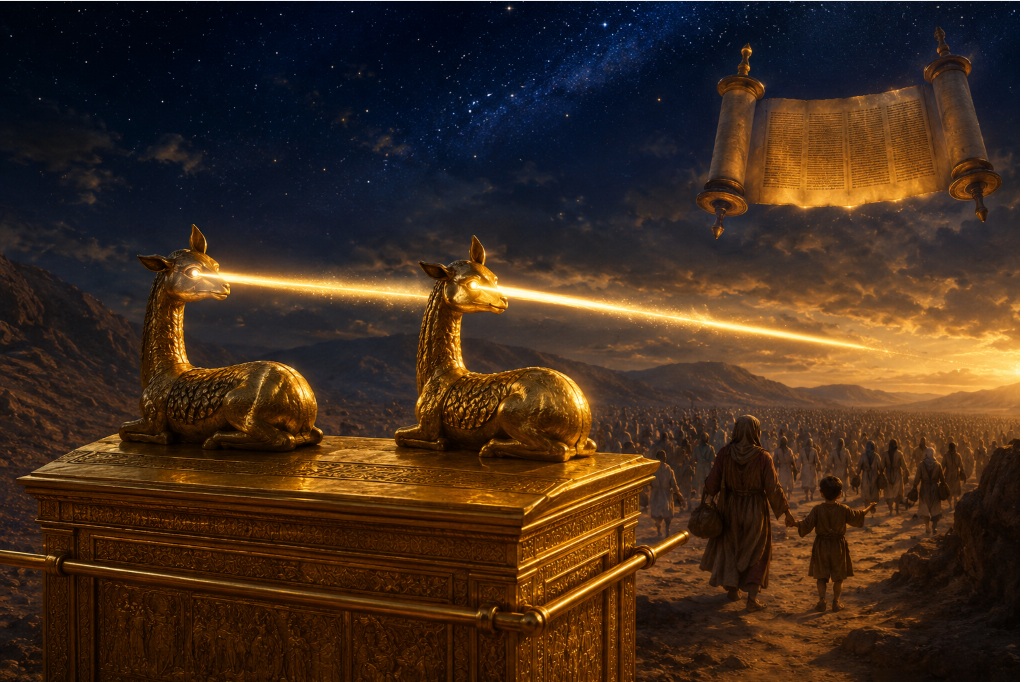
I want you to imagine the Ark of the Covenant of G-d. The Ark is square, right? Imagine the people of Israel and the Ark. Imagine that there is a Nun in front and a Nun behind.

Like a Mercedes has its symbol, the Jaguar. Imagine as if there is another Nun like a Jaguar here on the Ark and another Nun there. And imagine that this Nun — is the shape of a doe.

Just imagine they place two does on the Ark. Here is one doe, here is the second. But what is the difference between the regular doe and the does that are on the Ark? Their head is not forward as normal. It is as if the doe is crouching, sitting on the Ark, and she turns her face backward.

נ
Doe
looking back
The Ark
travels forward
נ
Doe
looking back

When you see this shape — you understand it is two inverted Nuns. That is why it is not like brackets. You see — an inverted Nun, an inverted doe. This is a doe sitting on its legs, on its belly, and with its head she looks backward.

📜 Words of the Zohar (Behaalotcha, p. 155a, §129—130)
קכ"ט) תָּא חֲזֵי, אֲרוֹנָא הֲוָה נָטֵל קַמַּיְיהוּ אוֹרַח תְּלָתָא יוֹמִין, לָא הֲוָה מִתְפָּרַשׁ מִנֵּיהּ, וְנָטֵל עִמֵּיהּ. וּמִגּוֹ רְחִימוּ דִּלְהוֹן דְּיִשְׂרָאֵל, אַהֲדַר אַנְפּוֹי וְאִסְתָּחַר מִלְּגַבֵּי אֲרוֹנָא, כְּהַאי אַיָּלָא דְּעָזַלְתָּא, כַּד אִיהוּ אָזִיל, אַהֲדַר אַפּוֹי לַאֲתָר דְּנָפִיק. וְעַל דָּא בִּנְסוֹעַ הָאָרוֹן, נוּ"ן אַסְחַר אַנְפִּין לְקֻבְלַיְיהוּ דְּיִשְׂרָאֵל, וְכִתְפֵי גּוּפָא לְגַבֵּי אֲרוֹנָא.

ק"ל) וְעַל דָּא כַּד אֲרוֹנָא הֲוָה נָטֵל, מֹשֶׁה אָמַר: קוּמָה ה', לֹא תִּשְׁבּוֹק זִילוֹן, אַהֲדַר אַנְפָּךְ לְגַבָּן, וְכֵדֵין נוּ"ן אִתְהֲדַר לְגַוַּיְיהוּ כְּגַוְונָא דָא ⌐ ⌐ — כְּמַאן דְּמַהֲדַר.
Translation: Come and see — the Ark was traveling before them a three-day journey, the Shekhinah was not separating from it, and was traveling with it. And out of their love for Israel — She turned Her face and revolved away from the Ark, like the young doe, when she walks — she turns her face to the place from which she came out. And about this, when the Ark traveled, the Nun turned its face toward Israel, and the shoulders of its body toward the Ark.
What is the Zohar really saying to us here? That these does are looking. When they turn their face backward — at whom are they looking? At the people of Israel.

That is — the Shekhinah, who is so to speak the doe with the face forward, when they start traveling — She turns Her face toward the people of Israel and continues to watch over them. To see that everything is all right.

8 The Parable of the Mother in the Mall
Like a mother walking with her child in the mall, right? She walks ahead because she walks faster. She wants to get in time to her store, to the boutique. But she every second will turn around and look at what is happening with the child.

If he is all right. Not all right. If he is still behind. He did not fall. Something is missing.
This is essentially the personal Divine Providence of the Holy One over the people of Israel in the desert. And therefore the symbol of this — is these two Nuns. That is, the Ark travels — and the Providence is all the time toward the people of Israel.
And then the Zohar continues and says — that when they stop, these Nuns turn back to the direction of walking. Because now we are in rest.

Blessed be G-d forever — Amen and Amen.

🎯 Quiz — Behaalotcha II

Five questions to check if you grasped the heart of the shiur. No bad score — just a chance to go deeper.

1
When exactly did the people of Israel leave Mount Sinai toward the Land of Israel?
✓ "And it was in the second year, in the second month, on the twentieth of the month" (Bamidbar 10:11). The second month is Iyar. After Pesach, the giving of the Torah, the sin of the Golden Calf, the erection of the Mishkan, the inauguration of the princes, and the first Pesach in the desert had passed.
2
According to the shiur, why did Yitro refuse to join the people of Israel for their entry into the Land?
✓ "And you shall be eyes for us" = you shall be an example. And Yitro understands: if I am an example — every time Israel sins, accusations will arise against him: "Shame on you!" Out of great love, he leaves.
3
According to Hazal, how many books are there in the Torah?
✓ The two verses "And it was when the Ark traveled" + "And when it rested" are framed by two inverted Nuns. Hazal say this is a book in its own right. So Bamidbar is divided into three parts, and there are a total of seven books.
4
According to the Zohar, what do the two inverted Nuns symbolize in their shape?
✓ The Zohar says: "Like the young doe, when she walks, she turns her face to the place from which she came out." The doe sits on her belly and looks backward.
5
What does the parable of the mother walking with her child in the mall symbolize?
✓ She walks ahead, but every second turns around — to see if the child is all right. So does G-d for the people of Israel. The love does not cease — even at the moment when it seems the Ark travels ahead and leaves them.

You're done! 🎉

0/5

📅 Weekly Plan — Behaalotcha
Sunday
Read the menorah kindling (Bamidbar 8) — raise the light until it rises on its own.
Monday
Kindle light in one person — strengthen them until they shine alone.
Tuesday
Moshe’s humility — "the man Moshe was very humble". Reflect on it.
Wednesday
They complained about the manna — give thanks for what you have today.
Thursday
"When the Ark traveled" — move forward, don’t stay stuck.
Friday
Pray briefly for someone ill, like Moshe: "Please heal her".
Shabbat
Be light in your family — not a source of complaint.
🗓 Weekly Program — Seven Steps of Providence
SUNDAY · The Human Observation
Watch one person in your environment for 5 minutes without speaking with them. What do they need? What are they missing? The mother in the mall does not tell the child she is watching — she simply watches.
MONDAY · The Lesson of Yitro
Identify what is your "birthplace" — not geographic. What is the pillar of your personality that you are not willing to give up? Write it down on one line.
TUESDAY · Like Schoolchildren Fleeing
Identify one thing today that you are fleeing from. Study? Prayer? A hard conversation? Stop a moment before fleeing. Just to ask: why am I fleeing?
WEDNESDAY · The Doe Who Turns Her Face
At every transition moment of the day (leaving home, moving between tasks) — stop 3 seconds and turn your head back. Look at what you left. Remember that G-d does this for you — all the time.
THURSDAY · Kal Vahomer for the Good
Find one person you usually see in a negative light — and find in them one thing you can learn from for the good.
FRIDAY NIGHT · The Shekhinah at Home
Before lighting the candles: go through in thought every member of the household. Who is all right? Who is not all right? Do for someone a small act of Providence — without them knowing.
SHABBAT · At the Torah Reading
When you reach "And it was when the Ark traveled" — imagine the two does turning their faces back toward you. Receive the gaze. Remember that G-d has never left you.
Go Deeper
🏠

Shalom Bayit — The Mouth at Home

What do you whisper to your children? To your spouse? Reveal a Shalom Bayit card.

🔢

Gematria — Rav Menashe

Hidden connections in the names according to Rav Menashe zatsal.

🔢 Gematria Course
📝

Torah Study

Dig deeper into the commentary of Rashi and the Zohar on the parashah of the week.

📝 Beith Hamidrach
📚

All Parashot

All shiurim of M. Yéhouda Himi — from Bereshit to Devarim and the festivals.

📚 All Parashot
📕

Books

Torah wisdom in thriller format — Éditions Gueoula.

🌙

Dream Interpretation

Did you dream of a doe? Of an Ark? Check the meaning according to Rav Almoli.

🌙 Dreams
🎬

Videos

Video shiurim on the festivals, the Menorah and the secrets of the Mishkan.

🎬 Videos
✉️

Contact

Do you have a question about the shiur? We would love to hear from you.

✉️ Contact
💛

Partners of the Redemption

Every page, every translation — built on Torah love. You are our partners.

💛 Become a Partner

📨 Get the Weekly Shiur
Every week, straight to your inbox — a new parashah shiur by M. Yéhouda Himi. No spam. One-click unsubscribe.
🕯️ Dedicate This Shiur
The doe who turns her face back — your partnership lights this candle through the generations.
🧱 See the Wall of Dedications →
Guardians of the Rift

Guardians of the Rift

A spiritual thriller · David Goldberg

Forty-nine gates open — the fiftieth hides in a single moment. An ancient secret resurfaces, and one man stands between the rift and the world. Drawn from Talmud and Kabbalah.

📖 Read the free excerpt · Book $9.90