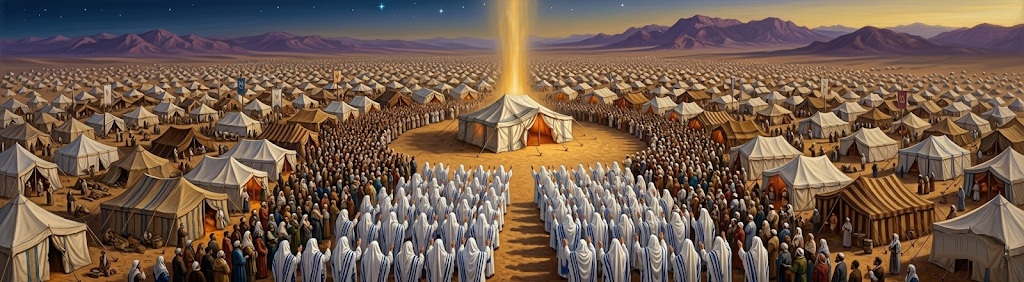
When God Places His Name Upon You
Éditions Gueoula · Paracha Nasso 5786
The longest paracha of the Torah holds four mysteries — the Sotah, the Nazir, the Priestly Blessing, the Princes' gifts. One thread runs through them all: how God places His Name upon Israel.
פרשת נשא — תקציר
פרשת נשא היא הפרשה הארוכה ביותר בתורה — 176 פסוקים. וזה לא במקרה.
היא נקראת תמיד בשבת שאחרי חג השבועות — שבת שבה ניצוצות מעמד הר סיני עוד טריים. הקב״ה נתן לנו את התורה, ועכשיו השאלה: איך הוא מניח את שמו עלינו בחיים היומיומיים?
ארבעה נושאים בפרשה, וכולם עונים על אותה שאלה:
1. סוטה (פרק ה)
אישה שבעלה חשד בה — אבל הגמרא (סוטה ז ע״א, לא ע״א) מלמדת שהטקס המלא של המים המרים כמעט ולא הופעל. בית הדין חוקר ארוכות, מנסה להשכין שלום, מחפש דרך להימנע מהטקס. הסוטה היא דווקא תרופה לרכילות: כשרינון פושט בציבור על אישה ידועה כצנועה, הטקס בא להשתיק את הלשון הרע. ה׳ מוחק את שמו כדי להחזיר שלום בית — ולסגור פיות.
2. נזיר (פרק ו)
אדם שבוחר להתקדש — נמנע מיין, לא מסתפר, לא נטמא למת. הוא מציב את עצמו תחת שם ה׳ בפרישות מרצון. אך כשהזמן נגמר, הוא מקריב חטאת — כי גם פרישות יתר היא חטא.
3. ברכת כהנים (פרק ו, כב-כז)
הלב של הפרשה — והלב של ימינו. שלוש מילים, ואז חמש, ואז שבע — חמש עשרה מילים עולות, אגד לכל יום משבעת ימי השבוע. הכהנים מניחים את שם ה׳ על העם, וה׳ עצמו מברך: וַאֲנִי אֲבָרֲכֵם.
4. קרבנות הנשיאים (פרק ז)
שנים עשר נשיאים, שנים עשר ימים, אותו קרבן בדיוק — אבל התורה כותבת כל אחד בנפרד. למה? כי שם ה׳ שורה בכל יחיד בנפרד — לא בהמון.
Parashat Nasso — Summary
Nasso is the longest paracha in the Torah — 176 verses. That's no accident.
It always falls on the Shabbat after Shavuot — when the sparks of Sinai are still fresh. God has given us the Torah; now the question becomes: how does He place His Name upon us in daily life?
Four topics fill the paracha, and all four answer the same question:
1. The Sotah (chapter 5)
A wife suspected by her husband — but the Gemara (Sotah 7a, 31a) makes clear that the full bitter-waters ceremony was almost never actually performed. The court questions at length, attempts reconciliation, looks for any way to avoid the ritual. The Sotah is in fact a cure for rumor: when public gossip surrounds a woman known for her modesty, the ritual exists to silence the lashon hara. God erases His Name to restore peace at home — and to close mouths.
2. The Nazir (chapter 6)
A person who chooses to be set apart — no wine, no haircut, no contact with the dead. He places himself under God's Name through voluntary restraint. But when his term ends, he brings a sin-offering — because even excessive holiness is a fault.
3. The Priestly Blessing (chapter 6:22-27)
The heart of the paracha — and the heart of our daily life. Three words, then five, then seven — fifteen words ascending, one set for each of the seven days of the week. The kohanim place God's Name upon the people, and then God Himself blesses: "And I will bless them."
4. The Princes' Offerings (chapter 7)
Twelve princes, twelve days, the exact same sacrifice — yet the Torah writes each one out separately. Why? Because God's Name rests on each individual distinctly — never on a faceless crowd.
Paracha Nasso — Résumé
Nasso est la plus longue paracha de la Torah — 176 versets. Ce n'est pas un hasard.
Elle tombe toujours le Shabbat qui suit Chavouot — quand les étincelles du Sinaï sont encore vives. D. nous a donné la Torah ; maintenant vient la question : comment pose-t-Il Son Nom sur nous dans la vie de tous les jours ?
Quatre sujets remplissent la paracha, et tous les quatre répondent à la même question :
1. La Sotah (chapitre 5)
Une femme soupçonnée par son mari — mais la Guemara (Sotah 7a, 31a) montre clairement que la cérémonie complète des eaux amères n'a presque jamais été appliquée en réalité. Le tribunal interroge longuement, tente la conciliation, cherche à éviter le rite. La Sotah est en vérité un remède contre la rumeur : quand une médisance publique entoure une femme connue pour sa pudeur, le rite existe pour faire taire le lashon hara. D. efface Son Nom pour restaurer la paix dans le foyer — et pour fermer les bouches.
2. Le Nazir (chapitre 6)
Une personne qui choisit la séparation — ni vin, ni coupe de cheveux, ni contact avec les morts. Il se place sous le Nom de D. par une retenue volontaire. Mais à la fin de son temps, il apporte un sacrifice d'expiation — parce que même la sainteté excessive est une faute.
3. La Birkat Kohanim (chapitre 6, 22-27)
Le cœur de la paracha — et le cœur de notre vie quotidienne. Trois mots, puis cinq, puis sept — quinze mots ascendants, un faisceau par jour de la semaine. Les kohanim placent le Nom de D. sur le peuple, et c'est D. Lui-même qui bénit : « Et Moi, Je les bénirai. »
4. Les offrandes des Nessiim (chapitre 7)
Douze princes, douze jours, exactement la même offrande — pourtant la Torah décrit chacun séparément. Pourquoi ? Parce que le Nom de D. repose sur chaque individu distinctement — jamais sur une foule anonyme.
פתיחה — הפרשה הארוכה ביותר
פרשת נשא היא בשתי דרכים יוצאת דופן: היא הפרשה הארוכה ביותר בתורה, והיא נקראת תמיד אחרי חג השבועות. שני הדברים האלה אינם במקרה.
בחג השבועות, ישראל קיבלו את התורה. אבל קבלת התורה היא רגע. החיים תחת התורה הם תהליך. פרשת נשא היא הגשר. היא לא מדברת על מעמד הר סיני — היא מדברת על מה שקורה אחרי. איך בונים חיים שבהם שם ה׳ שורה בכל פינה.
ארבעה נושאים מרכזיים בפרשה. הם נראים מנותקים. אבל הזוהר הקדוש (פרשת נשא, קכב ע״ב) מלמד שכולם מאוחדים בחוט אחד: ״ושמו את שמי על בני ישראל״.
חלק א — סוטה: כאשר ה׳ מוחק את שמו כדי להשתיק רכילות
הסיפור הקשה הזה פותח את הפרשה. בעל חשד באשתו. היא נשבעת שלא חטאה. הכהן כותב פרשה במגילה — ובתוכה את שם ה׳ המפורש — ואז מוחק את הכל במים מרים, והאישה שותה.
אבל כאן צריך לעצור — ולקרוא היטב את הגמרא.
אז מתי בכל זאת הסוטה שותה? כשבית הדין משוכנע שאין כאן חטא — אבל הציבור מפיץ רכילות עליה. אישה ידועה כצנועה שעליה רוננים בעיר. הטקס בא להשתיק את הלשון הרע פעם אחת ולתמיד: השם נמחק, האישה שותה, השמים מעידים על נקיותה — והעיר משתתקת.
השם נמחק לא כדי לחקור מה שכבר נחקר — אלא כדי להגן על אישה צנועה מפני לשון הרע. גדול שלום בית — וגדול ממנו, שלום הקהילה.
למה התורה דורשת נאמנות מן האישה?
וכאן עולה שאלה עמוקה: למה התורה כל כך מקפידה על נאמנות האישה? לכאורה זה לא הוגן — גם הגבר חייב נאמנות, אז למה הוא לא שותה מים?
אבל זה לא נושא של מוסר בלבד. זה נושא של ביולוגיה ושושלת. מה שיוצא מהגבר אינו ילד — הוא הופך לילד רק דרך האישה. מן האישה יוצאים בני אדם.
אם לאישה יש מספר גברים — אי אפשר לדעת מי האב. הילד גדל בלי שושלת. בלי שבט. בלי ייחוס. אם לגבר יש מספר נשים — האם ידועה, האב ידוע, השושלת ברורה.
זאת אינה אי-שוויון מוסרי — זאת אסימטריה אנתרופולוגית. התורה לא ממציאה את ההבדל. היא מכירה בו.
הפלישתים — האויב הקבוע של ישראל לאורך כל הנ״ך — לא נולדו עם אבי שבט אחד. הם נולדו מתוך החלפת נשים בין שני עמים. הם עם של ערבוב ייחוס. וזה מה שהופך אותם, מעצם הולדתם, לאויב של עם ישראל — שעצם זהותו היא שושלת: אברהם, יצחק, יעקב.
זאת הסיבה האמיתית שהתורה כל כך מתעצבת על שמירת בית יהודי. אישה צנועה אינה רק ערך מוסרי — היא שומרת הייחוס של עם שלם. וכשרכילות מאיימת על אישה כזו, השמים מתערבים. ה׳ מוחק את שמו בעצמו — כדי להחזיר את הסדר.
למה עם כזה גר בשערינו?
התורה היא החוקה היחידה על פני הארץ שהציבה קטגוריה הלכתית לילד שנולד מאיסור — מַמְזֵר. ועם ישראל לוקח את הקטגוריה הזו ברצינות, בעוד שכל ציוויליזציה אחרת מושכת בכתפיים. למה התורה כה חמורה? כי היא רואה מה שהעולם מסרב לראות.
כתינוק, אין לילד הזה בעיה. המשבר בא בגיל ההתבגרות — כשהוא מתחיל להבין איך נולדים ילדים. הוא פונה לאמו ושואל: ״מי אבי?״ והאם אינה יכולה לענות. ברגע הזה, כל זהותו קורסת. בעיניו, אמו הופכת לזונה, ואחיו ואחיותיו לזרים מדם בלתי ידוע. המשפחה חדלה להתקיים כיחידת מסירה. הצעיר עומד לבד מול תהום של ייחוס.
עם שלם הבנוי על הבלבול הזה אינו חש שום עכבה פנימית להשתמש בילדיו שלו כמגן אנושי — כי מבחינה מבנית, אף אחד אינו בנו של מישהו. שום קול לא קם לזעוק ״אל תירה, זה הבן שלי״ — כי אף אחד לא יודע של מי הוא הבן. ועם כזה מפתח, בריפלקס אונטולוגי, שנאה עמוקה לעם היחיד על פני האדמה ששומר על שושלתו שלמה — אברהם, יצחק, יעקב, שנים עשר השבטים, דור אחר דור. עצם קיומו של ישראל הוא מראה שהם אינם יכולים להתבונן בה. זאת אינה קנאה. זוהי דחייה אונטולוגית.
שושלת אדום — עשו, אחינו שהפך לאויבנו לאורך כל ההיסטוריה — לא נבנתה במקרה. היא נבנתה על גילוי עריות כמבנה, ממש כפי שהפלשתים נבנו על החלפת נשים.
וכאן התמונה מתרחבת. הפלשתים גרים בשערינו — האויב המקומי, האיום היומיומי. עשו פועל בזירה העולמית — רומא, אירופה, וכל המעצמות הגלובליות שניסו, מאה אחר מאה, להעלים את ישראל מהמפה. שתי קומות. אותו שורש. ציוויליזציה ששושלתה אינה יציבה אינה יכולה לסבול את קיומה של ציוויליזציה ששושלתה מתועדת.
השושנה בין החוחים
אז למה ה׳ מציב אותנו ליד עמים כאלה? למה הוא לא נותן לנו פינה שקטה של עולם?
שלמה המלך עונה בשיר השירים (ב, א-ב): ״אֲנִי חֲבַצֶּלֶת הַשָּׁרוֹן שׁוֹשַׁנַּת הָעֲמָקִים. כְּשׁוֹשַׁנָּה בֵּין הַחוֹחִים, כֵּן רַעְיָתִי בֵּין הַבָּנוֹת.״ ישראל נמשל לשושנה. ושושנה אינה גדלה למרות הקוצים — היא גדלה עם הקוצים. הקוצים שומרים על הפרח. בלי הניגוד, השושנה לא היתה מתגלה כשושנה.
העמים שסביבנו אינם תאונה גיאוגרפית. הם הקוצים שמקיפים את השושנה. שנאתם מאלצת אותנו, דור אחר דור, לדעת מי אנחנו. לזכור את אבינו. לשמור על השושלת. אם הם לא היו עומדים בשערינו, אולי היינו שוכחים מה הופך אותנו לעם. דחייתם המבנית היא, בהשגחה המוזרה של ההיסטוריה, הערובה לזיכרוננו.
אבל למה ה׳ ברא את זה?
השאלה האמיתית עולה כאן בלחישה: אם זה כל כך קשה, למה ה׳ ברא עולם כזה? למה לא עולם שכולו טוב?
כי בעולם הזה יש קוטב צפוני וקוטב דרומי. לכל דבר יש אנטגוניסט. אם כולם היו עושים את הטוב — איזה זכות היתה בעשיית הטוב? אם לא היה יצר הרע — לא היה שכר, לא בחירה, לא חזרה בתשובה. רק רובוטים זוהרים שאינם זוכים בכלום. הקדוש ברוך הוא ברא את העולם במתח — וזה מה שמאפשר לאדם להתעלות באמת. יצר הרע אינו פגם בבריאה. הוא תנאי קיומה.
אבל יש מלכודת נוראה יותר.
לא רק הצדיקים. גם הרשעים הגרועים ביותר. אלה שהובילו את האנושות לתהומות החשוכים ביותר של המאה העשרים היו משוכנעים שהם מצילים את העולם. אלה שמפוצצים את עצמם בקרב חפים מפשע מאמינים שהם קדושים. אלה שמצביעים נגד ישראל באולמות בינלאומיים מרגישים שהם מגינים על הצדק. הרע המוחלט אינו מגיע לבוש בגלימה שחורה עם קרניים. הוא מגיע לבוש כמצווה.
וזאת הסיבה שצריכה להיות תורה.
כי אם כל אחד חושב שהוא עושה את הטוב, השאלה אינה ״מי הצודק?״ אלא ״לפי איזה קריטריון?״ בלי תורה, האנושות מסתחררת בין ״טובים״ סובייקטיביים שהורגים זה את זה. עם תורה, יש קריטריון אובייקטיבי שניתן מסיני — וזה בדיוק מה שהאומות אינן יכולות לסבול. הן אינן מסרבות לתורת ישראל כי היא קשה. הן מסרבות לה כי היא קיימת. עצם קיומה של מערכת אמת אובייקטיבית מערערת את כל המגדלים שהן בנו לעצמן.
וכך אנו חוזרים לפסוק שהתקבל מן השמים: ״וְשָׂמוּ אֶת שְׁמִי עַל בְּנֵי יִשְׂרָאֵל וַאֲנִי אֲבָרֲכֵם.״ השם המונח על השושלת הופך את השושלת לבלתי ניתנת להשמדה. זה בדיוק מה שאויבינו אינם יכולים לשאת. זה מה שמשגע אותם. כי הישרדות ישראל מוכיחה, בכל דור ודור, שעם אחד על פני האדמה הזו סירב לבלבול — ונשאר חי. ולא רק שהוא נשאר חי — הוא נושא את הסולם שעליו האנושות כולה תוכל לעלות, ביום שתבחר.
חלק ב — נזיר: כאשר אדם מציב את עצמו תחת השם
הנזיר הוא אדם רגיל שמחליט: לזמן מוגדר, אני אהיה אחר. לא אשתה יין, לא אסתפר, לא אגע במת. אני מציב את עצמי תחת השם.
אבל יש כאן פרדוקס. בסוף ימי הנזירות, התורה מצווה על הנזיר להביא חטאת. למה? אם הוא התקדש, על מה הוא חוטא?
חלק ג — ברכת כהנים: לב הפרשה, לב היום
שלושה פסוקים. אבל שים לב למבנה שלוש מילים, חמש מילים, שבע מילים. עולה ועולה. שלוש פלוס חמש פלוס שבע — חמש עשרה מילים בדיוק.
הפסוק הראשון — שלוש מילים
יְבָרֶכְךָ ה׳ וְיִשְׁמְרֶךָ — ה׳ ייתן לך, וגם ישמור על מה שנתן. אומר רש״י: ״יברכך — בנכסים, וישמרך — שלא יבואו עליך שודדים.״ כי ברכה בלי שמירה היא ברכה שמושכת קנאה. ה׳ נותן וגם שומר.
הפסוק השני — חמש מילים
יָאֵר ה׳ פָּנָיו אֵלֶיךָ וִיחֻנֶּךָּ — שיאיר ה׳ את פניו אליך, ויחון אותך. אומר אור החיים: מה זה ״פני ה׳״? זו השכינה. הברכה היא לא רק מתנה — היא קרבת ה׳. ולא רק קרבה — חן. שתהיה אהוב בעיני ה׳, ובעיני הבריות.
הפסוק השלישי — שבע מילים
יִשָּׂא ה׳ פָּנָיו אֵלֶיךָ וְיָשֵׂם לְךָ שָׁלוֹם — שירומם ה׳ את פניו אליך, וישים לך שלום. אומר אור החיים: שלום הוא היסוד של עולם. ״מַשְׂכִּיל בְּתֵבַת שָׁלוֹם יֵדַע, כִּי זֶה הוּא יְסוֹד עוֹלָם.״ מי שמבין במילה שלום — יודע.
הפסוק הזה הוא הסוד של כל הברכה. הכהנים לא מברכים מעצמם. הם רק מניחים את שם ה׳ — ואז ה׳ מברך. וַאֲנִי אֲבָרֲכֵם. אני, בעצמי, מברך.
חלק ד — קרבנות הנשיאים: למה כל אחד בנפרד?
ביום שמשה גמר להקים את המשכן, הביאו שנים עשר נשיאי השבטים מתנות. אותה מתנה בדיוק. אבל התורה — שהיא תורת אמת ואין בה אות מיותרת — חוזרת שנים עשר פעמים על אותם הפסוקים, פעם לכל נשיא.
אז למה כל נשיא בנפרד? אם כולם הביאו אותו דבר, אפשר היה לכתוב פעם אחת ולהוסיף ״וכן עשו כולם״. למה התורה ״מבזבזת״ פסוקים?
סיכום — חוט אחד מחבר את כולם
חזור עכשיו לארבעת הנושאים. תראה שכולם נוגעים בשאלה אחת: איך שם ה׳ שורה בפועל?
🔹 סוטה — שם ה׳ נמחק כדי להציל את השלום בבית. השם נמצא ביחסים.
🔹 נזיר — אדם מציב את עצמו תחת השם בפרישות זמנית. השם נמצא בבחירה האישית.
🔹 ברכת כהנים — השם מונח על העם, וה׳ עצמו מברך. השם נמצא בהברכה היומית.
🔹 קרבנות הנשיאים — כל אחד מובא בנפרד. השם נמצא בהיחיד.
Opening — The Longest Paracha
Parashat Nasso is exceptional in two ways: it is the longest paracha in the entire Torah, and it is always read on the Shabbat right after Shavuot. Neither fact is coincidence.
On Shavuot, Israel received the Torah. But receiving the Torah is a moment. Living under the Torah is a process. Nasso is the bridge. It doesn't talk about Sinai — it talks about what happens after. How to build a life in which God's Name rests in every corner.
Four central topics fill the paracha. They look disconnected. But the Zohar (Nasso 122b) teaches that they're all united by one thread: "They shall place My Name upon the Children of Israel."
Part I — The Sotah: When God Erases His Name to Silence Gossip
This difficult story opens the paracha. A husband suspects his wife. She swears she did nothing wrong. The Kohen writes a passage on a scroll — including God's explicit Name — and then erases it all into bitter water, and the wife drinks.
But here we must stop — and read the Gemara carefully.
So when did the Sotah actually drink? Precisely when the court was convinced she had done nothing wrong — but the public was spreading rumor about her. A woman known for her modesty, around whom gossip had hardened into accusation. The ritual existed to silence the lashon hara once and for all: the Name is erased, the woman drinks, heaven testifies to her innocence — and the town falls silent.
The Name is erased not to investigate what has already been investigated — but to protect a modest woman from slander. Great is shalom bayit — and greater still is shalom of the community.
Why does the Torah demand fidelity from the woman?
Here a deeper question emerges: why does the Torah place such weight on a wife's fidelity? On the surface it seems unfair — the husband is also bound to fidelity, so why isn't he the one drinking water?
But this is not only a question of morality. It is a question of biology and lineage. What comes from the man is not yet a child — it only becomes a child through the woman. Human beings come out of the woman.
If a woman has multiple men — there is no way to know who the father is. The child grows up without lineage. Without tribe. Without yichus. If a man has multiple women — the mother is known, the father is known, the lineage is clear.
This is not moral inequality — it is anthropological asymmetry. The Torah does not invent this difference. It acknowledges it.
The Pelishtim — Israel's structural enemy throughout the entire Tanakh — were not born of a single tribal father. They were born through the exchange of wives between two peoples. They are a nation of confused lineage. And that is precisely what makes them, by their very birth, the enemy of the people of Israel — whose identity itself is lineage: Avraham, Yitzhak, Yaakov.
This is the deeper reason the Torah cares so intensely about the integrity of the Jewish home. A modest woman is not only a moral value — she is the guardian of an entire people's lineage. And when gossip threatens such a woman, Heaven intervenes. God Himself erases His own Name — to restore the order.
Why such a people lives at our gates
The Torah is the only constitution on earth that has institutionalized a category for the child of forbidden union — a category Israel takes seriously while every other civilization shrugs. Why does the Torah seem so harsh? Because it sees something the world refuses to see.
As a baby, such a child has no problem. The crisis comes at adolescence — when he begins to understand how children are made. He turns to his mother and asks: "Who is my father?" And the mother cannot answer. In that moment, his entire identity collapses. To his eyes, his mother becomes nothing more than a prostitute, and his brothers and sisters become strangers of unknown blood. The family ceases to exist as a unit of transmission. The young man stands alone before a genealogical void.
A whole people built on this confusion has no inner resistance to using its own children as human shields — because structurally, no one is anyone's son. No voice rises to say "don't shoot, that's my boy" — because no one knows whose boy it is. And such a people develops, by ontological reflex, a deep hatred for the only people on earth that maintains its lineage intact — Avraham, Yitzhak, Yaakov, the twelve tribes, generation after generation. Israel's mere existence is a mirror they cannot bear to face. This is not jealousy. It is structural revulsion.
The line of Edom — Esav, our brother who became our adversary throughout history — was not built by accident. It was built on incest as its structure, exactly as the Pelishtim were built on the exchange of wives.
And here the picture widens. The Pelishtim live at our gates — the local enemy, the daily threat. Esav operates on the world stage — Rome, Europe, all the global powers that have tried, century after century, to erase Israel from the map. Two scales. The same root cause. A civilization whose lineage is unstable cannot tolerate the existence of a civilization whose lineage is traced.
The rose among the thorns
So why does God place us next to such peoples? Why doesn't He give us a quiet corner of the earth?
King Solomon answers in Shir HaShirim (2:1-2): "I am the rose of Sharon, the lily of the valleys. As a lily among thorns, so is my beloved among the daughters." Israel is compared to a rose. And a rose does not grow despite the thorns — it grows with the thorns. The thorns protect the flower. Without the contrast, the rose would not reveal itself as a rose.
The peoples around us are not an accident of geography. They are the thorns that surround the rose. Their hatred forces us, generation after generation, to know who we are. To remember our father. To preserve the line. If they did not stand at our gates, we might forget what makes us a people. Their structural rejection is, in the strange providence of history, the guarantee of our memory.
But why did God create this?
The real question rises here in a whisper: if all this is so painful, why did God create such a world? Why not a world made only of good?
Because this world has a north pole and a south pole. Everything has its antagonist. If everyone did good — what merit would there be in doing good? Without a yetser hara, there would be no reward, no choice, no return. Only luminous robots earning nothing. The Holy One built the world under tension — and that is what allows a human being to truly rise. The evil inclination is not a flaw in creation. It is the condition of its existence.
But there is a trap more terrible still.
Not only the righteous. The very worst as well. Those who led humanity into the darkest abysses of the twentieth century were convinced they were saving the world. Those who blow themselves up in crowds of innocents believe they are holy. Those who vote against Israel in international chambers feel they are defending justice. Absolute evil never arrives wearing a black cloak with horns. It arrives dressed as a mitsva.
And that is why there must be a Torah.
Because if everyone believes they are doing good, the question is no longer "who is right?" but "by what criterion?" Without Torah, humanity spins between subjective "goods" that murder one another. With Torah, there is an objective criterion handed down at Sinai — and that is precisely what the nations cannot bear. They do not reject the Torah of Israel because it is difficult. They reject it because it exists. The very existence of an objective system of truth undermines every tower they have built for themselves.
And so we return to the verse received from heaven: "They shall place My Name upon the Children of Israel — and I Myself will bless them." The Name placed upon the lineage makes the lineage indestructible. This is precisely what our enemies cannot bear. It is what drives them mad. Because the survival of Israel proves, in every generation, that one people on this earth has refused the confusion — and lived. And not only lived — it carries the ladder on which all of humanity will one day be able to climb, on the day it chooses to.
Part II — The Nazir: When a Person Places Himself Under the Name
The Nazir is an ordinary person who decides: for a defined time, I will be different. No wine, no haircut, no contact with the dead. I am placing myself under the Name.
But there's a paradox. At the end of his Nazirite term, the Torah commands him to bring a sin-offering. Why? If he sanctified himself, what did he do wrong?
Part III — The Priestly Blessing: Heart of the Paracha, Heart of the Day
Three verses. But look at the architecture: three words, five words, seven words. Ascending, ascending. Three plus five plus seven — exactly fifteen words.
The first verse — three words
Yevarekhekha Hashem ve-yishmerekha — May God bless you and protect you. Rashi explains: "Bless you — with possessions; protect you — that no robbers come upon you." Because blessing without protection is a blessing that attracts envy. God gives and guards.
The second verse — five words
Ya'er Hashem panav eleikha vichunekha — May God illuminate His face toward you, and be gracious to you. Or HaChaim explains: What does "the face of God" mean? It is the Shekhinah — the Divine Presence. The blessing is not just a gift — it is closeness to God. And not only closeness — favor. That you should be beloved in God's eyes, and in the eyes of others.
The third verse — seven words
Yissa Hashem panav eleikha veyasem lekha shalom — May God lift His face upon you, and grant you peace. Or HaChaim explains: Peace is the foundation of the world. "One who understands within the word Shalom knows — for this is the foundation of the world."
This verse is the secret of the entire blessing. The kohanim do not bless on their own authority. They only place God's Name — and then God Himself blesses. "And I will bless them." I, Myself, bless.
Part IV — The Princes' Offerings: Why Each One Separately?
On the day Moshe finished erecting the Mishkan, the twelve princes of the tribes brought gifts. The exact same gift. Yet the Torah — which is a Torah of truth, with no extra letter — repeats the same verses twelve times, once for each prince.
So why each prince separately? If they all brought the same thing, the Torah could have written it once and added: "and so each one did." Why "waste" verses?
Conclusion — One Thread Through All Four
Return now to the four topics. You'll see they all touch the same question: how does God's Name actually rest in this world?
🔹 Sotah — God's Name is erased to save peace in a home. The Name lives in relationships.
🔹 Nazir — A person places himself under the Name through temporary withdrawal. The Name lives in personal choice.
🔹 Birkat Kohanim — The Name is placed on the people, and God Himself blesses. The Name lives in daily blessing.
🔹 Princes' Offerings — Each prince is brought separately. The Name lives in the individual.
Ouverture — La plus longue paracha
Paracha Nasso est exceptionnelle à deux titres : c'est la plus longue paracha de toute la Torah, et elle est toujours lue le Shabbat qui suit Chavouot. Ni l'un ni l'autre n'est un hasard.
À Chavouot, Israël a reçu la Torah. Mais recevoir la Torah est un instant. Vivre sous la Torah est un processus. Nasso est le pont. Elle ne parle pas du Sinaï — elle parle de ce qui se passe après. Comment construire une vie où le Nom de D. repose dans chaque recoin.
Quatre sujets centraux remplissent la paracha. Ils semblent déconnectés. Mais le Zohar (Nasso 122b) enseigne qu'ils sont tous unis par un seul fil : « Ils placeront Mon Nom sur les enfants d'Israël. »
Partie I — La Sotah : quand D. efface Son Nom pour faire taire la rumeur
Cette histoire difficile ouvre la paracha. Un mari soupçonne sa femme. Elle jure qu'elle n'a rien fait. Le Kohen écrit un passage sur un parchemin — incluant le Nom explicite de D. — puis efface le tout dans des eaux amères, et la femme boit.
Mais ici il faut s'arrêter — et lire attentivement la Guemara.
Alors, quand la Sotah buvait-elle vraiment ? Précisément quand le tribunal était convaincu qu'elle n'avait rien fait de mal — mais que la rumeur publique se répandait sur elle. Une femme connue pour sa pudeur, autour de laquelle des médisances avaient durci en accusation. Le rite existait pour faire taire le lashon hara une fois pour toutes : le Nom est effacé, la femme boit, le Ciel témoigne de son innocence — et la ville se tait.
Le Nom est effacé non pour enquêter sur ce qui a déjà été enquêté — mais pour protéger une femme pudique de la médisance. Grande est la paix du foyer — et plus grande encore, la paix de la communauté.
Pourquoi la Torah exige-t-elle la fidélité de la femme ?
Une question plus profonde émerge : pourquoi la Torah accorde-t-elle un poids si grand à la fidélité de l'épouse ? En surface cela semble injuste — le mari aussi est tenu à la fidélité, alors pourquoi n'est-ce pas lui qui boit les eaux ?
Mais ce n'est pas seulement une question de morale. C'est une question de biologie et de lignée. Ce qui sort de l'homme n'est pas encore un enfant — cela ne devient un enfant qu'à travers la femme. Les êtres humains sortent de la femme.
Si une femme a plusieurs hommes — il est impossible de savoir qui est le père. L'enfant grandit sans lignée. Sans tribu. Sans yih'us. Si un homme a plusieurs femmes — la mère est connue, le père est connu, la lignée est claire.
Ce n'est pas une inégalité morale — c'est une asymétrie anthropologique. La Torah n'invente pas cette différence. Elle la reconnaît.
Les Pelishtim — l'ennemi structurel d'Israël à travers tout le Tanakh — ne sont pas nés d'un père tribal unique. Ils sont nés par l'échange des femmes entre deux peuples. Ils sont une nation de lignée confuse. Et c'est précisément ce qui les rend, par leur naissance même, l'ennemi du peuple d'Israël — dont l'identité même est lignée : Avraham, Yits'haq, Yaakov.
C'est la raison plus profonde pour laquelle la Torah se soucie si intensément de l'intégrité du foyer juif. Une femme pudique n'est pas seulement une valeur morale — elle est la gardienne de la lignée d'un peuple entier. Et quand la médisance menace une telle femme, le Ciel intervient. D. Lui-même efface Son propre Nom — pour restaurer l'ordre.
Pourquoi un tel peuple vit-il à nos portes
La Torah est la seule constitution sur terre à avoir institutionnalisé une catégorie pour l'enfant d'union interdite — une catégorie qu'Israël prend au sérieux quand toute autre civilisation hausse les épaules. Pourquoi la Torah semble-t-elle si dure ? Parce qu'elle voit ce que le monde refuse de voir.
Bébé, un tel enfant n'a pas de problème. La crise vient à l'adolescence — quand il commence à comprendre comment on fait les enfants. Il se tourne vers sa mère et demande : « Qui est mon père ? » Et la mère ne peut pas répondre. À cet instant, toute son identité s'effondre. À ses yeux, sa mère devient une prostituée, et ses frères et sœurs deviennent des étrangers de sang inconnu. La famille cesse d'exister comme unité de transmission. Le jeune homme se tient seul face à un vide généalogique.
Un peuple entier construit sur cette confusion ne ressent aucune résistance intérieure à utiliser ses propres enfants comme boucliers humains — parce que, structurellement, personne n'est le fils de personne. Aucune voix ne s'élève pour dire « ne tire pas, c'est mon fils » — parce que personne ne sait de qui il est le fils. Et un tel peuple développe, par réflexe ontologique, une haine profonde pour le seul peuple sur terre qui maintient sa lignée intacte — Avraham, Yits'haq, Yaakov, les douze tribus, génération après génération. La simple existence d'Israël est un miroir qu'ils ne peuvent supporter. Ce n'est pas de la jalousie. C'est une répulsion structurelle.
La lignée d'Édom — Essav, notre frère devenu notre adversaire à travers toute l'histoire — n'a pas été bâtie par hasard. Elle a été bâtie sur l'inceste comme structure, exactement comme les Pelishtim ont été bâtis sur l'échange des femmes.
Et ici l'image s'élargit. Les Pelishtim vivent à nos portes — l'ennemi local, la menace quotidienne. Essav opère sur la scène mondiale — Rome, l'Europe, toutes les puissances globales qui ont tenté, siècle après siècle, d'effacer Israël de la carte. Deux échelles. La même cause racine. Une civilisation dont la lignée est instable ne peut tolérer l'existence d'une civilisation dont la lignée est tracée.
La rose parmi les épines
Alors pourquoi D. nous place-t-Il à côté de tels peuples ? Pourquoi ne nous donne-t-Il pas un coin tranquille de la terre ?
Le roi Salomon répond dans Chir HaChirim (2, 1-2) : « Je suis la rose du Sharon, le lys des vallées. Comme un lys parmi les épines, telle est ma bien-aimée parmi les filles. » Israël est comparé à une rose. Et une rose ne pousse pas malgré les épines — elle pousse avec les épines. Les épines protègent la fleur. Sans le contraste, la rose ne se révélerait pas comme rose.
Les peuples autour de nous ne sont pas un accident de géographie. Ils sont les épines qui entourent la rose. Leur haine nous force, génération après génération, à savoir qui nous sommes. À nous souvenir de notre père. À préserver la ligne. S'ils ne se tenaient pas à nos portes, nous oublierions peut-être ce qui fait de nous un peuple. Leur rejet structurel est, dans l'étrange providence de l'histoire, la garantie de notre mémoire.
Mais pourquoi D. a-t-Il créé cela ?
La vraie question s'élève ici dans un murmure : si tout cela est si douloureux, pourquoi D. a-t-Il créé un tel monde ? Pourquoi pas un monde fait uniquement de bien ?
Parce que ce monde a un pôle nord et un pôle sud. Chaque chose a son antagoniste. Si tout le monde faisait le bien — quel mérite y aurait-il à faire le bien ? Sans yetser hara, il n'y aurait ni récompense, ni choix, ni téchouva. Seulement des robots lumineux qui ne gagnent rien. Le Saint béni soit-Il a bâti le monde sous tension — et c'est précisément ce qui permet à un homme de s'élever vraiment. Le mauvais penchant n'est pas un défaut de la création. Il en est la condition d'existence.
Mais il y a un piège plus terrible encore.
Pas seulement les justes. Les pires aussi. Ceux qui ont conduit l'humanité dans les abîmes les plus noirs du vingtième siècle étaient convaincus de sauver le monde. Ceux qui se font exploser au milieu d'innocents pensent être saints. Ceux qui votent contre Israël dans les chambres internationales ressentent qu'ils défendent la justice. Le mal absolu n'arrive jamais vêtu d'une cape noire avec des cornes. Il arrive déguisé en mitsva.
Et c'est pour cela qu'il fallait une Torah.
Car si chacun croit faire le bien, la question n'est plus « qui a raison ? » mais « selon quel critère ? » Sans Torah, l'humanité tournoie entre des « biens » subjectifs qui s'entretuent. Avec la Torah, il existe un critère objectif descendu du Sinaï — et c'est précisément ce que les nations ne peuvent supporter. Elles ne rejettent pas la Torah d'Israël parce qu'elle est difficile. Elles la rejettent parce qu'elle existe. L'existence même d'un système de vérité objectif fait vaciller toutes les tours qu'elles ont bâties pour elles-mêmes.
Et ainsi nous revenons au verset reçu du Ciel : « Ils placeront Mon Nom sur les enfants d'Israël — et Moi, Je les bénirai. » Le Nom posé sur la lignée rend la lignée indestructible. C'est précisément ce que nos ennemis ne peuvent supporter. C'est ce qui les rend fous. Parce que la survie d'Israël prouve, à chaque génération, qu'un seul peuple sur cette terre a refusé la confusion — et est resté en vie. Et pas seulement en vie — il porte l'échelle sur laquelle l'humanité entière pourra un jour monter, le jour où elle le choisira.
Partie II — Le Nazir : quand une personne se place sous le Nom
Le Nazir est une personne ordinaire qui décide : pour un temps défini, je serai différent. Pas de vin, pas de coupe de cheveux, pas de contact avec les morts. Je me place sous le Nom.
Mais il y a un paradoxe ici. À la fin de son temps de naziréat, la Torah ordonne au Nazir d'apporter un sacrifice expiatoire. Pourquoi ? S'il s'est sanctifié, qu'a-t-il fait de mal ?
Partie III — La Birkat Kohanim : cœur de la paracha, cœur du jour
Trois versets. Mais regarde l'architecture : trois mots, cinq mots, sept mots. Crescendo. Trois plus cinq plus sept — exactement quinze mots.
Le premier verset — trois mots
Yevarekhekha Hashem ve-yishmerekha — Que D. te bénisse, et qu'Il garde ce qu'Il t'a donné. Rashi explique : « Te bénir — par des biens ; te garder — que des voleurs ne viennent pas sur toi. » Car une bénédiction sans protection est une bénédiction qui attire l'envie. D. donne et garde.
Le second verset — cinq mots
Ya'er Hashem panav eleikha vichunekha — Que D. illumine Sa face vers toi, et te fasse grâce. Or HaH'aïm explique : Que signifie « la face de D. » ? C'est la Chékhina — la Présence divine. La bénédiction n'est pas seulement un cadeau — c'est la proximité de D. Et pas seulement la proximité — la grâce. Que tu sois aimé aux yeux de D., et aux yeux des hommes.
Le troisième verset — sept mots
Yissa Hashem panav eleikha veyasem lekha shalom — Que D. élève Sa face vers toi, et qu'Il te donne la paix. Or HaH'aïm explique : La paix est le fondement du monde. « Celui qui comprend dans le mot Shalom — sait, car c'est le fondement du monde. »
Ce verset est le secret de toute la bénédiction. Les kohanim ne bénissent pas de leur propre autorité. Ils ne font que poser le Nom de D. — et ensuite D. Lui-même bénit. « Et Moi, Je les bénirai. » Moi, en Personne, Je bénis.
Partie IV — Les offrandes des Nessiim : pourquoi chacun séparément ?
Le jour où Moché finit de dresser le Mishkan, les douze princes des tribus apportèrent des cadeaux. Exactement le même cadeau. Pourtant la Torah — qui est Torah de vérité, sans une lettre superflue — répète les mêmes versets douze fois, une fois pour chaque prince.
Alors pourquoi chaque prince séparément ? Si tous ont apporté la même chose, la Torah aurait pu l'écrire une fois et ajouter : « et chacun fit de même. » Pourquoi « gaspiller » des versets ?
Conclusion — Un seul fil traverse les quatre
Reviens maintenant aux quatre sujets. Tu verras qu'ils touchent tous la même question : comment le Nom de D. repose-t-il réellement dans ce monde ?
🔹 Sotah — Le Nom de D. est effacé pour sauver la paix dans un foyer. Le Nom vit dans les relations.
🔹 Nazir — Une personne se place sous le Nom par une retenue temporaire. Le Nom vit dans le choix personnel.
🔹 Birkat Kohanim — Le Nom est posé sur le peuple, et D. Lui-même bénit. Le Nom vit dans la bénédiction quotidienne.
🔹 Offrandes des Nessiim — Chaque prince est amené séparément. Le Nom vit dans l'individu.
🎯 חידון פרשת נשא
חמש שאלות לחזק את הזיכרון של מה שלמדנו. לחץ על תשובה לראות אם צדקת.
1. כמה פסוקים יש בפרשת נשא?
2. בפועל, מתי האישה הסוטה שותה את המים המרים?
3. מדוע הנזיר מביא קרבן חטאת בסוף ימי נזירותו?
4. מהו הסוד של הפסוק ״וְשָׂמוּ אֶת שְׁמִי״ (במדבר ו, כז)?
5. למה התורה כותבת את קרבן כל אחד מ-12 הנשיאים בנפרד, אף שכולם הביאו אותו דבר?
🎯 Parashat Nasso — Quiz
Five questions to lock in what we learned. Click an answer to see if you got it right.
1. How many verses are in Parashat Nasso?
2. In practice, when did the Sotah actually drink the bitter waters?
3. Why does the Nazir bring a sin-offering at the end of his term?
4. What is the secret of the verse "And they shall place My Name" (Bamidbar 6:27)?
5. Why does the Torah write out each of the 12 princes' offerings separately, when all twelve brought the same thing?
🎯 Quiz Paracha Nasso
Cinq questions pour ancrer ce qu'on a appris. Clique sur une réponse pour voir si tu as juste.
1. Combien de versets compte la paracha Nasso ?
2. En pratique, dans quel cas la Sotah buvait-elle vraiment les eaux amères ?
3. Pourquoi le Nazir apporte-t-il un sacrifice expiatoire à la fin de son temps ?
4. Quel est le secret du verset « Ils placeront Mon Nom » (Bamidbar 6, 27) ?
5. Pourquoi la Torah décrit-elle l'offrande de chacun des 12 princes séparément, alors qu'ils ont tous apporté la même chose ?
קבל · הקדש · תמוך
כל יום שישי — פרשה חדשה לתיבת הדואר שלך. וגם — דרך להקדיש את הפרשה לאדם אהוב.
קבל את הפרשה
כל יום שישי לפני שבת — הפרשה החדשה, מלאה, בשלוש שפות, חינם.
הקדש את הפרשה
לעילוי נשמת, לרפואת חולה, להצלחת ילד — קבל תעודה מהודרת להדפסה ושמירה.
✦ הצע תפילה ←בחר את הכוונה בעמוד המוקדש. בדיסקרטיות, מאובטח, ללא התחייבות.
Receive · Dedicate · Support
Every Friday, a new paracha in your inbox — and a way to dedicate it to someone you love.
Receive the Paracha
Each Friday before Shabbat — the new paracha in full, trilingual, free.
Dedicate this Paracha
In memory of a loved one, for the healing of a patient, for the success of a child — receive a certificate to print and keep.
✦ Offer a prayer →Choose your intention on the dedicated page. Discreet, secure, no commitment.
Reçois · Dédie · Soutiens
Chaque vendredi, une nouvelle paracha dans ta boîte mail — et un moyen de la dédier à quelqu'un que tu aimes.
Recevoir la paracha
Chaque vendredi avant Shabbat — la nouvelle paracha en entier, trilingue, gratuite.
Dédier cette paracha
À la mémoire d'un proche, pour la guérison d'un malade, pour la réussite d'un enfant — reçois un certificat à imprimer et conserver.
✦ Offrir une prière →Choisis ton intention sur la page dédiée. Discret, sécurisé, sans engagement.
Guardians of the Rift
After October 7th, a hidden fracture opens in the soul of Israel. A spiritual thriller that reads like Dan Brown — and ends like the Zohar. Yours, free, in seconds.
📖 Download free (email required)
Les Gardiens de la Faille
Après le 7 octobre, une faille cachée s'ouvre dans l'âme d'Israël. Un thriller spirituel qui se lit comme Dan Brown — et finit comme le Zohar. À toi, gratuit, en quelques secondes.
📖 Télécharger gratuit (email requis)
Guardians of the Rift
אחרי השביעי באוקטובר, סדק נסתר נפתח בנשמת ישראל. תריילר רוחני שנקרא כמו דן בראון — ומסתיים כמו הזוהר. שלך, חינם, בשניות.
📖 הורד חינם (דרוש מייל)Éditions Gueoula · Parashat Nasso 5786 · gueoula.com