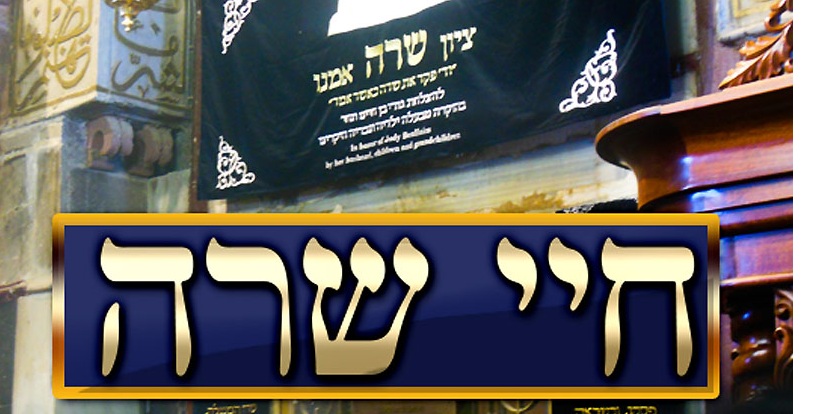
Sarah dies at 127 right after the Akeda; the Midrash links her death to terror, or to disappointment that the world was not yet repaired.
The small kaf of velivkotah teaches mourning in right measure: weep, but do not refuse the divine decree.
Avraham buys Mearat HaMakhpela from Efron for 400 silver shekels, with integrity, despite God's promise of the land.
Makhpela comes from makhpelet, a seam: the cave is the junction point between this world and Gan Eden.
Efron says much and does little; the Torah removes the vav from his name, whose gematria equals exactly 400.
Sarah dies at 127, immediately after the Akedat Yitzhak. The Midrash offers two readings: either she learns that Avraham is about to sacrifice Yitzhak and her soul departs in terror; or she learns the Akeda did not go through and her soul departs in disappointment.
"Avraham came to eulogize Sarah and to weep for her." The letter כ (kaf) in the word velivkotah is deliberately written small — a kaf ketana.
Though Hashem promised him all of Canaan, Avraham does not say: "This land was promised to me, I take what I want." He acts with respect and conducts a hard negotiation with Efron the Hittite.
He finally buys the cave for 400 silver shekels, "silver current with the merchant" — the strongest currency of the era.
Rashi offers several meanings: house and upper chamber (bayit vaaliya), two superimposed levels; chamber within chamber, doubled spaces; and kefula bezugot, doubled in couples — for four couples rest there: Adam and Hava, Avraham and Sarah, Yitzhak and Rivka, Yaakov and Leah (with Esau's head).
The Midrash on the previous parasha (Vayera) explains: during the angels' visit, Avraham runs "to the cattle" (el habakar). A calf escapes, Avraham pursues it, and the animal enters a cave.
Avraham follows, breathes an extraordinary fragrance, and discovers Adam and Hava buried there, lights at their heads. He then grasps the holiness of the place.
The Zohar teaches that Mearat HaMakhpela is the gate of Gan Eden. Expelled from the garden, Adam and Hava do not go far; they remain near the gate guarded by the Cherubim and the flaming sword. At his death, Adam asks to be buried right beside this gate. Since then, every soul of Israel, wherever it departs this world, passes through the Makhpela to enter Gan Eden.
"The junction of the upper and the lower": this is why Adam was buried there, to remain closest to the gate of the garden.
Efron begins with a grand gesture: "Take it for free! Bury your dead, no problem." But when it comes time to conclude, he demands 400 silver shekels, a considerable sum, in strong currency.
Throughout the parasha the name is written עֶפְרוֹן (Efron), with a vav. Only once — at the instant of payment — is it written עֶפְרֹן, without vav.
"For dust (afar) you are, and to dust you shall return." Even Efron's name (afar) binds him to the materiality of the earth.
Proper mourning: weeping for the deceased is a mitzvah, but weeping to excess is to refuse Hashem's decree. Accept His will: Hashem natan veHashem lakakh.
Word and deed: be like Avraham — say little, do much — and not like Efron, lavish in words and stingy in deeds.
🎯 Test yourself
Five questions. Click an answer.
Result
Shalom Bayit — The Mouth at Home
My covenant of peace — peace begins at home. Reveal a Shalom Bayit card.
Gematria — Rav Ménaché
Shalom, Mashiah, Yisamech — secrets of the letters by Rav Ménaché zatsal.
🔢 Gematria CourseAll Parashot
All shiurim of M. Yéhouda Himi — from Bereshit to Devarim and the festivals.
📚 All ParashotBooks
Torah wisdom in thriller format — Éditions Gueoula.

Guardians of the Rift
Forty-nine gates open — the fiftieth hides in a single moment. An ancient secret resurfaces, and one man stands between the rift and the world. Drawn from Talmud and Kabbalah.
📖 Read the free excerpt · Book $9.90