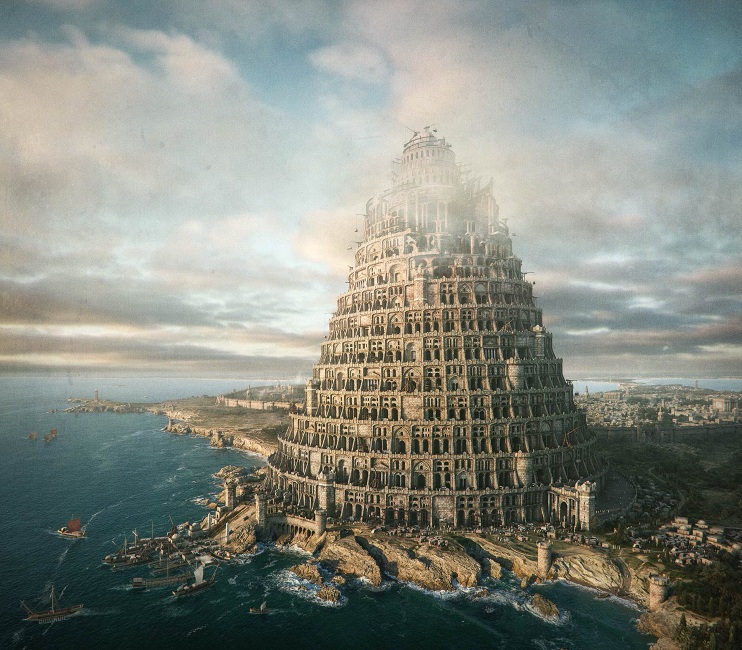
The Parasha contrasts two sinful generations: the Flood (destroyed) and Babel (merely dispersed).
The Flood's sin was erasing all boundaries — the denial of the divine order of creation.
Babel's sin was misdirected unity: refusing the divine command to disperse and fill the earth.
Dispersion serves to gather the sparks of holiness (Nitzotzot) fallen into the world since Adam's sin.
Israel's exile among the nations lets a Jew, anywhere, raise the local sparks through Mitzvot and repair the world.
Parashat Noah presents two generations that sinned: the Generation of the Flood (Dor Hamaboul) and the Generation of the Tower of Babel (Dor Haflaga). Yet their punishments are radically different.
M. Yehuda Himi explains that the Generation of the Flood committed a fundamental sin: the erasure of all boundaries, the denial of the very order of creation.
“All flesh had corrupted their way upon the earth.” In the Torah, gvoul (boundary) is not a mere physical separation: it is the divine order of creation. Each species within its limits, respect for family bonds and prohibitions, what belongs to one and not another, each element in its place.
Unlike the Flood, the Generation of the Tower had real cohesion. They did not destroy boundaries; on the contrary, they were united.
“And the whole earth had one language and one speech.” Where, then, was their sin? After the Flood, God had commanded humanity: פְּרוּ וּרְבוּ וּמִלְאוּ אֶת הָאָרֶץ — “Be fruitful, multiply and fill the earth.”
“Let us build a city and a tower... lest we be scattered.” Their sin: to disobey the command to disperse. They wished to stay centralized, refusing the mission to populate the entire earth.
To grasp the meaning of dispersion, we must go back to Adam's sin. Before the sin, the world stood in spiritual perfection: all the sparks of holiness were unified and elevated.
The mission of humanity, and of the Jewish people in particular, is to gather these sparks and elevate them. Every Mitzva performed raises a spark: eating kosher elevates the spark in food, Kiddush the spark in wine and Shabbat, Tzedakah the spark in money.
Here is one of the fundamental reasons for exile: the people of Israel scattered for nearly 2000 years throughout the whole world, so that Jews could be found in every country, every city, even the most remote.
The circle is thus complete: 1. Adam sins, the sparks scatter; 2. Babel, humanity spreads geographically; 3. exile, Israel scatters among the nations; 4. the Mitzvot raise the sparks; 5. when all are gathered, the world is repaired.
“The Holy One, blessed be He, wanted to make Israel meritorious, therefore He gave them an abundant Torah and many commandments.” The dispersion that sometimes feels painful is in truth a divine tool: to return all the sparks of holiness to their source and repair the world. Bimhera Beyamenu Amen.
🎯 Test yourself
Five questions. Click an answer.
Result
Shalom Bayit — The Mouth at Home
My covenant of peace — peace begins at home. Reveal a Shalom Bayit card.
Gematria — Rav Ménaché
Shalom, Mashiah, Yisamech — secrets of the letters by Rav Ménaché zatsal.
🔢 Gematria CourseAll Parashot
All shiurim of M. Yéhouda Himi — from Bereshit to Devarim and the festivals.
📚 All ParashotBooks
Torah wisdom in thriller format — Éditions Gueoula.
Guardians of the Rift
Forty-nine gates open — the fiftieth hides in a single moment. An ancient secret resurfaces, and one man stands between the rift and the world. Drawn from Talmud and Kabbalah.
📖 Read the free excerpt · Book $9.90