From the very opening a question arises: why « Eleh toldot Yaakov » followed by « Yosef »? We would expect the list of sons — Reuven, Shimon, Levi, Yehuda... Yet the Torah writes: « Eleh toldot Yaakov — Yosef ».
Rashi's first explanation « Toldot » here is not literal offspring but Yaakov's history — and that history begins precisely with Yosef: his sale, the descent to Egypt, and all that follows.
Rashi's second explanation « Toldot » can also mean « offspring ». Yaakov's whole stay at Lavan's was for Rachel, and from Rachel came Yosef. So Yaakov's essential offspring is Yosef. There is no contradiction between the two readings.
2 The Proximity to the Alufei Esav
The previous Parashah closed by listing all of Esav's chiefs (Alufim). Rashi, citing the Midrash, says Yaakov Avinu grew anxious seeing them: « What will be? »
Hashem reassures him: the house of Yaakov will be fire, the house of Yosef a flame, and the house of Esav straw — consumed in one stroke. That is why the text immediately continues: « Yosef ben 17 shanah ».
3 Why Did Yaakov Leave When Yosef Was Born?
In Vayetze, the moment Yosef is born, Yaakov tells Lavan: « Shalcheni ve'elcha el mekomi » — Let me go to my place. Why precisely at this eleventh son, and not the first, nor the twelfth?
« Ka'asher yalda Rachel et Yosef » — as soon as the one who is Esav's Satan (adversary) was born, as it says: the house of Yaakov will be fire and the house of Yosef a flame.
The difficulty But how did Yaakov know it was Yosef, and not Reuven or Yehuda, who is the « Sitno shel Esav »? What sign did he see in this newborn?
1. Son of old age Born in his old age, hence the last. Difficulty: Yosef is not the last — Binyamin is born after him. So Rashi offers another reading.
2. Zeh Kanah — he acquired wisdom Onkelos renders « bar chakim » — a wise son. « Zekunim » reads as « Zeh Kanah »: Yaakov transmitted to him all the Torah learned at Shem and Ever. From age 3, for 14 years — the same 14 years he had studied — he taught Yosef. At 17, Yosef is ready.
3. Ziv Ikonin — the radiance of the face « Shehaya ziv ikonin shelo domeh lo »: the radiance of Yosef's face resembled Yaakov's. To behold Yaakov, one had only to look at Yosef.
5 Yaakov — Shufra d'Adam Harishon
Yaakov is « Shufra d'Adam Harishon » — the beauty of Adam the first man. His face is the very face of Adam.
אָכֵן יֵשׁ ה' בַּמָּקוֹם הַזֶּה וְאָנֹכִי לֹא יָדָעְתִּיBereishit 28:16
The secret of « Achen » « Achen » (אכן) forms the initials of the faces of the Merkavah: אryeh (lion), כeruv (cherub), נesher (eagle). Ascending on high, Yaakov beholds his own face — the י, the face of man. « Anochi lo yadati »: I did not know that I too am up there. To see Adam Harishon, one looked at Yaakov.
6 The Sign: The Vaccine against Esav
Yaakov awaited the birth of a child resembling him. It was neither Reuven nor Shimon. But seeing the Ziv Ikonin in Yosef, he understood that a new « Shufra d'Adam Harishon » was born.
Esav's adversary is the one who repairs Adam Harishon's sin — the sin Esav perpetuates. To fight Esav one needs the one who resembles Yaakov. Here is the sign: « Nolad Sitno shel Esav » — Esav's adversary is born.
I now have the vaccine, the defense against the disease called Esav. Now I go to meet him — without fear.
7 The Man in the Field — Nasu Mizeh
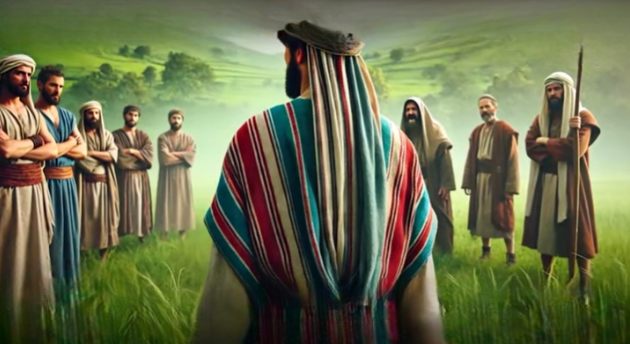
Sent to his brothers, Yosef first meets a man (an angel, per our Sages).
It is the angel who approaches Yosef, sensing what fills his heart. Yosef answers with two requests: « it is my brothers I seek » and « tell me where they are shepherding ».
« Nasu mizeh » — הסיעו עצמן מן האחוה — They removed themselves from brotherhood.
The parallel structure The angel answers point by point. To « it is my brothers I seek » he replies « Nasu mizeh » = they departed from brotherhood, they are no longer your brothers. To « where are they shepherding? » he replies « let us go to Dotan ». From this parallel Rashi derives the meaning of « mizeh ».
9 The Equation: Mizeh = Achavah
The word « Mizeh » thus means « Min ha-achavah » — brotherhood. « They departed from this » — and « this » is brotherhood.
מִזֶּה = אַחֲוָה — Mizeh equals Brotherhood.
10 Yosef's Final Message
At the end of his life, Yosef repeats to his brothers, with one decisive nuance:
« Veha'alitem et atzmotai MIZEH » — you shall bring up my bones from this. The same word « mizeh » from the field returns here, charged with the same secret.
11 The Condition for Redemption
Yosef's hint The condition for God to bring you up from Egypt and redeem you is to restore brotherhood. « Bring up my bones from this » — bring back up the מזה, brotherhood itself.
The entire exile came from « Nasu min ha-achavah » — departing from brotherhood. The repair of exile is therefore to restore it. Without brotherhood, one remains stuck in Egypt.
וַיִּקַּח מֹשֶׁה אֶת עַצְמוֹת יוֹסֵף עִמּוֹ — And Moshe took Yosef's bones with him. They brought up his bones (atzmot) AND his essence (atzmiyut): brotherhood. Without it, no redemption.
12 The Circle Closes at Shechem
Where is Yosef buried? In Shechem. Where did the story begin?
In Shechem as well! The circle opens and closes at the same place. Israel merited redemption thanks to the brotherhood it restored.
The lesson for our generation The Egyptian exile is the mold of all exiles. To be redeemed from the exile of Rome — the longest — we must « bring up his bones from this », that is, restore brotherhood. Then the Geulah will come without delay. Baruch Hashem Le'olam, Amen ve'Amen.
🎯 Test yourself
Five questions. Click an answer.
1
Why does the Torah write « Eleh toldot Yaakov » followed by « Yosef »?
Per Rashi, « toldot » means Yaakov's history (beginning with Yosef) and his essential offspring, born of Rachel for whom he labored at Lavan's.
2
What sign showed Yaakov that Yosef is the « Sitno shel Esav »?
Yaakov, Shufra d'Adam Harishon, awaited a son resembling him. Yosef's Ziv Ikonin reveals he is fit to repair Adam's sin and fight Esav.
3
What does the « Zeh Kanah » interpretation of « Ben Zekunim » mean?
« Zekunim » reads as « Zeh Kanah »: from age 3 and for 14 years, Yaakov transmitted to Yosef all the Torah learned at Shem and Ever.
4
How does Rashi understand « Nasu mizeh »?
« Hisi'u atzman min ha-achavah » — they withdrew from brotherhood. This is the angel's answer to « it is my brothers I seek ».
5
According to the lesson, what is the condition for the Geulah?
Exile came from departing brotherhood (« nasu mizeh »). Its repair, and thus redemption, is restoring brotherhood — « veha'alitem et atzmotai mizeh ».
Result
📅 7 Days to Restore Brotherhood
Sunday
Sunday: Take the first step to reconcile with someone you have grown distant from.
Monday
Monday: Transmit a Torah teaching to a child or friend, as Yaakov did to Yosef.
Tuesday
Tuesday: Look at someone close and seek the « Ziv Ikonin » — the divine reflection in them.
Wednesday
Wednesday: Facing worry, recall the promise « beit Yaakov esh » and keep your trust.
Thursday
Thursday: Mend an ongoing rift; refuse « nasu mizeh », the departure from brotherhood.
Friday
Friday: Before Shabbat, ask forgiveness and offer forgiveness to a family member.
Shabbat
Shabbat: Study the link between מזה and אחוה, and meditate on brotherhood as the key to the Geulah.
Four Practical Steps
🏠
Shalom Bayit — The Mouth at Home
My covenant of peace — peace begins at home. Reveal a Shalom Bayit card.
🔢
Gematria — Rav Ménaché
Shalom, Mashiah, Yisamech — secrets of the letters by Rav Ménaché zatsal.
Every week, straight to your inbox. No spam. One-click unsubscribe.
🕯️ Dedicate This Shiur
Dedicate this shiur for the days of Bein HaMetzarim — in memory, for healing or for success.
Guardians of the Rift
A spiritual thriller · David Goldberg
Forty-nine gates open — the fiftieth hides in a single moment. An ancient secret resurfaces, and one man stands between the rift and the world. Drawn from Talmud and Kabbalah.