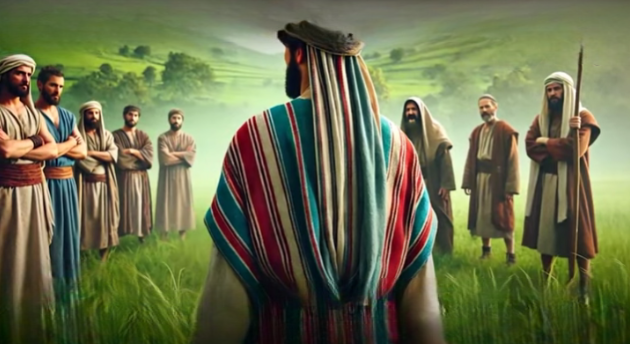
Yaakov settled in the land of his father's sojournings, in Canaan. "These are the generations of Yaakov: Yosef, seventeen years old..."
The difficulty From the very opening we must ask: we expected "Reuven, Shimon, Levi, Yehuda...". Yet the Torah writes "Eleh toldot Yaakov — Yosef." Why?
Rashi's first explanation "Toldot" here does not mean descendants literally, but Yaakov's history. That history begins with Yosef and unfolds through his sale, the descent to Egypt, and all that follows.
Second explanation "Toldot" can also mean "offspring." Yosef is the very reason Yaakov ended up at Lavan's: his whole stay there was for Rachel, and from Rachel came Yosef. So Yaakov's essential offspring is Yosef.
In truth there is no contradiction between the two explanations.
2 The Fire, the Flame and the Straw
What is the proximity (semikhut) to the Alufei Esav? The end of the previous Parashah lists all of Esav's chiefs. Rashi, in the name of the Midrash, explains that Yaakov Avinu grew anxious: "What will be, facing such power?"
The Holy One reassures him: "Do not worry! The house of Yaakov will be fire, the house of Yosef a flame, and the house of Esav straw — I consume them in a single stroke."
The key It is Yosef, the "flame," who neutralizes Esav. That is why the juxtaposition is immediate: "Yosef ben 17 shanah."
3 Why Did Yaakov Leave at Yosef's Birth?
How did Yaakov know to tell Lavan "Shalcheni ve'elcha el mekomi" — let me go to my place? The moment Yosef is born, the Torah immediately records his departure.
The question Why does Yaakov decide to leave precisely at this eleventh child? Not the first, not the second. If he was waiting for the 12 tribes, he would have awaited Binyamin. If not, he would have left after Reuven. Why Yosef?
"As soon as the one who is Esav's Satan was born" — for it says: "the house of Yosef will be a flame."
The mystery of the sign But what sign told Yaakov that specifically Yosef — not Reuven or Yehuda — is the Sitno shel Esav? The instant he looks at the newborn, he understands.
Israel loved Yosef more than all his sons, for he was to him a "son of old age." Rashi offers three readings of "Ben Zekunim."
1. Born in old age The last-born of his old age. Difficulty: Yosef is not the last — Binyamin is born after him. Hence a further explanation.
2. Zeh Kanah — he acquired wisdom Onkelos renders "Bar Chakim" — a wise son. Zekunim reads as "Zeh Kanah": this one acquired. All that Yaakov learned at Shem and Ever he transmitted to Yosef. That is why, at 17, Yaakov dares send him to his brothers despite their plotting: from age 3 he taught him, for 14 years, the Torah of Shem and Ever.
3. Ziv Ikonin — the radiance of the face "Shehaya ziv ikonin shelo domeh lo" — the radiance of his countenance resembled Yaakov's. To see what Yaakov looked like, one looked at Yosef: the very face of the father.
5 Yaakov, Shufra d'Adam Harishon
Yaakov is "Shufra d'Adam Harishon" — the beauty of Adam the first man. His face is Adam's face. This we learn from his waking after the dream of the ladder.
אָכֵן יֵשׁ ה' בַּמָּקוֹם הַזֶּה וְאָנֹכִי לֹא יָדָעְתִּיBereishit 28:16
The secret of Achen "Achen" (אכן) forms the initials of Aryeh (lion), Keruv (cherub), Nesher (eagle) — the faces of the Merkavah. But ascending, Yaakov sees his own face — the י, the human face of the Chariot. "Anochi lo yadati": I did not know that I too am up there.
Yaakov thus corresponds to Adam's face in the Merkavah. To know what Adam Harishon looked like, one need only look at Yaakov.
The team of repair Seeing the Ziv Ikonin in Yosef, Yaakov understands: here is a second "Shufra d'Adam Harishon," fit to fight Esav — the one who caused Adam's sin. "I now have the vaccine against the disease called Esav. I can go out to meet him."
6 The Man in the Field — Nasu Mizeh
Before reaching his brothers, Yosef meets a man — an angel.
It is the man who addresses Yosef, not the reverse: Yosef was not impudent. The angel senses what stirs within him, and Yosef responds with two requests: "it is my brothers I seek" and "where are they shepherding?"
"Nasu mizeh" — הסיעו עצמן מן האחוה — they removed themselves from brotherhood.
Two questions, two answers To "it is my brothers I seek," the angel answers "Nasu mizeh": they have departed — they are no longer your brothers. To "where are they shepherding?" he answers "I heard them say: let us go to Dotan."
7 Mizeh = Achavah: the Condition for Redemption
The word "Mizeh" equals "Min ha-achavah" — from brotherhood. "You seek your brothers (achai)? They have removed themselves from this — brotherhood; there is none here anymore."
To grasp this word's weight, go to the end of the story, in Parashat Vayechi. Yosef first promises redemption, then adds something seemingly identical yet decisive.
Yosef's hint "Bring up my bones from this!" If "Mizeh" = brotherhood, then the condition for redemption is to restore brotherhood. Without it, one stays stuck in Egypt: the whole exile came from "Nasu min ha-achavah," and its repair will be restored ahavah.
Twice: atzmot and atzmiyut Moshe took up the bones (atzmot) AND the essence (atzmiyut) of Yosef. Yosef's essence is brotherhood. Without it, there is no exodus from Egypt.
The circle closes at Shechem: where it all began ("Halo acheicha ro'im biShechem"), there Yosef is buried. The people merited the Geulah through restored brotherhood.
For our generation The Egyptian exile is the matrix of all exiles. To be redeemed from the exile of Rome — the longest — "let us bring up his bones from this": restore brotherhood, and the Geulah comes at once. Baruch Hashem Le'olam, Amen ve'Amen!
🎯 Test yourself
Five questions. Click an answer.
1
What does "Eleh toldot Yaakov" mean according to Rashi's first explanation?
Rashi explains that "Toldot" here denotes Yaakov's history, which begins with Yosef, his sale, and the descent to Egypt.
2
Why does Yaakov decide to leave Lavan precisely at Yosef's birth?
Rashi: "as soon as the one who is Esav's Satan was born" — the "flame" (Yosef) that consumes Esav's straw. Yaakov can then face Esav.
3
According to the second explanation, what does "Ben Zekunim" (Zeh Kanah) mean?
"Zeh Kanah": he acquired wisdom. Yaakov transmitted to Yosef all the Torah learned at Shem and Ever, over 14 years.
4
What does the word "Achen" (אכן) reveal in Yaakov's verse upon waking?
"Achen" = Aryeh (lion), Keruv, Nesher, the faces of the Merkavah; Yaakov also discovers his own face (the י), that of Adam.
5
What is the condition for the Geulah according to the teaching on "Mizeh"?
Mizeh = Achavah. "Veha'alitem et atzmotai mizeh": without restoring brotherhood, one remains in exile; with it comes redemption.
Result
📅 7 Days of Brotherhood — Vayeshev Program
Sunday
Day 1 — Take the first step toward someone you've grown apart from: restore a measure of brotherhood (Mizeh = Achavah).
Monday
Day 2 — Transmit a Torah teaching to someone younger, as Yaakov passed to Yosef the wisdom of Shem and Ever.
Tuesday
Day 3 — Practice recognizing a divine sign in your day, as Yaakov recognized the Ziv Ikonin in Yosef.
Wednesday
Day 4 — Facing a worry beyond you, recall "do not worry": keep faith in the divine promise.
Thursday
Day 5 — Complete something left unfinished: close a circle, as the story closes at Shechem.
Friday
Day 6 — Carry the essence, not just the form: act for the unity of the people, not appearances alone.
Shabbat
Day 7 — Study the verses of "Nasu mizeh" (Bereishit 37) and "Veha'alitem et atzmotai mizeh" (Bereishit 50), and reflect on the link between exile and brotherhood.
Four Practical Steps
🏠
Shalom Bayit — The Mouth at Home
My covenant of peace — peace begins at home. Reveal a Shalom Bayit card.
🔢
Gematria — Rav Ménaché
Shalom, Mashiah, Yisamech — secrets of the letters by Rav Ménaché zatsal.
Every week, straight to your inbox. No spam. One-click unsubscribe.
🕯️ Dedicate This Shiur
Dedicate this shiur for the days of Bein HaMetzarim — in memory, for healing or for success.
Guardians of the Rift
A spiritual thriller · David Goldberg
Forty-nine gates open — the fiftieth hides in a single moment. An ancient secret resurfaces, and one man stands between the rift and the world. Drawn from Talmud and Kabbalah.