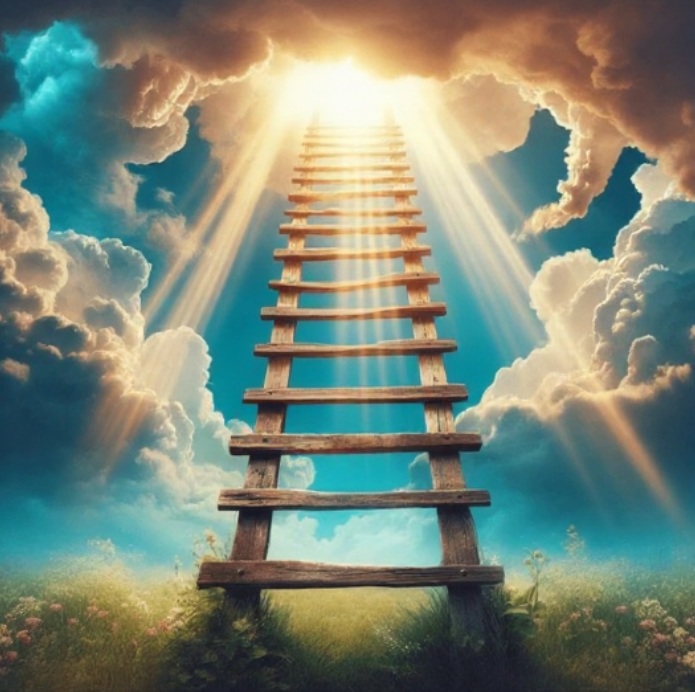
The Torah writes both "Vayetze" and "Vayelekh" to teach that a Tzaddik's departure from a place leaves a spiritual imprint.
Fourteen years of study at the Yeshiva of Shem and Ever lie between Beer-Sheva and Haran, preserving the Torah of Adam HaRishon.
The dream occurs at Har HaMoriah; per Rashi (Rabbi Yose ben Zimra), the middle of the ladder's slope faces the future Beit HaMikdash.
Beer-Sheva symbolizes matter, Beth-El spirit; man, like Yaakov, must live in the middle — Shifua (slope) evokes Shefa (abundance).
Jerusalem, the Even HaShtiya, is the gate of heaven from which abundance descends; man himself is a ladder that raises or lowers angels by his deeds.
Gematria: Tzom, Kol, and Mamon (Teshuvah, Tefilah, Tzedakah) each equal 136, like Sulam — the middle way annuls the evil decree.
With God's help we read Parashat Vayetze this Shabbat. It cannot be understood without the end of the previous portion: after Yitzhak blesses Yaakov and then Esav, Esav says of his brother, "The days of mourning for my father are approaching, then I will kill my brother."
Rivkah perceives Esav's vengeful intent through the holy spirit. She tells Yitzhak, "I am not at ease with Yaakov staying here; let him go find a wife from our family." Yitzhak calls him, gives him the blessing for the road, repeats it, and Yaakov sets out.
"Yaakov went out from Beer-Sheva and went toward Haran." Three questions arise. First: why state both that he went out FROM Beer-Sheva AND went to Haran? It would have sufficed to write "Yaakov went to Haran."
Second: does "Harana" mean he has already arrived in Haran, or not yet? Third: if he had arrived, why does it say "Vayifga baMakom vayalen sham ki va hashemesh" — "he encountered the place and lodged there, for the sun had set" — and why does he name that place Beth-El, when the city was called Luz? Proof that he had not yet reached Haran.
Rashi asks why the Torah writes both "Vayetze" (he went out) and "Vayelekh" (he went). The answer: the departure of a Tzaddik from a place makes an impression. Every action we perform leaves a spiritual imprint; if we could perceive it, we would know where each person had been at every moment.
Yaakov, a Tzaddik, radiated the Shekhinah upon Beer-Sheva. When he left, Beer-Sheva lost his spiritual presence — that is why the Torah stresses his going out, not only his destination.
Wherever the Torah writes "HaMakom" with the definite article, it means the known place. Which one? That of the Akedat Yitzhak: "Go to the place that I will show you" — Har HaMoriah. There Yaakov prays Arvit, falls asleep, and sees the ladder.
"He dreamed: and behold, a ladder set upon the earth, and its top reaching the heavens." A ladder cannot stand upright; it must lean at an angle. So where are its feet, and where does its top rise?
Beer-Sheva evokes the well (Be'er), water, the source of life, and the "seven" of the covenant of seven ewes and seven wells with Avimelekh: it symbolizes matter. Beth-El — "house of God" — by contrast sounds lofty and spiritual.
The ladder thus has its base in the earth (Beer-Sheva) and its top in the heights (Beth-El). But the essence lies elsewhere:
Yaakov symbolizes this middle. As children of Israel, we need not aspire to be angels — God has enough of them — nor to behave like animals. Our task is to bring divine abundance into the world, and that is done through the middle.
The phrase "middle of the slope," be'emtsa haShifua, conceals a wordplay: Shifua (slope) is also Shefa (abundance). To bring the Shefa down into the world, one must stand in the middle measure (Midat HaEmtsa), combining matter and spirit in balance.
Where is that midpoint? In Jerusalem, upon the Even HaShtiya, the Foundation Stone. "Hashtiya" derives from tashtit (foundation): it is the stone from which the world was founded, the point from which God radiates His Divinity and inflates the world like a ball.
It is the same place where Adam HaRishon was formed from the dust, where the Akedat Yitzhak occurred, where David bought the Jebusite's threshing floor, where the First and Second Temples were built. From there all abundance descends — which is why the eyes of the whole world turn to Jerusalem, the source of blessing.
"Yaakov awoke and said: … This is none other than the house of God, and this is the gate of heaven." Jerusalem is the gate joining heaven and earth — the peace of "Oseh shalom biMromav" is the peace between above and below, made in this very place.
"The angels of God ascend and descend Bo": "on it," the ladder — but also "in him," in Yaakov. How? Pirkei Avot explains: "One who performs a mitzvah acquires a defender (a good angel); one who commits a transgression acquires an accuser." Every act creates an angel; man himself is a ladder upon which he raises or lowers angels.
🎯 Test yourself
Five questions. Click an answer.
Result
Shalom Bayit — The Mouth at Home
My covenant of peace — peace begins at home. Reveal a Shalom Bayit card.
Gematria — Rav Ménaché
Shalom, Mashiah, Yisamech — secrets of the letters by Rav Ménaché zatsal.
🔢 Gematria CourseAll Parashot
All shiurim of M. Yéhouda Himi — from Bereshit to Devarim and the festivals.
📚 All ParashotBooks
Torah wisdom in thriller format — Éditions Gueoula.

Guardians of the Rift
Forty-nine gates open — the fiftieth hides in a single moment. An ancient secret resurfaces, and one man stands between the rift and the world. Drawn from Talmud and Kabbalah.
📖 Read the free excerpt · Book $9.90