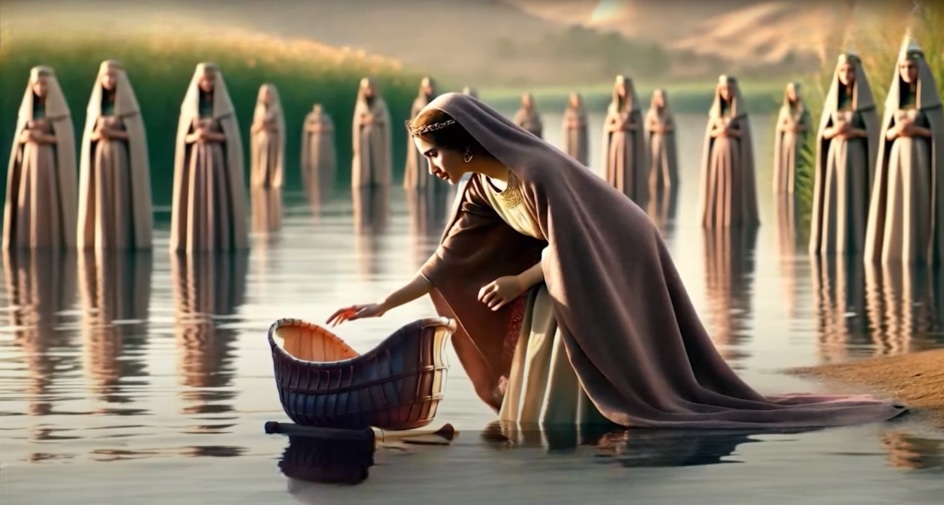
We open the book of Shemot (Exodus). Israel had gone down to Egypt; Joseph and his whole generation died, and the children of Israel multiplied prodigiously. A new king arises over Egypt and issues his decrees. We reach the episode of the Hebrew midwives.
"The king of Egypt spoke to the Hebrew midwives, one named Shifra and the other Puah."
Only two women? How could there have been only two midwives in all of Egypt, when the people had multiplied without end? These are in fact titles of function.
The meaning of the names Shifra, the one who "beautifies" (משפרת) the newborn; Puah, the one who makes the baby "cry out" (פועה) so it begins to breathe.
Rashi specifies: Shifra is Yocheved (Moses' mother); Puah is Miriam (her daughter).
2 "He Made Them Houses"
The midwives refuse to obey Pharaoh and let the children live. What is their reward?
"And because the midwives feared God, He made them houses."
Which houses? What does "He made them houses" mean? Villas? Duplexes? The reward must match the greatness of the deed.
Batei Kehunah, Leviyah u'Malkhut Rashi explains: houses of Priesthood, of Levites, and of Royalty. A sacred dynasty would come forth from these two women.
3 Pharaoh's True Intention
Where is the measure for measure? To grasp the exact link between the midwives' deed and their reward (מידה כנגד מידה), we must first reread Pharaoh's decree.
"Every son that is born, cast him into the Nile; but every daughter, keep her alive." Yet by Jewish law, one born to a Jewish mother is Jewish. If all the daughters survive and marry Egyptians, their children will be Jewish all the same. What, then, was the decree for?
Pharaoh was no fool Had he wished to exterminate Israel, he would have killed both boys and girls. His real target was different: to destroy the Kehunah, the Leviyah, and the Malkhut — the three institutions that pass through the FATHER. Cohen father → Cohen son; Levi father → Levi son; king father → king son.
4 Pharaoh's Spiritual War
Without Kohanim and Levi'im, there is no Beit HaMikdash. Without the Temple, Adam's sin cannot be repaired. Without Malkhut, there is no Melekh HaMashiakh, the King Messiah. By striking the boys, Pharaoh was aiming at Israel's very spiritual root.
לִי יְאֹרִי וַאֲנִי עֲשִׂיתִנִיYechezkel 29:3
"The Nile is mine, and I created myself." Pharaoh proclaimed himself a god.
A war against Heaven Pharaoh's battle was not demographic but spiritual: to cut Israel off from its sacred source and forever prevent the coming of the Temple and the Messiah.
5 Perfect Measure for Measure
Now the reward becomes clear. Yocheved and Miriam saved the boys precisely to preserve the Kehunah, the Leviyah, and the Malkhut. In return, Hashem gives them exactly that.
From Yocheved Moses, the first of the Levites, and Aaron, the first Kohen Gadol: the houses of Priesthood and Leviyah come from her.
From Miriam Married to Calev ben Yefuneh (tribe of Judah), she is the mother of Hur, ancestor of Bezalel: a line leading all the way to the King Messiah, the house of Royalty.
"A man of the house of Levi went and took a daughter of Levi." Why "went and took," as though marrying anew? Because he had first divorced her.
Amram's decree Amram, head of the Sanhedrin, had ordered all men to divorce: why beget children if all the boys will be thrown into the Nile?
His daughter Miriam, six years old, bursts into the Sanhedrin assembly: "Father, you are worse than Pharaoh! He decreed only against the boys; you, through divorce, prevent the birth of the girls as well."
צָדְקָה מִמֶּנִּי An ordinary father would have had the child removed. Amram accepts the rebuke: "She is right!" And he orders everyone to take back their wives.
"And the man Moses was very humble, more than any person on the face of the earth." Where does this humility come from? From his father Amram, able to receive a rebuke from a six-year-old child before the entire Sanhedrin.
Pirkei Avot teaches: "Moses received the Torah from Sinai" (מסיני) — not "at Sinai" (בסיני). For Moses learned humility from Mount Sinai itself.
The silence of Sinai When the mountains vied for the honor of bearing the Torah, Sinai kept silent — not out of poverty, for it had already received the promise at the Burning Bush, "You shall serve God on this mountain." It could have said so, yet it stayed silent. That is true humility.
סיני = ענוה Gematria: סִינַי = 130 (60+10+50+10); עֲנָוָה = 131 (70+50+6+5). With the kollel (+1), Sinai equals Anavah. Moses received all his Torah from the humility he inherited from Amram and from Sinai. Baruch Hashem, Shabbat Shalom.
🎯 Test yourself
Five questions. Click an answer.
1
According to Rashi, who are Shifra and Puah really?
Rashi identifies Shifra as Yocheved (Moses' mother) and Puah as Miriam (her daughter); the names describe their role.
2
What does "He made them houses" (בתים) mean?
Batei Kehunah, Leviyah u'Malkhut: a dynastic, spiritual reward rather than a material one.
3
Why did "let every daughter live" not amount to extermination?
Since Jewish identity is through the mother, sparing daughters would not destroy the people; the true target lay elsewhere.
4
What was Pharaoh's true intention in striking the boys?
These three institutions pass through the father; without them, no Temple and no King Messiah.
5
Where does Moses get his humility, according to the shiur?
Amram accepts Miriam's rebuke; Sinai stays silent despite its promise — סיני = ענוה with the kollel.
Result
📅 Seven-Day Programme — Parashat Shemot
Sunday
Sunday: Read the opening verses of Shemot and locate the passage of the midwives (Shemot 1:15-21).
Monday
Monday: Study the Rashi that identifies Shifra and Puah as Yocheved and Miriam; note what "role" adds to "name."
Tuesday
Tuesday: Meditate on "He made them houses" — write three qualities you want to pass on to your own house.
Wednesday
Wednesday: Reflect on transmission through the father (Kehunah, Leviyah, Malkhut) and give thanks for what you inherited from your parents.
Thursday
Thursday: Perform one measure-for-measure act — repay a kindness in the very area where you were helped.
Friday
Friday: Accept a criticism without defending yourself, like Amram saying "tzadkah mimeni" (she is right).
Shabbat
Shabbat: Study the gematria סיני = ענוה and keep a moment of humble silence before prayer.
Four Practical Steps
🏠
Shalom Bayit — The Mouth at Home
My covenant of peace — peace begins at home. Reveal a Shalom Bayit card.
🔢
Gematria — Rav Ménaché
Shalom, Mashiah, Yisamech — secrets of the letters by Rav Ménaché zatsal.
Every week, straight to your inbox. No spam. One-click unsubscribe.
🕯️ Dedicate This Shiur
Dedicate this shiur for the days of Bein HaMetzarim — in memory, for healing or for success.
Guardians of the Rift
A spiritual thriller · David Goldberg
Forty-nine gates open — the fiftieth hides in a single moment. An ancient secret resurfaces, and one man stands between the rift and the world. Drawn from Talmud and Kabbalah.