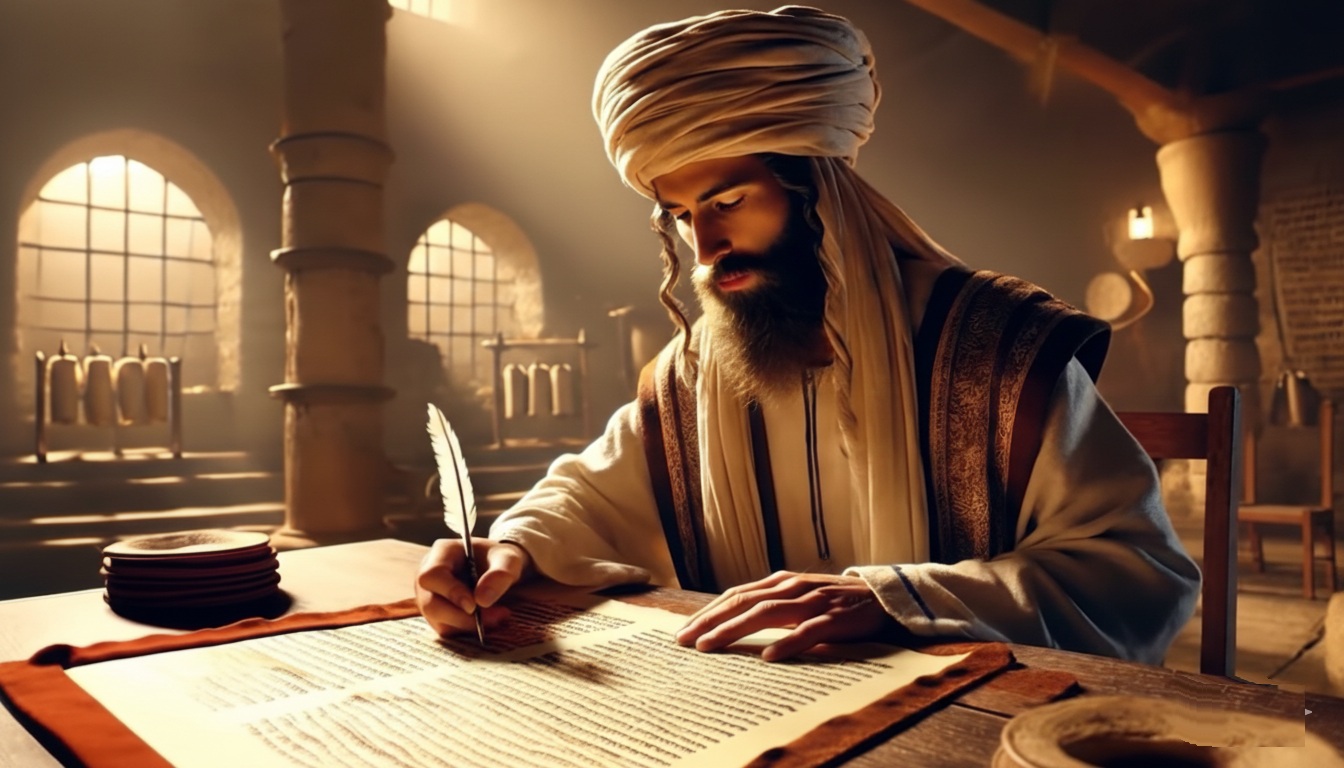
The Mizbeach HaKetoret is absent from Teruma and appears only at the end of Tetzaveh: not an oversight but a secret.
The Ketoret's smoke (ashan) symbolizes the arafel, and the arafel symbolizes the Shechina — so the Ketoret is the final station of all the avoda.
The word Ketoret stems from the root Keshura, 'bound': like Ketura who bound herself, the Ketoret binds Israel to their Father in Heaven.
As an intermediate state between matter and spirit, the smoke joins Heaven and Earth — humanity's mission since creation.
In the Heavenly Temple, where the Shechina is infinite, the Mizbeach HaKetoret is needless — like a match struck in daylight.
The condition for this whole bond is unity: the half-shekel of Ki Tisa, your half and my half forming one.
We stand on the eve of 7 Adar — the day of Moshe Rabbenu's passing, yet also the day of his birth. Everything we study is the Torah of Moshe Rabbenu.
Baruch Hashem, may we merit to bring nachat ruach before the Kadosh Baruch Hu by grasping a secret of the parasha in honor of this day.
Compare Parashat Teruma and Parashat Tetzaveh. Teruma describes the Mishkan and its vessels in a logical order: first the Aron (at the heart of the Kodesh HaKodashim), then the Menorah, then the Shulchan. Tetzaveh speaks of the olive oil, the garments of the Kohanim, and the preparation of the Levi'im.
We cannot say Moshe Rabbenu forgot it and suddenly remembered. There must be something far deeper here.
What was the service of the Mizbeach HaKetoret? The incense was placed upon the coals, and smoke (ashan) rose up. What does this smoke possess that no other Mishkan service has?
"And Moshe drew near to the arafel where God was." Wherever the Torah wishes to evoke the presence of the Shechina, Hashem declares that He dwells within the arafel. The ashan symbolizes the arafel, which in turn symbolizes the Shechina.
The entire building of the Mishkan — the vessels, the garments, the Levi'im — converges upon a single final station. Why do we do all this? To reach the state in which the Shechina is revealed.
What does the word Ketoret mean? Let us open Chumash Bereshit. After Sarah's passing, Avraham Avinu is left alone. Sarah had once sent away Hagar. What became of Hagar? She did not despair — she waited, telling herself she might yet return and marry Avraham. The Torah then calls her Ketura.
Absolute modesty. She was "Ketura" — bound — no one would touch her until the return of Avraham Avinu.
The Holy Zohar teaches that the essence of the Ketoret is to bind the people of Israel to our Father in Heaven.
Our entire mission since creation is to bind Heaven and Earth. When the Beit HaMikdash stands, through the korbanot; when it does not, through "uNeshalema Parim Sefateinu" — our lips replace the bulls. We are a kingdom of Kohanim and a holy people: each of us is a Kohen whose role is to join Heaven and Earth.
We say it daily in the Kriat Shema: "veHaya im Shamoa Tishme'u" — if you listen, the land will yield its produce and the rain will fall. The channel of our communication with the Kadosh Baruch Hu is our prayers.
Corresponding to the Beit HaMikdash below, there is a Beit HaMikdash Above. The Kohen Gadol Above is Michael, prince of Israel, together with Eliyahu. And what korbanot are offered there? The souls of the Tzaddikim, rising as an ola temima, elevated to a higher level.
This is why Teruma and Tetzaveh describe the Mishkan here as a copy of the one Above — without mentioning the Mizbeach HaKetoret, which does not exist there. Then, once the description is complete, the Torah adds this final detail: the Mizbeach HaKetoret, which links the Temple Above to the Temple below and closes the circle of the Avoda.
What is the condition for the Mizbeach HaKetoret to work, for the service to be accepted with nachat ruach before Hashem? Look at the very next parasha: Ki Tisa — and the Machatzit HaShekel.
"When you take a census of the Children of Israel... each shall give the ransom of his soul to Hashem." If we want a bond between Heaven and Earth, between the Kadosh Baruch Hu and Israel, Hashem asks for unity. How? Each gives a half-shekel: your half with my half form one.
🎯 Test yourself
Five questions. Click an answer.
Result
Shalom Bayit — The Mouth at Home
My covenant of peace — peace begins at home. Reveal a Shalom Bayit card.
Gematria — Rav Ménaché
Shalom, Mashiah, Yisamech — secrets of the letters by Rav Ménaché zatsal.
🔢 Gematria CourseAll Parashot
All shiurim of M. Yéhouda Himi — from Bereshit to Devarim and the festivals.
📚 All ParashotBooks
Torah wisdom in thriller format — Éditions Gueoula.
Guardians of the Rift
Forty-nine gates open — the fiftieth hides in a single moment. An ancient secret resurfaces, and one man stands between the rift and the world. Drawn from Talmud and Kabbalah.
📖 Read the free excerpt · Book $9.90