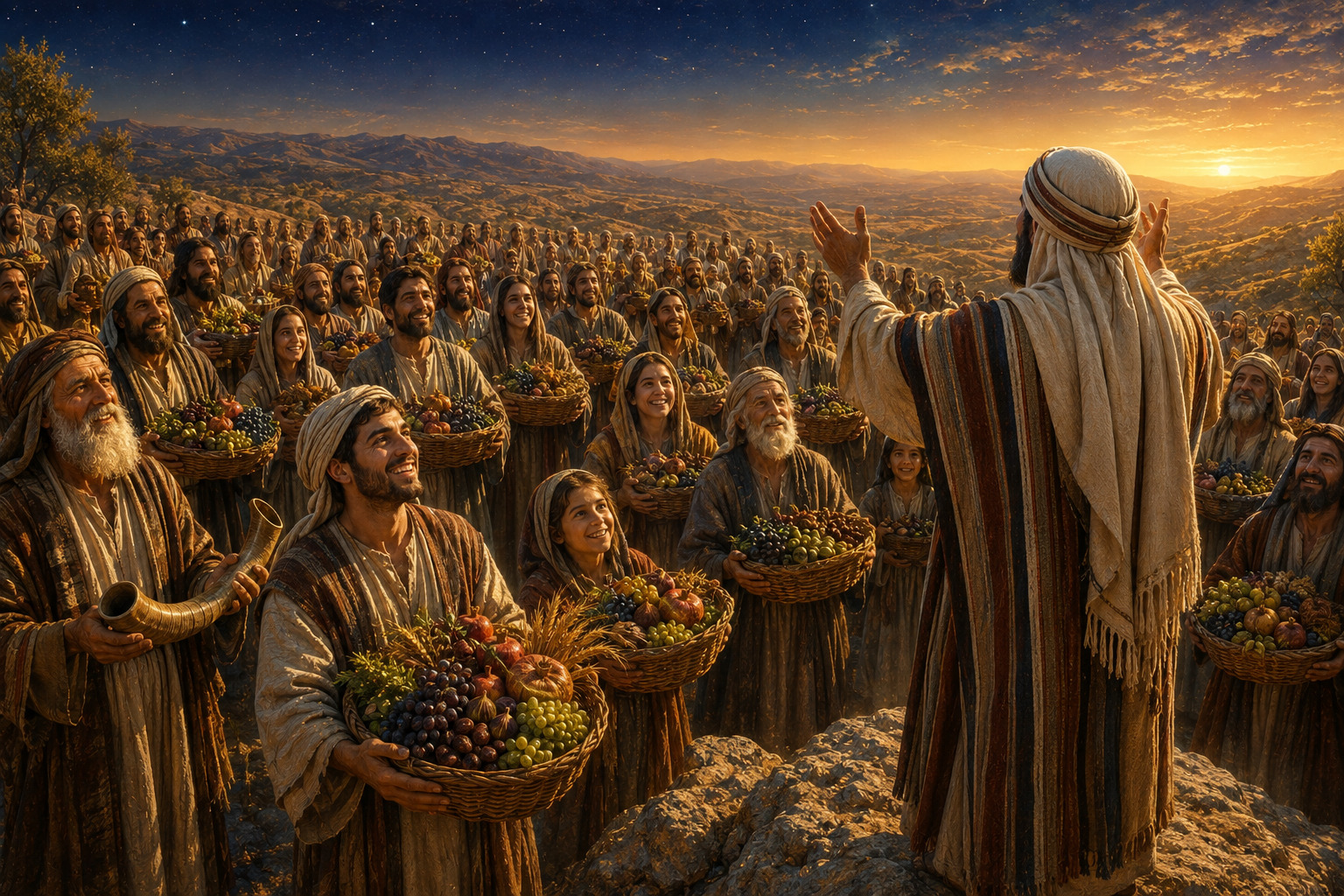
A man carries his basket of first fruits up to the Temple, and the Torah writes: "And you shall answer and say." But no one has asked him anything. Rashi explains: to raise the voice. The Or HaChaim HaKadosh offers another reading: ve'anita comes from ani, the poor man — stand before the Kohen and make yourself poor.
Why first fruits specifically, and not fruit brought in mid-season? Because the first fruit is precisely the moment of "my strength and the might of my hand." That is where a man must stop: this fruit is not yours.
The first ever to bring first fruits were Kayin and Hevel. The idea was Kayin's — yet the offering accepted is Hevel's. Not because it was finer: "to listen is better than sacrifice." The hint is in the verse itself — "and Hevel brought, he too": he brought himself.
The Kohen takes the basket and sets it aside: what counts is what you say and how you say it. Our own first fruits on Rosh Hashana are the hevel of the shofar — the bare breath that comes from within. And the Zohar teaches: the prayer of the poor man enters first, and it carries all the others up with it.
It is a Sunday, on the threshold of Nitzavim-Vayelech, and we are going back for a make-up shiur on Ki Tavo. The parasha opens with the mitzva of Bikurim, the first fruits.
A man walks into his field, sees the first fig appear, and marks it — this one will go up to the Beit HaMikdash. Bikurim, from bechor, firstborn: the very first fruits he has.
We know the sequence from the Pesach Haggada: he comes to the Kohen, he declares, the Kohen takes the basket from his hand and sets it down before the altar. Then comes the next verse:
Rashi feels the difficulty and answers: here ve'anita does not mean giving a reply, but raising the voice. Just as later in the parasha, with the tribes standing on Mount Gerizim and Mount Eval, it is written "and they shall answer and say" — meaning they shall raise their voice and say.
Heaven forbid that we dispute Rashi. But the question still stands: how does the word ve'anu itself express raising the voice? We have whom to lean on — another commentator gives a different sense.
In other words, the verse is not about answering a question but about an inner state: how you feel as you stand there, before the Kohen, basket in hand.
This reading is decisive, and to understand it we must ask: what is the point of the mitzva of Bikurim?
The first reason, the obvious one: to say thank you. This farmer came up to the Land, worked his plot, planted his orchard, and beautiful fruit came out. Who gave him that blessing? The Holy One, blessed be He. He owes thanks.
And now the Or HaChaim HaKadosh fits perfectly: you arrive before the Kohen carried by a good feeling, the feeling of a man who has succeeded. The Torah tells you first ve'anita — make yourself poor — and then you shall speak.
Let us go far back in the history of the Torah and ask: who was the very first to bring first fruits? Kayin and Hevel.
Whose idea was it first? Kayin's. Hevel is only following: "and Hevel brought, he too" — if my brother gives, I give as well. And yet:
The Midrash teaches that Kayin brought the least regarded produce — flaxseed. What is there to eat in flaxseed? He brought rejected fruit. Hevel may have come second, but he understood that one brings something good to the Holy One, blessed be He — not a lame or blind animal.
Recall Shaul's war against Amalek. Shmuel had commanded him to destroy everything, flocks and herds included. Shaul spares the sheep, and when Shmuel challenges him he answers: I kept them to sacrifice to the Lord your God.
What interests Him is listening and hearing what you say — not what you bring. So why was Hevel's offering received? On the face of it, Kayin's should have been: he was the first to think of giving thanks. We must conclude that Hevel had something more than the objects he carried.
Now back to our basket. Watch what happens when the man brings it: "And the Kohen shall take the basket from your hand, and set it down before the altar of the Lord your God" — as if to say: fine, that is not what interests Me, I am putting it aside.
One step further. Why do we read these parashot right before the Days of Awe? Next week we will read "You are standing today" — and the Zohar HaKadosh teaches: "this day is Rosh Hashana."
What did Hevel bring? Himself. And what does hevel mean? In Hebrew: nothing. A breath that leaves the mouth. Emptiness.
What does this say to us today? What first fruits can we bring to the Holy One, blessed be He? The ones Hevel brought: our hevel.
One could arrive differently: "here I am entering Rosh Hashana, I fill a large basket with mitzvot — I prayed three times a day, I gave tzedaka, I did chassadim, I am a righteous man." And the Kohen takes the basket and sets it aside. All of that may be a performance. What are you bringing up from within, now that you stand before Me?
What is left to us? To let out a breath. That is the tekia of the shofar: the hevel we draw out of the body, and through which we bind ourselves to the Holy One, blessed be He. With this ache, this poverty, this humility and lowliness, we seek to sweeten the judgments and annul the decrees.
The same idea returns in prayer. On Rosh Hashana, before the evening service, we say the piyut "Achot Ketana"; on Yom Kippur, "Lecha Eli Teshukati." Then comes the long piyut of the "Aneh": He who answered Daniel, He who answered Israel at the Sea of Reeds — one after another, all those whose prayer was answered.
The last in the list is exactly this: answer the poor. We stand now before the Holy One, blessed be He, as poor men. And standing before Him as a poor man is a segula for your prayer to be received.
In parashat Balak the Zohar asks: four prayers are called tefila in Tanach — a prayer of the poor man, a prayer of Chavakuk the prophet, a prayer of Moshe the man of God, and a prayer of David. Which is the choicest of them all?
First explanation of ya'atof, wrapping: the poor man has nothing to eat. How does he quiet his hunger? He takes his scarf, covers his face with it, and the breath he exhales returns to him — and it is as though he were eating. He is sated by his own hevel.
Why the priority? Because the poor man comes with a claim: "why did You do this to me? Of all people, why me? What did I do?" And there is nothing with which to console him. By the force of that claim — and by the tzedaka his very existence makes possible — his prayer wraps all the others and carries them up with it before the Holy One, blessed be He.
From this we learn that the ani is not only the one poor in money: he is also the one poor in spirit. We must feel that our reality is that we are worth nothing on our own, and that everything comes from the Holy One, blessed be He. What do we truly have? Nothing. The rest is wrapping and performance; the truth is that it all comes from Him.
🎯 Test yourself
Five questions. Click an answer.
Result
Shalom Bayit — The Mouth at Home
My covenant of peace — peace begins at home. Reveal a Shalom Bayit card.
Gematria — Rav Ménaché
Shalom, Mashiah, Yisamech — secrets of the letters by Rav Ménaché zatsal.
🔢 Gematria CourseAll Parashot
All shiurim of M. Yéhouda Himi — from Bereshit to Devarim and the festivals.
📚 All ParashotBooks
Torah wisdom in thriller format — Éditions Gueoula.

Guardians of the Rift
Forty-nine gates open — the fiftieth hides in a single moment. An ancient secret resurfaces, and one man stands between the rift and the world. Drawn from Talmud and Kabbalah.
📖 Read the free excerpt · Book $9.90