Rashi reads the verse plainly: appoint judges who rule the din, and officers who enforce the ruling. But why does the Torah say you shall appoint and your gates — in the singular — when appointing judges is the business of the entire community?
The masters of mussar take it one step further: every man holds seven gates — two eyes, two nostrils, two ears and one mouth. Post judges: what do you look at, what do you listen to, what do you let in? And officers: whatever entered wrongly, know how to put it out again.
The Midrash sends a man to study the ant. Rabbi Shimon ben Chalafta tested it: no ant touches a grain another ant has handled. Remarkable integrity — except that the grain itself was dragged out of the owner's storehouse. The same scene yields two opposite verdicts.
Hence the conclusion: trust neither your eye nor your logic. That is why the Torah commands judges and officers. And the ant's very name — nemala, the one that cuts — holds the key: she severs the grain so it will not sprout, exactly as tomorrow's Hallel says ki amilam, from the same root.
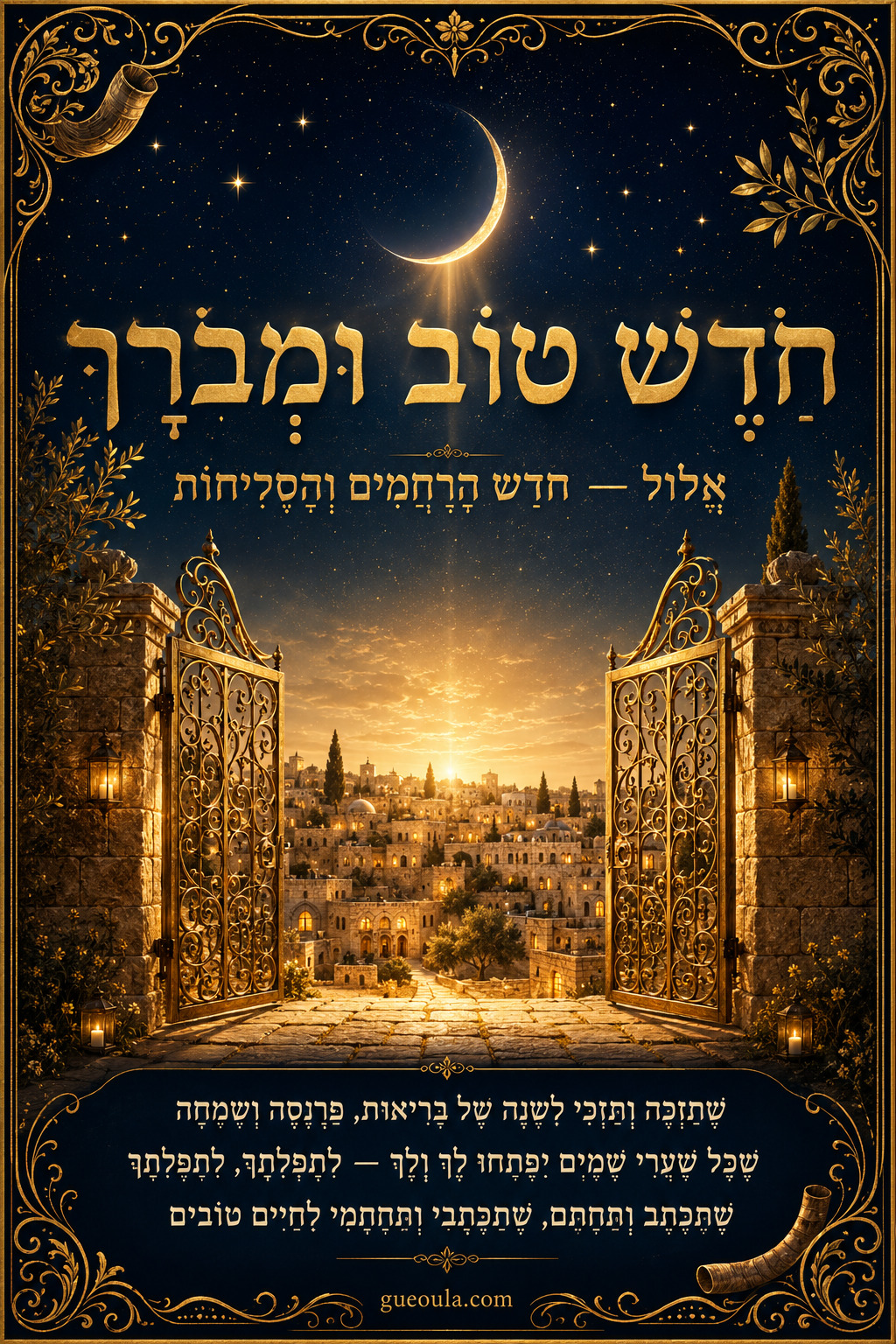
Tonight is erev Rosh Chodesh Elul — may it come upon us for good: the month of mercy and forgiveness. We owe something to the parashiyot of these weeks, so let us learn a little parasha; and the one we are walking toward is Shoftim.
The whole shiur tonight lives inside this verse — and inside one grammatical detail no one notices.
Shoftim are the dayanim, those who rule the judgment. Shotrim, says Rashi, are those who hold the people to their command — the enforcers. The judge issues the ruling; the officer has to carry it out.
Rashi says it bluntly: they strike and bind, with rod and with strap, until the man accepts the judge's ruling upon himself. We would call it today the enforcement of a court decision.
And this applies in all your gates — in every single city, for your tribes. On the plain level, then, Rashi explains that there is a mitzvah to appoint judges and officers, because a society does not run itself: there must be a court, there must be police, there must be everything that is needed.
If that is indeed the mitzvah — appointing judges and officers — then why does the Torah speak in the singular? It should have read: judges and officers you (plural) shall appoint for yourselves, in every city, and in all your (plural) gates.
It is precisely because of this point that the masters of mussar came and said: there is a further message here, more inward and more personal, to each and every one of us. Not that Rashi is wrong — Rashi is right, he explains the plain sense of the verse, order must be established. But the masters of mussar took it one step forward.
Here is the derasha everyone knows: judges and officers you shall appoint for yourself in all your gates — for each and every man, privately. Because every man has seven gates. Sefer Yetzirah notes it, and along the same path the Shlah HaKadosh brings this very derasha we all know:
Two eyes through which he sees; two nostrils through which he breathes; two ears through which he hears; and one mouth through which he eats. Seven openings.
A man must know what he lets in and what he sends out. What food enters the mouth — kosher or not. And what lashon hara leaves it — kosher or not. Let us speak good words and not evil ones. What we take in through the nose and what we do not. The ears: what to hear and what not to hear. The eyes: what to look at and what not to look at.
And why does this derasha suit these days in particular? If we pay attention, every parasha from before Rosh Chodesh Elul until Simchat Torah is tied to the season we are standing in.
All the parashiyot run in the order of the days we are walking toward. How deep these parashiyot are.
And unrelated to that: the whole of Sefer Devarim is Moshe Rabbenu's address, begun on Rosh Chodesh Shevat and completed on the 7th of Adar, the day of his passing. That is why parashat Vezot HaBracha is said on the 7th of Adar, when Moshe Rabbenu departed.
Now, from within parashat Shoftim, let us learn a foundation that Chazal state in Midrash Rabbah. On judges and officers you shall appoint for yourself in all your gates, our Sages of blessed memory say: this is what Shlomo HaMelech writes in Mishlei —
Shlomo HaMelech is proposing to us: if you want to understand wisdom, go and observe the ant and learn from her. And he continues — she has no chief, no officer and no ruler — all of it brought under the verse judges and officers you shall appoint. This is what we need to understand: why did Shlomo HaMelech send us to observe the ant and learn from her?
And indeed there was one Tanna who accepted Shlomo HaMelech's proposal, went and observed the ant, and wanted to see what he would learn from her. The Rabbanan say: see the upright conduct in her — the ant flees from theft.
See the wisdom in her: no officer and no judge, as it says, she has no chief, no officer and no ruler. In that place of the ants you do not see one ant in a police cap standing guard — there is no one there. And still, every one of them had discipline, every one of them was upright: not to touch what is not hers.
So far we have learned well. But then a very fine question arises. Forgive me: you want to teach me that ants are honest and upright, wonderful — but let us ask a more important question: that grain of wheat, where is it from?
One might object that the Torah says to leave leket and shichecha for the poor — but that is not our case here: ants are not presumed poor. When the Tanna observed, he evidently saw a punctured sack and a line of ants hauling wheat away.
Let us say it plainly: the ant makes no calculation. If she sees a grain, she does not ask herself excuse me, is this theft or is this ownerless? — she simply takes it. So now the verse must be read differently: go to the ant, sluggard, see her ways and grow wise — she has no chief, no officer and no ruler: and because she has no chief, no officer and no ruler, she robs the owner. So that you should not arrive at robbery, it is highly advisable that you appoint judges and officers for yourself.
But what did we really learn? We see two directions here. One side looks at the ant and says: what righteousness! Ants will not touch their fellow's grain. The opposite picture: what wickedness! These ants rob the owner, they bored a hole in his sack and hauled off his wheat.
Do not ask me questions — because you will never understand why it is essential that there be judges and officers. The Torah descended to a man's understanding and said: you need this. For who created man? The Holy One blessed be He. He knows how this machine works — and one cannot lean on our own uprightness alone.
This look at the ant therefore teaches that you can never know the truth on your own unless you take someone from outside to be judge and officer, and to give what needs to be given. That is the strongest lesson in this whole passage.
Since we are speaking of ants, let us take something pleasant. Why is the ant called nemala? What does the name mean?
To understand it we have a verse in the Torah that speaks of the brit mila. It says umaltem — you shall circumcise. But in Sefer Bereshit, when the Torah tells of Avraham Avinu and the brit mila, it does not say umaltem but unemaltem.
What is the difference? In umaltem you will see a dagesh in the mem. Why? Because the nun has dropped: this is called chasrei pei-nun. The root is נ-מ-ל, and the nun is not pronounced in the ordinary form.
Accordingly, the root of nemala is נ-מ-ל — the very root of unemaltem. And what does unemaltem mean? To cut. And you shall circumcise the foreskin of your heart — to cut. The ant is therefore called nemala because of her defining trait: she cuts.
See how manifold are Your works, Hashem: how He gives wisdom to this tiny creature, so that she understands that were she not to do this she would never have anything to eat — for every grain she brought in would sprout into a field outside.
Tomorrow, please God, we will have Hallel — half Hallel. Why is the full Hallel not said on every Rosh Chodesh?
So that we should feel the festival: when there is full Hallel, those are the special days on which the whole Hallel is said. And in my humble opinion, one of the reasons is this: Rosh Chodesh is joyful, but it is not a whole joy — because in a whole joy we say the whole Hallel.
Why is Rosh Chodesh not a whole joy? You need to know that on Rosh Chodesh a particular korban is brought:
Meaning: we bring a korban chatat to atone, as it were, for a fault of the Holy One blessed be He. People look at me when I say it — but this is the subject, and it is hard to say: were it not written, I would not say it; but this is what is written.
The moon said: the sun and I are the same size, since You made two great lights; but it is impossible for two kings to wear one crown. Said the Holy One blessed be He: go and diminish yourself.
She answered: but what did I do? Did I say something wrong? I said something true. I did not say that I want to be the greater — I only said, think again whether it is possible for there to be two great ones; as far as I am concerned, let him be the greater. But I did not say it should be me: why are You diminishing me?
Rosh Chodesh is therefore, on the whole, deeply joyful, since it opens the month — but it carries that taste in it: someone was wronged by the fact that there is a Rosh Chodesh. For that, half a Hallel is enough. This is the explanation I offer; there are surely better answers than this one.
We have been speaking of the ant. Now pay attention to what we will say tomorrow:
Have you ever asked yourself what that word means? They surrounded me, they also encircled me: in the name of Hashem, ki amilam. They surrounded me like bees, they were extinguished like a fire of thorns: in the name of Hashem, ki amilam. What is amilam?
Mem-lamed yields lemolel or linmol, and it all belongs to the same matter: to score, to destroy, to erase. If I now take a blade of grass between my fingers and rub it like this — what am I doing? I am crushing it. Memolel. That is what David HaMelech says he will do to all the nations.
And that is what will be, please God, to all the nations that surround us: that the Holy One blessed be He cut them off and grind them down — and we, in the name of Hashem our God, will rise. Baruch Hashem le'olam, amen ve'amen.
🎯 Test Yourself
Five questions. Click on an answer.
Result
Shalom Bayit — the mouth at home
The first gate to guard is the one at home. Draw a Shalom Bayit card.
Gematria — Rav Menashe
Hidden connections in names according to Rav Menashe zatsal.
🔢 Gematria shiurimAll the Parashiyot
Every shiur by M. Yehouda Himi — from Bereshit to Devarim and the festivals.
📚 All ParashiyotBooks
Torah wisdom in thriller form — Éditions Gueoula.

Guardians of the Rift
Forty-nine gates stand open and one man is posted at every one of them. The fiftieth is hidden inside a single instant — and something ancient is already moving toward it. Drawn from Talmud and Kabbalah.
📖 Read the free excerpt · Book $9.90