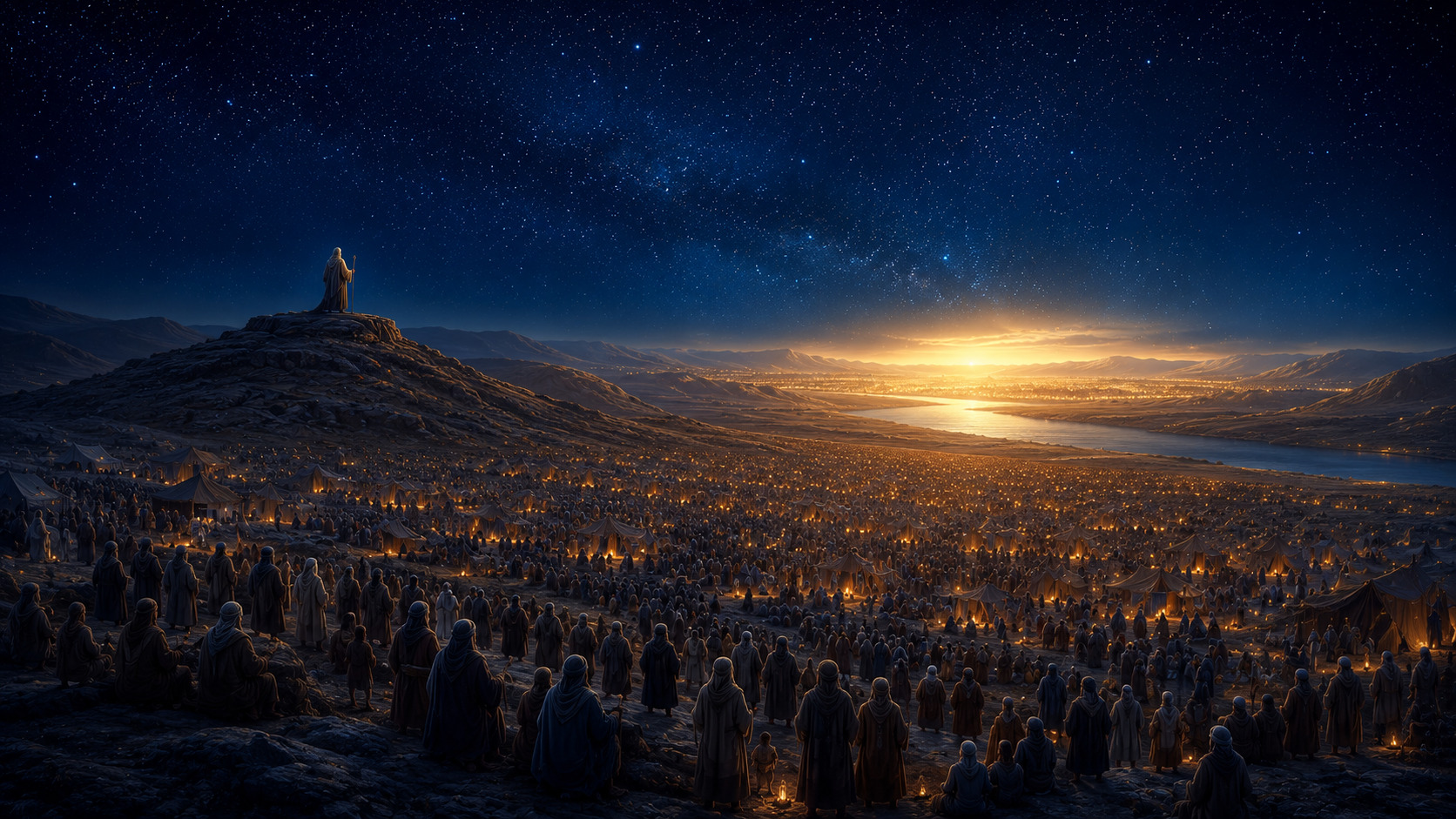
Va'etchanan has the numerical value 515. Moshe prays 515 prayers to enter the Land — and the word tefillah itself = 515. Why exactly 515?
Elokim (midat hadin, strict judgment) = 86. On the first day of creation, "Elokim" appears six times — 6 × 86 = 516. One more prayer (the 516th) would have annulled the decree — so Hashem stops him at 515: "Rav lach."
The 515 were not wasted: out of love for Israel, Moshe paved the path — so that our Yom Kippur prayers could rise. And "Rav lach" means not "enough," but "you have far more."
Why couldn't Moshe enter? He is sealed in Netzach — his Temple would be eternal, indestructible; then Hashem's wrath would fall on Israel, not on wood and stone. Moshe steps back for his people — first redeemer and last redeemer. And the Churban itself is an act of love — hence Nachamu.
Opening his plea, Moshe beseeches Hashem. And Va'etchanan has the numerical value 515.
Moshe prays 515 prayers to enter the Land — and the very word tefillah (prayer) also equals 515. The midrash says his prayer pierced heaven after heaven.
The Name Elokim — strict judgment — equals 86. On the first day of creation, "Elokim" appears six times: judgment sixfold.
Hashem gathered the angels to block Moshe's prayers, so that not one more would be received. Were the 515 prayers wasted, God forbid?
Now, when we pray on Yom Kippur to soften the judgment and draw down mercy, the way is already paved above, by the merit of Moshe. His prayers live inside our Ne'ilah.
On the surface: "enough." But the sod: not "I am weary of you" — rather "you have something far greater than what you ask." To enter the Land now is small next to what awaits you.
Moshe is sealed in the sefira of Netzach (eternity): Chesed — Avraham, Gevurah — Yitzchak, Tiferet — Yaakov; Netzach & Hod — Moshe & Aharon; Yesod — Yosef; Malchut — David. Whatever Moshe touches lasts forever: the Torah still ours after 3,300 years, the Mishkan vessels stored away for the third Temple.
Had he entered, three mitzvot fall upon entering the Land: appoint a king, erase Amalek, build the Temple. Moshe would appoint Mashiach, erase Amalek in a single war, and build an eternal Temple.
Why is "Va'etchanan / Nachamu" always read right after Tisha B'Av? Consolation.
The midrash asks: why "a song" (mizmor) and not a lament? A parable: a king built a wedding house for his son; the son went astray; the king tore the curtains and broke the poles — and the tutor took a flute and sang. Why? Because the king vented his wrath on the canopy, not on his son.
🎯 Test Yourself
Five questions. Click on an answer.
Result
Shalom Bayit — The Mouth at Home
My covenant of peace — peace begins at home. Reveal a Shalom Bayit card.
Gematria — Rav Ménaché
Shalom, Mashiah, Yisamech — secrets of the letters by Rav Ménaché zatsal.
🔢 Gematria CourseAll Parashot
All shiurim of M. Yéhouda Himi — from Bereshit to Devarim and the festivals.
📚 All ParashotBooks
Torah wisdom in thriller format — Éditions Gueoula.

Guardians of the Rift
Forty-nine gates open — the fiftieth hides in a single moment. An ancient secret resurfaces, and one man stands between the rift and the world. A spiritual thriller drawn from Talmud and Kabbalah.
📖 Read the free excerpt · Book $9.90