Yom Yerushalayim · Why God Swore on His Own Right Hand · Holidays · 5786
To Never Forget Jerusalem · The Right-Hand Oath
Why God Swore on His Own Right Hand
Based on the shiur of M. Yéhouda Himi
To Never Forget Jerusalem · The Right-Hand Oath
Based on the shiur of M. Yéhouda Himi · Why God Swore on His Own Right Hand · Holidays · 5785
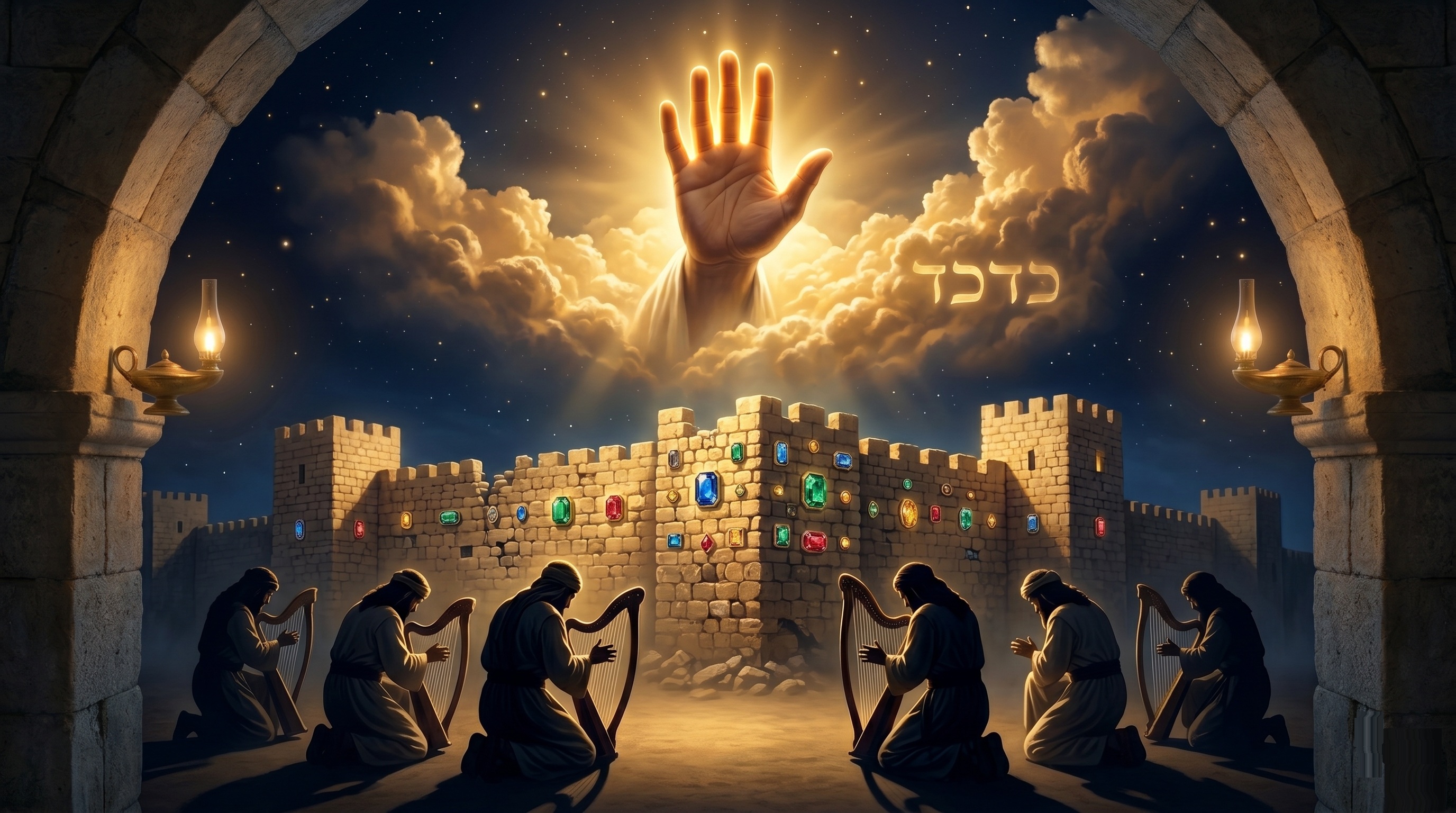
Yeshayahou 54 prophesies Jerusalem rebuilt with a strange doubled word, Kadkhod, hinting at a hidden dispute.
Two angels, Mikha'el and Gavri'el, argue over which stone — Shoham (Yossef) or Yashfe (Binyamin) — will pave Jerusalem's streets; Hachem rules "both, together."
Binyamin's silence when falsely accused of theft (Yashfe = "Yesh Pe," he had a mouth but stayed quiet) earned him the merit that the Beit Hamiqdash stands in his portion.
In Bavel, the Levites bit off their own fingertips rather than play sacred music before idols — and at that moment Hachem Himself swore on His own right hand never to forget Jerusalem.
Since 1967, Jerusalem being in Jewish hands is read as the living fulfillment of that divine oath — measure for measure.
Yeshayahou sees Jerusalem rebuilt of stones, gates and borders. Why stones?
Behold, I will set your stones in carbuncle, and lay your foundations with sapphires. And I will make your windows of Kadkhod, and your gates of Avnei Ekdach, and all your borders of precious stonesYeshayahou 54:11-12
This is one of the seven haftarot of consolation read after Tisha be-Av. Avnei Hefetz = precious stones, jewels. Avnei Ekdach = pierced stones (the Hebrew root kadach means "to bore"), threaded with rods for ornate construction.
Highlight In the middle of the vision sits a strange word: Kadkhod — kaf-dalet-kaf-dalet. Two times the same syllable. The second kaf, after a sheva, has no dagesh.
Secret Whenever the Torah doubles a word, something is hiding. The Zohar will reveal it.
2 Two Angels at War in Heaven
The Talmud (Bava Batra 75a) opens a window onto the heavenly debate.
Rabbi Shmuel bar Na'hmani teaches: two angels argued in heaven. Mikha'el and Gavri'el. The subject: with what stones will the streets of Jerusalem be paved in the days of Mashia'h?
HighlightMikha'el said: Shoham.Gavri'el said: Yashfe. Both come from the Cohen Gadol's Hoshen Mishpat — twelve stones for twelve tribes.
Sapphire The Holy One does not pick a side. He says: kadén ve-kadén — like this, and like that. Both. Together. That is what the prophet writes: Kadkhod. Kad — kad.
Secret The word is no longer strange. It is the verdict of Hachem.
3 The Stones and the Tribes
Which tribe does each stone represent?
The four rows of the Hoshen: Odem, Pitda, Bareket. Nofech, Sapir, Yahalom. Leshem, Shvo, A'hlama. Tarshish, Shoham, Yashfe. The order follows the birth of Ya'akov's sons.
Highlight The fourth row holds the youngest. Shoham = Yossef.Yashfe = Binyamin. The two sons of Ra'hel.
Secret The debate between Mikha'el and Gavri'el was never about geology. It was about which son of Ra'hel will define the redemption.
4 Yashfe = "Yesh Pe" — The Mouth That Stayed Silent
Why does the stone Yashfe correspond to Binyamin? The Midrash splits the word in two.
Yashfe = Yesh Pe — "he has a mouth." When the brothers found the goblet in Binyamin's sack, they turned on him: "You are a thief! Son of a thief! Just like your mother, who stole the trafim from Lavan." They struck him on the shoulder.
Sapphire Binyamin had a mouth. He could have said, "It was not me. Yossef planted it there."He stayed silent. He absorbed the blows and the accusation against his mother.
Highlight For that silence, the Midrash teaches, Binyamin earned an eternal reward: the Beit Hamiqdash stands in his portion. The Temple Mount is in the inheritance of Binyamin. Not by chance — by silence.
Secret To this day, the Temple Mount is in Binyamin's portion. The Beit Hamiqdash sits on the seam between Yehuda and Binyamin.
5 The Deeper Layer — Mashia'h ben Yossef and Mashia'h ben David
Why does Hachem rule "kadén ve-kadén"? Because the debate hides a second debate.
The angels were not arguing about decorative pavement. They were arguing about the structure of the redemption. Shoham = Yossef = Mashia'h ben Yossef, the platform of awakening, the gathering of Israel. Yashfe = Binyamin = Mashia'h ben David, who builds the Third Beit Hamiqdash in Binyamin's inheritance.
Highlight Hachem says: kadén ve-kadén. First Mashia'h ben Yossef — the platform that gathers all of Israel. Then Mashia'h ben David — the Beit Hamiqdash descends and is built. Yossef and Binyamin. Both. Neither alone.
6 'Hessed and Din — Creation Repeats Itself
Beyond Mashia'h: the names of the angels reveal a deeper structure.
Gavri'el — his name contains gevurah, severity, Din. Mikha'el — the prince of Israel, the angel of 'Hessed. Fire and water. Two opposites.
Sapphire"In the beginning, G-d created the heavens and the earth." Hachem wanted to create with strict Din. He saw the world could not stand. So He joined Ra'hamim to Din. From chapter two of Bereshit, the world is created with Hachem Elokim — mercy and judgment together.
Highlight Just as Hachem built the world — 'Hessed and Din together — so too Jerusalem will be rebuilt. Both Mikha'el and Gavri'el. Both Shoham and Yashfe. Both will be there. That is the meaning of Kadkhod.
7 Tehilim 137 — By the Rivers of Bavel
The first half of the shiur ends. The second begins. From prophecy to exile.
By the rivers of Bavel, there we sat and wept when we remembered Tzion. On the willows in its midst we hung our harpsTehilim 137:1-2
After the destruction of the first Beit Hamiqdash, the people of Israel were taken into exile in Bavel. With them went the Levites — the musicians of the Beit Hamiqdash. On the way, they rested by the rivers, by the willows.
Sapphire Nabuchodonosor came to them: "Why do you sit and weep? Stand up. While we eat and drink, play for us — play for our gods — as you used to play before your G-d."
Highlight A king of empires, not asking. Commanding. Play the music of the Beit Hamiqdash — before idols. The Levites had a choice. They had instruments. They had skill.
8 The Fingers in the Mouth
What did the Levites do?
They stood up. All of them. They put their right thumbs into their mouths — and they bit them off. They chewed the tips of their own fingers. Blood ran down their hands. They could no longer play.
Highlight They turned to Nabuchodonosor and said: "How shall we sing the song of Hachem on foreign soil?" They raised their bitten fingers: "We were tied up — and our fingers were cut off."
Sapphire The king flew into a rage. He threw them into mounds upon mounds of dead. He killed them for refusing. And the Levites died in joy — that they had not played the music of the Holy of Holies before an idol.
Secret This is the Levites' oath, written into the psalm: "If I forget you Jerusalem — let my right hand forget itself." I swore on my hand. I cut off my hand. I will not forget.
9 The Holy One's Right-Hand Oath
The classical reading: the Levites swore. The Midrash reveals a hidden second layer.
If I forget you Jerusalem — let My right hand forget itself. Let my tongue cling to my palate if I do not remember you, if I do not raise up Jerusalem upon my chief joyTehilim 137:5-6
The Midrash teaches: at that hour — when the Levites bit off their own fingers — Hachem Himself made an oath. Not in a courtroom. Not before witnesses. In His own being.
Highlight"You ruled over yourselves and cut off your own right fingers so that you would not play. I too swear — and My oath does not return to Me empty — as it is said: If I forget you Jerusalem, let My right hand forget itself."Hachem swears on His own right hand. Yemin Hachem osa 'hayil — the right hand of Hachem acts with strength.
SapphireMeasure for measure. The Levites gave up the use of their right hands so as not to defile the Beit Hamiqdash. Hachem pledges His own right hand to never forget the Beit Hamiqdash. 1967 — we are the generation that sees the oath fulfilled.
🎯 Test yourself
Five questions. Click an answer.
1
What does the strange word Kadkhod in Yeshayahou 54 mean, according to the Zohar?
The Zohar reveals that the doubled word Kadkhod encodes Hachem's ruling "kadén ve-kadén" — both stones together — settling the angels' dispute.
2
In the heavenly debate, what stones did Mikha'el and Gavri'el propose?
Mikha'el said Shoham (representing Yossef) and Gavri'el said Yashfe (representing Binyamin), both stones from the Cohen Gadol's Hoshen.
3
Why does the stone Yashfe correspond specifically to Binyamin?
When accused of stealing the goblet, Binyamin had every right to speak in his own defense but chose silence, like his mother Ra'hel.
4
When ordered to play before idols in Bavel, what did the Levites do?
The Levites bit off their own fingertips rather than defile the sacred music of the Beit Hamiqdash by playing it before idols.
5
In the Midrash, who utters the verse "If I forget you Jerusalem, let My right hand forget itself"?
The Midrash teaches that at the moment the Levites cut off their fingers, Hachem Himself swore on His own right hand never to forget Jerusalem.
Result
📅 Week Programme — Seven Steps of the Oath
Sunday
Sunday — Remember Yom Yerushalayim: write down what you felt, or why you missed it. The covenant is yours.
Monday
Monday — The right hand: each time you use your right hand today, remember Hachem swore on His.
Tuesday
Tuesday — The silence of Binyamin: notice a moment you could have defended yourself but chose silence, and honor it.
Wednesday
Wednesday — Both, together: in any tension between 'Hessed and Din, don't choose one — combine them, kadén ve-kadén.
Thursday
Thursday — A song you would not play: refuse one piece of surrounding culture today, like a Levite.
Friday
Friday night — Open the map: before kiddush, spend one minute looking at a map of Jerusalem's Old City walls.
Shabbat
Shabbat — The word Yerushalayim: pause on that word in Birkat Hamazon and remember the right-hand oath, 59 years since 1967.
Four Practical Steps
🏠
Shalom Bayit — The Mouth at Home
My covenant of peace — peace begins at home. Reveal a Shalom Bayit card.
🔢
Gematria — Rav Ménaché
Shalom, Mashiah, Yisamech — secrets of the letters by Rav Ménaché zatsal.
Every week, straight to your inbox. No spam. One-click unsubscribe.
🕯️ Dedicate This Shiur
Dedicate this shiur for the days of Bein HaMetzarim — in memory, for healing or for success.
Guardians of the Rift
A spiritual thriller · David Goldberg
Forty-nine gates open — the fiftieth hides in a single moment. An ancient secret resurfaces, and one man stands between the rift and the world. Drawn from Talmud and Kabbalah.