The Bread of the Face — The Menorah — The Egyptian Son
Based on the shiur of M. Yéhouda Himi
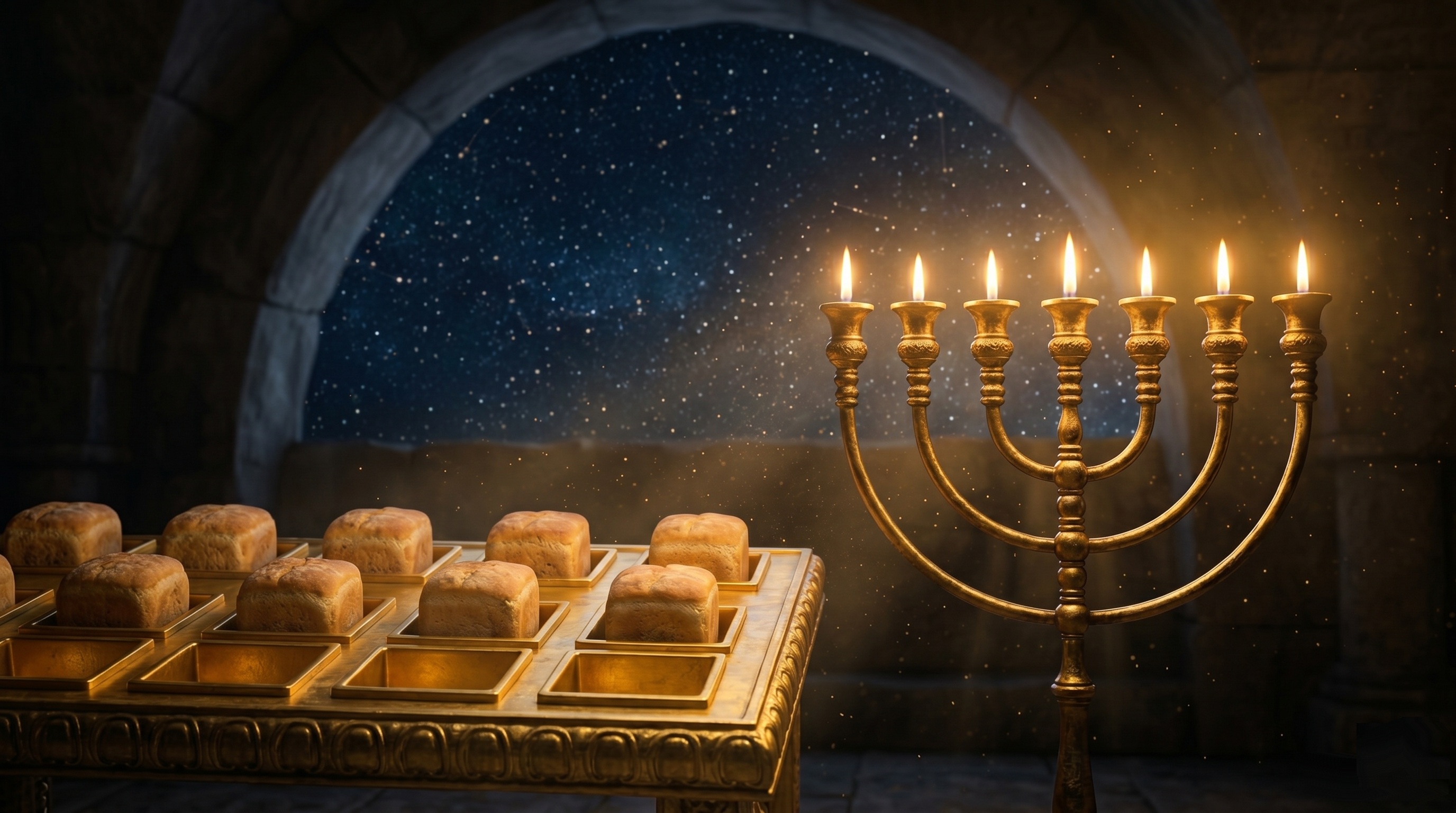
At the end of Parashat Emor, the Torah seemingly returns out of context to commands already given in Tetzaveh: pure olive oil for the Menorah, twelve loaves on the showbread table. Rashi attempts an answer. The Or HaHayim breaks an unwritten rule and replies: “His words are not sufficient.” Then he reveals the hidden code — one code that explains everything, including why an Egyptian-born man steps out the next moment and curses G-d.
1 The Strange Repetition — Why Here?
Why does the Torah repeat the laws of the olive oil and the Menorah at the end of Emor? They are already explicitly commanded in Tetzaveh!
G-d spoke to Moshe saying: command the Children of Israel to take pure pressed olive oil for lighting, to kindle a continual lamp Leviticus 24:1-2
Stop and ask. Why this command, here, at the end of Parashat Emor, right after the chapter on the festivals? And what is the connection between the Menorah and the festival cycle we just finished? It is not an isolated repetition either. Right after the Menorah, the Torah continues with the showbread — the twelve loaves — another double command already given in Tetzaveh.
Rashi proposes: “The parasha of Tetzaveh was only the announcement, in the order of the Mishkan’s construction. Here is the actual command for execution.”
🔷 But the Or HaHayim HaKadosh uses words almost no commentator dares: “Rashi zatsal explained what he explained, but his words are not sufficient.” Why split between announcement and execution? And why exactly here? There is more than a technical answer at stake — there is a hidden code.
2 The Ramban’s Answer — Did the Oil Run Out?
The Ramban suggests: between the dedication of the Mishkan in Nissan and now, the original supply of oil ran out. The new command is for replenishment. Is this convincing?
The Ramban offers a pragmatic solution: between the dedication of the Mishkan (1 Nissan) and the period of Parashat Emor, the original allotment of oil was exhausted. The repetition here is the renewed command for ongoing supply.
The Or HaHayim rejects this too: “There is no proof for this.” Nothing in the verses says the oil ran out. It is mere speculation, and speculation alone cannot explain the placement in Torah. There must be a deeper reason — one that connects everything around it.
⭐ This moment — where the Or HaHayim halts the two greatest classical commentators and says “not enough” — signals that something massive is hidden under the surface of Parashat Emor. His resolution will tip every card on the table.
3 The Answer — The Code of Seven
What preceded the repetition of the Menorah and the showbread? Look back — and you see the code.
The Or HaHayim asks us to remember the context. Just before the Menorah, what was discussed? The festivals. “G-d spoke to Moshe saying: these are the festivals of G-d... Shabbat, Pesach, the counting of the Omer, Shavuot, Rosh Hashanah, Yom Kippur, Sukkot.”
The Or HaHayim asks: “Since the Torah was already commanding the laws of seven” — what do we see in every festival? The number seven returns again and again.
Pesach
Seven days of the festival. Seven days forbidden in chametz.
Counting of the Omer
Seven complete weeks. 49 days = 7 × 7.
Sukkot
Seven days of dwelling. The Four Species — seven days of waving.
Rosh Hashanah / Yom Kippur
In the seventh month. They themselves bear the quality of seven.
Shabbat
The seventh day — also recalled in this parasha.
The Menorah
Seven branches — corresponding to the seven days of creation.
⭐ “The general principle of all the laws of seven is one and the same.” If the Torah is already gathering “sevens,” include the Menorah (7 branches). Include the showbread table. Why? Because the table itself is also in the secret of seven.
4 The Showbread Table in the Secret of Seven
How does the showbread table fit into the code of seven? There are twelve loaves, not seven!
You shall take fine flour and bake twelve loaves... and place them in two arrays, six in each array, on the pure table Leviticus 24:5-6
Two arrays of six loaves each. Six and six. But that is not the whole picture — the table itself is the base that holds both arrays. It is the seventh element that carries them all.
The Or HaHayim notes precisely: “The table itself is also in the secret of seven, for it is written ‘six in each array,’ and the table on which they are arranged completes the seven.” Six arrays + the table itself = seven.
⭐ This is no coincidence. All the laws of seven unite under one idea: G-d created the world in seven days, and rested on the seventh — testifying that His Presence dwells in the world. Every “seven” in Torah is testimony that creation is not abandoned, that the King remains in His palace.
5 The Menorah Is Not for Light — It Is for Testimony
If G-d created light itself — what does He need with the light of the Menorah? What is it actually illuminating?
Outside the Curtain of the Testimony in the Tent of Meeting, Aharon shall arrange it Leviticus 24:3
The Talmud in Shabbat asks the exact question: “Does He need its light?” For forty years in the desert, Israel walked not by sunlight but by the pillar of cloud by day and the pillar of fire by night. If they did not need the sun for illumination — how much more so does the Divine Presence not need the Menorah’s light.
So why the Menorah? The Talmud answers: “It is testimony to all who come into the world that the Divine Presence dwells in Israel.” The Menorah is not lighting — it is testimony. A sign that the King resides here.
🔷 Every day, Aharon HaKohen kindles the seven lamps. The seven lamps correspond to the seven days of creation. With every kindling, he renews the declaration: the Divine Presence rests here. This is not the home of a man praying to a distant deity. This is the home where G-d Himself dwells. The Code of Seven = the Code of Presence.
6 The Pivot — From the Table to the Egyptian Son
Immediately after the command of the twelve loaves, the Torah jumps to the story of a man who curses G-d. “He went out” — from where did he go out? Why here?
The son of an Israelite woman went out, and he was the son of an Egyptian man, in the midst of the Children of Israel; and the son of the Israelite woman fought in the camp with an Israelite man Leviticus 24:10
The Midrash asks the question explicitly: “He went out — from where did he go out?” Three answers, and they all interlock:
Answer 1
“He went out of his world” — meaning his end was to leave this world. He was sentenced to death, and that was his exit.
Answer 2
“He went out from the parasha above” — from the previous passage. He stepped out and mocked: “Is it the way of a king to eat warm bread daily, or stale bread of nine days?” — he ridiculed the showbread.
Answer 3
“He went out from Moshe’s court convicted” — he came to court over his claim to the tribe of Dan and was rejected. Then he began to curse.
⭐ The placement is dramatic. The Torah inserts this story without explanation, suddenly, mid-instruction, between the table and the Menorah. The connection is the explosion: this is a story of a man who did not understand what the Bread of the Face was — and so he mocked it.
7 Shlomit bat Divri — The Full Backstory
Who is the “son of the Egyptian man”? And did Moshe really kill an Egyptian back in Egypt for no reason?
Back to the book of Shemot. Rashi gives the full story. Shlomit bat Divri was an Israelite woman, wife of Datan (per the Midrash). Her name hints at her conduct: “Divri divri — to every man she would say ‘Shalom alecha, shalom alecha.’” She greeted everyone openly, lacking the depth of modesty.
The Egyptian taskmaster — charged with overseeing slave labor — noticed her openness. One day, he waited until her husband left for work. The moment the husband stepped out, the Egyptian entered. Shlomit assumed her husband had returned. Without checking carefully, she did not realize. That act caused her pregnancy. The son of the Israelite woman — the one now cursing in Parashat Emor — is the son of that Egyptian.
🔷 Later, to destroy the evidence, that same Egyptian beat Shlomit’s husband. Moshe Rabbenu saw “an Egyptian man striking a Hebrew man” — he saw the beating. “He looked and saw there was no man” — he saw with the holy spirit that no good descendant for Israel would emerge from him. He struck the Egyptian and severed the line. But one child had already been born.
⭐ That child converted. He was a Jew in every halakhic sense. But for tribal lineage — before the giving of the Torah, lineage followed the father. His father was Egyptian. So he had no tribe.Shtuki — without root in the people of Israel.
8 No Contradiction — The Egyptian DNA
How do the three answers connect? How are his exit from the world, his mockery of the table, and his conviction in court — in fact the same thing?
The son of the Egyptian man came to Moshe’s court demanding a place in the tribe of Dan (his mother’s tribe). Rejected. “Each man by his banner, by the houses of their fathers” — your father is an Egyptian; you have no place. He left the court cursing.
Why did he curse? Because as a man raised with Egyptian DNA, he failed to grasp two foundational truths:
(1) That G-d is not a flesh-and-blood king who needs honor. In Egypt, honor for the king = bringing him fresh warm bread daily. So when he heard about the showbread — nine-day-old bread placed before G-d! — he mocked: “Is it the way of a king to eat warm bread daily, or stale bread of nine days?” He failed to understand that it was not bread for G-d at all.
🔷 (2) What is the Bread of the Face? On the surface: the loaves face each other. But in depth: “May G-d shine His Face upon you”Numbers 6:25. G-d shines His face upon Israel, and through this table the flow of sustenance descends. G-d does not receive from us — He gives to us. The table is a channel of blessing, not a gift to a king.
⭐ This is the inner contradiction of the Egyptian son: he could not absorb the Israelite code. To him, G-d was like Pharaoh — a king who receives. When he saw something that did not match his standards, he mocked. In that same moment, he left the court convicted, and ultimately left the world. The three answers are one: a man with no root in Israel cannot remain in Israel. This is what Moshe “saw that there was no man” — he read this future in advance.
📕 This story — a man who curses a King he imagines needs honor, and loses his root — is exactly the kind of tension David Goldberg explores in his novel “The Dream Thief.” What happens when someone cannot see the truth standing in front of them? First chapter free.
📅 Weekly Program — Seven Days, Seven Sevens
Sunday · The Seven of Pesach
Reflect on the seven days of Pesach — seven days of freedom. Ask: in what part of my life am I still a slave? What “Egypt” have I not yet left?
Monday · The Seven of the Omer
We are inside the Omer right now. Seven full weeks = 49 days of inner construction. Ask: what am I building this week? Which trait am I refining?
Tuesday · The Seven of the Seventh Month
Rosh Hashanah and Yom Kippur fall in the seventh month — not by chance. Ask: what was my last “judgment”? Did I leave acquitted or convicted?
Wednesday · The Seven of Sukkot
Seven days in the sukkah. Seven days without permanent walls. Ask: what do I rely on when I have no walls? What is my real source of security?
Thursday · The Seven of the Menorah
The Menorah is not for light — it is for testimony. Seven branches = seven days of creation. Ask: what do I testify to in my life? When people see me — what do they learn about the Divine Presence?
Friday Night · The Seven of the Table
Before Kiddush, look at your Shabbat table. Six arrays + the table = 7. G-d does not receive warm bread from you — He gives you sustenance through this very table. Say: “G-d, Your Face shines upon me.”
Shabbat · The Seven of Shabbat
During the Torah reading, when you hear the command of the oil and the bread — remember: this is the code. Not random commandments. Every “seven” in Torah is the Creator’s signature. Shabbat is the greatest testimony of all. Keep it today as if you were the very first to receive it.
Go Further
⚖️
Halakha Yom Yom
One ruling per day — MOUTTAR or ASSOUR. Clear, practical. Sephardic psak (Yalkout Yossef / Hazon Ovadia).
The Code of Seven — Bread of the Face and the Menorah
Friday Night · Emor 5786 · Based on the shiur of M. Yéhouda Himi
At the end of Emor, the Torah repeats the laws of olive oil for the Menorah and of the showbread — commands already given in Tetzaveh. Rashi attempts an answer. The Or HaHayim, in rare words, replies: “His words are not sufficient.” The Ramban suggests the oil ran out — also rejected: “No proof for this.”
The real answer: the Code of Seven. The parasha just covered the festivals — and they are all in the secret of seven. Pesach 7 days, Sukkot 7 days, Omer 7 × 7, the seventh month, Shabbat. So the Menorah (7 branches) and the table (6+6+the base = 7) belong here too. “The general principle of all the laws of seven is one and the same.” All testify to one truth — the Divine Presence dwells in the world. Shabbat shalom.
B”H
The Egyptian Son and the Mockery of the Table
Shabbat morning · Emor · M. Yéhouda Himi
Right after the showbread — a man steps out and curses G-d. Why here? The Midrash: “He went out from the parasha above” — he mocked the showbread. “Is it the way of a king to eat warm bread daily, or stale bread of nine days?” But this is the deepest mistake. G-d does not receive — He gives. The Bread of the Face = sustenance flowing through the table to Israel.
The Egyptian son grew up with Egyptian DNA. To Pharaoh, a king receives. To G-d, the King gives. He could not absorb this. He left the court convicted, and left the world. The three answers are one: a man with no root in Israel cannot remain in Israel. Shabbat shalom umevorach.