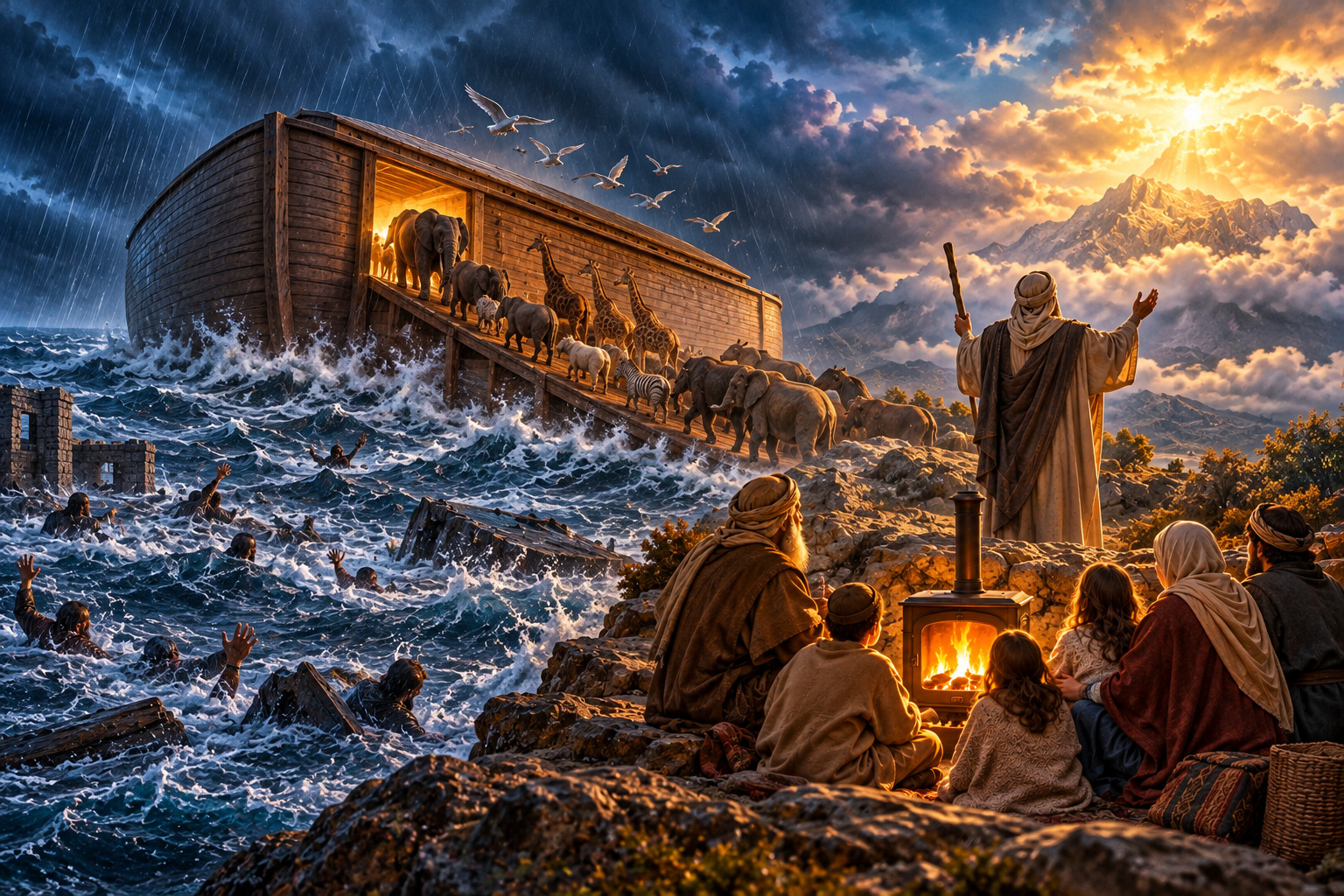
Noach — Saving yourself, or saving your world
Noach is righteous, yet his righteousness raises a demand: what does he do for his generation? A fur coat warms its wearer; a stove warms others. Avraham spreads knowledge of Hashem, and Moshe stakes his own place on Israel’s survival. Parallels between the tevot, the Aron, the Flood and Sinai prepare this contrast. Vayyahel Noach leads to the vineyard, whereas vayyehal Moshe becomes prayer. Noach’s name, hands freed through tools, and the two cantillation marks in zeh yenahamenu carry the hope of repair: receiving from above in order to raise the world.
The Torah introduces Noach as righteous and wholehearted: he walked with God. Rashi explains that the true offspring of the righteous are their good deeds. Yet “in his generations” admits two readings: some say he would have been even greater among righteous people; others say he would have counted for nothing in Avraham’s generation. How can such a severe assessment coexist with the Torah’s own testimony to his righteousness? This question sets the entire shiur in motion.
A first opening is to hear “nothing” as humility. Moshe and Aharon ask: “What are we?” A person who does not inflate his own importance can thereby grow in holiness. Standing before Avraham, Noach could have acknowledged his smallness without losing his righteousness. Yet the question remains: what does each man do with his righteousness for the sake of others? The shiur therefore moves from self-effacement to responsibility.
When a group suffers from the cold, one can put on a fur coat and warm oneself; one can also light a stove that warms everybody. This mashal illuminates the contrast between Noach and Avraham. Avraham does not keep his discovery of Hashem to himself: “the souls they made in Haran” express a life that brings others closer to God. The warmth he receives becomes shared warmth. Noach enters the ark with his family. The question is therefore how righteousness can reach those who remain outside.
The long building of the ark was meant to draw attention and questions. Rashi presents the hundred and twenty years as an opportunity for people to return. The shiur follows the whole process, from preparing the timber to completing the ark: waiting itself could become a call to teshuvah. Yet at the end Noach enters, and his generation disappears. He obeyed and preserved his household; the shiur asks us to consider what responsibility beyond that household might have achieved.
The comparison unfolds on two levels: the objects, heftsa, and the people, gavra. Noach’s ark preserves life amid the waters; Moshe’s basket preserves an infant on the Nile. Moshe’s mother takes a basket of reeds and coats it with bitumen and pitch; Noach coats his ark with kofer, inside and out. These echoes lead from the preservation of a world to the cradle of the man who will save his people. Moshe’s basket is placed among the reeds at the riverbank: this is the Nile narrative.
A third chest enters the comparison: the Aron that houses the Tablets of the Covenant. The Torah calls it aron. The shiur places this sacred chest alongside the two tevot. The wooden ark coated with kofer finds an echo in the acacia-wood Aron covered with gold, also “inside and outside.” Both receive precise measurements: three hundred, fifty and thirty cubits for the ark; two and a half, one and a half and one and a half for the Aron. The tsohar above the ark and the kaporet above the Aron extend the parallel, while kofer and kaporet echo each other in sound.
The Flood’s motifs recur in the Sinai narrative. Seven days precede the rain; at Sinai, Hashem calls Moshe on the seventh day. Rain falls for forty days; Moshe remains on the mountain for forty days and nights. The waters cover the mountains; the cloud covers Sinai. The entry into the ark and the arrival at Sinai each mark a decisive day. These correspondences prepare the comparison between two men faced with the threat of destruction and the possibility of a new beginning.
After the Golden Calf, Moshe is offered a new beginning with himself as its origin. Noach survived, and humanity began again from his household. Moshe could likewise become the beginning of a new nation. Yet he refuses to separate himself from Israel: if there is no forgiveness, “erase me from Your book.” Here mesirut nefesh, self-sacrifice, becomes visible. He does not seek a glorious future that leaves his people behind. Israel carries the calling to repair the world, and Moshe stakes his own place on the people’s survival.
The Midrash places Noach and Moshe in dialogue. Noach points out that he was saved from his generation, whereas Moshe died with the wilderness generation. Moshe responds with a mashal about two ships and two captains: one saves himself while abandoning his ship; the other saves himself and his ship. Which deserves praise? The captain who brings his crew to safety. Moshe obtained the preservation of his generation at the Golden Calf. The mashal distinguishes personal survival from responsibility for the survival of others.
“You are righteous” is more than praise; it is also a summons. Having found favor, Noach could have brought his generation before Hashem. An objection arises: if Hashem announced destruction, was Noach not simply following His will? Moshe shows that an announcement of judgment can open a space for prayer. He hears in “leave Me” the possibility of interceding. The righteous person does not claim mastery over divine purposes; he takes up his human task: to pray, teach and seek the rescue of those around him.
At the end of Bereshit, the divine Name associated with mercy accompanies the announcement of judgment. The text also speaks of grief. The shiur teaches us to hear that pain, rather than only the sentence. A manager who threatens to close his factory while grieving its loss may be approached with a plea and a commitment to change. Likewise, the mention of the heart’s inclination invites advocacy and education. Torah, compared to an antidote to the evil inclination, becomes a call to teach instead of leaving others alone.
On leaving the ark, Noach plants a vineyard. Rashi hears in vayyahel that he made himself profane: another planting should have come first. He had brought what was needed to renew cultivation. The shiur then recounts Satan watering the vine with the blood of animals. The images of sheep, monkey, lion and pig depict deterioration under drunkenness: seeming gentleness, restless antics, imagined strength and finally degradation. The mashal calls for self-control. The first act of rebuilding reveals the direction one gives to life.
The same letters, differently vocalized, reveal two directions. Noach begins with a vineyard; Moshe pleads with Hashem for his people. His prayer asks what the nations will say if Israel is destroyed after the Exodus. The shiur links that plea to the sanctification of the divine Name: Moshe dares to bring the risk of hillul Hashem before Hashem. Where wine lowers Noach, Moshe’s prayer raises responsibility. The closeness of the words sharpens the contrast between a life centered on enjoyment and a life extended through intercession.
The genealogy of ten generations moves quickly from birth to death. With Noach, it pauses over his name and his father’s hope for relief from work and the toil of human hands. How could Lemech know what the child would become? The shiur explores several avenues: prophetic insight, a name given after the child’s gifts emerged, or a sign visible at birth. Among them is the tradition of a child born circumcised, signaling the beginning of repair after Adam’s sin. Noach’s name carries the expectation of a renewed world.
Another tradition related in the shiur describes hands whose fingers were not separated, and sees Noach’s birth as a change that makes toolmaking possible. The image illuminates “the toil of our hands.” Rashi emphasizes that Noach prepared plowing implements for people; labor under Adam’s curse finds relief. Why Noach rather than Nahum or Menahem? Because yenahamenu is understood as the arrival of rest, menuhah. The shiur connects hands, tools and name: relief becomes concrete through a new way of working the soil.
The shiur closes with the two cantillation signs accompanying zeh in zeh yenahamenu: telisha gedolah and gershayim. Their musical movement carries a final image: descent and ascent, itaruta dile’ela and itaruta diletata, awakening from above and awakening from below. Descent calls forth elevation. This was the hope placed in Noach: to receive help and lift the world. He accomplishes part of that task, while the work of repair continues with Avraham. In our own lives, received warmth must become warmth we give.
Test yourself
Five questions on the shiur. Choose an answer.
Result
Shalom Bayit — The Mouth at Home
My covenant of peace — peace begins at home. Reveal a Shalom Bayit card.
Gematria — Rav Ménaché
Shalom, Mashiah, Yisamech — secrets of the letters by Rav Ménaché zatsal.
🔢 Gematria CourseAll Parashot
All shiurim of M. Yéhouda Himi — from Bereshit to Devarim and the festivals.
📚 All ParashotBooks
Torah wisdom in thriller format — Éditions Gueoula.

Guardians of the Rift
Forty-nine gates open — the fiftieth hides in a single moment. An ancient secret resurfaces, and one man stands between the rift and the world. Drawn from Talmud and Kabbalah.
📖 Read the free excerpt · Book $9.90