Vayetze —
The Folded Land and Rachel’s Reward
Yaakov lies down on Mount Moriah, on the Foundation Stone from which the world was laid, and God promises him: “The land on which you lie, to you I will give it.” Rashi explains that God folded the whole Land of Israel beneath him. Yaakov is lying on the root of the land, and by lying there he conquers it, so that it will be easy for his children to conquer — just as the Torah a child learns in the womb is forgotten at birth and then comes back to him with ease. In the second part, Rachel gives up a night with Yaakov in exchange for the mandrakes, and Yissachar is born: yesh sakhar, “there is a reward.” Because of Rachel’s sacrifice and her silence, God promises: “There is a reward for your deed… and the children shall return to their own border.”
Words of Torah do good when they are shared. Send this shiur to your family and friends on WhatsApp.
📲 Send on WhatsApp👥 Join the Gueoula groupParashat Vayetze opens with Yaakov leaving Be’er Sheva for Charan. On the way he comes upon the place, spends the night there because the sun has set, takes some of the stones of the place, puts them under his head — “and he lay down in that place.”
Where is “that place”? We have already said it: Mount Moriah. Today we will learn two more ideas from the parasha. The first is about this night Yaakov spent lying on the ground. The second is about the tribe of Yissachar.
In his dream Yaakov sees a ladder set on the earth with its top reaching heaven, and angels of God going up and down on it. Then comes the revelation: “And behold, Hashem stood above him and said: I am Hashem, the God of Avraham your father and the God of Yitzchak. The land on which you lie, to you I will give it and to your descendants.”
Now ask yourself: what is “the land on which you lie”? Four cubits at most. How tall was Yaakov? Let’s say about six feet, and a foot and a half wide — no need to exaggerate. Is that the gift? That patch of ground?
Read plainly, the verse is difficult: the land — meaning the very ground you are lying on — “to you I will give it and to your descendants.” It cannot be understood literally.
Since the verse cannot be taken literally, Rashi steps in. Don’t think it means exactly the spot you are lying on. “The land” is the whole Land of Israel. But on the other hand — you are not lying on the whole Land of Israel!
So Rashi explains: the Holy One, blessed be He, folded the entire Land of Israel beneath him, hinting to him that it would be as easy for his children to conquer as four cubits — the space a man occupies.
In other words: just as it is easy to take the ground a person is standing on — wherever I stand, I have already taken it. Am I standing here? Taken, effortlessly. Do I want that spot over there? I walk over and stand on it. And just as Yaakov lay down and took the four cubits beneath him, so it would be easy for his children, the people of Israel, to take the whole Land of Israel.
But what does it mean that God “folded the whole land beneath him”? Today we might picture it like this: the Holy One, blessed be He, took the map of the Land of Israel, folded it, folded it again, and slipped it under Yaakov’s back.
That cannot be what is meant either. If He had folded up the whole Land of Israel, what would have been left everywhere else? So we have to go deeper into the expression.
Here is what it means: Yaakov is now lying on the root of the Land of Israel — on the seed from which the whole land grows. The entire land is folded into that root, and from it the land comes out and is built. And where did the whole Land of Israel grow from? From the Temple.
How do we know this? Where did he sleep? We said it: on Mount Moriah, at the place of the Even HaShtiyah. What is the Even HaShtiyah? Not “drinking,” as the word might sound in Hebrew, and not a well. Shtiyah comes from tashtit, foundation: the place from which the whole world was laid.
When the Holy One, blessed be He, wanted to create the world — the globe — He began from one particular point: the point where Mount Moriah stands. From there He formed the whole earth.
Think of a basketball. It is round, and every part of it looks the same. Not so. There is one spot unlike the rest of the ball: the valve, the place where you pump the air in. That is how to picture it. If the whole earth is a ball, the place from which it was “inflated” is Mount Moriah — the Foundation Stone.
From there the Holy One, blessed be He, laid the foundation of the whole world, and from there He spread out the whole earth. And we know that Jerusalem is the navel of the entire world. Mount Moriah is the Temple Mount; the Foundation Stone is still there today, and the building on the Temple Mount is built around it.
This is what the Holy One, blessed be He, is telling Yaakov: the place you are lying on — this very point — is the root not only of the Land of Israel but of the whole world. But the Land of Israel, at least, I am giving to you.
And how do I hint to you that it will be easy for your children to take it? Because you are taking it right now. By sleeping in this place, you have conquered it. “That it would be easy for his children to conquer.”
By this act, Yaakov opened the way for the people of Israel to take the land with greater ease.
What does this remind us of? Something we all know from Tractate Niddah. Rabbi Simlai taught: what is a child in its mother’s womb like? A folded notebook. A candle burns above its head, and it gazes from one end of the world to the other. There are no days in which a person is in greater bliss than those days, and it is taught the entire Torah. And once it comes out into the air of the world, an angel comes, strikes it on the mouth, and makes it forget the entire Torah.
So we have a baby folded in its mother’s womb — and that brings us right back to what was said here: He folded the whole land beneath him. The same word. The Holy One, blessed be He, folded the whole Land of Israel and placed it beneath Yaakov, like that child folded inside its mother, to whom an angel comes and teaches the whole Torah.
Everyone asks: why teach the child the entire Torah if, before it is born, an angel comes, strikes it on the mouth and makes it forget everything? What do we gain? We gain — and how! When the child is born, it has forgotten everything. But when it begins to learn, the words will feel familiar, because it has already heard them once.
Here is a parable. I go out to a field and dig a hole. Digging is very hard. Then I put the earth back. The next time I come to dig, it will be easier, because the soil has already been loosened.
It is the same with Yaakov. He lies on the land, and by lying there he conquers it. Later, when the people of Israel come out of slavery in Egypt and enter the land in the days of Yehoshua bin Nun, it will be easy for them to conquer it. Why? Because Yaakov already conquered it once. How? He slept on the root of the land, on Mount Moriah. And if he took the root, the whole land could be taken before his children.
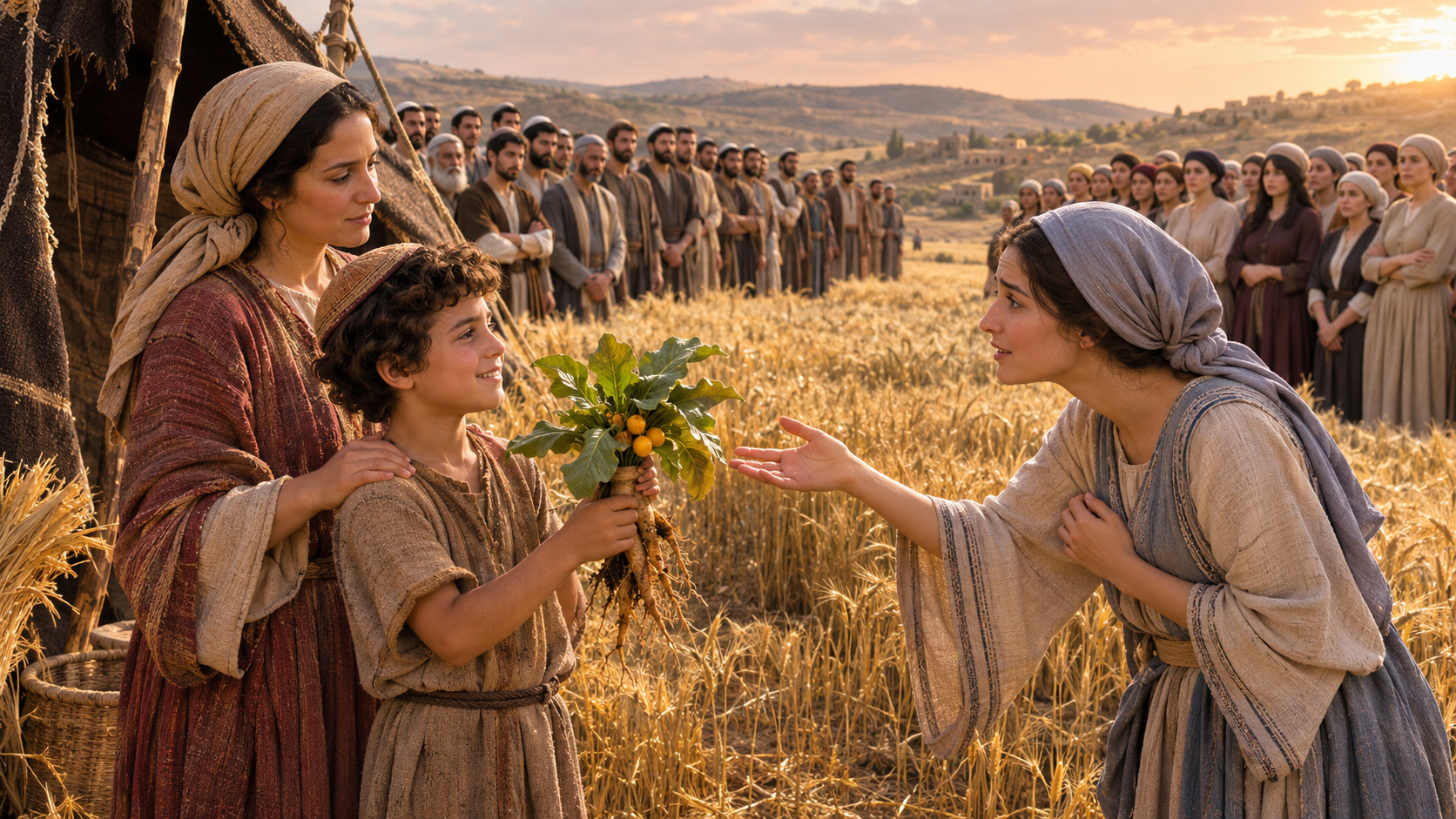
The second point is about the tribe of Yissachar. “And Reuven went in the days of the wheat harvest and found mandrakes in the field.” What are mandrakes? It is said they are a plant with a segulah, a special power, for fertility. “And he brought them to Leah his mother.”
Rachel sees this and thinks: they found mandrakes — maybe at last I can take some, and I will have children too. “And Rachel said to Leah: Please give me some of your son’s mandrakes.”
“And she said to her: Is it not enough that you have taken my husband, that you would also take my son’s mandrakes?” Why on earth should I give you any? Isn’t it enough that I know Yaakov loves you more than me? I give him children, you give him none, and still Yaakov’s heart is with you. You have taken Yaakov’s heart — and now you want my son’s mandrakes too?
You might say there is some nerve on Leah’s part here — even a touch of cruelty. After all, Rachel had given up, for Leah’s sake, the right to be first with Yaakov.
Our Sages offer two ways of seeing it. According to the first, Leah knew nothing at all about the arrangement between Rachel and Yaakov; it was hidden even from her, so that she would not be ashamed. That is the merit we find for Leah: she did not know. Leah thought all along that everything was in order.
According to the view that Leah did know Rachel had given way for her — why does she still say, “you won’t get any mandrakes”? To pain her even more, so that Rachel would grieve and pray all the harder to the Holy One, blessed be He, and Hashem would open her womb — as with Chana and Peninah.
Either way, Leah does not give them to her.
Rachel does not give up: “Therefore he shall lie with you tonight in exchange for your son’s mandrakes.” Tonight is my turn to be with Yaakov — they apparently had a fixed arrangement, who and when. Rachel says: I give up my turn in exchange for the mandrakes you will give me.
Rashi on the spot: “This night’s lying was mine, and I give it to you in exchange for your son’s mandrakes.” And immediately the criticism of Rachel: “And because she made light of lying with the righteous man, she did not merit to be buried with him.” Rachel is not in the Cave of Machpelah; Rachel was buried by the roadside.
Why? Because she gave up one night with Yaakov. True, she lost only one night, and in return she would have mandrakes and children — but she made light of being with the tzaddik. “And Yaakov came from the field in the evening” — all day long, who was he thinking of? Of Rachel. “And Leah went out to meet him and said: You will come to me, for I have hired you with my son’s mandrakes. And he lay with her that night.”
Our question: did anything good come out of what Rachel did? It cannot be that she did such a thing for nothing. Doesn’t she know what it means to give up being with Yaakov, the tzaddik? Leah was with Yaakov that night — and it was not for nothing. Something good came of it.
“And God listened to Leah, and she conceived and bore Yaakov a fifth son. And Leah said: God has given me my reward because I gave my maidservant to my husband; and she called his name Yissachar.”
How is Yissachar written in Hebrew? You hear one shin, but two are written: yod, shin, shin, kaf, resh. Split the word in two and you get yesh sakhar — “there is a reward.”
So how could Rachel do such a thing — make light of lying with the tzaddik and give it up, even at the price of not being buried with him in the Cave of Machpelah — and have nothing good come of it for her? Something very great came of it, not only for Rachel but for the whole people of Israel.
Where do we see it? In the Book of Yirmiyahu, as the people of Israel go into exile: “A voice is heard in Ramah… Rachel weeping for her children, refusing to be comforted.” And what does the Holy One, blessed be He, answer her? “Keep your voice from weeping and your eyes from tears, for there is a reward for your deed… and the children shall return to their own border.”
What is this “reward”? It is because Rachel gave up her night with the tzaddik — and because she kept silent. She did not say to Leah: how dare you speak to me like that, after I gave way for you? Even then Rachel held back. She did not want to shame Leah by revealing that she had passed the signs on to her, so that Leah would not be humiliated on her first night with Yaakov.
And in the merit of that silence the people of Israel are redeemed. The Holy One, blessed be He, promises: yes, they are going into exile now, but “there is a reward for your deed” — for that very deed you did, there is a reward. And what will we gain from it? “The children shall return to their own border.”
And with this I will close. There is a well-known Midrash. When the decree went out to destroy the Temple and the people of Israel were going into exile, Yirmiyahu went to the Patriarchs — to Avraham, to Yitzchak: pray that the decree be annulled, that Israel not go into exile.
Each one came and pleaded. Avraham: I bound Yitzchak on the altar. Yitzchak: I was the one bound on the altar. Yaakov: all that I suffered for my children. Moshe Rabbeinu: I ran before them for forty years in the desert to bring them out of Egypt. And the Holy One, blessed be He, turned them all away: the decree has been sealed.
Until Rachel came and said: one moment, forgive me — why were You angry with the people of Israel? Because they worshipped idols. What does that mean? That they took another in Your place? I too lived my whole life with another woman who took my husband from me — and I said nothing. And with the mandrakes as well, I said nothing.
That plea — the one no other plea could match — the Holy One, blessed be He, accepted: because you gave way to your sister, I promise you, “the children shall return to their own border.” And that is also why Rachel was not buried in the Cave of Machpelah: so that when the people of Israel go into exile, they will pass by Rachel’s tomb, see her grave, and be comforted.
So we learn that nothing a righteous man or a righteous woman does is ever lost, thank God. Even this sacrifice — giving up a night with the tzaddik — in the end, in its merit, we will be redeemed and come home.
And with God’s help, in its merit the Messiah will come and the Third Temple will be built, speedily in our days. Amen.
Genèse / Genesis / בראשית 28,10–13
Rachi sur Genèse / Rashi on Genesis / רש״י על בראשית 28,13
Genèse / Genesis / בראשית 30,14–18
Rachi sur Genèse / Rashi on Genesis / רש״י על בראשית 30,15
Yirmiyahou / Jeremiah / ירמיהו 31,15–17
Eikha Rabba / Eikhah Rabbah / איכה רבה · Petihta / Petichta / פתיחתא 24
Words of Torah do good when they are shared. Send this shiur to your family and friends on WhatsApp.
📲 Send on WhatsApp👥 Join the Gueoula groupTest yourself
Five questions on the shiur. Choose an answer.
Result
Shalom Bayit — The Mouth at Home
My covenant of peace — peace begins at home. Reveal a Shalom Bayit card.
Gematria — Rav Ménaché
Shalom, Mashiah, Yisamech — secrets of the letters by Rav Ménaché zatsal.
🔢 Gematria CourseTorah Study
Go deeper into Rashi on Genesis 28:13 and 30:15: “He folded the whole Land of Israel beneath him” and yesh sakhar — then the Midrash of Rachel’s plea (Eikhah Rabbah, Petichta 24).
📝 Beith HamidrachAll Parashot
All shiurim of M. Yéhouda Himi — from Bereshit to Devarim and the festivals.
📚 All ParashotBooks
Torah wisdom in thriller format — Éditions Gueoula.
Guardians of the Rift
Forty-nine gates open — the fiftieth hides in a single moment. An ancient secret resurfaces, and one man stands between the rift and the world. Drawn from Talmud and Kabbalah.
📖 Read the free excerpt · Book $9.90