Vayetze —
Dina, Asenat and Yosef’s Flame
On the 7th of Kislev, M. Himi continues Parashat Vayetze and focuses on Dina and on Yosef. Yaakov actually has thirteen children: there is also Dina. Rashi: Leah “judged within herself” — if it is a boy, my sister Rachel will not even be like one of the maidservants — she prayed, and the child became a girl. A daughter on the outside, but still a son within; that is why “Dina, the daughter of Leah, went out” — like mother, like daughter, as in “Leah went out to meet him,” a going-out for the sake of a mitzvah that brought Issachar into the world. But Shechem son of Chamor took her. The Yalkut Shimoni, in the name of the Midrash: Asenat, daughter of Poti-Phera, is the baby born to Dina from Shechem. Yaakov hung a gold plate around her neck — whoever marries her joins the seed of Yaakov — and the angel Gavriel brought her down to Egypt, to Potiphar’s house. Yosef saw the plate, asked to marry “the maidservant,” and married his niece. The Arizal: a spark of Rabbi Akiva was hidden in Shechem son of Chamor — like diamonds in a garbage bag, so that the sitra achra would not harm them. And right after Dina, Yosef is born, and Yaakov says “Send me away”: fire without a flame does not reach far.
Words of Torah do good when they are shared. Send this shiur to your family and friends on WhatsApp.
📲 Send on WhatsApp👥 Join the Gueoula groupToday, with Hashem’s help, is the 7th of Kislev. We continue Parashat Vayetze, and I want to focus on Dina and on Yosef. How many children does Yaakov our father actually have? We are used to saying twelve tribes. True, but in fact they are thirteen — because Dina was born too, and Dina is also Yaakov’s daughter.
And the Torah tells us that Dina did not just “go out” like that, by chance. We see Leah give birth to a son, and another son, and another son; then there is the matter of the dudaim, from which Issachar is born; then one more is born, Zevulun. “Afterwards she bore a daughter, and called her name Dina.”
It was supposed to be a boy? Exactly — that is what Rashi says there. Why was she called Dina? Because Leah “judged within herself” (“dana din”). She made the judgment between herself and herself and said: if it is a boy, my sister Rachel will not even be like one of the maidservants. She prayed for him, and he was turned into a girl.
Why does she pray precisely now that he become a girl? Because of Leah’s calculation: we are four wives — Leah, Bilhah, Zilpah and Rachel. On average, each one has to bring three children, so that there will be twelve tribes.
And why precisely twelve? Because when Yaakov goes out and places the stone under his head, that stone was twelve stones that merged into one. That was the hint that he would have twelve children.
So, three on average. In the meantime, only Leah is giving birth. If she has already had six, she has already reached half, and beyond six is more than half. It follows that Rachel, if she does not give birth, will be like one of the maidservants — and Leah did not want that. That is why she prays: if it is a son, let him become a girl. She prayed for him, and he became a girl.
Now we need to understand: how is this possible biologically? If she has already conceived and is carrying a son, she prays for him and he becomes a girl?
Up to forty days, one can pray, and the child’s sex can change. So Leah apparently “judged within herself” during those forty days, while it was still possible to change the situation.
But originally it was supposed to be a son. The fact that its sex was changed to a girl — that may be so outwardly, but inwardly it is still, in a sense, a son.
Why do we say this? Because girls usually do not go out and walk around outside — “all the glory of the king’s daughter is within.” And we know that Dina’s story does not end here. In chapter 34 it is written: “Dina, the daughter of Leah, whom she had borne to Yaakov, went out to see the daughters of the land.”
Why are you walking around outside? She apparently felt secure enough — because inside she is a son. She can walk around, what could possibly happen? And she went to see the daughters of the land. Only, there was a mishap.
Here Rashi stops and asks: why is it written “Dina, the daughter of Leah, went out”? We know she is Leah’s daughter — we just read that Leah gave birth to her. Why does the Torah stress “the daughter of Leah, whom she had borne to Yaakov,” and not “the daughter of Yaakov”? Because of her going out she is called the daughter of Leah, for Leah too was one who “went out,” as it is written: “Leah went out to meet him.”
You remember that yesterday we learned about the dudaim: they made the deal — “therefore he shall lie with you tonight” — and Yaakov comes back from the field; in his mind, it is Rachel’s turn. “Leah went out to meet him” and tells him: my dear, tonight you are with me — “for I have surely hired you with my son’s dudaim.”
So Leah went out; she was a “yatzanit,” one who goes out — heaven forbid, not in the sense the word has today. Clearly it was for the sake of a mitzvah: the holy Matriarchs did it for the sake of a mitzvah, and the proof — Issachar came out of it, one more tribe in Israel.
Issachar is not just any tribe. We know there is the partnership of Issachar and Zevulun. Issachar’s role: “chamor garem,” a strong donkey. What donkey? A donkey that carries books. They are the ones who learn Torah in Israel, and Zevulun is the one who supports them. So Issachar did not come out of this story by chance.
But the very fact that Leah went out to meet Yaakov — just as she “went out” in the positive sense, so too Dina: “Dina, the daughter of Leah, went out.” From here comes the saying: like mother, like daughter. She went out like her mother.
Now we need to understand: why would the daughter Dina do such a thing? For there was a danger in it — and the danger came true. Shechem son of Chamor sees her, takes her to his house and violates her, as the Torah says: “he took her, lay with her and afflicted her.”
This means there is something here that is not by chance. Something caused Dina to go out and be taken, and caused this to happen. We will soon see what is hidden in this.
Yaakov’s sons do what they do with the people of Shechem: they play a trick on them — become like us, we will circumcise you — and on the third day they kill them all, and they take Dina out of the king’s house. Where does this story continue? Further on in the book of Bereshit, with Yosef.
Yosef arrives in Egypt and rises to greatness. It is impossible for him to be Pharaoh’s second-in-command and remain single — so they look for a wife for him; he has to be married. “Pharaoh said to Yosef: I am Pharaoh, and without you no man shall lift up his hand or his foot in all the land of Egypt.” And in chapter 41: “Pharaoh called Yosef’s name Tzafnat Paneach, and he gave him Asenat, the daughter of Poti-Phera, priest of On, as a wife.”
Who is this Asenat, daughter of Poti-Phera? And who is Poti-Phera? Poti-Phera — that is Potiphar.
And everyone asks: how can it be that Yosef marries a non-Jewish woman? It is not that he had much choice — in Egypt there was not yet a single Jew. But how does he marry a non-Jewish woman? And on top of that, Menashe and Ephraim are born to him from her!
They become like one of the tribes of Israel — the “tribes of Yah,” fifteen: twelve children, Menashe and Ephraim, fourteen, and Dina. And they receive such a status that we bless: “May Elokim make you like Ephraim and like Menashe” — and they were born, at best, from a convert?
But here is the answer: the Yalkut Shimoni, in the name of the Midrash, brings that Asenat, daughter of Poti-Phera, is no more and no less than that baby born when Shechem son of Chamor violated Dina. That very child.
And how did she end up in Egypt? The Midrash says: as soon as Dina conceived from Shechem son of Chamor and gave birth to a baby girl, they wanted to kill her — so that people would not say that in Yaakov’s house grew up a daughter born of harlotry, heaven forbid.
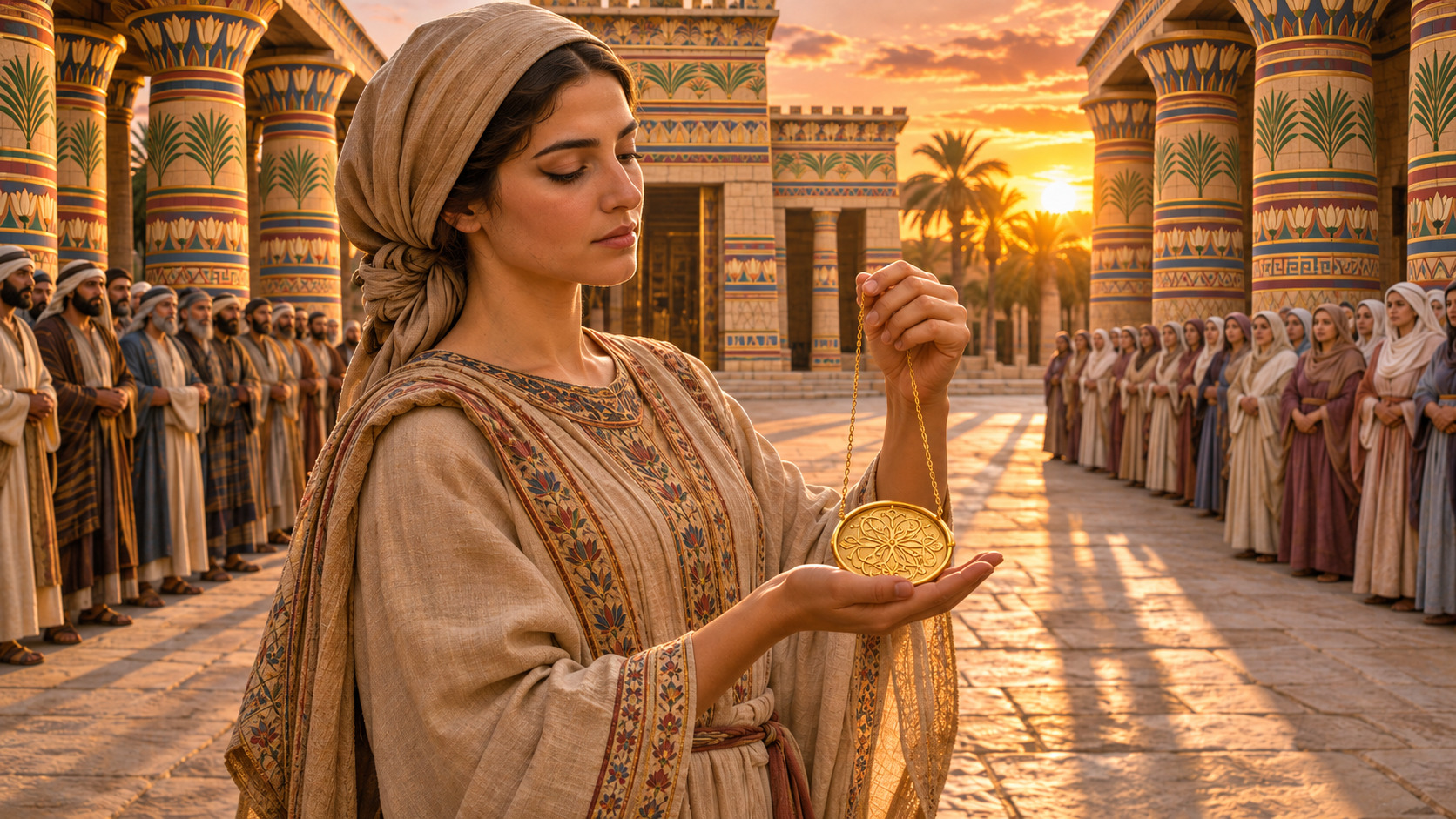
And Yaakov saved this baby. He took a gold plate and wrote on it: whoever marries this girl joins the seed of Yaakov. He put this ornament around her neck and sent her on her way. And Targum Yonatan ben Uziel brings a Midrash that the angel Gavriel brought her down to Egypt.
What is the first stop when you arrive in Egypt? The place that buys the slaves. Who bought Yosef as a slave? Potiphar. In the same way, Potiphar sees this sweet little girl. And Potiphar’s wife was barren and had no children — so they adopt the girl and raise her as their own daughter. That is why she is called “Asenat, daughter of Poti-Phera”: whoever adopts a child and raises him is considered as if he had given birth to him, as if he were his father and his mother.
And did Potiphar’s wife have ruach hakodesh? She had “ruach hakodesh” from the other side, from the sitra achra — since she tried to seduce Yosef. But we will talk about Potiphar’s wife when we reach Parashat Miketz.
I want to focus on this little girl, Asenat. What happens? Pharaoh says to Yosef: I want you to marry — do you have any preference? Yosef answers: listen, I am a slave. The fact that I have now risen to greatness — I do not forget that I was a slave. It suits me to marry a maidservant; I am not going to marry some princess now. A slave — a maidservant suits him. Well then, whom do you want? When I was a slave at Potiphar’s, there was a young woman there, a maidservant — she is the one I want to marry.
Why does Yosef want her in particular? Because when Yosef arrived at Potiphar’s house and saw this girl, he noticed that she had the gold plate, with what Yaakov had written on it. Only he could read that Hebrew: whoever joins this girl joins the seed of Yaakov. And they decided between them to keep the secret, that neither would tell about the other. And when Pharaoh asks whom he wants to marry — he takes this girl as his wife: his niece. Chazak u’varuch!
What was so special about her? And why does Hashem arrange that Dina should go out precisely to see the daughters of the land, that Shechem son of Chamor should be with her and make her pregnant, and that this Asenat should come from her?
The Arizal explains in the teaching of reincarnations: hidden in Shechem son of Chamor was a spark of Rabbi Akiva. He passed it on to Dina, who gave birth to Asenat, who joined with none other than Yosef. And Rabbi Akiva is Rabbi Akiva ben Yosef. It was a passage through non-Jews, and it is hinted: “the land is wide enough before them” — that is Shechem son of Chamor.
In any case, Hashem does it deliberately. He moves very lofty souls through stories of which you would say: there is no chance this will happen. And the spark travels on, until it reaches Rabbi Akiva. Why does Hashem do this?
As we once explained: a diamond merchant who wants to take his diamonds to the bank vault will not put them in a gold-plated Louis Vuitton bag, because then everyone will say: he has something very valuable there. He will put them in a black garbage bag and walk into the bank with that — so that no one suspects there are diamonds inside.
In the same way, Hashem moves the lofty soul of Rabbi Akiva along this tortuous path — so that the sitra achra will not harm it and will not foil the plan.
As with King David, for example. What is his history? He comes from Ruth the Moabite, who came, so to speak, from the forbidden union of Lot with his daughters. That is where you hide the soul of King David — because there no one suspects it is to be found, and no one will try to make it stumble. These are the ways of Divine conduct, the ways of Providence.
Our time is already up, let us just take the continuation — notice how the story closes. We said that Leah did not want to give birth to more than six sons, so that Rachel would not be left with nothing. Who is born right after Dina? Yosef. So first of all, Leah’s “patent” worked — and right after that, Yosef was born. And Yosef, later on, married his niece. You see the connection.
“She conceived and bore a son,” Yosef — “And it was, when Rachel had borne Yosef,” immediately: “Yaakov said to Lavan: Send me away, and I will go to my place and to my land.”
Why is it precisely when Yosef is born that Yaakov says: now we go? If Yaakov knows he is meant to have twelve children, Yosef is the eleventh. Binyamin has not yet been born; Binyamin will be born only in the Land. So why do you get up precisely when Yosef is born? Wait until Binyamin is born too, and then go.
This is exactly what Rashi explains, and with this I conclude, because it is a very, very important foundation. “When Rachel had borne Yosef” — once Esav’s adversary was born, as it is said: “The house of Yaakov shall be fire, the house of Yosef a flame, and the house of Esav straw.” Fire without a flame does not reach far; once Yosef was born, Yaakov trusted in Hashem and wanted to return.
What does this verse mean? Yaakov is, so to speak, fire. So if Esav is straw, what is the problem — let the fire burn the straw! But that is not enough: the fire is here, and the straw is over there. What do we need? A flame. Yaakov’s flame is Yosef. Then Yaakov feels secure enough to set out back to the Land; and if he meets Esav, he will be able to overcome him, with Hashem’s help.
And this is also what we await for the complete redemption: that at last we will be rid of Esav as well. “Saviors shall go up on Mount Zion to judge the mount of Esav, and the kingship shall be Hashem’s”; “Hashem shall be King over all the earth; on that day Hashem shall be One and His Name One.”
Genèse / Genesis / בראשית 30,14–25
Rachi sur Genèse / Rashi on Genesis / רש״י על בראשית 30,21
Rachi sur Genèse / Rashi on Genesis / רש״י על בראשית 30,25
Genèse / Genesis / בראשית 34,1–2
Rachi sur Genèse / Rashi on Genesis / רש״י על בראשית 34,1
Genèse / Genesis / בראשית 41,44–45
Genèse / Genesis / בראשית 48,20
Words of Torah do good when they are shared. Send this shiur to your family and friends on WhatsApp.
📲 Send on WhatsApp👥 Join the Gueoula groupTest yourself
Five questions on the shiur. Choose an answer.
Result
Shalom Bayit — The Mouth at Home
My covenant of peace — peace begins at home. Reveal a Shalom Bayit card.
Gematria — Rav Ménaché
Shalom, Mashiah, Yisamech — secrets of the letters by Rav Ménaché zatsal.
🔢 Gematria CourseTorah Study
Go deeper into Rashi on Genesis 30:21, 34:1 and 30:25: Leah’s prayer, “the daughter of Leah” — and Yaakov’s fire that needs Yosef’s flame.
📝 Beith HamidrachAll Parashot
All shiurim of M. Yéhouda Himi — from Bereshit to Devarim and the festivals.
📚 All ParashotBooks
Torah wisdom in thriller format — Éditions Gueoula.

Guardians of the Rift
Forty-nine gates open — the fiftieth hides in a single moment. An ancient secret resurfaces, and one man stands between the rift and the world. Drawn from Talmud and Kabbalah.
📖 Read the free excerpt · Book $9.90