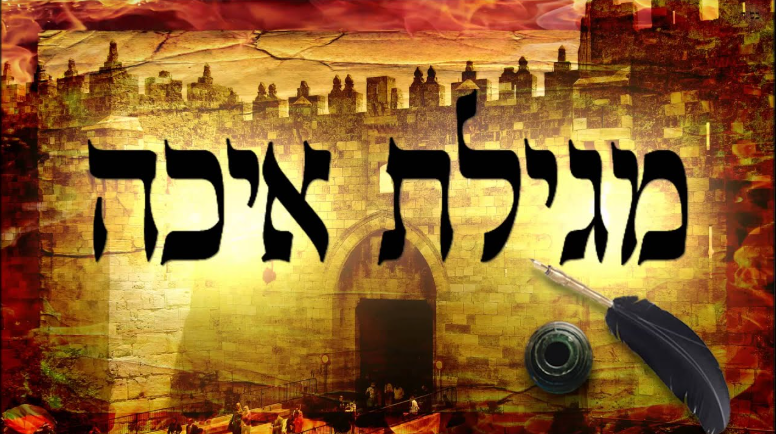
Three prophets — Moses, Isaiah, Jeremiah — cry "Eikha" over Israel in tranquility, fallen strength, and exile.
Moses' "tranquility" hides a danger: boredom, endless litigation, suspicion and strife, as Rashi explains.
The word "Ayeka" ("Where are you?") spoken to Adam can also be read "Eikha": an eternal call to self-awareness.
Israel is called "Adam," charged with Tikkun Olam; the name holds two paths: "adama" (dust) or "Edameh la'elyon" (to resemble the Most High).
Every 9th-of-Av dirge ends in consolation: God's love prevails, and redemption hinges on our answer to "Eikha?".
The Midrash on Lamentations teaches that three prophets, like three attendants of honor, accompanied the Community of Israel at different stages of her history. Each saw her from a unique angle and voiced his vision with the same powerful word: "Eikha" (Alas, how).
In Deuteronomy, just before the 9th of Av, Moses laments over the people's relative prosperity and peace, which were already breeding trouble.
Isaiah sees Israel at the height of her power, yet already corrupted by idolatry, debauchery and injustice.
Jeremiah, prophet of the destruction, saw with his own eyes the Temple set ablaze and the people led into exile. He opens the scroll of Lamentations with this cry.
At first glance, the "tranquility" Moses saw seems a blessing. But analyzing his words reveals a deep hidden calamity. How can such a state be called "tranquil"?
It is boredom and the absence of challenge that breed such behavior. When all is well, a person starts inventing problems: that is the danger of tranquility.
To grasp the power of "Eikha," we must go back to the very first man. After Adam sinned, the Holy One, blessed be He, calls out to him in the garden.
God knows exactly where Adam is. This question is no request for information but an attempt to awaken him, to bring him to self-awareness. Now, if we take the word "Ayeka" unvocalized, it can be read "Eikha": the divine question posed to man becomes the question man must ask of himself.
The Torah constantly seeks to awaken man so that he asks where he stands. The prophet Ezekiel says: "You, people of Israel, are called 'man' (Adam)", and our Sages explain that the nations of the world are not called "man" with the same intensity.
Our distinctive quality is to be "men." Of all the descendants of the first Adam, God willed that Israel be the group that would bring the world to its repair (Tikkun Olam). That is why this "man" must ceaselessly hear the voice that calls to him.
Man is called "Adam." This name holds two fundamental possibilities, two paths he may take.
Man therefore holds two potentials: to be adama, to behave basely with his head bent toward the earth like a beast; or to be Edameh la'elyon, to look upward and seek to resemble God, as it is said, "You made him a little less than the angels." On what does this depend? On our answer to the question "Eikha?". If you awaken, you can become Edameh la'elyon.
All the dirges (kinot) we recite on the 9th of Av always end with a verse of consolation: we never lose hope. Even in the Haftarot of calamity, light breaks through. In the last Haftara we read, God says:
We are the firstborn, the first fruits of the Holy One; "all who devour him shall be guilty; evil shall come upon them." In the end, God's love always prevails.
If we choose to be Edameh la'elyon, if we heed the question "Eikha?" and strive to rise, then we will hasten the redemption: the Messiah will come, the Third Temple will be built, perhaps even before the next 9th of Av. Amen.
🎯 Test yourself
Five questions. Click an answer.
Result
Shalom Bayit — The Mouth at Home
My covenant of peace — peace begins at home. Reveal a Shalom Bayit card.
Gematria — Rav Ménaché
Shalom, Mashiah, Yisamech — secrets of the letters by Rav Ménaché zatsal.
🔢 Gematria CourseAll Parashot
All shiurim of M. Yéhouda Himi — from Bereshit to Devarim and the festivals.
📚 All ParashotBooks
Torah wisdom in thriller format — Éditions Gueoula.
Guardians of the Rift
Forty-nine gates open — the fiftieth hides in a single moment. An ancient secret resurfaces, and one man stands between the rift and the world. Drawn from Talmud and Kabbalah.
📖 Read the free excerpt · Book $9.90