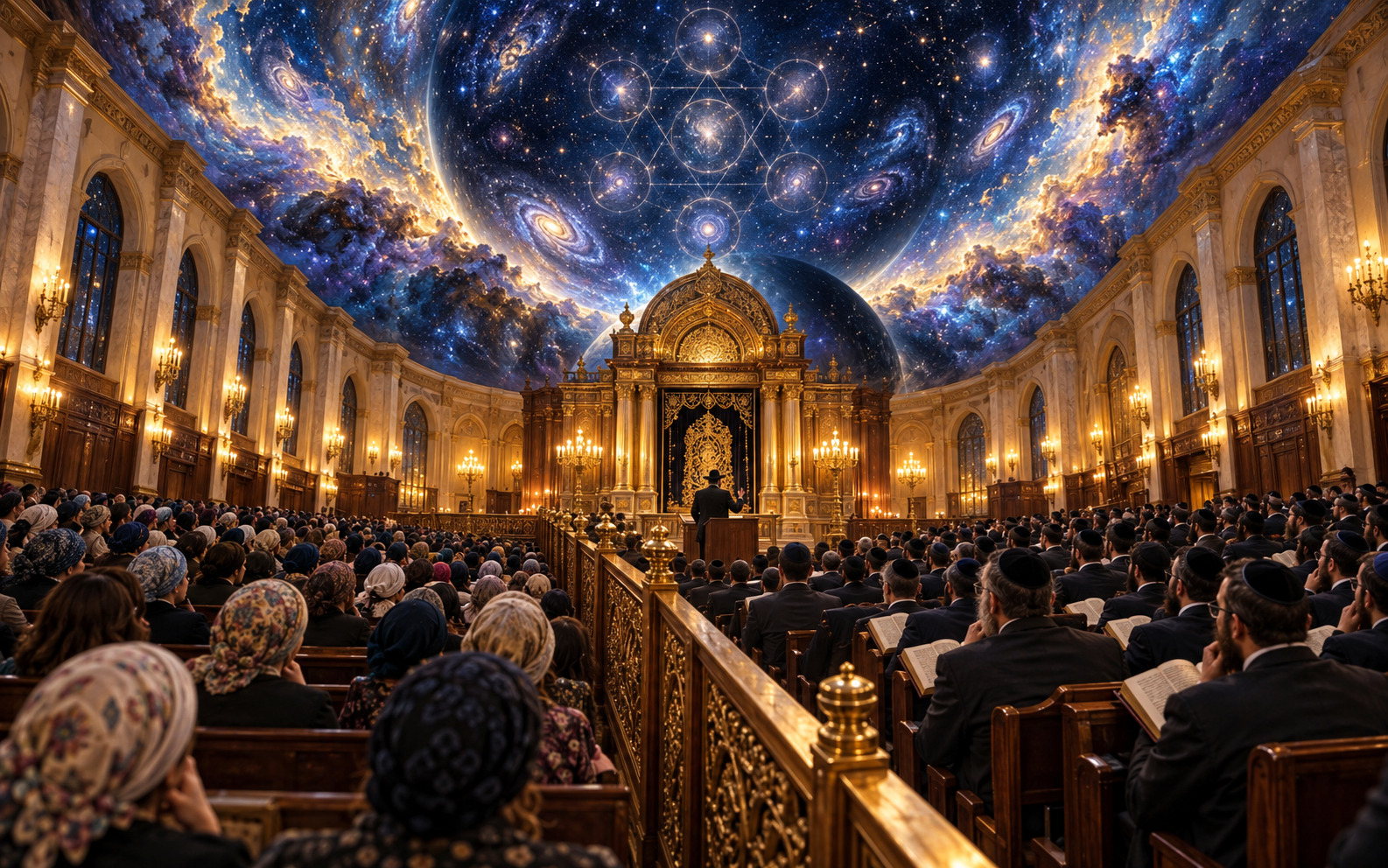
🎙️ A lecture given at Beit Knesset Eikhal Etan — 5 Stamper Street, Netanya The first lecture in the series "From Creation to the Big Bang"
From Creation to the Big Bang — the infinite light, the shattering of the vessels and the secret of the Menorah
Lecture · Eikhal Etan, Netanya
From Creation to the Big Bang
The infinite light and the darkness · The shattering of the vessels · The secret of the Menorah and the Magen David
A lecture by Yehouda Ben Danan
🎥
🎥 Watch the lecture · in French
From Creation to the Big Bang — Eikhal Etan, Netanya
▶ Open on YouTube
From Creation to the Big Bang
Yehouda Ben Danan · Eikhal Etan, Netanya

The moment you name a thing, you limit it. The Creator being infinite, no name can designate Him: every Name we know designates not Him but the way He manifests in this world. The closest to Him and the furthest from us is called Or Ein Sof, the infinite light.

Why create, if nothing is lacking? Because what one loves, one wishes to share. But to give, there must be a receiver — and the only system able to receive light is darkness. A sphere of darkness therefore opened within the light, and the light was left with a single desire: to return to its place.

That is the shattering of the vessels: the outer light penetrates the universe and turns into billions of galaxies. This is what science calls the Big Bang — except that science sees an explosion of matter where we have received that it is an entry of light.

Then the lecture descends from the heavens toward us: the Name Shaddai and the number 314, the seven circles of the Magen David, the symmetry of the Menorah across the six days, the human body built on the same plan — and finally the true sin of Adam, which is not the one we assume.

📖 Read the lecture
⛶ Watch the animation full screen
1 To name is to limit

This is a glass. This is a chair, that is a camera. The moment a thing is named it becomes limited: it is that thing and nothing else.

But the Creator is infinite and without limit. How then can He be given a name? If we name Him we define Him; and if we define Him, it is no longer He.

You will object: but there are Names — Elokim, Shaddai, Shalom, and thousands more. How is that to be understood?

2 The Names are manifestations

Like everyone, I have several traits of character. Sometimes I am generous, sometimes less so. Whoever sees me generous will say: there is a generous man. Whoever sees me otherwise will say something else. In other words: the way I am perceived receives a name.

⭐ So too, all the Names we meet are not Him: they are His emanations, the way He acts in this world and the way we perceive Him. And since He acts measure for measure, according to our own way of functioning, those Names are countless: every word of the Torah, indeed every letter, is a Name.

We human beings are finite: a beginning, an end. It is therefore not in our power to grasp what lies beyond all limit. But the kabbalists sought to go as far as one is permitted to go.

3 Or Ein Sof — the infinite light
The Name closest to Him and furthest from us is called Or Ein Sof, the infinite light. Why light? Because we see stars billions of light-years away: on our scale, light is that which has no end.
4 Why create, if nothing is lacking?

That is the question my grandson used to ask me, over the telephone, for years — and it was his questions that eventually became a book, the story of a grandfather and a small boy.

If the Creator is perfect, why did He need to create? He lacks nothing — and least of all us.
⭐ And the grandfather answers: because when you possess something you love more than anything, you want to share it. You look for someone to let enjoy it.
5 What can receive the light?

Ask yourself: what system is capable of receiving light? Night, someone answered from the hall. More generally: darkness.

I form the light and create the darkness Yeshayahu 45, 7

He therefore created what is called the ratzon lekabel, the will to receive. For He is mashpia, the One who gives; and if I give and no one is there to receive, nothing happens. Life exists only from the moment there is a transfer between the giver and the receiver.

Take a river. Flowing water is clear, you want to drink it. The water of a marsh, motionless, you would not even bathe in. Life is movement — and here the movement is the passage from giver to receiver.
6 The sphere of darkness

He opened a space of darkness, which grew and grew, until it took on such proportions that we, who are inside it, have the impression that it is infinite.

But it is not. Behind the universe there is His light — still not He, but His light. There are now two spaces: that of light, and that of darkness.
7 The dam
Picture a mountain with a river running through it. I want energy: I build a dam, a wall. The water gathers behind it, and that wall I must raise in height and in thickness, ever more solid — otherwise the water will carry everything away and take back its place.

That is what happened with the light. It filled everything; and now an enormous volume of darkness is planted in the middle. What does the light want? To return where it was. Its place was taken; it gathered on the rim of the universe, and it wants to come back.

⭐ We know that feeling. You arrive five minutes late at the Beit Knesset and someone is sitting in your seat. You will be courteous, you will sit elsewhere — but it troubles you. That disturbance comes from the primordial light, which wanted one thing only: to return to its place.
8 The shattering of the vessels — and the Big Bang

This is what is called Shevirat haKelim, the shattering of the vessels: the universe cracks, and the light that remained outside penetrates within.

But at the moment of that penetration, what happens? That light was purely spiritual, impalpable. Think of lightning: electricity between the clouds, and suddenly a discharge that splits a tree or destroys a building. Here it is lightning on the scale of the universe.
That light turns into magma and produces the billions of constellations we see. That is the Big Bang. Scientists think an enormous mass exploded and produced the galaxies. What we received through Moshe Rabbeinu and those who transmitted this teaching is something else: the outer light entered the universe and turned into galaxies.

This meeting of light and darkness is the model of every union: the light is the principle that bestows, the darkness the one that receives. That is why, when a man marries a woman, he offers her jewels — the image of those billions of stars — for he is about to reproduce, on his own scale, the creation of the world.

9 "Dai" — and the Name Shaddai

Have you ever seen a tsunami on television? Do you believe that wave can be stopped? So it is here: that profusion of light turned to magma went out in every direction, and the universe was nearly carried away by it.

I am the One who said to the world: enough Chagiga 12a, teaching of Resh Lakish
⭐ He halted the universe with the Name Shaddai, written shin, dalet, yud. And if you count: shin is 300, dalet 4, yud 10. Total: 314. Does that remind you of nothing? It is the number with which circles and spheres are calculated.
10 A ball resting on nothing

It is told that the son of Resh Lakish was coming out of the yeshiva, and Rabbi Yochanan asked him what he had studied that day. The child answered: that the world is like a ball resting on nothing.

How could a child, twenty-five hundred years ago, know that the earth was round and rested on nothing? Not so long ago it was still believed to be flat.

And that is not the only instance. In the Pitum haKetoret, which we say every morning, it is said that three hundred and sixty-eight measures were prepared, three set aside, leaving three hundred and sixty-five, like the days of the solar year. We have known all along that the earth is spherical and that the year has three hundred and sixty-five days.

11 Seven circles — the origin of the Magen David

With the Name Shaddai we enter the circles. So here is a simple question: how many circles of equal size can you place around one circle?

Take glasses: one glass at the centre, and you place six around it. Seven in all, counting the middle one. That is why the world was created in six days, with the seventh at the centre.
⭐ And if you draw those six circles around the seventh, the figure that appears is the Magen David. That is its origin: the six days of creation around the seventh, which is Shabbat.

3D animation: the seven spheres, the Magen David, the twelve tribes around the Kohanim, then the Menorah. Drag to rotate, “Replay” to start again. Open full screen

12 Bereshit — two beginnings

A book normally begins with one beginning. But we read Bereshit, which can be heard as bet-reshit: two beginnings. Why two?

In the beginning God created the heavens and the earth Bereshit 1, 1
The heavens and the earth: the spiritual part and the material part. The world indeed has two beginnings — a beginning of the spiritual and a beginning of the material.
13 The body built on the same plan

Do you know that you are built on that same model? Look: above, the head and the two arms; below, the two legs. That makes six extremities — and at the centre, the trunk.

⭐ And this is how Shabbat works. The trunk is in the middle: when you eat, the food descends into it. What does it do with that food? It does not keep it — it gives life to all the peripheral organs. Not one of them takes in food by itself; it is the centre that feeds all the rest.
Exactly so with Shabbat: six days shall work be done, and on the seventh you shall rest. Shabbat corresponds to the trunk — it is what gives energy to the six days of the week. By keeping your Shabbat, you give life to your whole week.

Look at your face too: two eyes, two ears, two nostrils — six openings — and a single mouth at the centre. The Sages relate that the mouth complained: why am I alone? It was answered that with two mouths one would speak twice too much. But the mouth is the Shabbat of the face: through it the food enters, and it is the mouth that feeds the whole body.

14 The secret of the Menorah

Let us now verify all this on the Menorah. The branches face the centre: on one side the first, second and third days; in the middle Shabbat; on the other side the fourth, fifth and sixth.

The first day faces the fourth. On the first day, light — the light that enters, the encompassing light. And on the fourth day: sun, moon and stars, that is, the inhabitants of the light, the inner light.
The second day faces the fifth. On the second, He separates the upper waters from the lower. On the fifth, He creates the fish and the birds — the inhabitants of the lower waters and of the upper waters. Indeed shamayim, heaven, reads as sham mayim: there is water there.
The third day faces the sixth. On the third, the waters withdraw and the earth emerges. On the sixth, from that earth are drawn the animals and man.
15 The earth that disobeyed to preserve life

On the third day an order is given to the earth: bring forth a fruit tree making fruit — that is, a tree whose very wood would have the taste of the fruit. And the earth brings forth a tree of wood bearing fruit. It did not do what was asked.

Why? The Sages considered the question.
⭐ The earth said to itself: men want to be served at once. When there is no fruit left on the tree and the tree itself tastes of fruit, what will they do? They will eat the tree. And if they eat the tree there will be no more fruit; and with no more fruit there will be nothing to eat; and with nothing to eat there will be death. So it made a tree of wood, inedible, so that men would be obliged to work and there would always be fruit.

In other words: that disobedience was to preserve life.

16 And on the other side of the Menorah

Remember the principle: what you find on one side of the Menorah, you find its opposite facing it. If on the third day the earth disobeys to preserve life, then on the sixth day man, drawn from that same earth, receives an order — do not eat of this tree — and his disobedience will bring the opposite.

Then, within that same sixth day, it is said: it is not good for man to be alone. And from man the woman is drawn. Man and woman are not the same thing, whatever we are urged to believe today: each has his own place and his own role.
And consider how the prohibition is framed. If I set a thousand things before you and say: take whatever you wish, but the one in the middle you shall not touch — what have I done? I have focused your attention on that one thing. You will think about it, you will wonder why. In truth that sin was a necessary road.
17 We begin to die on the day we are born

I am going to say something that requires a prepared audience. If you stop eating, drinking and breathing, what happens? We therefore spend our time dying — and by eating, drinking, breathing and tending to ourselves, we keep ourselves alive.

⭐ In parashat Tazria, Rashi explains that the moment the child comes out of its mother's womb is called peter hakever, the opening of the grave. And the cemetery is called beit hachaim, the house of the living. In other words: we begin to die on the day of our birth, and we stop dying on the day we leave this world. It is the reverse of what we were taught at school.

Why? Because we are not bodies: we are souls. The body is a tool. The driver is not the car; when the car is finished, the driver takes another.

18 Why this world
Take a child: give him everything — internet, telephone, computer, scooter. Then ask him to tidy his room. He will have no time. Why? Because he lacks nothing. It is from the moment lack appears that one begins to ask questions.

That is why this world was created: we enter it in bodies that are constantly breaking down, and we are forced to seek our sustenance without pause. And since the soul is immortal — a part of the Eternal, therefore eternal — it is precisely in this confrontation with its opposite that it is built. It is in the face of destruction that the soul constructs itself.

⭐ In the other world one cannot build, for nothing is lacking there. And there is what is called nahama dekisufa, the bread of shame. You know it: when you are invited you do not arrive empty-handed — no one likes to feel indebted. That feeling comes to us from the other world.
19 Adam's true sin

We have said that the sin was unavoidable. Why then were they driven from Gan Eden? Because it is not that sin they are reproached for.

The woman whom You placed with me, she gave me of the tree, and I ate Bereshit 3, 12
⭐ There is the true sin. What should he have said? I ask Your forgiveness, I have sinned, You gave me an order and I did not keep it. Instead: the woman You gave me — which is to say, You are responsible. He did not acknowledge.

And to this day we have inherited it: the little boy who breaks a glass answers at once it was my brother. We have a natural tendency to shift the fault onto someone else.

20 Yehuda and Tamar — to acknowledge, and receive kingship

See the opposite. Yehuda is then av beit din, head of the court. Tamar does not accuse him publicly: she says only that the child belongs to the owner of these objects. He could have kept silent, let it pass, let her be condemned.

She is more righteous than I Bereshit 38, 26
He acknowledged immediately, in a second. That is why he received malchut, kingship — and why kingship will never depart from Yehuda. When a man is able to acknowledge his wrongs, he draws kingship upon himself.

So do not be afraid to acknowledge. No one will accuse you for having done so.

21 "I understand"

A word about communication — which is not the telephone or messaging apps, but the art of speaking with one another. When someone comes to reproach you with something, even if you cannot bring yourself to agree, there is one sentence to say: I understand that you may be angry.

It is the valve of the pressure cooker. You lift the little cap, the steam escapes, and the pressure drops: at last you can open the lid. If, facing someone who is angry, you grow angry in turn, the pot explodes. To say I understand is to acknowledge that you have a share in the other's anger — and it removes an enormous number of problems.
⭐ It is also why we are called Adam. Every day in prayer — except in Tishrei, on the festive days — we say that we have sinned. We are the people able to acknowledge our wrongs. And if someone objects that he has not committed every sin on the list: all Israel are responsible for one another — what you have not done, another has, and by acknowledging it we repair.
22 The bush that burns and is not consumed

One last point. Where does Moshe Rabbeinu receive the first revelation? At Sinai. Listen to the word: within it one hears sin'a, hatred. Hatred came down into the world together with the revelation. And what is the bush called? The sneh — the same letters.

That bush burns and is not consumed. And Moshe understands: the bush is the people of Israel. We will always be there, without exception; we will burn, but we will never be consumed. They may persist — we always return. The smallest of peoples, and no one can destroy it.

Moshe at first drew back: how can one announce to people suffering in Egypt that there will be suffering still? And he was answered that he had no choice.

⭐ For do you know how metal is hardened? It is plunged first into fire, then into water. And the water, here, is the Torah. When Israel passes through fire, the water of the Torah comes immediately after — and what emerges is a people stronger than before.

🎯 Test yourself

Five questions. Click an answer.

1
Why can no name be given to the Creator?
Every Name we know tells how He acts in this world, not what He is.
2
What is the only system able to receive the light?
To give, there must be a receiver: life exists only in the passage from giver to receiver.
3
What is the gematria of the Name Shaddai, and what does it point to?
Shin 300, dalet 4, yud 10. It is by this Name that He said to the world "enough".
4
Why did the earth bring forth a tree of wood instead of a tree tasting of fruit?
And facing it, on the other side of the Menorah, the disobedience of the sixth day will bring the opposite.
5
What is the true sin for which Adam is reproached?
Unlike Yehuda, who acknowledged in a second — and received kingship for it.

Result

📅 Seven-day program
Sunday
Reread Bereshit 1, 1 and look for the two beginnings: the spiritual and the material.
Monday
Take seven glasses and set them out: one at the centre, six around. Look at the figure you get.
Tuesday
Read the six days of creation and check the correspondences 1-4, 2-5, 3-6 for yourself.
Wednesday
Say the Pitum haKetoret, paying attention to the 365 measures.
Thursday
Once today, acknowledge a wrong without justifying yourself. One sentence is enough.
Friday
Prepare for Shabbat thinking of it as the centre that feeds the six days.
Shabbat
Say to someone, and mean it: "I understand." Watch what happens.
Four Practical Steps
🏠

Shalom Bayit — The Mouth at Home

My covenant of peace — peace begins at home. Reveal a Shalom Bayit card.

🔢

Gematria — Rav Ménaché

Shalom, Mashiah, Yisamech — secrets of the letters by Rav Ménaché zatsal.

🔢 Gematria Course
📝

Torah Study

Dig deeper into the Rashi and the masters of Kabbalah on the account of Creation.

📝 Beith Hamidrach
📚

All Parashot

All shiurim of M. Yéhouda Himi — from Bereshit to Devarim and the festivals.

📚 All Parashot
📕

Books

Torah wisdom in thriller format — Éditions Gueoula.
🌙

Dream Interpretation

Did you dream? Check the meaning according to Rav Almoli.

🌙 Dreams
🎬

Videos

Video shiurim on the festivals, the Menorah and the secrets of the Mishkan.

🎬 Videos
💡

Idea Box

An idea, a remark, a suggestion for the site? Share it with us.

💡 Idea Box
🤝

Maasser

Give your Maasser and take part in spreading Torah.

🤝 Maasser
📨 Get the Weekly Shiur
Every week, straight to your inbox. No spam. One-click unsubscribe.
🕯️ Dedicate This Shiur
Dedicate this shiur for the days of Bein HaMetzarim — in memory, for healing or for success.
🧱 Wall of Dedications →
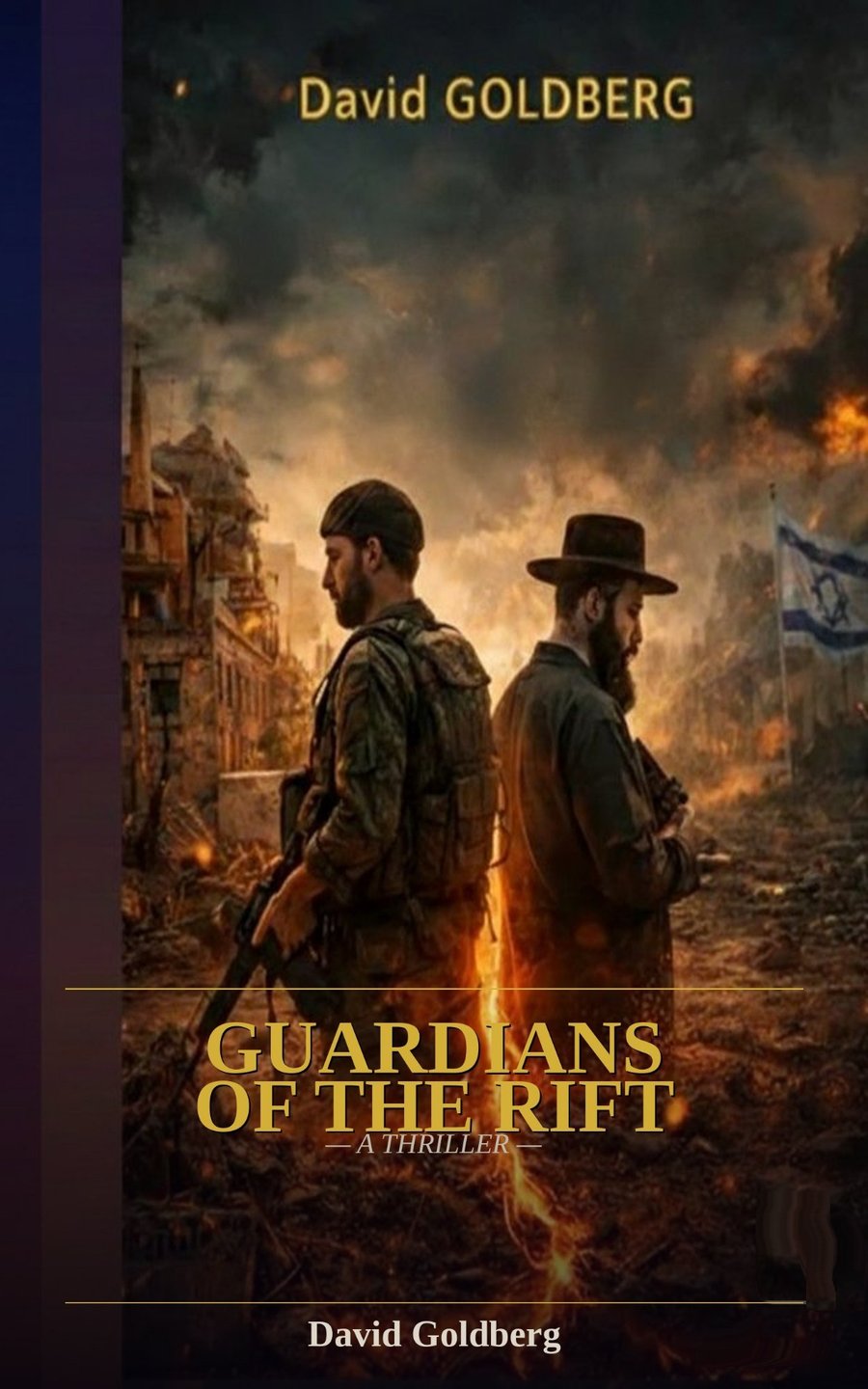
Guardians of the Rift

Guardians of the Rift

A spiritual thriller · David Goldberg

Forty-nine gates open — the fiftieth hides in a single moment. An ancient secret resurfaces, and one man stands between the rift and the world. Drawn from Talmud and Kabbalah.

📖 Read the free excerpt · Book $9.90