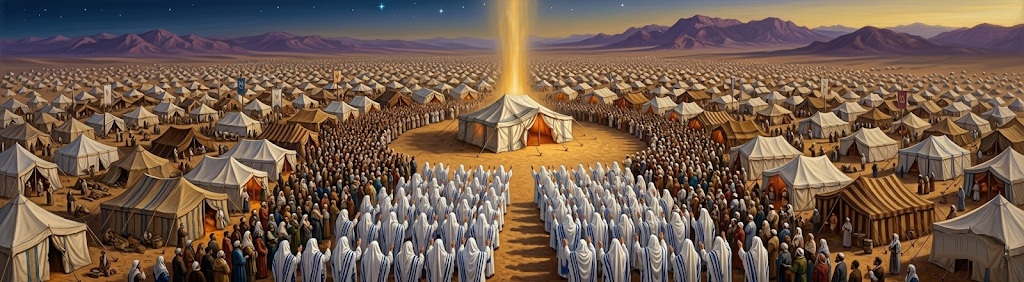
When God Places His Name Upon You
Éditions Gueoula · Paracha Nasso 5786
The longest paracha of the Torah holds four mysteries — the Sotah, the Nazir, the Priestly Blessing, the Princes' gifts. One thread runs through them all: how God places His Name upon Israel.
Parashat Nasso — Summary
Nasso is the longest paracha in the Torah — 176 verses. That's no accident.
It always falls on the Shabbat after Shavuot — when the sparks of Sinai are still fresh. God has given us the Torah; now the question becomes: how does He place His Name upon us in daily life?
Four topics fill the paracha, and all four answer the same question:
1. The Sotah (chapter 5)
A wife suspected by her husband — but the Gemara (Sotah 7a, 31a) makes clear that the full bitter-waters ceremony was almost never actually performed. The court questions at length, attempts reconciliation, looks for any way to avoid the ritual. The Sotah is in fact a cure for rumor: when public gossip surrounds a woman known for her modesty, the ritual exists to silence the lashon hara. God erases His Name to restore peace at home — and to close mouths.
2. The Nazir (chapter 6)
A person who chooses to be set apart — no wine, no haircut, no contact with the dead. He places himself under God's Name through voluntary restraint. But when his term ends, he brings a sin-offering — because even excessive holiness is a fault.
3. The Priestly Blessing (chapter 6:22-27)
The heart of the paracha — and the heart of our daily life. Three words, then five, then seven — fifteen words ascending, one set for each of the seven days of the week. The kohanim place God's Name upon the people, and then God Himself blesses: "And I will bless them."
4. The Princes' Offerings (chapter 7)
Twelve princes, twelve days, the exact same sacrifice — yet the Torah writes each one out separately. Why? Because God's Name rests on each individual distinctly — never on a faceless crowd.
Opening — The Longest Paracha
Parashat Nasso is exceptional in two ways: it is the longest paracha in the entire Torah, and it is always read on the Shabbat right after Shavuot. Neither fact is coincidence.
On Shavuot, Israel received the Torah. But receiving the Torah is a moment. Living under the Torah is a process. Nasso is the bridge. It doesn't talk about Sinai — it talks about what happens after. How to build a life in which God's Name rests in every corner.
Four central topics fill the paracha. They look disconnected. But the Zohar (Nasso 122b) teaches that they're all united by one thread: "They shall place My Name upon the Children of Israel."
Part I — The Sotah: When God Erases His Name to Silence Gossip
This difficult story opens the paracha. A husband suspects his wife. She swears she did nothing wrong. The Kohen writes a passage on a scroll — including God's explicit Name — and then erases it all into bitter water, and the wife drinks.
But here we must stop — and read the Gemara carefully.
So when did the Sotah actually drink? Precisely when the court was convinced she had done nothing wrong — but the public was spreading rumor about her. A woman known for her modesty, around whom gossip had hardened into accusation. The ritual existed to silence the lashon hara once and for all: the Name is erased, the woman drinks, heaven testifies to her innocence — and the town falls silent.
The Name is erased not to investigate what has already been investigated — but to protect a modest woman from slander. Great is shalom bayit — and greater still is shalom of the community.
Why does the Torah demand fidelity from the woman?
Here a deeper question emerges: why does the Torah place such weight on a wife's fidelity? On the surface it seems unfair — the husband is also bound to fidelity, so why isn't he the one drinking water?
But this is not only a question of morality. It is a question of biology and lineage. What comes from the man is not yet a child — it only becomes a child through the woman. Human beings come out of the woman.
If a woman has multiple men — there is no way to know who the father is. The child grows up without lineage. Without tribe. Without yichus. If a man has multiple women — the mother is known, the father is known, the lineage is clear.
This is not moral inequality — it is anthropological asymmetry. The Torah does not invent this difference. It acknowledges it.
The Pelishtim — Israel's structural enemy throughout the entire Tanakh — were not born of a single tribal father. They were born through the exchange of wives between two peoples. They are a nation of confused lineage. And that is precisely what makes them, by their very birth, the enemy of the people of Israel — whose identity itself is lineage: Avraham, Yitzhak, Yaakov.
This is the deeper reason the Torah cares so intensely about the integrity of the Jewish home. A modest woman is not only a moral value — she is the guardian of an entire people's lineage. And when gossip threatens such a woman, Heaven intervenes. God Himself erases His own Name — to restore the order.
Why such a people lives at our gates
The Torah is the only constitution on earth that has institutionalized a category for the child of forbidden union — a category Israel takes seriously while every other civilization shrugs. Why does the Torah seem so harsh? Because it sees something the world refuses to see.
As a baby, such a child has no problem. The crisis comes at adolescence — when he begins to understand how children are made. He turns to his mother and asks: "Who is my father?" And the mother cannot answer. In that moment, his entire identity collapses. To his eyes, his mother becomes nothing more than a prostitute, and his brothers and sisters become strangers of unknown blood. The family ceases to exist as a unit of transmission. The young man stands alone before a genealogical void.
A whole people built on this confusion has no inner resistance to using its own children as human shields — because structurally, no one is anyone's son. No voice rises to say "don't shoot, that's my boy" — because no one knows whose boy it is. And such a people develops, by ontological reflex, a deep hatred for the only people on earth that maintains its lineage intact — Avraham, Yitzhak, Yaakov, the twelve tribes, generation after generation. Israel's mere existence is a mirror they cannot bear to face. This is not jealousy. It is structural revulsion.
The line of Edom — Esav, our brother who became our adversary throughout history — was not built by accident. It was built on incest as its structure, exactly as the Pelishtim were built on the exchange of wives.
And here the picture widens. The Pelishtim live at our gates — the local enemy, the daily threat. Esav operates on the world stage — Rome, Europe, all the global powers that have tried, century after century, to erase Israel from the map. Two scales. The same root cause. A civilization whose lineage is unstable cannot tolerate the existence of a civilization whose lineage is traced.
The rose among the thorns
So why does God place us next to such peoples? Why doesn't He give us a quiet corner of the earth?
King Solomon answers in Shir HaShirim (2:1-2): "I am the rose of Sharon, the lily of the valleys. As a lily among thorns, so is my beloved among the daughters." Israel is compared to a rose. And a rose does not grow despite the thorns — it grows with the thorns. The thorns protect the flower. Without the contrast, the rose would not reveal itself as a rose.
The peoples around us are not an accident of geography. They are the thorns that surround the rose. Their hatred forces us, generation after generation, to know who we are. To remember our father. To preserve the line. If they did not stand at our gates, we might forget what makes us a people. Their structural rejection is, in the strange providence of history, the guarantee of our memory.
But why did God create this?
The real question rises here in a whisper: if all this is so painful, why did God create such a world? Why not a world made only of good?
Because this world has a north pole and a south pole. Everything has its antagonist. If everyone did good — what merit would there be in doing good? Without a yetser hara, there would be no reward, no choice, no return. Only luminous robots earning nothing. The Holy One built the world under tension — and that is what allows a human being to truly rise. The evil inclination is not a flaw in creation. It is the condition of its existence.
But there is a trap more terrible still.
Not only the righteous. The very worst as well. Those who led humanity into the darkest abysses of the twentieth century were convinced they were saving the world. Those who blow themselves up in crowds of innocents believe they are holy. Those who vote against Israel in international chambers feel they are defending justice. Absolute evil never arrives wearing a black cloak with horns. It arrives dressed as a mitsva.
And that is why there must be a Torah.
Because if everyone believes they are doing good, the question is no longer "who is right?" but "by what criterion?" Without Torah, humanity spins between subjective "goods" that murder one another. With Torah, there is an objective criterion handed down at Sinai — and that is precisely what the nations cannot bear. They do not reject the Torah of Israel because it is difficult. They reject it because it exists. The very existence of an objective system of truth undermines every tower they have built for themselves.
And so we return to the verse received from heaven: "They shall place My Name upon the Children of Israel — and I Myself will bless them." The Name placed upon the lineage makes the lineage indestructible. This is precisely what our enemies cannot bear. It is what drives them mad. Because the survival of Israel proves, in every generation, that one people on this earth has refused the confusion — and lived. And not only lived — it carries the ladder on which all of humanity will one day be able to climb, on the day it chooses to.
Part II — The Nazir: When a Person Places Himself Under the Name
The Nazir is an ordinary person who decides: for a defined time, I will be different. No wine, no haircut, no contact with the dead. I am placing myself under the Name.
But there's a paradox. At the end of his Nazirite term, the Torah commands him to bring a sin-offering. Why? If he sanctified himself, what did he do wrong?
Part III — The Priestly Blessing: Heart of the Paracha, Heart of the Day
Three verses. But look at the architecture: three words, five words, seven words. Ascending, ascending. Three plus five plus seven — exactly fifteen words.
The first verse — three words
Yevarekhekha Hashem ve-yishmerekha — May God bless you and protect you. Rashi explains: "Bless you — with possessions; protect you — that no robbers come upon you." Because blessing without protection is a blessing that attracts envy. God gives and guards.
The second verse — five words
Ya'er Hashem panav eleikha vichunekha — May God illuminate His face toward you, and be gracious to you. Or HaChaim explains: What does "the face of God" mean? It is the Shekhinah — the Divine Presence. The blessing is not just a gift — it is closeness to God. And not only closeness — favor. That you should be beloved in God's eyes, and in the eyes of others.
The third verse — seven words
Yissa Hashem panav eleikha veyasem lekha shalom — May God lift His face upon you, and grant you peace. Or HaChaim explains: Peace is the foundation of the world. "One who understands within the word Shalom knows — for this is the foundation of the world."
This verse is the secret of the entire blessing. The kohanim do not bless on their own authority. They only place God's Name — and then God Himself blesses. "And I will bless them." I, Myself, bless.
Part IV — The Princes' Offerings: Why Each One Separately?
On the day Moshe finished erecting the Mishkan, the twelve princes of the tribes brought gifts. The exact same gift. Yet the Torah — which is a Torah of truth, with no extra letter — repeats the same verses twelve times, once for each prince.
So why each prince separately? If they all brought the same thing, the Torah could have written it once and added: "and so each one did." Why "waste" verses?
Conclusion — One Thread Through All Four
Return now to the four topics. You'll see they all touch the same question: how does God's Name actually rest in this world?
🔹 Sotah — God's Name is erased to save peace in a home. The Name lives in relationships.
🔹 Nazir — A person places himself under the Name through temporary withdrawal. The Name lives in personal choice.
🔹 Birkat Kohanim — The Name is placed on the people, and God Himself blesses. The Name lives in daily blessing.
🔹 Princes' Offerings — Each prince is brought separately. The Name lives in the individual.
🎯 Parashat Nasso — Quiz
Five questions to lock in what we learned. Click an answer to see if you got it right.
1. How many verses are in Parashat Nasso?
2. In practice, when did the Sotah actually drink the bitter waters?
3. Why does the Nazir bring a sin-offering at the end of his term?
4. What is the secret of the verse "And they shall place My Name" (Bamidbar 6:27)?
5. Why does the Torah write out each of the 12 princes' offerings separately, when all twelve brought the same thing?
📅 Weekly Plan — Nasso
- Sun — Read the Priestly Blessing (Bamidbar 6:24-26) slowly; notice the three ascending blessings.
- Mon — Study the Sotah: how God lets His Name be erased for peace in the home.
- Tue — One act of shalom bayit: choose peace over being right.
- Wed — Learn the Nazir: when separation elevates, when it diminishes.
- Thu — Bless someone (child/spouse/friend) with intention, as a kohen blesses.
- Fri — Reflect: where does God’s Name rest in my home this week?
- Shabbat — Receive the Priestly Blessing with full presence.
✨ Take Action — Nasso
- 🕊️ Shalom bayit — defuse one tension at home with a soft word.
- 🙏 Blessing — bless one person out loud this week.
- 📖 God’s Name — add one kavana that His Name rests on your home.
- 🌿 Nazir — choose one elevating “separation” (a fast from a habit) for a set time.
Receive · Dedicate · Support
Every Friday, a new paracha in your inbox — and a way to dedicate it to someone you love.
Receive the Paracha
Each Friday before Shabbat — the new paracha in full, trilingual, free.
Dedicate this Paracha
In memory of a loved one, for the healing of a patient, for the success of a child — receive a certificate to print and keep.
✦ Offer a prayer →Choose your intention on the dedicated page. Discreet, secure, no commitment.
J’accuse the Nations
The most dangerous plots are the ones you never see coming. A buried truth, powers that want it silenced — and one man standing against the nations.
📕 Read the Book · $9.90Daily Halakha
Every day — clear ruling: MOUTTAR or ASSOUR. Sephardic halakha, Yalkout Yossef / Hazon Ovadia.
⚖️ Daily Halakha
Shalom Bayit
20 floors. One question per card. No answers — only mirrors.
Torah Study
Want to dive deeper into Parashat Bamidbar? Our Beit Midrash offers extensive shiurim.
📝 Beit Midrash
Spiritual Thrillers
Torah wisdom hidden inside gripping thrillers. The first book is free.
This shiur was built thanks to donors
Every shiur, every translation, every page — love of Torah and generosity. You become a partner in the Redemption.
💛 I want to be a partnerÉditions Gueoula · Parashat Nasso 5786 · gueoula.com