🕯️ This shiur was given on the eve of the Hilula of the Ohr HaChaim HaKadosh — 3rd of Tammuz 5786Rabbenu Chaim Ben Attar zatsal · May his merit protect us and all of Am Yisrael · Amen
🕯️ In memory of Rav Ron Chaya zt”lThis shiur is also dedicated to the memory of Rav Ron Chaya zt”l, who devoted his life to spreading Torah, awakening return, and strengthening a true peace — a peace rooted in holiness, responsibility, and truth.May the merit of the tzaddik protect us and all Israel. May his soul be bound in the bond of life. Amen.
🎙️
🎙 Full recorded shiur · M. Yéhouda Himi
Pinhas — Shiur 1 · The Small Yod and the Vav in Trust
At the end of Balak, Bilam's advice leads to the act of Zimri and Cozbi. Pinhas rises, stops the plague (24,000 dead) and receives "My covenant of peace."
The small yod in Pinhas means to diminish the act. A red light: this is halakha but we do not rule this way. Right for Pinhas — but not a precedent.
The broken vav in Shalom: the peace is not yet complete. Pinhas is Eliyahu — "I have been zealous," present at every brit milah.
Eliyahu's vav (written deficient) is held in trust by Yaakov (written full) until the redemption. "Yaakov shall be redeemed" = letters of Mashiah. Shalom = Mashiah in gematria (358).
At the end of Parashat Balak, Bilam — who failed to curse — gives Balak one last counsel: "The G-d of Israel hates immorality." As a result, the daughters of Midian descend upon the camp of Israel.
Israel settled in Shittim and the people began to commit harlotry with the daughters of Moav Numbers 25:1
Zimri ben Salu, prince of the tribe of Shimon, takes Cozbi the Midianite woman before the eyes of Moshe and the entire assembly. The one who does not lose his composure is Pinhas.
Pinhas ben Elazar ben Aharon the priest takes a spear and stops the plague — 24,000 dead from the tribe of Shimon (who had surrounded the pair and enabled the act). Immediately: "Pinhas... turned back My wrath... I hereby grant him My covenant of peace."
2 The Small Yod — Diminishing the Act
In the Torah, Pinhas is written with a yod — but in our parasha it is a small yod (yod zeira). Why?
At the end of Balak, "Pinhas" is written with a regular yod. But here — "Pinhas ben Elazar" (verse 11) — the yod is small, like the diminished alef of "Vayikra."
⭐ Pinhas did the right act, in the right place, at the right time. But this is halakha and we do not rule this way — one must not learn from it as a precedent. If someone sees such a situation and says "I want to be like Pinhas" — that is a red light.
Had it come before a court — Pinhas would have been liable: perhaps the man is not Jewish, perhaps it requires a Sanhedrin trial. The small yod is the Torah's protest — to diminish the act, to show it must not be imitated.
3 The Broken Vav — Peace That Is Not Complete
Therefore say: I hereby grant him My covenant of peace Numbers 25:12
In the word "Shalom" — the vav is broken (ketia, severed). It looks like a yod with a gap. Why?
⭐ "Shalom" = wholeness. But within this wholeness — the scribe makes a broken vav intentionally (not invalid!) to show the act is not complete to the very end. One must not derive a halakha from it.
This zealotry is not good in every place. And the Torah expresses this through the small deficiencies in the letters.
4 Pinhas is Eliyahu — The Zealotry
Pinhas is Eliyahu the Prophet. In the Book of Kings, when G-d asks him "What are you doing here, Eliyahu?" — he answers:
I have been very zealous for the L-rd, G-d of Hosts, for the children of Israel have forsaken Your covenant Kings I 19:10
G-d, as it were, says to him: You cast aspersion on Israel that they "forsook Your covenant"? — No problem. You shall be present at every brit milah, and you will see with your own eyes that for all generations they give their lives for the covenant. That is why Eliyahu attends every brit — the "Chair of Eliyahu."
5 The Vav Held in Trust — Until the Redemption (Baal HaTurim)
The Baal HaTurim hints at a deep connection. Eliyahu is written 5 times in Tanakh without a vav (Eliyah). Yaakov is written 5 times with a full vav (Yaakov).
⭐ Yaakov took Eliyahu's vav as a pledge and told him: until you announce the redemption — your name is not complete, and I keep the vav with me. "Yaakov shall be redeemed... Israel shall lean (yisamech)" — Yisamech = letters of Mashiah.
Yisamech
letters of Mashiah
Shalom
in gematria = Mashiah (358)
Yod
small → complete at redemption
Pinhas = Eliyahu
The vav and yod are restored only at the complete redemption — peace without zealotry
This is why the sages sometimes write "Pinhas" without a yod — to say: we do not restore the yod until the true and complete peace arrives, without coercion and without zealotry.
6 The Family of Yimna — Wrapped in the Name Y-H
In the census of families: HaChanochi, HaPalui, HaChetzroni — with a heh and yod. But "the family of HaYimna" stayed as is. Why?
The Torah wrapped each family in heh and yod (HaChanochi, HaChetzroni). Yimna — already contains yod and heh (Y-H), so it stayed unchanged.
⭐ Rashi: the nations mocked Israel, saying — "How do they trace their lineage? Did not the Egyptians rule over their bodies!" Therefore G-d placed His Name upon them — heh on one side, yod on the other — to testify they are the children of their fathers. "The tribes of Y-H, a testimony for Israel."
The same with "Bihosef samo" (Psalms): the Zohar says — when Potiphar's wife seized Yosef, G-d added a heh from His Name (the power of the Shekhinah) and he was saved. So too Pinhas received the heh (corresponding to wisdom) to perform his act — but a small yod to say: with measure and tradition, and we do not rule this way.
🎯 Test Yourself
Five questions. Click on an answer.
1
What does the small yod in "Pinhas" express?
The small yod = the Torah's protest. Pinhas acted rightly, but one must not learn from it as a precedent. A red light.
2
What does the broken vav in "Shalom" express?
"Shalom" = wholeness, but the broken vav shows the act is not complete to the end. The scribe does this intentionally.
3
Who is Pinhas according to the sages?
Pinhas is Eliyahu. For casting aspersion that they "forsook Your covenant," he attends every brit milah throughout the generations.
4
Why is Yaakov written full with a vav and Eliyahu deficient?
5 times Yaakov is full, 5 times Eliyahu is deficient. The vav is held in trust until the redemption. "Yisamech" = letters of Mashiah.
5
Why did "the family of HaYimna" remain unchanged?
The Torah wrapped each family in Y-H to testify to their lineage. Yimna was already wrapped, so it remained. "The tribes of Y-H, a testimony for Israel."
Result
📅 Seven-Day Programme — Pinhas Shiur 1
Sunday
Read Numbers 25:10-12. Look at the small yod and the broken vav. The Torah speaks through tiny letters.
Monday
Reflect: "this is halakha but we do not rule this way." Where in your life is something right in one place yet wrong to imitate?
Tuesday
Study Eliyahu's zealotry. When does zeal build, and when does it harm? Examine your heart.
Wednesday
Study the idea of the vav held in trust (Baal HaTurim). What are you keeping "in trust" until the complete moment arrives?
Thursday
"Shalom = Mashiah" in gematria. Today, do one act of true peace — without coercion.
Friday
Before Shabbat: "The tribes of Y-H, a testimony for Israel." Give thanks for the lineage and purity of Am Yisrael through the generations.
Shabbat
In honor of the Hilula of the Ohr HaChaim HaKadosh (3 Tammuz): study his commentary on Parashat Pinhas. May his merit protect us.
Four Practical Steps
🏠
Shalom Bayit — The Mouth at Home
My covenant of peace — peace begins at home. Reveal a Shalom Bayit card.
🔢
Gematria — Rav Ménaché
Shalom, Mashiah, Yisamech — secrets of the letters by Rav Ménaché zatsal.
Every week, straight to your inbox. No spam. One-click unsubscribe.
🕯️ Dedicate This Shiur
Special Hilula dedication available — in honor of the Ohr HaChaim HaKadosh (3 Tammuz).
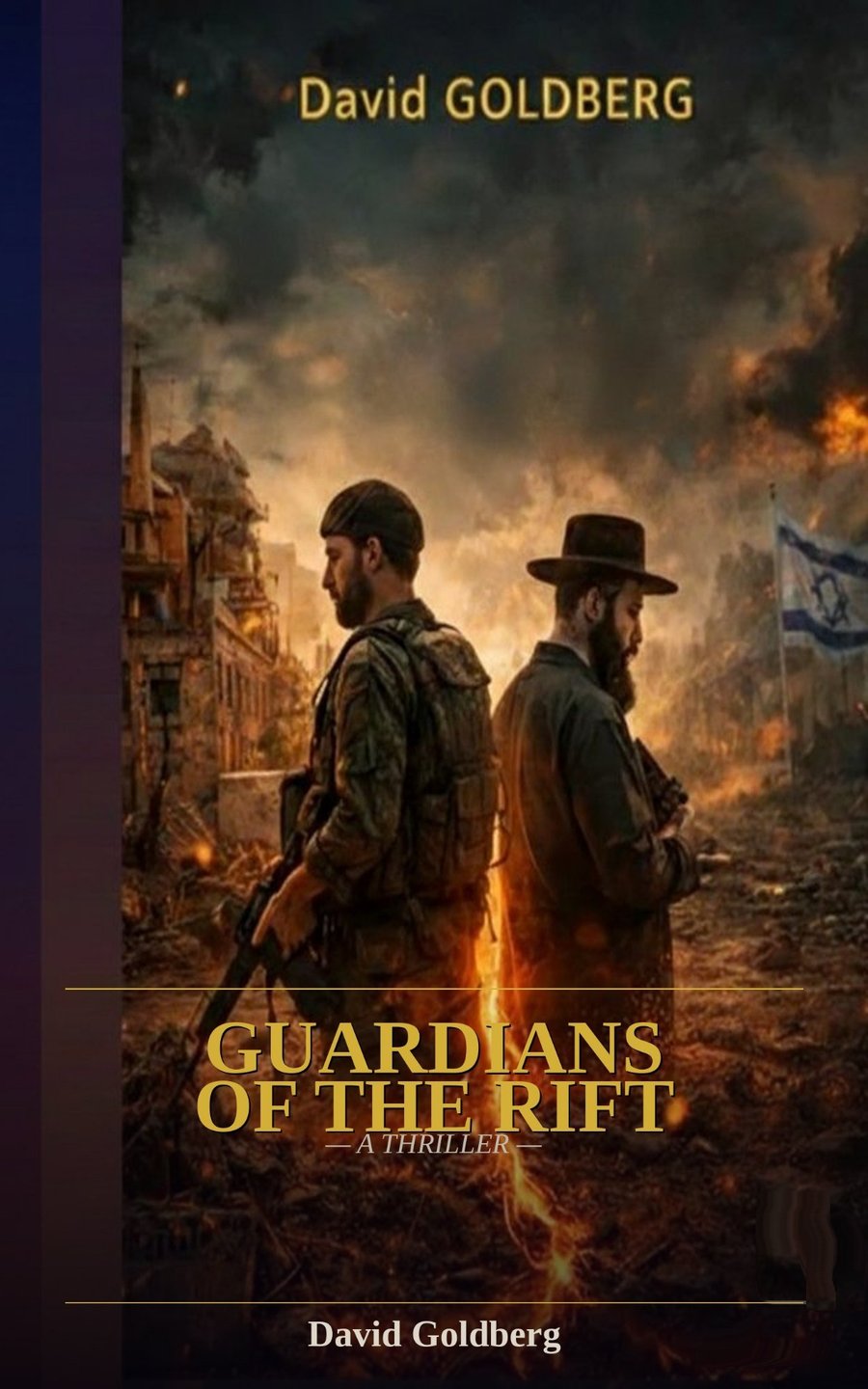
Guardians of the Rift
A spiritual thriller · David Goldberg
Forty-nine gates open — the fiftieth hides in a single moment. An ancient secret resurfaces, and one man stands between the rift and the world. Drawn from Talmud and Kabbalah.