On Simhat Torah we do something extraordinary: we finish reading Vezot Haberakha, the blessing of Moses, and immediately, without the slightest pause, we begin again with Bereshit bara Elokim — 'In the beginning, God created.'
Look closely: the last letter of the Torah is the Lamed (ל) of the word 'Israel,' and the first letter is the Bet (ב) of 'Bereshit.' Together they form the word לב — LEV, the Heart.
The message of the heart This is no coincidence. The Torah teaches that we must connect to the great heart of the nation of Israel as a whole. The heart is the center of everything: it is where our deepest connection with Hashem and with the Torah is found.
2 The Three Levels of Mitzvot
To understand why we perform the Hakafot on Simhat Torah, we must first know that there are three types of commandments.
1. D'Oraita (דאורייתא) — what is written explicitly in the Torah: the Ten Commandments, 'You shall not murder, you shall not commit adultery,' Shabbat, the dietary laws. All clearly stated in the text.
2. Derabbanan (דרבנן) — what is written by allusion. Of Tefillin the Torah says, 'You shall bind them as a sign upon your hand,' but never specifies which hand, how, or what shape. The Sages drew the details out of the hints: 'Yadekha' spelled with a final Hei points to the weaker hand, the left.
3. Minhagim (מנהגים) — customs, which are not written in the Torah at all. Such are the Hakafot on Simhat Torah. The Shulhan Arukh simply says, 'It is a custom that the people of Israel adopted.' But where does this custom truly come from?
3 The Couple Analogy: Understanding Minhagim
To understand where Minhagim come from, imagine a married couple and three degrees of love.
Level 1 — the explicit request. The wife says, 'Do you love me? Then bring me a glass of cold water.' The loving husband goes to the refrigerator and gives it to her. This is the explicit Torah commandment: clear and direct.
Level 2 — the hint. The wife comes in and says, 'It is really hot outside!' She did not ask for water; she gave a hint. The husband who loves her understands her need and brings the water on his own.
Level 3 — the connection of souls. The wife asks nothing and gives no hint. Yet the husband knows she will be home in half an hour, and he already sets the glass of water on the counter. How is this possible? Because his soul is bound to her soul; he lives her life through her.
The application to Simhat Torah When Hashem told Moses, for Shemini Atseret, 'On the eighth day, one bull — I want a small, intimate meal with you, just you and Me,' the people of Israel understood, with their collective soul, what Hashem truly meant. He did not literally want a small meal; He meant: 'What makes Me happiest is that you rejoice with My Torah!' That is why we dance with the scrolls: the soul of Israel knows what truly gladdens Hashem.
4 The Mystery of the Hakafot: Five Questions, One Answer
Several riddles surround Simhat Torah.
The questions that arise 1) Hashem asked for a 'small, intimate feast' — why do we hold a great carnival? 2) The Torah says 'Zman Simhatenu' (the time of our joy) for Sukkot, not for Shemini Atseret — how did it enter our prayers? 3) Moses died on Simhat Torah — where is the mourning? 4) Where does the custom of Hakafot come from, written nowhere? 5) We normally do not take the scrolls out of the synagogue — yet on this day, every scroll is out!
All these questions share one answer: the people of Israel, with their collective soul bound to Hashem, understand what truly makes Him happy. These are not written rules — they are expressions of love born of a soul-to-soul connection.
For Moshe Rabbenu If we asked Moses on the day of his death, 'What can we do that would do you the most good in the world of truth?' he would answer, 'Rejoice with my Torah!' So there is no contradiction: our joy is the greatest elevation of soul we can offer him.
5 The End of Bereshit: The Danger of Sadness
At the end of the Parasha, before the Flood, a terrible verse is spoken.
וַיַּרְא ה' כִּי רַבָּה רָעַת הָאָדָם בָּאָרֶץ … וַיִּנָּחֶם ה' כִּי עָשָׂה אֶת הָאָדָם בָּאָרֶץ וַיִּתְעַצֵּב אֶל לִבּוֹGenesis 6:5-6
'The Lord saw that the wickedness of man was great upon the earth… and the Lord regretted that He had made man on the earth, and He was grieved in His heart.'
The reading of the masters of Mussar As long as there is only the Yetzer Hara and the sin, Hashem consoles Himself: 'I created him with an evil inclination; he can rise again.' But when sadness is added — 'He was grieved in His heart' — that is, when a person says, 'I have no chance of rising from where I have fallen,' then comes: 'I will blot out man whom I have created.'
The message is clear: Hashem cannot tolerate a reality of sadness. To fall is acceptable; but to fall into the despair that says 'I can never rise again' removes our very right to exist.
And the message of hope: if you fall, that is normal, for you have a Yetzer Hara — but Hashem also gave you a Yetzer Tov and the strength to rehabilitate yourself. Joy is the key that gives you the power to go on.
6 Simhat Torah: The Model of Universal Joy
On Simhat Torah, no one keeps accounts. Observant and non-observant, all dance together with the Torah scrolls. No one judges anyone.
This is what that joy teaches us: Simhat Torah is the hope that lifts us and can carry us, with Hashem's help, all the way to the Mashiah — may he come speedily in our days.
Always begin again Whenever a person falls and grows discouraged, let them recall that joy and say: 'I can rise again. Hashem believes in me. Joy is my strength.' For 'Bereshit' means 'In the beginning': every day, every prayer, is a new beginning.
🎯 Test yourself
Five questions. Click an answer.
1
Which word do the last and first letters of the Torah form together?
The Lamed of 'Israel' and the Bet of 'Bereshit' form לב, the Heart.
2
To which category do the Hakafot of Simhat Torah belong?
The Hakafot are not written in the Torah; they are a custom the people of Israel adopted.
3
In the couple parable, what does the husband preparing water before his wife returns represent?
Anticipating with no request or hint illustrates the soul connection that is the source of Minhagim.
4
According to the masters of Mussar, what turns sin into the danger of being blotted out?
'He was grieved in His heart': it is the sadness added to the sin that becomes intolerable.
5
What would Moses answer, on the day of his death, about what would do him the most good?
Our joy on Simhat Torah is the greatest elevation of soul offered to Moses — hence no mourning.
Result
📅 Seven-Day Program — Parashat Bereshit
Sunday
Sunday — Link end to beginning: meditate on לב, the Heart formed by the Lamed and the Bet, and on the Torah as an endless circle.
Monday
Monday — Study the three levels of mitzvot: find one example each of D'Oraita, Derabbanan, and Minhag in your day.
Tuesday
Tuesday — Revisit the couple parable; ask which mitzvah would gladden Hashem without His having explicitly asked for it.
Wednesday
Wednesday — Reflect on the five Hakafot questions and their single answer: Israel's collective soul senses Hashem's will.
Thursday
Thursday — Meditate on 'He was grieved in His heart': spot a place where sadness paralyzed you and replace it with hope.
Friday
Friday — Prepare for Shabbat in the joy of Simhat Torah, judging no one; create a small personal 'minhag' of love.
Shabbat
Shabbat — Live each mitzvah as a new Bereshit: 'I can rise again, Hashem believes in me, joy is my strength.'
Four Practical Steps
🏠
Shalom Bayit — The Mouth at Home
My covenant of peace — peace begins at home. Reveal a Shalom Bayit card.
🔢
Gematria — Rav Ménaché
Shalom, Mashiah, Yisamech — secrets of the letters by Rav Ménaché zatsal.
Every week, straight to your inbox. No spam. One-click unsubscribe.
🕯️ Dedicate This Shiur
Dedicate this shiur for the days of Bein HaMetzarim — in memory, for healing or for success.
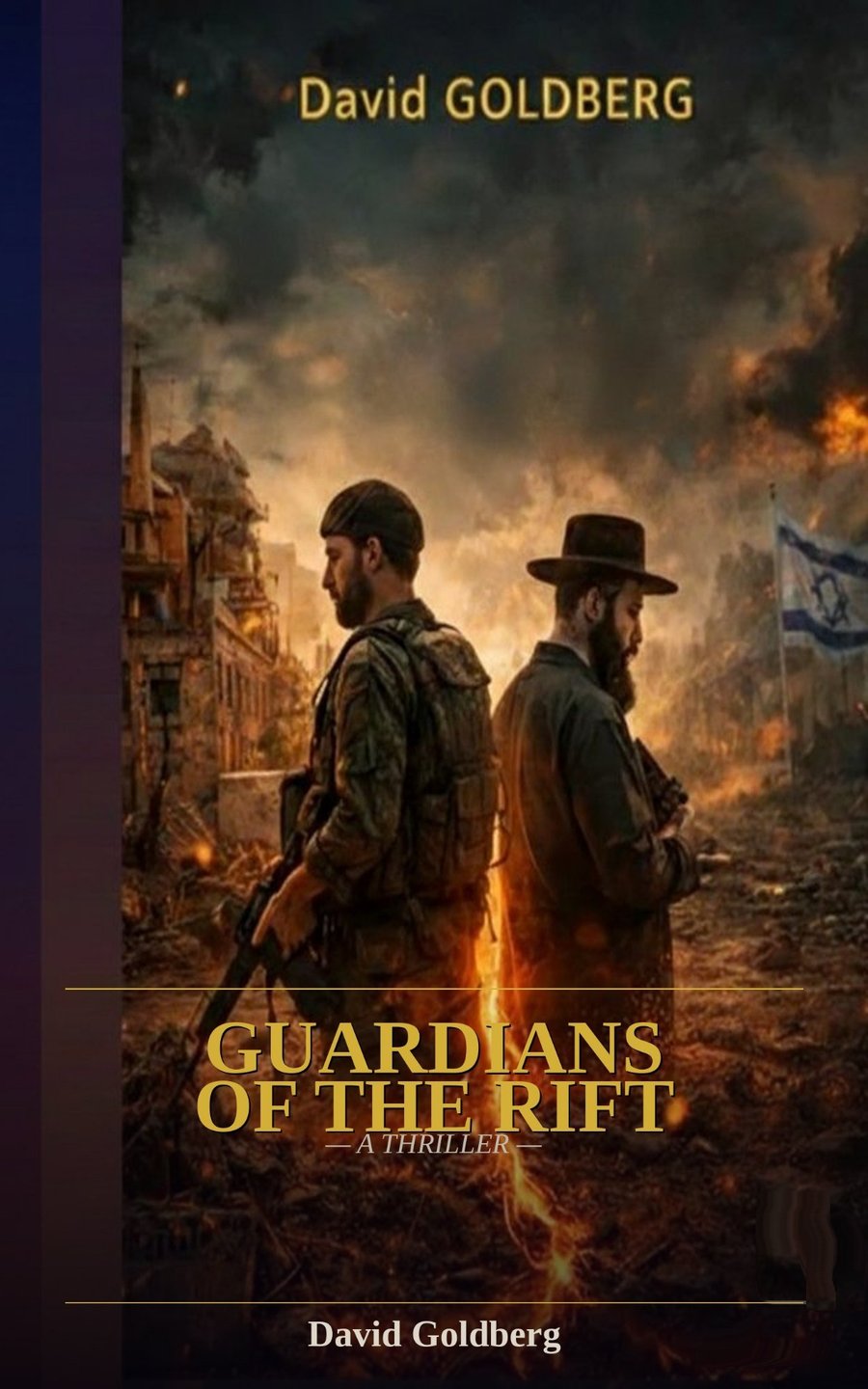
Guardians of the Rift
A spiritual thriller · David Goldberg
Forty-nine gates open — the fiftieth hides in a single moment. An ancient secret resurfaces, and one man stands between the rift and the world. Drawn from Talmud and Kabbalah.