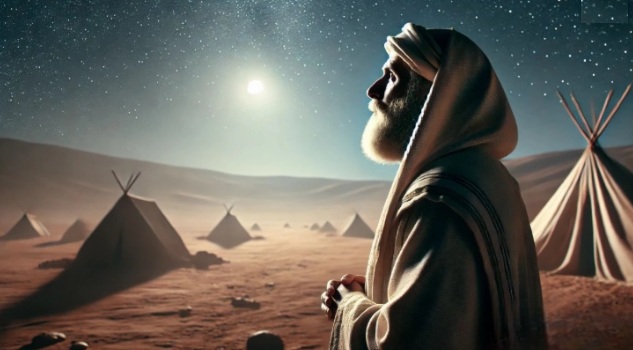
Abraham's descent to Egypt, seemingly a lack of bitachon, is actually the highest fulfillment of his test.
Per the Ramban, "Ma'aseh Avot Siman LaBanim": the deeds of the fathers trace the road for the children.
Every stage of Abraham's journey prefigures the Exodus: famine, descent, sojourn, Sarah/Knesset Yisrael, plagues, wealth, return, altar.
Rashi grounds our right to the Land in divine sovereignty and in Shem's inheritance, unlawfully seized by Canaan.
A sign: Abraham was born in the year 1948 from Creation, and Israel was reborn in 1948 CE.
Studying Parashat Lekh Lekha, we meet a troubling paradox about Abraham's first explicit test in the Torah.
"And the Lord said to Abram: Go for yourself from your land, your birthplace and your father's house, to the land that I will show you." Abraham succeeds: he leaves everything and sets out for the Land of Israel. So far, all seems perfect.
Yet no sooner has he reached the Land of Israel than we read a disconcerting verse.
"There was a famine in the land, and Abram went down to Egypt to sojourn there, for the famine was severe."
The situation worsens: nearing Egypt, Abraham asks Sarah to say she is his sister, fearing he would be killed so his wife could be taken — "that it may go well with me, and my soul will live because of you." Where is the spiritual heroism? Where is the bitachon?
The Ramban (Nachmanides) gives an answer that transforms our whole view.
"The deeds of the fathers are a sign for the children." As soon as God told him "I will make you a great nation," Abraham understood that an entire people would come from him — and therefore grasped his deeper mission.
Consider the step-by-step correspondence between Abraham's journey and the Exodus. The famine: with Abraham "there was a famine in the land"; for Israel, Jacob goes down to Egypt because of famine. The descent: "Abram went down to Egypt" echoes "Do not fear to go down to Egypt" (Bereishit 46:3). And the phrase לָגוּר שָׁם, "to sojourn there," is identical in both.
Sarah represents Knesset Yisrael, the congregation of Israel, the mother of the Jewish people. When Pharaoh tries to take her, it prefigures the oppression of the people of Israel.
Abraham foresees: "They will kill me and let you live." We find exactly this in Pharaoh's decree to the midwives.
"If it is a boy, kill him; if it is a girl, let her live" — precisely as Abraham had said. And the midwives "feared God and did not do as the king of Egypt commanded, and let the children live": they follow Abraham's precedent, preserving life despite danger — "and my soul will live because of you."
"The Lord struck Pharaoh with great plagues (nega'im), him and his house, because of Sarai." Likewise at the Exodus: "One more plague I will bring" — culminating in the Ten Plagues. The same Pharaoh, the same nega'im, the same reason: to protect Knesset Yisrael.
The departure is parallel too: Pharaoh tells Abram "Take and go," as he will tell Israel "Rise up, go out from among my people." And Abram "went up from Egypt… very wealthy in livestock, silver and gold," as Israel will leave with silver and gold vessels asked of the Egyptians.
Then Abraham returns "by his stages" to the place of the altar he had built at first, between Bethel and Ai. Israel will enter the Land through Jericho and build the Mishkan at Shiloh, then the Temple in Jerusalem. The Ramban adds that even Abraham's disputes over wells prefigure the battles of Joshua and the Judges.
Rashi answers in two ways. First, divine sovereignty: "By His will He gave it to them, and by His will He took it from them and gave it to us." The Master of the world decides who owns each land — this is the meaning of "Bereishit bara Elokim."
Second, historical inheritance: the Canaanite was in the process of conquering the Land of Israel that belonged to the seed of Shem. After the Flood, Noah had assigned this land to Shem; Canaan, son of Ham, had no right to it and seized it unlawfully. Abraham, of Shem's line, is only reclaiming what was his from the beginning.
Rav Himi closes with a striking sign: Abraham was born in the year 1948 from Creation, and the State of Israel was established in 1948 of the common era. After nearly two thousand years of exile, we returned exactly as Abraham prefigured.
Abraham did not "fail" his test: he passed it in the highest possible way, by creating the spiritual pathway for all of Jewish history. Our own actions, like his, can open paths for future generations — true strength being, at times, to patiently trace the road others will walk.
🎯 Test yourself
Five questions. Click an answer.
Result
Shalom Bayit — The Mouth at Home
My covenant of peace — peace begins at home. Reveal a Shalom Bayit card.
Gematria — Rav Ménaché
Shalom, Mashiah, Yisamech — secrets of the letters by Rav Ménaché zatsal.
🔢 Gematria CourseAll Parashot
All shiurim of M. Yéhouda Himi — from Bereshit to Devarim and the festivals.
📚 All ParashotBooks
Torah wisdom in thriller format — Éditions Gueoula.
Guardians of the Rift
Forty-nine gates open — the fiftieth hides in a single moment. An ancient secret resurfaces, and one man stands between the rift and the world. Drawn from Talmud and Kabbalah.
📖 Read the free excerpt · Book $9.90