The true "generations" (תולדות) of a righteous person are their good deeds, not only their children.
The verse "righteous in his generations" can be read both to Noah's praise and to his blame.
Noah looks like a "nothing" (כלום): a farmer, then a drunken man — yet this "nothing" saved all humanity.
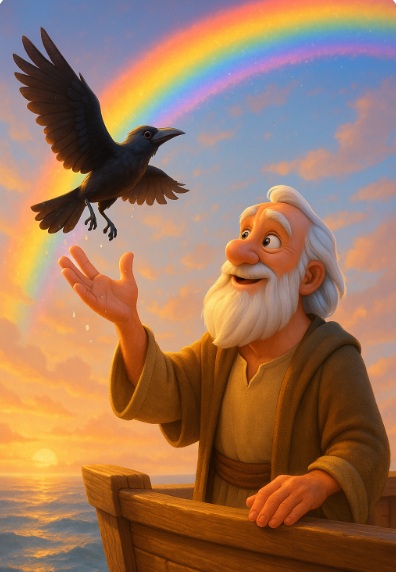
The raven, judged useless, held a divine role: to feed Elijah the prophet centuries later.
No creature is superfluous; all the more so, each of us has an irreplaceable mission.
"These are the generations of Noah — Noah was a righteous man (צדיק), perfect (תמים) in his generations; Noah walked with God."
Rashi asks a brilliant question. When the Torah says "These are the generations of Noah," we expect it to name his children — Shem, Ham, and Japheth. Another verse does exactly that. So why here, instead of naming the children, does the Torah say: "Noah was a righteous and perfect man"? Where are the "generations"?
The verse specifies: righteous and perfect IN HIS GENERATIONS (בדורותיו). Rashi notes: יש כאן עקיצה — "there is a sting here." This seemingly complimentary phrase is read by our Sages in two opposite ways.
The Darchan offers a bold answer: the phrase "he would have been nothing in Abraham's day" is not blame at all — it is praise, and immense praise.
Who was Noah? At first, a simple farmer, a "man of the earth" (איש האדמה), announcing that the land could now be worked more easily. At the end, after the Flood, his first act disappoints:
"And Noah, a man of the earth, began and planted a vineyard." The Sages read וַיָּחֶל together with חולין, the profane: his first act out of the Ark is an ordinary one. He plants, makes wine, gets drunk. We might have expected him to open a house of study (בית מדרש) and launch a spiritual revolution like Abraham. So he seems to be "nothing" (כלום).
The theme of "nothing" continues with a creature thought to be useless: the raven (העורב).
Noah sends the raven, but it does not fulfill its mission: it circles the Ark and returns. Noah then sends the dove. Why choose the raven first, then switch birds? The Midrash reveals a tense dialogue between the raven and Noah.
The hint is hidden in the verse: עד יבשת המים — "until the waters dried up." Rearranging the letters of יבשת gives תשבי: Elijah the Tishbite (אליהו התשבי).
When Elijah, in conflict with King Ahab, had to hide, it was the ravens who brought him bread and meat, morning and evening. That is the raven's role. Noah was wrong to risk its extinction: one day a righteous man would need it.
🎯 Test yourself
Five questions. Click an answer.
Result
Shalom Bayit — The Mouth at Home
My covenant of peace — peace begins at home. Reveal a Shalom Bayit card.
Gematria — Rav Ménaché
Shalom, Mashiah, Yisamech — secrets of the letters by Rav Ménaché zatsal.
🔢 Gematria CourseAll Parashot
All shiurim of M. Yéhouda Himi — from Bereshit to Devarim and the festivals.
📚 All ParashotBooks
Torah wisdom in thriller format — Éditions Gueoula.
Guardians of the Rift
Forty-nine gates open — the fiftieth hides in a single moment. An ancient secret resurfaces, and one man stands between the rift and the world. Drawn from Talmud and Kabbalah.
📖 Read the free excerpt · Book $9.90