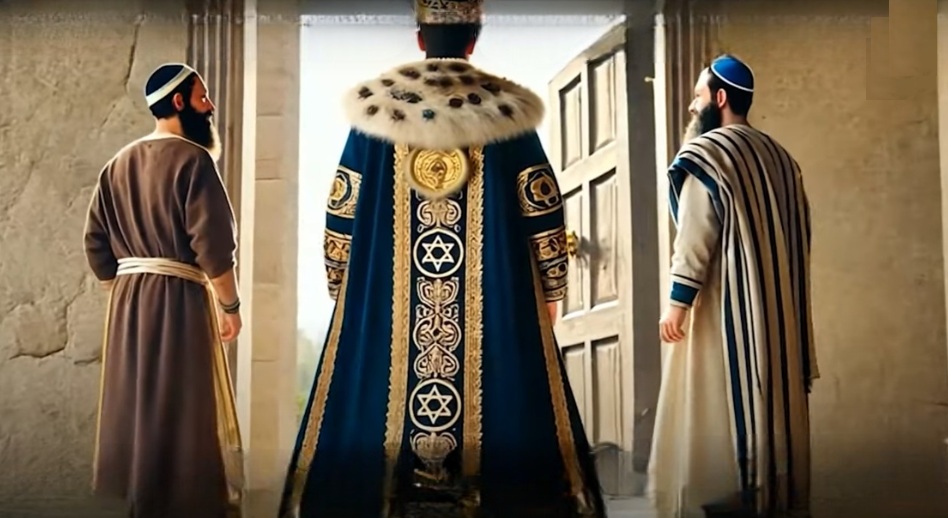
Of 147 years, only 34 of Jacob's were happy — 17 before Joseph's sale, 17 in Egypt — matching the value of “Vayehi.”
The Or HaChaim teaches: when the end is good, it is as if the whole life was; “Tov” (good) equals 17 in gematria.
Jacob and Joseph are one soul — the secret of the filled Vav (וו); the filling of אמת (Truth) = 156 = יוסף.
Joseph contains all twelve tribes: hence his name on the Ephod stone and the key of blessings passed to him.
Illness before death began with Jacob, who requested it so he could bless his children — hence “Lishuatecha kiviti Hashem” at a sneeze.
Given on the 10th of Tevet: every prayer is a stone of the Temple; reciting the Korbanot with kavana hastens its rebuilding.
This Paracha concludes the book of Bereishit and deals with the passing of Jacob and Joseph from this world. Its opening verse raises a deep question about what a true life really is.
The Baal Haturim notes that of Jacob's 147 years, only 34 years were years of happiness without suffering: 17 years from Joseph's birth until his sale, and 17 years in Egypt with Joseph reunited. That total of 34 is the numerical value of the word “Vayehi” (ויחי).
The Or HaChaim HaKadosh asks a simple question: why does the Torah specify that Jacob lived 17 years in Egypt? He arrived at 130 and died at 147 — the arithmetic is obvious. The verse must be teaching something else.
Those 17 years were Jacob's only truly happy days. His whole life was a chain of trials: at birth, Esav his enemy was born alongside him; then Lavan changed his wages ten times; then the affair of Dina; and finally the loss of Joseph.
The Or HaChaim reveals that Joseph is the “completion” (מילוי) of Jacob: they are not merely father and son — they share one spiritual essence.
This is the secret of the filled Vav: when the letter ו is spelled out in full, it is written וו — two Vavs together that never separate. Jacob embodies the midda of Emet (Truth) — “Titen emet l'Yaakov”; Joseph embodies the midda of Yesod, the 6th sefirah, and the number 6 is the Vav itself.
An extraordinary secret from Rav Leib Heiman (Chikrei Lev) confirms it: the filling (מילוי) of the letters of the word אמת (Emet, Truth) — without the base letters — equals 156, exactly the value of יוסף (Joseph). Joseph is literally the filling of the Truth that is Jacob.
The Torah says: “These are the generations of Jacob: Joseph” — without listing the other sons. Why?
Rabbeinu Bachya answers on three levels. Pshat: Joseph encompasses all the brothers' qualities — the כתר כהונה of Levi, the כתר מלכות of Yehuda, the כתר תורה of Yissachar; he is the synthesis of all twelve. Drash: whatever happened to one happened to the other. Kabbalah: both are present in the Kiseh HaKavod — Jacob as the form of Man (אדם), Joseph as the form of the Bull (שור).
This is why the names of the twelve tribes were engraved on the Shoham stone (Joseph's) rather than Reuven's: Joseph, the synthesis of the brothers, contains them all. The Gemara Sotah teaches that the ten sons who “should have” come from Joseph emerged instead through Binyamin.
Joseph was Jacob's “Ben Zekunim.” The Baal Haturim explains that Jacob transmitted to him all the Torah he had received from Shem and Ever. ZEKUNIM (זקונים) is the acronym of five of the six orders of the Mishnah: Zeraim, Kodashim, Nashim, Moed, Nezikin (only Taharot is missing).
The Ramban adds that the “key of blessings” passed from Abraham to Isaac, then Jacob, then Joseph. And Isaac's blessings to Jacob — “May peoples serve you, may nations bow to you” — were fulfilled not in Jacob but in Joseph, before whom all bowed down in Egypt.
The phrase “Vayehi achar hadevarim haeleh” (And it came to pass after these things) appears only a few times in the Torah, all in Bereishit, always preceded by “words.” In our Paracha, the Chizkuni explains it refers to the first illness before death.
Before Jacob, for 2447 years, no one had ever fallen ill: people would sneeze and die instantly, without any warning.
Rachel named her son “Yosef” though she had just said “Asaf Hashem et cherpati” (Hashem removed my shame) — she should have called him “Asaf.” But she added “Yosef Hashem li ben acher” — may Hashem add to me another son. The name “Yosef” means “one who adds, who continues”: of all the sons, only he bears a name of continuity, for he is the natural sequel of his father.
The Malach HaBrit teaches that each Patriarch has his festival: Pesach for Abraham, Shavuot for Isaac, Sukkot for Jacob. And Shemini Atzeret is Joseph's festival: it is the continuation of Sukkot while being “Regel bifnei atzmah” — a festival in its own right. Exactly like Joseph: an extension of Jacob, yet a complete entity.
This is also why, among the twelve tribes, only Joseph's death is recorded in Bereishit, the “Book of the Fathers”: by receiving the double portion (Ephraim and Menashe), Joseph rose to the rank of a Father, and his death fittingly closes the book.
This study was given on the 10th of Tevet, the day the siege of Jerusalem by Nebuchadnezzar began. The Chatam Sofer teaches that every year on this date the heavenly court decides whether the Temple will be rebuilt in the coming year.
Rashi on Kohelet teaches that Hashem becomes, as it were, the “worker” of the one who prays for Jerusalem, serving him in return. The Shla stresses the importance of reciting the Korbanot each morning, an expression of our longing for the Temple service to resume.
Let us take upon ourselves to recite the Korbanot with kavana, at Shacharit and Mincha, and may Hashem rebuild His Temple speedily, in our days. Amen.
🎯 Test yourself
Five questions. Click an answer.
Result
Shalom Bayit — The Mouth at Home
My covenant of peace — peace begins at home. Reveal a Shalom Bayit card.
Gematria — Rav Ménaché
Shalom, Mashiah, Yisamech — secrets of the letters by Rav Ménaché zatsal.
🔢 Gematria CourseAll Parashot
All shiurim of M. Yéhouda Himi — from Bereshit to Devarim and the festivals.
📚 All ParashotBooks
Torah wisdom in thriller format — Éditions Gueoula.
Guardians of the Rift
Forty-nine gates open — the fiftieth hides in a single moment. An ancient secret resurfaces, and one man stands between the rift and the world. Drawn from Talmud and Kabbalah.
📖 Read the free excerpt · Book $9.90